



What Is a Recruitment Agreement?
A recruitment agreement is a contract between an employer and a staffing agency, recruiting firm, or independent recruiter that defines the terms under which the recruiter will source, screen, and present candidates for open positions. It establishes the fee structure, payment terms, guarantee period, candidate ownership rules, confidentiality obligations, and the scope of the engagement. Without a written agreement, both parties operate in ambiguity, and disputes about fees, candidate attribution, and replacement obligations become significantly harder to resolve.
These agreements are used across industries, from technology startups filling engineering roles to healthcare systems staffing travel nurses to private equity firms searching for C-suite executives. The specifics vary depending on whether the engagement is contingency or retained, exclusive or non-exclusive, and whether it covers a single role or an ongoing staffing partnership. Regardless of the model, the core function is the same: put the terms in writing before the search begins so that both sides know what they are agreeing to.
Our template is built for employers who are engaging external recruiters and want a clear, enforceable agreement that covers every material term. It is also useful for recruiting firms that want a professional contract to present to new clients. The agreement protects both parties by documenting the fee, the scope, the timeline, and the consequences of early termination or candidate departure.
Clear Fee Terms
Defines placement fees, payment triggers, and billing timelines
Guarantee Protection
Specifies replacement or refund terms if the hire does not work out
Candidate Ownership
Prevents fee disputes by defining who owns each candidate introduction
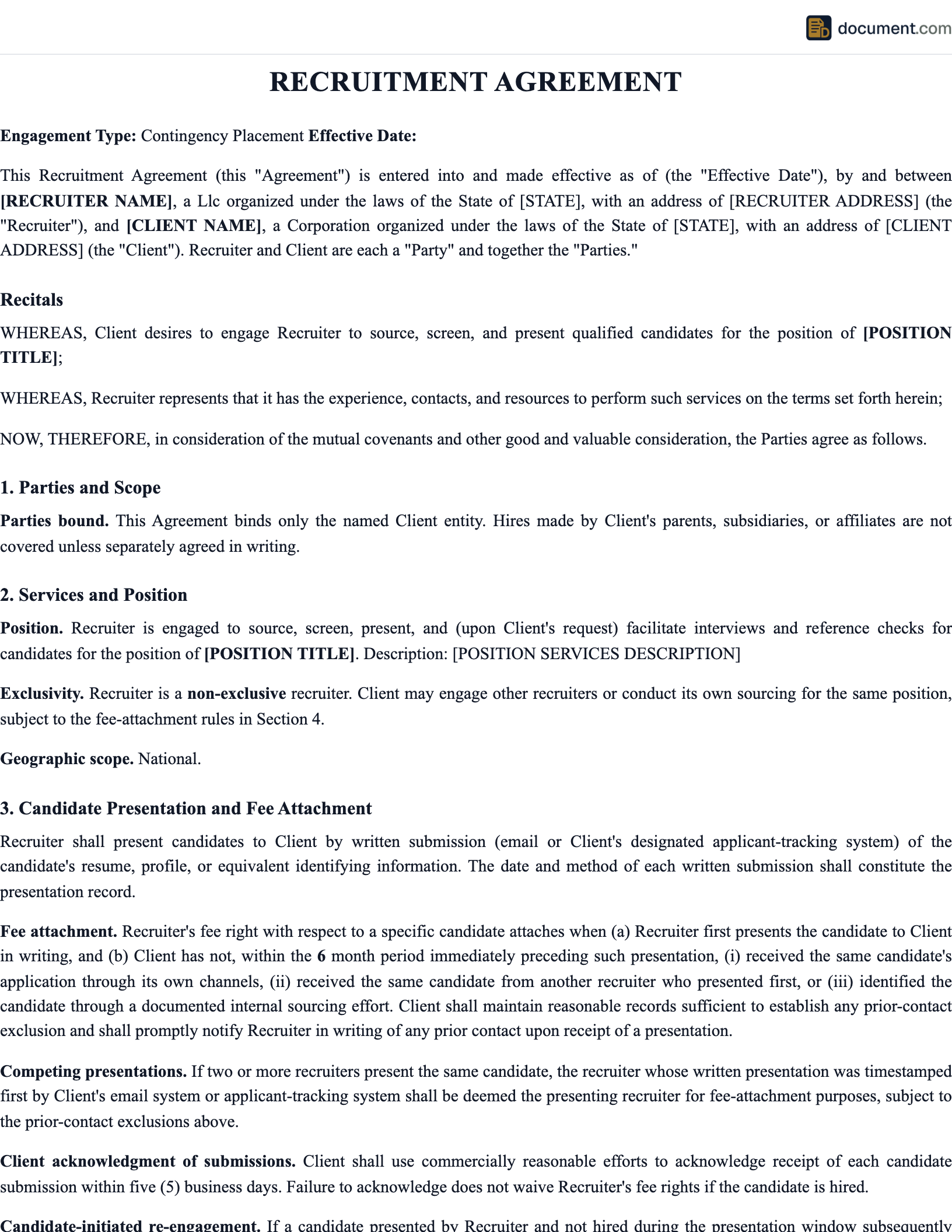
Recruitment Agreement Preview
The preview below shows the key sections of a standard recruitment agreement. Your final document will be fully customized with the names of both parties, fee terms, and specific engagement details.
Recruitment Services Agreement
This Recruitment Services Agreement ("Agreement") is entered into as of [Date] by and between [Employer Name] ("Client") and [Recruiter/Agency Name] ("Recruiter").
1. Scope of Services
Recruiter agrees to identify, screen, and present qualified candidates for positions specified by Client. Recruiter will exercise professional judgment and due diligence in evaluating candidates' qualifications, experience, and fit.
2. Fees and Payment
Client agrees to pay Recruiter a placement fee of [X]% of the placed candidate's first-year annual base salary, payable within [30] days of the candidate's start date.
3. Guarantee Period
If the placed candidate voluntarily resigns or is terminated for cause within [90] days of the start date, Recruiter will [provide one replacement candidate at no additional fee / refund [X]% of the placement fee].
4. Candidate Ownership
Candidates submitted by Recruiter are attributed to Recruiter for a period of [12] months from the date of submission. If Client hires a Recruiter-submitted candidate within this period, the placement fee applies.
5. Confidentiality
Both parties agree to maintain the confidentiality of proprietary information, candidate data, and the terms of this Agreement.
Types of Recruitment Agreements
The right type of agreement depends on the nature of the role, the urgency of the hire, and how much the employer is willing to commit to a single recruiter.
Contingency Agreement
The recruiter is paid only when a candidate they submitted is hired. Most common for mid-level positions. The employer typically works with multiple recruiters simultaneously.
Retained Search Agreement
The employer pays the recruiter an upfront retainer to conduct an exclusive search, usually for senior or executive roles. Fees are paid in installments over the course of the search.
Exclusive Agreement
The employer commits to working with only one recruiter for a specific role or time period. The recruiter receives the fee regardless of the candidate source, giving them full incentive to invest in the search.
Staffing Agreement
Used for temporary, contract, or temp-to-hire placements. The staffing agency employs the worker and bills the client an hourly markup. If the client converts the worker to a permanent hire, a conversion fee applies.
Key Terms and Clauses
A strong recruitment agreement addresses every term that could become a point of contention. Here are the clauses that matter most:
Scope of Engagement
Define the specific roles the recruiter is authorized to fill, the qualifications required, and any geographic or industry restrictions.
Fee Calculation
Specify the fee percentage, whether it is calculated on base salary or total compensation, and any caps or minimum fees.
Payment Terms
State when the fee is due (upon start date, after 30 days, etc.), the payment method, and late payment penalties.
Guarantee and Replacement
Define the guarantee period length, what triggers it, and whether the remedy is a replacement candidate or a fee refund.
Candidate Submission Process
Describe how the recruiter submits candidates (email, ATS portal), what information must be included, and the employer's review timeline.
Exclusivity Terms
Clarify whether the engagement is exclusive or non-exclusive, and what happens if the employer fills the role through another source.
Non-Solicitation
Restrict the recruiter from soliciting the employer's existing employees and vice versa during and after the engagement.
Termination
Define how either party can end the agreement, the notice period required, and what happens to pending candidates and accrued fees.
Fee Structures
Recruitment fees vary significantly based on the type of engagement, the level of the role, and the industry. Understanding the common fee models helps both employers and recruiters negotiate fair terms.
Contingency fees are the most common model and typically range from 15% to 25% of the candidate's first-year base salary. The fee is paid only when a hire is made, which means the employer carries no risk if the search is unsuccessful. The downside is that contingency recruiters work on multiple searches simultaneously and may prioritize roles that are easier to fill.
Retained fees are structured as a total engagement fee (usually 25% to 35% of first-year total compensation) paid in installments. A typical structure is one-third upon engagement, one-third upon presentation of a shortlist, and one-third upon hire. The upfront commitment ensures the recruiter dedicates focused resources to the search.
Staffing and temp-to-hire agreements use a markup model where the agency bills the client an hourly rate that includes the worker's pay plus the agency's margin (typically 25% to 75% depending on the role and industry). If the client converts the temporary worker to a permanent employee, a conversion fee is calculated based on the number of hours worked and the remaining value of the temp assignment.
Guarantee Periods
The guarantee period is one of the most negotiated terms in any recruitment agreement. It protects the employer from paying a full fee for a candidate who does not stay. The standard guarantee for contingency placements is 90 days from the candidate's start date. For retained executive searches, the guarantee often extends to 6 or even 12 months.
Guarantees typically come in two forms: a replacement guarantee, where the recruiter conducts a new search at no additional fee, or a refund guarantee, where the recruiter returns a portion or all of the placement fee. Replacement guarantees are more common because they keep the recruiter engaged in filling the role. Refund guarantees are stronger protection for the employer but are harder to negotiate.
Be specific about what triggers the guarantee. Most agreements cover voluntary resignation and termination for cause. They typically exclude situations where the employer materially changes the role, reduces compensation, relocates the position, or creates conditions that any reasonable employee would find unacceptable. Some agreements also exclude layoffs, restructuring, and elimination of the position entirely.
Candidate Ownership
Candidate ownership rules determine when a recruiter is entitled to a fee for a candidate they introduced to the employer. This is especially important when the employer works with multiple recruiters or has an active internal recruiting team. Without clear ownership language, disputes arise when two recruiters submit the same candidate, when the employer hires a recruiter-submitted candidate months later for a different role, or when the candidate applies directly after being introduced by a recruiter.
The standard approach is a time-based ownership window: the recruiter owns the candidate for 6 to 12 months from the date of submission. Any hire of that candidate within the window triggers the fee. After the window closes, the candidate is free to be hired without obligation to the recruiter. Some agreements also include a "prior knowledge" exception that protects the employer if the candidate was already in their pipeline before the recruiter's submission.
To avoid conflicts, require recruiters to submit candidates in writing (email or ATS), and maintain a log of all submissions with dates. When working with multiple agencies, notify each recruiter of your policy on dual submissions and establish a clear "first to submit" rule.
How to Draft a Recruitment Agreement
- 1
Identify the engagement type
Decide whether this will be a contingency, retained, exclusive, or staffing engagement. The type drives the fee structure, payment timeline, and exclusivity terms.
- 2
Define the scope
List the specific roles the recruiter is authorized to fill, the qualifications you require, and any geographic, industry, or seniority restrictions.
- 3
Set the fee and payment terms
Agree on the fee percentage or flat rate, how it is calculated, when payment is due, and what happens if the candidate's compensation changes during negotiations.
- 4
Establish the guarantee period
Agree on the length of the guarantee, what triggers it, and whether the remedy is a replacement search or a fee refund.
- 5
Define candidate ownership
Set the ownership window, establish a submission process, and address dual submissions and prior-knowledge exceptions.
- 6
Add confidentiality and compliance
Include mutual confidentiality obligations, EEO compliance, data privacy terms, and any non-solicitation restrictions.
- 7
Include termination provisions
Define how either party can end the agreement, the notice required, and what happens to pending candidates and accrued fees upon termination.
Legal Considerations
Recruitment agreements intersect with several areas of law that both parties should be aware of. Anti-discrimination laws, including Title VII of the Civil Rights Act, the Americans with Disabilities Act (ADA), and the Age Discrimination in Employment Act (ADEA), apply to the recruitment process. The agreement should include a clause requiring the recruiter to source and screen candidates in compliance with all applicable equal employment opportunity laws and to refrain from discriminating based on race, color, religion, sex, national origin, age, disability, or any other protected characteristic.
State licensing requirements are another consideration. Several states, including California, New York, Illinois, Texas, Florida, and Massachusetts, require staffing agencies and employment agencies to hold specific licenses or registrations. Operating without the required license can void the agreement and expose the recruiter to penalties.
Data privacy is increasingly relevant, especially for recruiters handling personally identifiable information (PII) such as Social Security numbers, background check data, and employment history. The agreement should address how candidate data is collected, stored, shared, and deleted. If the recruiter operates in states with comprehensive privacy laws (California CCPA/CPRA, Virginia VCDPA, Colorado CPA, Connecticut CTDPA), additional compliance terms may be necessary.
Finally, consider choice of law and dispute resolution. The agreement should specify which state's law governs interpretation and enforcement, and whether disputes are resolved through litigation, arbitration, or mediation. These clauses may seem boilerplate, but they matter significantly if a fee dispute escalates.
Frequently Asked Questions
Official Resources
EEOC Employer Resources
Equal Employment Opportunity Commission guidance on hiring practices and anti-discrimination compliance
DOL Wage and Hour Division
Federal guidance on wage laws, contractor classification, and staffing compliance
SHRM Talent Acquisition
Society for Human Resource Management recruiting and staffing best practices
American Staffing Association
Industry association for staffing firms with legal compliance resources and standards
FTC Non-Compete Rule
Federal Trade Commission guidance on non-compete agreements in employment and staffing
Bureau of Labor Statistics
Occupational data and salary benchmarks for fee calculation and market analysis
Create your Recruitment Agreement in under 10 minutes.
Answer a few questions and download a compliant, attorney-drafted document ready for your state.