



Key Takeaways
- •A signed release is the legal defense to a right-of-publicity claim. Without one, using a person's AI voice or likeness can trigger damages, an injunction, and attorney fees.
- •California Civil Code section 3344 sets a statutory minimum recovery of $750 plus profits and attorney fees, and section 3344.1 extends the right 70 years after death.
- •Tennessee's ELVIS Act, effective 2024, was the first U.S. law to protect a person's voice from AI cloning as a property right.
- •A single-use grant is not a training-data grant. This release separates them, so an AI model is never trained on a person's voice or face without explicit, named consent.
- •Minors require a parent or guardian's signed consent; a deceased person's rights are controlled by their estate.
- •The release covers voice, likeness, or both, with options for commercial use, term, territory, compensation, and revocation with model retirement.
Reviewed for accuracy by the document.com legal team. Educational information, not legal advice.
What Is an AI Voice and Likeness Release?
An AI voice and likeness release is a written consent that lets one party use another person's voice, image, name, or likeness to create, train, or generate artificial intelligence content.That content can include a cloned voice, a digital double, a synthetic video, an avatar, or a machine-learning model trained on a person's recorded performances. Without a signed release, using someone's voice or face to build an AI version of them is one of the fastest-growing sources of legal exposure in the country, and the person whose identity was used can sue to stop the use and to recover damages.
What it really pins down is consent. A court or a platform looking at an AI clone asks one thing before anything else: did this person agree to it? The release answers that in writing, then draws the lines around the agreement. Which uses are allowed, and is training a model one of them? Is it commercial? For how long, and where? Can the person revoke later, and if they do, what happens to a model that was already trained on their voice? Those terms are the document. A narrator licensing a synthetic version of her voice to a publisher, a startup recording an employee to build an in-house assistant, an agency standing up a brand avatar, they all need the same set of answers, which is why the form is built from options you swap in and out rather than one rigid clause.
Consent on Record
Documents that the person agreed, the fact every court and platform looks for first
Clear Boundaries
Defines use, term, territory, and whether the grant covers AI training
Revocation Rights
Optional withdrawal of consent plus deletion and model retirement terms
Why This Is Suddenly Everywhere
Voice cloning and digital doubles went from science fiction to a phone app in the span of a couple of years, and the disputes followed immediately. In early 2023, an anonymous track called "Heart on My Sleeve" that used AI-cloned voices of two well-known musicians drew millions of streams before it was pulled, forcing the music industry to confront synthetic voices in public. The same year, the use of AI digital replicas was one of the central issues in the SAG-AFTRA actors' strike, which settled only after the studios agreed to terms requiring a performer's informed consent and compensation before a digital replica of them can be created or used.
Legislatures moved next. In March 2024, Tennessee answered the cloning of its artists by passing the ELVIS Act, the first law in the country to treat the human voice as a property right. Scammers, meanwhile, learned to clone a relative's voice from a few seconds of audio, and a wave of nonconsensual synthetic images pushed statehouse after statehouse to act. Each of those fights turned on a single fact: was there consent, in writing? The licensed uses survived. The unlicensed ones became lawsuits, takedowns, or a new statute named after Elvis. A release is how you end up on the first side of that.
Why a Release Matters: The Right of Publicity
All of this rests on the right of publicity, your right to control the commercial use of your own identity. There is no single federal version of it. It is a patchwork, fifty states each going their own way, and the AI-specific pieces are some of the newest law on the books. Four states set the tone that the rest follow, so they are worth understanding before you sign anything.
California: the strongest statutory remedy
California gives this right unusual strength. Under California Civil Code section 3344, a person whose name, voice, signature, photograph, or likeness is used for advertising or commercial purposes without consent can recover the greater of actual damages or a statutory minimum of seven hundred fifty dollars, plus the user's profits attributable to the use and attorney fees. California Civil Code section 3344.1 extends that protection for seventy years after death, which is why the estates of deceased performers can still control AI recreations. For any project touching California talent or audiences, section 3344 is the provision that sets the stakes.
New York: written for synthetic media
New York modernized its law specifically for digital replicas. New York Civil Rights Law sections 50 and 51 created the original privacy and publicity protections, and section 50-f, added in 2021, directly addresses digital replicas of deceased performers and digitally manipulated sexual depictions of any person. If you are dealing with a New York performer or production, section 50-f is the provision that controls a synthetic recreation, and it requires clear authorization from the performer or the estate.
Tennessee: the first true AI voice statute
Tennessee passed the most pointed AI statute in the country. The Ensuring Likeness, Voice, and Image Security Act, known as the ELVIS Act and codified at Tennessee Code Annotated section 47-25-1101 and following, was the first state law written to protect a person's voice from unauthorized AI cloning. It treats the voice itself as a protected property right, makes it unlawful to distribute a tool whose primary purpose is producing an unauthorized voice clone, and gives both the individual and, in many cases, their record label or representatives standing to sue. After the ELVIS Act, a release that mentions only image is no longer enough to authorize a voice model.
Illinois, the proposed federal law, and union rules
Illinois protects the same interests through its Right of Publicity Act at 765 ILCS 1075, and most other states get there through their own statutes or common law. Above the states, the proposed federal NO FAKES Act would create a nationwide right against unauthorized AI replicas, and the SAG-AFTRA agreements already demand separate, informed consent before any performer's digital replica is made or used. A release drafted to satisfy all of them at once holds up wherever the fight lands, state court, federal court, or a union arbitration. Consent is the defense, full stop. A release that names the exact use, the term, and the territory is what turns that defense from a theory into something you can actually rely on.
Right of Publicity by State: All 50 States and DC
Right-of-publicity law varies sharply by state. 24 states and territories protect it by statute; the rest rely on common law, and three (Kansas, Mississippi, and North Dakota) do not clearly recognize it. 22 states now have AI or digital-replica-specific provisions, a number that is climbing every legislative session. The table below covers all fifty states and the District of Columbia: the governing statute or common-law basis, the post-mortem term the estate controls, and any AI-specific protection. Confirm the current statute for the state whose law applies before relying on it.
| State | Statute or basis | Post-mortem | AI / digital replica |
|---|---|---|---|
| Alabama | Ala. Code § 6-5-772 | 55 years | None |
| Alaska | Common law only | Common law | None |
| Arizona | A.R.S. §12-761 (soldiers/military only); Common law right of... | Soldiers only | No explicit AI-specific language in A.R.S |
| Arkansas | Ark. Code Ann. §§ 4-75-1101 et seq. (Frank Broyles Publicity Rights... | 50 years | AI digital replica provisions added via HB1071 (signed February 25, 2025, effective... |
| California | Cal. Civ. Code §§ 3344 (living persons) and 3344.1 (deceased... | 70 years | Digital replica provisions in §3344 (via SB 683, signed October 10, 2025, effective... |
| Colorado | Common law only | Common law | None |
| Connecticut | Common law only | Common law | None |
| Delaware | Common law only | Common law | HB 353 (Amelia Kramer Act) addresses synthetic media/deepfakes for minors and... |
| District of Columbia | Common law only | None | None |
| Florida | Fla. Stat. § 540.08 | 40 years | None |
| Georgia | Common law only | Common law | Georgia 'No Fakes' bill (HB 566) failed to advance in 2025 legislative session; no... |
| Hawaii | Hawaii Revised Statutes Title 26, Chapter 482P (HRS § 482P-1 et seq.) | 70 years | None |
| Idaho | Common law only | Common law | Idaho has enacted targeted deepfake legislation: House Bill 575 (explicit deepfakes),... |
| Illinois | 765 ILCS 1075 (Right of Publicity Act), as amended by HB 4875... | 50 years | HB 4875 (effective January 1, 2025) explicitly prohibits unauthorized digital replicas |
| Indiana | Indiana Code Title 32, Article 36, Chapter 1 (IC § 32-36-1 et seq.) | 100 years | None |
| Iowa | Common law only | Common law | Senate File 2243 and House File 2240 address synthetic media involving minors and... |
| Kansas | No recognized right | None | None |
| Kentucky | KY Rev. Stat. § 391.170 | 50 years | None |
| Louisiana | La. Rev. Stat. Ann. § 51:470.1 et seq. (Allen Toussaint Legacy Act) | 50 years | Digital replica defined in § 51:470.2 as computer-generated or electronic reproduction of... |
| Maine | Common law only | Common law | None |
| Maryland | Common law only | Common law | None |
| Massachusetts | Mass. Gen. Laws Ann. ch. 214, § 3A | None | Massachusetts HB 4744 (enacted 2024, Chapter 118 of Acts of 2024) addresses... |
| Michigan | Common law only | Common law | Michigan House Bills 4047 and 4048 (Protection from Intimate Deep Fakes Act, signed... |
| Minnesota | Common law only | Common law | Minnesota Statute 617.262 (enacted 2023, amended 2024) criminalizes nonconsensual... |
| Mississippi | Common law only | Undefined (no court... | No AI-specific provision; Mississippi has not enacted HB 768 or an ELVIS Act |
| Missouri | Common law only | Common law | None |
| Montana | Common law only | Common law | None |
| Nebraska | Neb. Rev. Stat. §20-202 (with post-mortem survival under §20-208) | Indefinite | None |
| Nevada | Nev. Rev. Stat. §597.770 et seq. (specifically §597.790) | 50 years | None |
| New Hampshire | Common law only | Common law | Deepfake law (H.B |
| New Jersey | Common law only | 50 years | Deepfake law (A3540/S2544 signed 2025) - separate from ROP, establishes civil/criminal... |
| New Mexico | Common law only | Common law | None |
| New York | N.Y. Civ. Rights Law §§50, 51, 50-f | 40 years | N.Y |
| North Carolina | Common law only | Common law | None |
| North Dakota | No recognized right | None | None |
| Ohio | Ohio Rev. Code §2741 (Chapters 2741.01-2741.09) | 60 years | None |
| Oklahoma | Okla. Stat. tit. 12 §1448 (deceased); Okla. Stat. tit. 12 §1449... | 100 years | Oklahoma HB 1364 (synthetic intimate content; 2024-2025) |
| Oregon | Common law only | Common law | Oregon HB 2299 addresses synthetic intimate imagery but not voice cloning specifically... |
| Pennsylvania | 42 Pa.C.S. §8316 (right of publicity); 18 Pa.C.S. §4101.1 (digital... | 30 years | 18 Pa.C.S |
| Rhode Island | R.I. Gen. Laws §9-1-28 (commercial use); R.I. Gen. Laws §9-1-28.1... | None | None |
| South Carolina | Common law only | Unclear (common law... | None |
| South Dakota | S.D. Codified Laws § 21-64 et seq. | 70 years | None |
| Tennessee | Tenn. Code Ann. § 47-25-1101 et seq. (ELVIS Act 2024) | 10 years | ELVIS Act - Tenn |
| Texas | Tex. Prop. Code § 26.001 et seq. | 50 years | None |
| Utah | Utah Code § 45-3 (Abuse of Personal Identity Act), as amended by SB... | 70 years | Yes |
| Vermont | Common law only | Common law | None |
| Virginia | Va. Code § 8.01-40 (civil); Va. Code § 18.2-216.1 (criminal) | 20 years | None |
| Washington | Wash. Rev. Code § 63.60.010 et seq. (amended by SB 5886, effective... | 10 years | RCW 63.60 amended 2026 to include 'forged digital likeness' - digital representations... |
| West Virginia | Common law only | Common law | None |
| Wisconsin | Common law only | Common law | None |
| Wyoming | Common law only | Common law | None |
Compiled from primary state statutes and verified against legislative sources in 2026. Post-mortem terms and AI-specific provisions change frequently; see the linked statutes in Legal Authorities & Sources below, and confirm current law for your state.
Voice, Likeness, and Training Data: The Distinction That Matters
This is where the free templates fall apart. A voice release, a likeness release, and a training-data grant are not interchangeable. Sign one and you have not signed the others, and the gaps between them are exactly where the disputes start.
Voice
The sound of a person's voice, including a cloned or AI-synthesized version protected under Tennessee's ELVIS Act
Likeness
The visual identity: photographs, video, digital doubles, avatars, and any recognizable depiction of face or body
Training Data
Permission to feed voice or image recordings into a model that can generate new synthetic output
Name and Persona
The person's name, signature, and recognizable persona used to imply endorsement or identity
The distinction people miss most is single use versus training use. One advertisement that runs your voice is a small, finite thing. Feeding your recordings into a model that can then say anything, in your voice, forever, is not. A release that lumps the two together quietly hands over far more than anyone meant to give.
Single use
The releasee uses your voice or likeness for one defined project, then stops.
- • One ad, one video, one narration
- • No new output once the project ends
- • Easy to scope, lower risk to the releasor
Training-data use
Your recordings train a model that can generate unlimited new output in your likeness.
- • Unlimited new speech or images, indefinitely
- • Must address deletion and model retirement
- • A far broader grant; price and limit it on purpose
The form pins the two apart, so the grant is set deliberately: a one-time use, a defined project, or a license to train and run a model. Training grants also force a decision that a single-use release simply never raises, which is what happens to the model and the training data once the arrangement ends.
When You Need This Form
You should use an AI voice and likeness release any time a person's identity will be captured, cloned, or used to generate AI content. The most common situations include a creator, narrator, actor, influencer, or musician licensing their voice or appearance for an AI product or campaign; a business building a voice assistant, a training-video presenter, or a brand avatar from a real person; a studio or agency producing synthetic media that needs every featured person on record; a developer collecting voice or image samples to train a model; a parent or guardian deciding whether a minor's likeness can be used; and an estate licensing the likeness of a deceased person, which states like California and Tennessee permit but only with the rights holder's consent.
Timing matters as much as the situation. Sign before anything is recorded or generated. Consent collected after the fact is worth far less, and in several states it does not undo the original violation at all. Two other documents usually ride along with this one: a non-disclosure agreement to keep the raw recordings and samples confidential, and a work for hire agreement to settle who owns whatever gets built from the likeness.
Already a victim of an unauthorized clone? A release is the document you sign to authorize a use going forward. If someone has already used your voice or face without permission, the right tool is a deepfake and unauthorized likeness cease and desist letter, which demands that the use stop and preserves your right to sue.
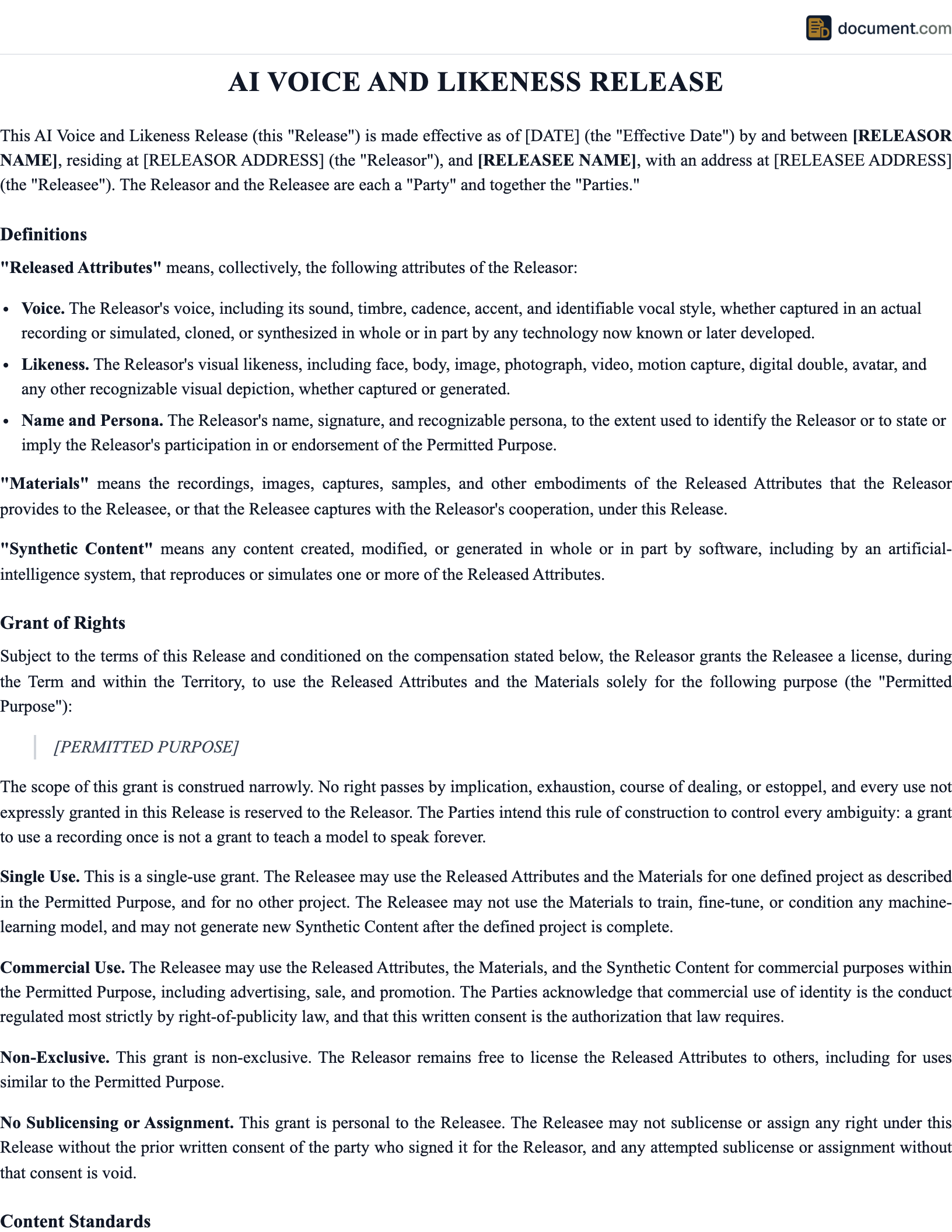
AI Voice and Likeness Release Form Preview
Below is a preview of the sections and fields the release includes. The finished document comes formatted and ready to sign, tailored to the grant, the parties, and the use you pick.
AI Voice and Likeness Release
Consent and License for Artificial Intelligence Use
Section 1: Parties
Section 2: What Is Released
Section 3: Scope and Limits
How to Fill Out the AI Voice and Likeness Release
The form walks through each decision in plain language. Here is what each part asks for and how to complete it.
1. The parties
Enter the full legal name and address of the releasor, the person whose voice or likeness is being used, and the releasee, the company or individual receiving the rights. If the releasor is under eighteen, the form switches to a guardian consent version and asks for the parent or guardian's name and signature.
2. What is being released
Choose voice, likeness, or both. If you are not sure, select both, because a voice clone and a video double raise different rights and you usually want full coverage.
3. The permitted use
Select whether the grant is for a single defined project, a broad commercial license, or training and operating an AI model. State the purpose in one or two clear sentences, for example to create and distribute a synthetic narration of a named audiobook, or to train an internal customer-service voice assistant. The narrower the purpose, the safer it is for the releasor and the clearer it is for the releasee.
4. Commercial or non-commercial
Indicate whether the releasee can use the result to make money. Commercial use triggers the strongest publicity protections under statutes like California Civil Code section 3344, so this choice should match reality.
5. Term and territory
Choose how long the permission lasts, from a fixed period to perpetual, and where it applies, from a single country to worldwide. Perpetual and worldwide grants are common in media deals but should be a deliberate choice, not a default.
6. Compensation
State whether the release is granted for a flat fee, for royalties, or without compensation. A release given without payment is still valid, but the form records the arrangement so there is no later dispute.
7. Revocation and model retirement
Decide whether the releasor can withdraw consent and what happens if they do. For training uses, the form can require the releasee to stop generating new outputs, delete the training copies of the person's data, and retire the model features built from them. This is one of the most important protections in an AI context and it is missing from most off-the-shelf forms.
8. Signatures
Both parties sign and date. The form includes an optional notarization block, recommended for high-value or perpetual grants and for any release involving a minor or a deceased person's estate. When you finish, download the document as a PDF or Word file, sign it electronically, or send it for signature through the built-in e-sign flow.
Key Terms Defined
A few terms carry specific legal meaning in an AI voice and likeness release. Here is what each one means.
- Right of publicity
- The legal right of every person to control the commercial use of their identity, including their name, voice, image, and likeness. It is recognized through state statutes and common law and is the legal foundation of an AI voice and likeness release.
- Likeness
- A recognizable depiction of a person's visual identity, including photographs, video, digital doubles, and AI-generated avatars of their face or body.
- Voice clone
- An artificial copy of a person's voice generated by AI from recordings, capable of producing new speech the person never recorded. Tennessee's ELVIS Act protects the voice against unauthorized cloning as a property right.
- Digital replica
- A computer-generated, AI-enabled recreation of a real person's voice or visual likeness that is so realistic it is difficult to distinguish from the real person. New York Civil Rights Law section 50-f governs digital replicas of performers.
- Training-data use
- Permission to feed a person's voice or image recordings into a machine-learning model so the model can generate unlimited new output in their likeness. It is a broader grant than a single, defined use and is treated separately in a well-drafted release.
- Post-mortem right of publicity
- The continuation of a person's right of publicity after death, controlled by their estate. California protects it for seventy years under Civil Code section 3344.1.
Release vs Other Documents
An AI voice and likeness release authorizes a future use. Several related documents handle adjacent problems, and choosing the right one matters.
Deepfake Cease and Desist
Use when a voice or likeness has already been used without permission. A deepfake cease and desist letter demands the use stop, where a release grants permission going forward.
Workplace AI Use Policy
Governs how employees may use AI tools at work. If your company builds AI from staff voices or images, pair the workplace AI use policy with a release from each employee whose identity is captured.
Estate and Post-Mortem Planning
A person planning how their likeness may be used after death should address it in their estate plan. A last will and testament can direct who controls the post-mortem right that California Civil Code section 3344.1 protects for seventy years.
Legal Authorities & Sources
This page is grounded in primary law. The statutes and official resources below are the authorities behind the guidance above. Verify the current text of any statute before relying on it.
- California Civil Code section 3344 (use of name, voice, likeness)
- California Civil Code section 3344.1 (deceased personalities, 70-year post-mortem right)
- New York Civil Rights Law section 50-f (digital replicas of performers)
- Tennessee ELVIS Act, Tenn. Code Ann. section 47-25-1101 et seq.
- Illinois Right of Publicity Act, 765 ILCS 1075
- U.S. Copyright Office, Copyright and Artificial Intelligence study
- NO FAKES Act (proposed federal digital-replica law), Congress.gov
Frequently Asked Questions
Create your AI Voice and Likeness Release in under 10 minutes.
Answer a few questions and download a clear, attorney-drafted release that separates single use from AI training and reflects current right-of-publicity law.