



Key Takeaways
- •A deepfake cease and desist letter formally demands that a creator, distributor, or platform stop using an unauthorized AI version of your face, voice, or identity.
- •It can stack several legal grounds at once: right of publicity, state deepfake statutes, false endorsement under the Lanham Act, and defamation or false light.
- •Preserve evidence first. Take dated screenshots and screen recordings, capture URLs and account names, and do not delete your copies.
- •Run two tracks in parallel: a platform or DMCA takedown to get the content down fast, and the cease and desist letter to pursue the creator for damages.
- •Sending the letter creates a record of notice. If the recipient continues anyway, the conduct looks willful, which can increase damages.
- •The protection is not limited to celebrities. Right-of-publicity and deepfake statutes protect every person, and ordinary people are now the most common targets.
Reviewed for accuracy by the document.com legal team. Educational information, not legal advice.
What Is a Deepfake Cease and Desist Letter?
A deepfake cease and desist letter is a formal written demand sent to a person, company, or platform that has created or distributed an artificial-intelligence depiction of you without your permission, requiring them to stop. A deepfake is synthetic media, a video, image, or audio recording generated or altered by AI to make a real person appear to do or say something they never did. The technology that once required a studio now runs on a phone, which is why unauthorized clones of ordinary people, not just celebrities, have become common. This letter is the tool that puts a stop to it.
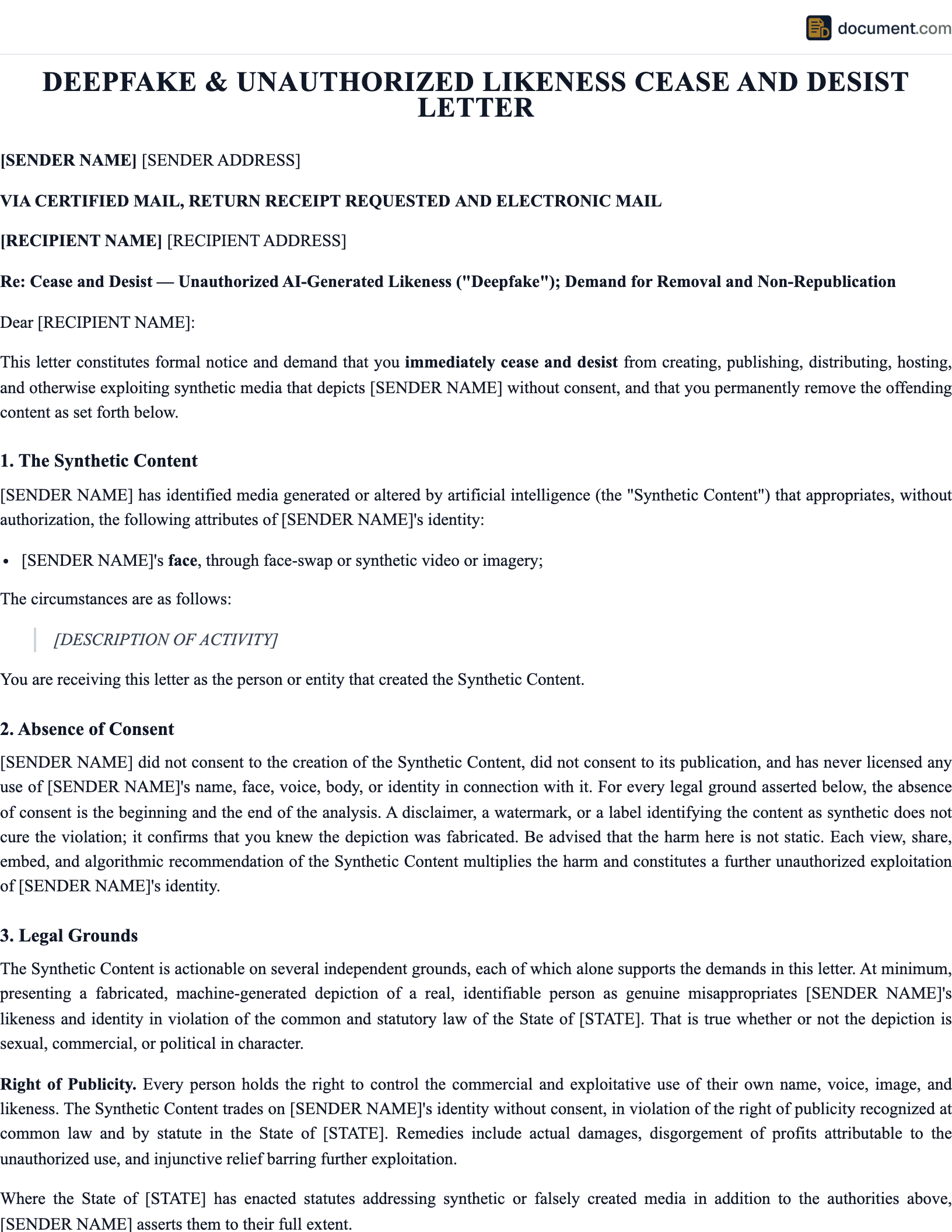
The letter names the offending content by URL, account, and date, so there is no argument later about what had to come down. The legal grounds come next, pulled from whatever fits the facts: the right of publicity, a state deepfake statute, false endorsement, defamation. Then the demand itself, on a deadline, take it down, stop reposting it, and in many cases say who else received it. Putting all of that in writing is what documents your objection, and a recipient who keeps going afterward looks willful, which is exactly what raises the damages later. It is the mirror image of an AI voice and likeness release: the release grants permission going forward, this letter shuts down a use that was never permitted.
Demand Removal
Requires the content be taken down and not republished by a set deadline
Assert the Law
Cites right of publicity, deepfake statutes, and the Lanham Act
Preserve Your Rights
Documents your objection so continued use looks willful
Why Deepfake Disputes Are Exploding
The tools that make a convincing fake of a real person used to require a studio. Now they run on a phone, and the consequences have arrived fast. In January 2024, an AI-generated robocall imitating a sitting president's voice went out to voters before a primary, and within weeks federal regulators confirmed that AI-voice robocalls of this kind are unlawful. Schools and workplaces have reported fabricated images of students and colleagues. Scammers clone a relative's voice to demand money. What was once a novelty has become a routine source of fraud, harassment, and reputational harm.
The legal system has responded on two fronts. States have passed deepfake-specific statutes, especially for sexual and election content, and existing law, the right of publicity, defamation, and the Lanham Act, already reaches most unauthorized synthetic depictions. The result is that a person targeted by a deepfake today usually has several overlapping legal grounds to demand removal. This letter is how you assert them in writing, before the content spreads further.
The Legal Grounds You Can Assert
A deepfake letter is strong because it can stack several independent legal theories, and the recipient has to overcome all of them. The letter is drafted to assert whichever grounds fit your facts.
Right of Publicity
Unauthorized commercial use of your name, voice, or likeness under California Civil Code section 3344 and Tennessee's ELVIS Act
Deepfake Statutes
State laws targeting nonconsensual synthetic media, including California, Texas, and Virginia statutes
False Endorsement
Lanham Act section 43(a) where the deepfake falsely implies you endorse a product or message
Defamation / False Light
Where the synthetic content portrays you saying or doing something false and harmful
Right of publicity
The right of publicity protects your control over the commercial use of your identity. California Civil Code section 3344 lets a person recover the greater of actual damages or a statutory minimum, plus profits and attorney fees, when their name, voice, or likeness is used without consent. Tennessee's ELVIS Act (Tenn. Code Ann. section 47-25-1101 and following) goes further and protects the voice itself against AI cloning. When a deepfake uses your face or voice in a way that trades on your identity, these statutes are the backbone of the demand.
State deepfake statutes
A growing number of states have passed laws aimed squarely at synthetic media. California created a private right of action for sexually explicit deepfakes under Civil Code section 1708.86 and has regulated deceptive deepfakes in elections. Texas enacted criminal provisions targeting deepfakes, and Virginia section 18.2-386.2 prohibits the unlawful dissemination of falsely created videographic or still images. The letter cites the statutes of the state whose law applies to your situation, which raises the stakes well beyond a generic complaint.
False endorsement, defamation, and false light
When a deepfake implies that you endorse a product, service, or message, the Lanham Act section 43(a) (15 U.S.C. section 1125(a)) provides a federal false-endorsement claim. When it portrays you saying or doing something false that harms your reputation, defamation and false-light claims apply. These theories matter because they reach deepfakes that are neither sexual nor obviously commercial, such as a fabricated video of you making a statement you never made. The letter selects and asserts the theories that match your facts so the demand is grounded, not generic.
What you can recover
Naming the remedies in the letter is part of what makes it persuasive, because the recipient can see what a lawsuit would cost them. The available relief depends on which grounds apply, but it commonly includes an injunction ordering the content removed and barring future use, actual damages for the harm you suffered, and the profits the other side earned from exploiting your identity. Right-of-publicity statutes add more: California Civil Code section 3344 provides a statutory minimum recovery plus attorney fees, and several deepfake statutes provide their own damages and, in the criminal context, penalties enforced by the state. Where the conduct was willful, which becomes far easier to show once you have sent this letter and the recipient continued anyway, courts can enhance the award.
The protection is not limited to celebrities. Right-of-publicity and deepfake statutes protect every person, and the rise of cheap cloning tools means ordinary people, employees, students, and private citizens are now the most common targets. Whether the depiction is a fabricated endorsement, an impersonation used for fraud, a synthetic sexual image, or a doctored clip that puts false words in your mouth, the same framework applies. The letter scales from a single offending post to a coordinated campaign, and it works alongside a forward-looking voice and likeness release if you later decide to license a use on your own terms.
State Deepfake Laws: All 50 States and DC
Deepfake law is a fast-moving patchwork, and it has grown quickly: 49 of the 51 U.S. jurisdictions now have at least one deepfake statute. Most target nonconsensual intimate or sexual deepfakes, and a growing number also regulate deceptive election or political deepfakes. The table below lists, for every state and the District of Columbia, the primary intimate-deepfake and election-deepfake statutes. The letter cites the provisions that fit your facts and the state whose law applies.
| State | Intimate / sexual deepfake law | Election deepfake law |
|---|---|---|
| Alabama | Ala. Code § 13A-6-240 | Ala. Code § 17-5-16.1 |
| Alaska | None | None |
| Arizona | A.R.S. § 13-1425 | A.R.S. § 16-1024 |
| Arkansas | A.C.A. § 5-14-139 | None |
| California | Cal. Civ. Code § 1708.86 | Cal. Elec. Code § 20010 |
| Colorado | C.R.S. § 18-7-107, § 18-7-108 | C.R.S. § 1-46-103 |
| Connecticut | Conn. Gen. Stat. § 53a-189c | HB 5342 |
| Delaware | Del. Code Title 10 § 7802 et seq. | Del. Code Title 15 § 5145 |
| District of Columbia | D.C. Code § 22-3053 | None |
| Florida | Fla. Stat. § 836.13 | None |
| Georgia | O.C.G.A. § 16-11-90 | O.C.G.A. § 16-12-80 |
| Hawaii | HI SB1156 | None |
| Idaho | Idaho Code § 18-6606 | Idaho Code § 67-6628A |
| Illinois | 740 ILCS 190 | Election deepfake provisions integrated into omnibus... |
| Indiana | IC 35-45-4-8 | IC 3-9-8-5 |
| Iowa | Iowa Code 708.7 | No enacted law. Multiple bills proposed in 2026 |
| Kansas | KSA 21-5510 | None |
| Kentucky | KRS Chapter 411 | KRS 42.722, KRS 42.726 |
| Louisiana | La. R.S. 14:73.14 | None |
| Maine | Me. Rev. Stat. Ann. tit. 17-A, § 511-A | Me. Rev. Stat. Ann. tit. 21-A |
| Maryland | Md. Code, Crim. Law § 3-809 | Md. Code, Election Law |
| Massachusetts | Mass. Gen. Laws c. 265 § 43A | None |
| Michigan | MCL 752.383 | None |
| Minnesota | Minn. Stat. § 617.262 | Minn. Stat. § 609.771 |
| Mississippi | Miss. Code § 97-5-31 | Miss. Code § 97-13-47 |
| Missouri | None | None |
| Montana | MCA 45-8-331 | MCA Title 13 |
| Nebraska | Neb. Rev. Stat. § 28-311.08 | None |
| Nevada | NRS 200.780 | AB 73 (2025) - requires clear and conspicuous... |
| New Hampshire | RSA 644:9-a | None |
| New Jersey | N.J.S. 2C:21-17.8 | N.J.S. 2C:21-17.8 - covers false political advertising... |
| New Mexico | NOT ENACTED. Section 30-37A-1 NMSA 1978 covers only... | ENACTED: Section 1-19-26.4 NMSA 1978 |
| New York | Civil Rights Law §52-c | None |
| North Carolina | G.S. §14-190.5A | None |
| North Dakota | N.D.C.C. §12.1-27.1-01 | N.D.C.C. §16.1-10 |
| Ohio | Ohio Revised Code § 2917.211 | None |
| Oklahoma | 21 O.S. § 1040.13b | None |
| Oregon | ORS 163.472 | None |
| Pennsylvania | 18 Pa.C.S. § 3131 | HB 811 |
| Rhode Island | RI Gen. Laws § 11-64-3 | RI Gen. Laws § 17-30-1 |
| South Carolina | SC Code § 16-15-332 | SC Code § 7-25-230 |
| South Dakota | SB41 (signed March 18, 2026, effective July 1, 2026) -... | SDCL SB164 |
| Tennessee | Tenn. Code Ann. § 39-17-1901 | None |
| Texas | Tex. Penal Code § 21.165 | Tex. Elec. Code § 255.004 |
| Utah | Utah Code § 76-5b-205 | None |
| Vermont | 13 V.S.A. § 2606 | 17 V.S.A. Chapter 35, Subchapters 4 & 5 |
| Virginia | Va. Code § 18.2-386.2 | None |
| Washington | RCW 9A.60.045 | RCW 42.62 |
| West Virginia | West Virginia Code §61-8-28a | Not enacted. HB 4963 |
| Wisconsin | Wis. Stat. § 942.09 | Wis. Stat. § 11.1303 |
| Wyoming | Wyo. Stat. § 6-4-307 | None |
Compiled from primary state statutes and verified against legislative sources in 2026. "None" means no specific statute of that type was confirmed; the right of publicity, defamation, and the Lanham Act may still apply. Confirm current law for your state.
When to Send One and What to Do First
Send a deepfake cease and desist letter as soon as you discover an AI-generated depiction of yourself that you did not authorize, whether it is a face-swapped video, a cloned-voice recording, a synthetic image, or an avatar trading on your identity. The sooner you act, the easier it is to limit the spread and the stronger your position looks.
Preserve the evidence before you do anything else.
- • Take dated screenshots and a screen recording of the content.
- • Capture the full URLs and the poster's account and profile details.
- • Note when you first saw it and any messages about it.
- • Do not delete or edit your copies; they prove the content existed.
Deepfake Cease and Desist Letter Preview
Below is a visual preview of the structure your letter follows. The finished letter is fully formatted and customized to your facts, the recipient, and the law of the applicable state.
Date:
To: Name of creator, distributor, or platform
Re: Demand to cease unauthorized AI likeness and voice use
1. Identification. This letter concerns AI-generated content depicting me, located at the URLs listed below, which I did not authorize.
2. Your conduct is unlawful. The content violates my right of publicity, applicable state deepfake statutes, and federal false-endorsement law.
3. Demand. Remove the content within [X] days, cease all further use and distribution, and confirm in writing that you have done so.
4. Reservation of rights. I reserve all legal remedies, including injunctive relief and damages, if you do not comply.
How to Fill Out the Deepfake Cease and Desist Letter
1. Your information
Enter your full legal name and contact details as the person whose likeness or voice was used. If an attorney is sending on your behalf, enter the attorney's information as the sender.
2. The recipient
Identify who is receiving the letter: the individual creator, the company distributing the content, or the platform hosting it. You can send separate letters to each.
3. Describe the content
Paste the exact URLs, account names, and dates, and briefly describe what the deepfake shows. Specific identification is what forces a clean takedown and removes any excuse for inaction.
4. Select the legal grounds
Choose the theories that fit: right of publicity, a state deepfake statute, false endorsement, or defamation and false light. The form inserts the correct statutory citations for the applicable state.
5. Set the demand and deadline
State exactly what you require, removal, no republication, and written confirmation, and set a reasonable deadline, commonly seven to fourteen days.
6. Send with proof of delivery
Download the letter as a PDF or Word file and send it by a method that proves delivery, such as certified mail or a traceable email, or send it through the built-in e-sign and delivery flow. Keep the proof of delivery with your evidence file.
Key Terms Defined
A few terms carry specific legal meaning when you challenge a deepfake. Here is what each one means.
- Deepfake
- Synthetic media, a video, image, or audio recording, generated or altered by artificial intelligence to make a real person appear to do or say something they never did.
- Right of publicity
- The right of every person to control the commercial use of their identity, including their name, voice, image, and likeness. It is a core legal ground for a deepfake demand.
- False endorsement
- A claim under the Lanham Act, 15 U.S.C. section 1125(a), that arises when a deepfake falsely implies a person endorses a product, service, or message.
- False light
- A privacy tort that applies when content portrays a person in a misleading way that would be highly offensive to a reasonable person, even if it is not strictly defamatory.
- Synthetic media
- Content created or substantially modified by AI, including face swaps, voice clones, and fully generated images of real people.
- DMCA takedown
- A notice under 17 U.S.C. section 512 asking a platform to remove content that infringes a copyrighted work, often used when a deepfake reuses footage or photos you own.
Platform Takedowns: A Second Path
The cease and desist letter targets the person responsible. A platform notice gets the content down fast. Use both. Most major platforms now prohibit nonconsensual synthetic media in their own policies, so a clear notice identifying the content and explaining why it is unlawful often results in quick removal under the platform's rules, independent of any court.
If the deepfake also copies a work you own, such as your original video or photograph used as source material, a DMCA takedown notice under 17 U.S.C. section 512 gives the platform a strong incentive to remove it promptly in order to preserve its safe harbor from liability. Running the cease and desist letter and the platform or DMCA notice in parallel is the most effective strategy: one stops the spread now, the other pursues accountability and damages from the creator.
If the same person keeps targeting you, or the content is also defamatory, consider pairing this letter with a defamation cease and desist letter, and browse the full AI and digital documents library for related protections.
Legal Authorities & Sources
This page is grounded in primary law. The statutes and official resources below are the authorities behind the guidance above. Verify the current text of any statute before relying on it.
- California Civil Code section 1708.86 (sexually explicit deepfakes, private right of action)
- Virginia Code section 18.2-386.2 (unlawful dissemination of falsely created images)
- Lanham Act section 43(a), 15 U.S.C. section 1125(a) (false endorsement)
- DMCA takedown, 17 U.S.C. section 512
- California Civil Code section 3344 (use of name, voice, likeness)
- NO FAKES Act (proposed federal digital-replica law), Congress.gov
Frequently Asked Questions
Create your Deepfake Cease and Desist Letter in under 10 minutes.
Answer a few questions about the content and the recipient, and download an attorney-drafted demand that cites the right statutes and preserves your right to sue.