
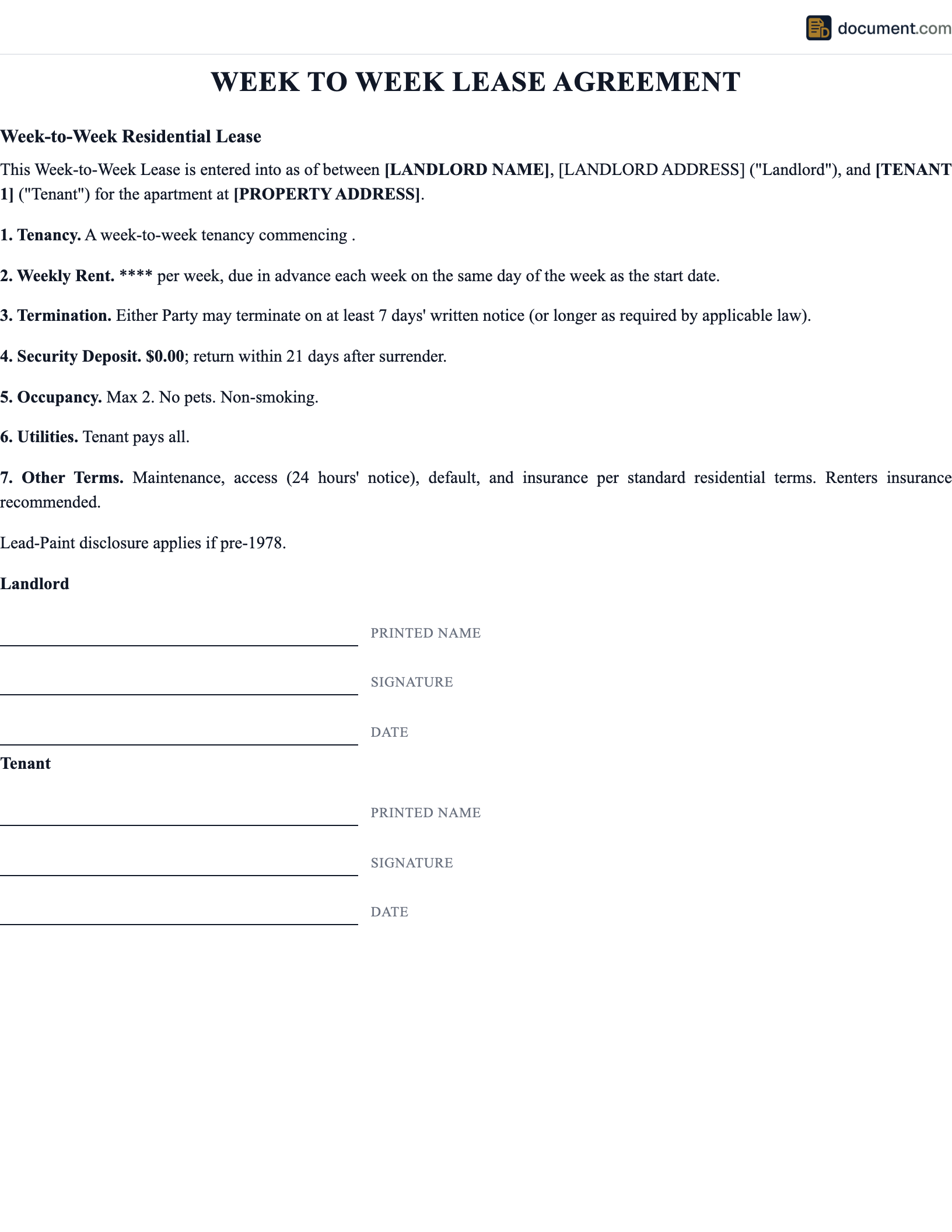



Pennsylvania Weekly Lease Overview
A week-to-week tenancy in Pennsylvania operates under the Landlord and Tenant Act of 1951 (68 P.S. §250.101 et seq.), a statute that predates most modern landlord-tenant codes and carries several provisions landlords in other states rarely encounter. The most distinctive feature is a two-tier security deposit cap: landlords may collect up to two months' rent during the first year but must reduce the held deposit to one month's rent once the tenancy passes its first anniversary. No other state structures its deposit ceiling quite this way, and the rule applies with equal force to a seven-day weekly lease.
Weekly tenancies are common across Pennsylvania's economically diverse landscape — from furnished rooms near the University of Pennsylvania and Temple University in Philadelphia to seasonal worker housing in the Poconos and Hershey-Lancaster tourism corridor, and transient quarters near military installations like Carlisle Barracks, Tobyhanna Army Depot, and the Defense Logistics Agency compound at Susquehanna. In each case the same statewide statute governs the fundamental landlord-tenant relationship, but Philadelphia and Pittsburgh overlay significant local ordinances that can change disclosure, licensing, and eviction obligations.
7 days
Notice to Terminate
2 → 1 mo.
Two-Tier Deposit Cap
30 days
Deposit Return Deadline
10 days
Non-Payment Notice
Pennsylvania's Two-Tier Security Deposit System
Pennsylvania's deposit rules under 68 P.S. §250.511a are unlike those of any other state. During the first year of a tenancy the landlord may hold up to two months' rent as a security deposit. Once the tenant has occupied the unit for twelve months, the maximum drops to one month's rent, and the landlord must refund the difference within 30 days of the anniversary date. Failure to return the excess exposes the landlord to double the amount wrongfully withheld under §250.512.
When a deposit exceeds $100 and the landlord has held it for more than two years, 68 P.S. §250.511b requires the funds to be deposited in an interest-bearing escrow account at a Pennsylvania banking institution regulated by the state or federal government. The landlord must inform the tenant in writing of the bank's name and address. Interest accrued belongs to the tenant and must be paid out annually, though the landlord may retain a 1% administrative fee. For a weekly lease that quietly persists beyond two years — common with long-term rooming-house tenants — the escrow obligation can catch landlords off guard.
Upon termination, the landlord has 30 days to return the deposit with an itemized list of deductions. If the landlord fails to provide the itemized statement within that window, the tenant may recover double the deposit amount. Deductions are limited to actual damages beyond normal wear and tear, unpaid rent, and breach-of-lease costs — the landlord bears the burden of proving each charge.
Two-Year Escrow Trigger
Many weekly landlords do not realize that a tenant who renews week after week can cross the two-year threshold that triggers escrow obligations under §250.511b. Track tenancy duration carefully and open the required interest-bearing account before the deadline. Missing the escrow requirement does not void the deposit, but it gives the tenant a strong argument in any dispute over the return.
Termination & Eviction Rules for Weekly Tenancies
Seven-Day Notice to Quit
Under 68 P.S. §250.501, a periodic tenancy requires written notice equal to the rental period. For a week-to-week lease that means the landlord or tenant must deliver seven days' written notice before the start of the next weekly cycle. The notice must clearly state the date the tenancy will end. If the tenant holds over after a valid notice, the landlord may file for possession in the Magisterial District Judge (MDJ) court.
Non-Payment Eviction
When a weekly tenant falls behind on rent, the landlord must serve a 10-day notice to quit under 68 P.S. §250.501(b) before initiating a court action. Evictions in Pennsylvania are heard by a Magisterial District Judge rather than the Court of Common Pleas. After the MDJ issues a judgment for possession, the tenant has 10 days to file an appeal to the Court of Common Pleas and may be required to post an appeal bond. The entire process, from notice through appeal period, can take several weeks even for a seven-day lease.
Self-Help Prohibition
Pennsylvania strictly prohibits self-help evictions. A landlord who changes locks, removes a tenant's belongings, shuts off utilities, or blocks access to the unit outside of a court order may face liability for actual damages, consequential losses, and the tenant's attorney's fees. This prohibition applies regardless of whether the tenant is on a week-to-week or multi-year lease.
- 7-day written notice required for no-cause termination (§250.501)
- 10-day notice to quit for non-payment of rent (§250.501(b))
- Eviction complaints filed with Magisterial District Judge (MDJ)
- Tenant has 10 days to appeal MDJ judgment to Court of Common Pleas
- Self-help evictions (lockouts, utility shutoffs) are illegal
Habitability & Tenant Rights
Pennsylvania's implied warranty of habitability does not come from a statute — the state Supreme Court adopted it through case law in Pugh v. Holmes (1976). The ruling obligates every residential landlord, including those renting on a weekly basis, to deliver and maintain premises that are safe, sanitary, and fit for human habitation. A weekly tenant who discovers serious defects — such as a failing furnace, sewage backup, or structural hazard — has the same right to withhold rent or seek repair-and-deduct remedies that a yearly leaseholder would.
The Utility Service Tenants Rights Act (66 Pa.C.S. §1521) adds a separate layer of protection. If a landlord fails to pay the utility bill on an account that serves tenants, the utility company must notify the affected tenants before terminating service. Tenants may then pay the utility directly and deduct the payments from rent. This protection is especially relevant to weekly tenants in rooming houses or multi-unit buildings where utilities are included in the rent and controlled by the landlord.
Disclosure obligations at the state level are limited but important. Every landlord must provide the name and address of the property owner and any authorized agent (68 P.S. §250.512.1). Federal law requires lead-based paint disclosure for pre-1978 properties. Pennsylvania does not mandate statewide mold, radon, or bed-bug disclosures, though individual municipalities may impose them.
Philadelphia & Pittsburgh Local Laws
Philadelphia operates what amounts to a parallel tenant-protection regime. The Philadelphia Lead Disclosure and Certification Law goes well beyond the federal lead-paint disclosure requirement: landlords of pre-1978 rental housing must obtain a lead-safe or lead-free certification from a certified inspector before a tenant moves in, and they must provide a copy of the certificate to the tenant. Failure to comply can result in fines and an order barring the landlord from renting the unit until certification is obtained. The city's Fair Practices Ordinance further prohibits discrimination based on source of income, a protection not available under state law. Philadelphia also requires a rental license and periodic property inspections that landlords outside the city do not face.
The City Council has debated Good Cause Eviction protections that would restrict a landlord's ability to non-renew a periodic tenancy without a qualifying reason — a provision that could fundamentally alter the flexibility that makes week-to-week leases attractive to landlords. Weekly landlords operating in Philadelphia should monitor these legislative developments closely.
Pittsburgh has adopted its own tenant protections, including a rental registration program and code-enforcement inspections. While Pittsburgh's local ordinances are not as extensive as Philadelphia's, landlords in the city must register rental properties and comply with additional habitability inspection requirements. Weekly landlords in Pittsburgh's university neighborhoods near Pitt and Carnegie Mellon should verify that their units are properly registered.
Statewide vs. Local Rules
Pennsylvania has no statewide rent control, but Philadelphia and Pittsburgh may adopt local tenant protections that go beyond 68 P.S. §250.101 et seq. Always check the municipal code for the city where the rental unit is located before drafting a weekly lease. Licensing, inspection, lead-certification, and anti-discrimination requirements vary significantly between jurisdictions.
University Towns, Military Bases & Seasonal Tourism
Week-to-week leases serve distinct markets across Pennsylvania. In university towns — State College (Penn State), Philadelphia (Penn, Temple, Drexel), and Pittsburgh (Pitt, Carnegie Mellon) — weekly arrangements fill gaps during summer sessions, between semesters, and for visiting researchers who need housing measured in weeks rather than months. Landlords near campuses should be aware that student tenants hold the same statutory rights as any other tenant and cannot be subjected to abbreviated notice or relaxed deposit rules.
Military-connected tenants near Carlisle Barracks, Tobyhanna Army Depot, and the Defense Logistics Agency facility at Susquehanna frequently use weekly leases during temporary duty assignments or while awaiting permanent housing. These tenants may also hold early-termination rights under the federal Servicemembers Civil Relief Act (SCRA), which can override state-law notice periods when a service member receives qualifying orders.
In the Poconos and the Hershey-Lancaster corridor, seasonal tourism drives demand for short-term furnished rentals. A landlord offering a weekly lease for a vacation cabin or resort-area apartment must still comply with 68 P.S. §250.511a deposit limits and §250.501 notice requirements. Some Poconos municipalities have adopted short-term rental registration ordinances — a weekly lease that functions as a vacation rental may trigger local permitting, occupancy-tax collection, and fire-safety inspection obligations that do not apply to conventional residential leases.
Other Pennsylvania Lease Agreement Types
Need a different type of lease agreement for Pennsylvania? We offer state-specific templates for every type of rental arrangement.
Pennsylvania Residential Lease
Standard fixed-term residential lease agreement
Pennsylvania Month-to-Month Lease
Flexible periodic tenancy with 30-day notice
Pennsylvania Sublease Agreement
Agreement to sublet all or part of a rental unit
Pennsylvania Roommate Agreement
Agreement between co-tenants sharing a rental unit
Pennsylvania Week-to-Week Lease FAQ
Answers to common questions about Pennsylvania weekly tenancy law, the two-tier deposit system, escrow requirements, and city-specific obligations in Philadelphia and Pittsburgh.
Official Pennsylvania Resources
Create your Pennsylvania Week To Week Lease Agreement in under 5 minutes.
Answer a few questions and download a Pennsylvania-compliant document, ready for the state agency.