



Pennsylvania Sublease Agreement Overview
Pennsylvania does not have a dedicated commercial sublease statute, so commercial subleases are governed entirely by the terms of the prime lease and the sublease agreement itself. The original tenant retains full liability to the landlord after subleasing, and the subtenant has no direct privity with the landlord. Philadelphia and Pittsburgh are the primary commercial sublease markets in the state, with office sublease availability rising as tenants have given back space in post-pandemic portfolio reductions.
The absence of privity creates meaningful risk for Pennsylvania commercial subtenants. If the original tenant defaults on the prime lease, the landlord can terminate the prime lease and the sublease with it, displacing the subtenant regardless of whether the subtenant has been paying rent faithfully. Negotiating a non-disturbance agreement directly with the landlord is the most effective protection against this scenario.
A well-drafted Pennsylvania commercial sublease should incorporate the relevant prime lease terms by reference, specify how the sublease rent compares to the prime rent, address the subtenant's responsibility for operating expense pass-throughs if the prime lease is a net or modified gross structure, and include clear default remedies and security deposit provisions.
Per lease
Subletting default
Yes
Consent required
Yes
Tenant remains liable
2 months'
Deposit rules
Pennsylvania Commercial Sublease Requirements
A Pennsylvania commercial sublease needs to address the key privity, liability, and flow-down provisions that protect both the original tenant and the subtenant given the absence of a direct landlord-subtenant relationship.
Pennsylvania-Specific Note
Pennsylvania commercial leases are governed by contract law, not a residential landlord-tenant act, so there are fewer statutory protections for subtenants. The prime lease consent requirement controls whether subletting is permitted at all, and the landlord's ability to withhold consent may be broad unless the prime lease restricts it. Subtenants in Philadelphia and Pittsburgh should evaluate requesting a non-disturbance agreement from the landlord, particularly for longer sublease terms.
Key Sublease Provisions
- Landlord Consent: Obtain prior written consent from the landlord as required by the prime lease before executing the sublease
- Flow-Down of Prime Lease Terms: Incorporate the prime lease obligations by reference so the subtenant is bound by the same use restrictions, maintenance obligations, and insurance requirements
- Original Tenant Liability: Acknowledge that the original tenant remains fully responsible to the landlord under the prime lease notwithstanding the sublease
- No Privity Acknowledgment: State that the sublease does not create a direct landlord-tenant relationship between the landlord and the subtenant
- Default Remedies: Define what happens if the subtenant defaults, including notice requirements and the original tenant's right to terminate the sublease and re-enter the premises
- Security Deposit: Specify the deposit amount; there is no statutory cap for Pennsylvania commercial subleases, so the amount is fully negotiable
How to Draft a Pennsylvania Commercial Sublease Agreement
Drafting a Pennsylvania commercial sublease requires reviewing the prime lease carefully to understand what is permitted, what consent procedure applies, and which obligations must flow down to the subtenant.
Review the Prime Lease and Obtain Consent
Read the subletting provisions of the prime lease carefully. Identify the consent requirement, any restrictions on the subtenant's permitted use, and any approval timeline. Submit a formal written consent request to the Pennsylvania landlord with information about the proposed subtenant's business and financial background. Obtain written consent before proceeding.
Draft the Sublease Agreement
Include the full legal names of the sublessor, sublessee, and landlord. Reference the prime lease by date and attach it as an exhibit. Define the subleased premises, sublease term (which cannot exceed the prime lease term), sublease rent, security deposit, and permitted use. For Philadelphia properties, specify whether the subtenant is responsible for any BIRT filing obligations connected to business activity on the premises.
Attach Supporting Documents
Attach the original prime lease, the landlord consent letter, and any applicable building rules or operating expense schedules. If you have negotiated a non-disturbance agreement with the landlord, attach that as well to document the subtenant's occupancy protections.
Execute and Distribute
Both the sublessor and sublessee must sign the agreement. For Pennsylvania commercial subleases, notarization is not required between the parties but may be needed if a memorandum of sublease is to be recorded at the county recorder of deeds. Distribute executed copies to all parties and provide one to the landlord as required by the prime lease consent process.
Pennsylvania Commercial Sublease Key Facts
Key rules and considerations for commercial subleases in Pennsylvania.
| Topic | Pennsylvania Rules |
|---|---|
| Landlord Consent Requirement | Required by virtually all commercial prime leases; PA has no statute limiting consent discretion unless prime lease does |
| Original Tenant Liability | Remains fully liable to landlord under prime lease after subleasing; subtenant default does not excuse original tenant |
| Subtenant Privity with Landlord | None; sublease does not create direct landlord-subtenant relationship without separate agreement |
| Security Deposit | No statutory cap for commercial subleases; amount negotiable between sublessor and subtenant |
| Subtenant Displacement Risk | Subtenant can be displaced if original tenant defaults on prime lease; non-disturbance agreement with landlord mitigates this risk |
| Attorney Review | $300 to $600 for commercial sublease review; strongly recommended for multi-year terms |
Sample Pennsylvania Sublease Agreement
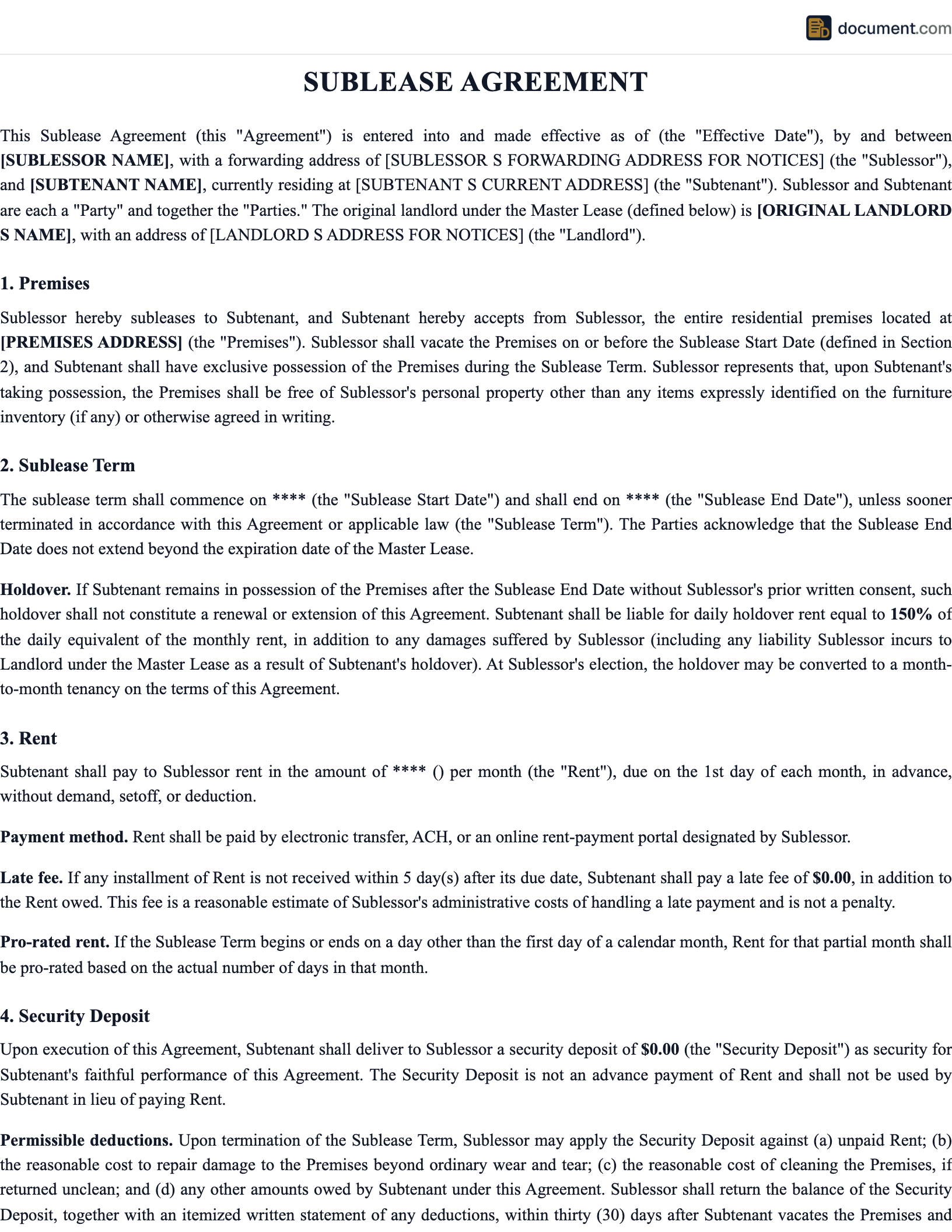
Below is a preview of our Pennsylvania-specific sublease agreement. Your customized document will include all provisions required under PA law.
STATE OF PENNSYLVANIA
SUBLEASE AGREEMENT
Residential Subletting Contract
SUBLESSOR (Original Tenant):
Name: [Sublessor Name]
Address: [Pennsylvania Address]
SUBLESSEE (New Occupant):
Name: [Sublessee Name]
Current Address: [Address]
SUBLEASE TERMS
Start Date: [Date]
End Date: [Date]
Monthly Rent: $[Amount]
Security Deposit: $[Amount]
Pennsylvania Sublease Agreement FAQ
Answers to common questions about sublease agreements in Pennsylvania.
Other Pennsylvania Lease Agreement Templates
Need a different type of lease agreement for Pennsylvania? We offer state-specific templates for every type of rental arrangement.
Pennsylvania Residential Lease
Standard rental agreements
Pennsylvania Month-to-Month Lease
Flexible short-term rentals
Pennsylvania Vacation Rental
Short-term vacation properties
Pennsylvania Commercial Lease
Business and retail spaces
Pennsylvania Roommate Agreement
Shared living arrangements
Pennsylvania Rent-to-Own
Lease with purchase option
Pennsylvania Equipment Lease
Equipment rental agreements
Pennsylvania Land Lease
Land rental agreements
Pennsylvania Room Rental
Individual room rentals
Create your Pennsylvania Sublease Lease Agreement in under 5 minutes.
Answer a few questions and download a Pennsylvania-compliant document, ready for the state agency.