
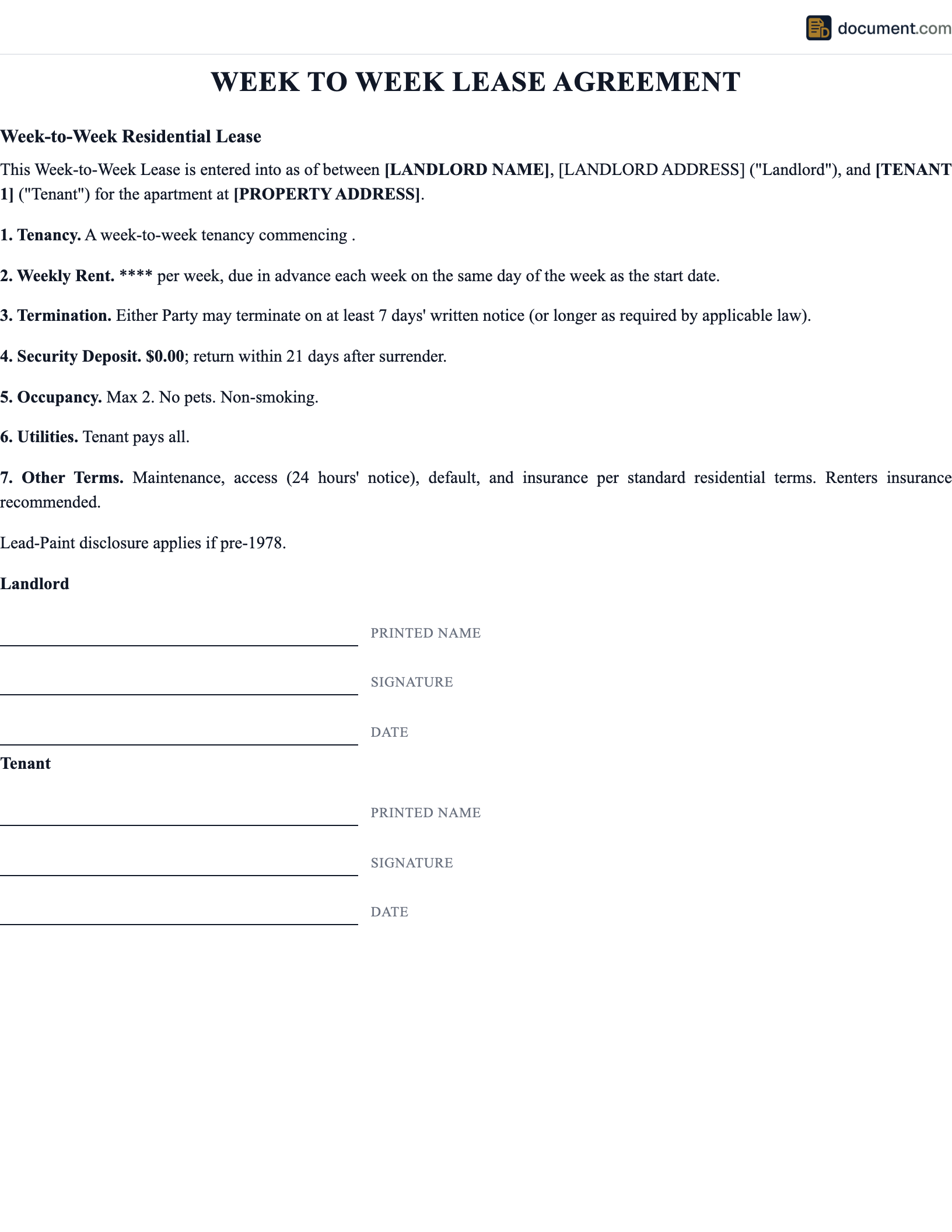



Why Nevada Drives Weekly Lease Demand
Few states produce as much demand for week-to-week leases as Nevada. The Las Vegas Strip alone employs hundreds of thousands of casino dealers, hotel staff, food-service workers, and entertainment professionals who rotate through swing, graveyard, and day shifts around the clock. Many of these workers relocate from out of state on short notice and need flexible housing that does not lock them into a long-term commitment. Weekly leases governed by NRS Chapter 118A fill that gap — automatically renewing every seven days under the full protection of Nevada landlord-tenant law.
Beyond the Strip, Reno's expanding technology and logistics corridor, military installations such as Nellis AFB, Creech AFB, and Fallon NAS, and university populations at UNLV and UNR all sustain a steady pipeline of tenants who prefer short-term arrangements. Nevada's absence of a state income tax adds another draw for workers crossing from California, creating additional weekly rental demand in border communities like Reno-Sparks and Laughlin. Because Nevada law treats weekly tenants identically to any other residential tenant, landlords must comply with the same habitability standards (NRS §118A.290), deposit limits, and eviction procedures that govern longer leases.
7 days
Termination Notice (NRS §118A.460)
3 months
Max Deposit (NRS §118A.242)
5%
Late-Fee Cap (SB 151)
30 days
Deposit Return Window
NRS Chapter 118A Requirements & Mandatory Disclosures
Termination Notice Under NRS §118A.460
Either party to a Nevada week-to-week tenancy must deliver at least 7 days' written notice before the start of the next rental period to end the lease. The notice must clearly state the date on which the tenancy will terminate. Oral notice alone is not legally sufficient. If the tenant fails to vacate after receiving a valid notice, the landlord must proceed through the courts — self-help removal is prohibited under NRS §118A.390.
Habitability Standards (NRS §118A.290)
Nevada landlords must maintain every rental unit — including weekly rentals — in a condition that is fit for human habitation. Under NRS §118A.290, this means working plumbing and hot water, functioning electrical systems, adequate heating and cooling (essential in Nevada's desert climate where summer temperatures regularly exceed 110°F in Las Vegas), structural integrity, and compliance with all applicable building and housing codes. If a landlord fails to address a habitability defect after written notice from the tenant, the tenant may pursue remedies including rent abatement or lease termination.
Mandatory Disclosures (NRS §118A.200)
Before a weekly tenancy begins, the landlord must disclose the name and address of the property owner or the person authorized to manage the premises and receive legal notices. Federal law requires a lead-based paint disclosure for any property built before 1978. Nevada also requires a move-in inspection checklist signed by both parties — this document is the primary evidence in deposit-return disputes and is especially important for weekly leases where tenant turnover is frequent. In Clark County and Washoe County, landlords should verify whether the property requires a short-term rental permit, as local ordinances impose registration, licensing, and tax-collection obligations that can vary significantly between jurisdictions.
Security Deposit Rules Under NRS §118A.242
Nevada caps security deposits at three months' rent for all residential tenancies. For a weekly lease at $400 per week, this translates to a maximum deposit of roughly $5,200 (approximately 13 weeks of rent). The landlord must return the deposit — or deliver a written, itemized statement of deductions for damages beyond normal wear and tear — within 30 days after the tenant surrenders possession. Failure to meet the 30-day deadline entitles the tenant to recover the entire deposit regardless of actual damages.
Nevada does not require landlords to hold deposits in a separate escrow account or pay interest on the deposit balance, but keeping the funds segregated is a best practice that simplifies accounting during the rapid turnover common in weekly tenancies. If a landlord withholds any portion of the deposit, the deductions must be specific — vague entries like “cleaning” or “damages” without dollar amounts and descriptions can be challenged by the tenant in justice court.
Move-In Inspection Is Your Best Protection
Because weekly tenancies turn over rapidly, conducting a thorough move-in inspection with dated photos and a signed checklist is critical. Without this documentation, landlords have little evidence to justify deposit deductions, and tenants have limited proof that pre-existing damage was not caused by them. Nevada courts consistently side with whichever party can produce the clearest contemporaneous records.
Termination Notice & Nevada's Summary Eviction Process
Nevada's eviction framework is notably faster than most states, built around the “affidavit of complaint” summary eviction procedure in NRS §40.253. When a weekly tenant fails to pay rent, the landlord serves a 7-day notice to pay or quit. If the tenant neither pays nor vacates within that window, the landlord files a verified affidavit with the local justice court describing the non-payment. The court then issues an order for the tenant to appear and show cause why they should not be evicted — typically within five judicial days. If the tenant fails to respond or cannot demonstrate a valid defense, the court orders removal and a lockout is scheduled through the constable.
This summary process can resolve a non-payment eviction in roughly two to three weeks from the initial notice — a timeline that makes weekly leases in Nevada far less risky for landlords than in states where eviction litigation can stretch for months. However, landlords must follow every procedural step precisely. Serving notice by improper methods, filing an incomplete affidavit, or attempting self-help removal (prohibited under NRS §118A.390) can result in the case being dismissed and the tenant recovering damages.
- 7-day written notice to pay or quit for non-payment (NRS §40.253)
- 7-day written notice to terminate without cause (NRS §118A.460)
- Affidavit of complaint filed in justice court after notice expires
- Self-help eviction strictly prohibited — landlords face up to $2,500 in damages (NRS §118A.390)
- Retaliatory eviction barred within 90 days of a tenant's protected activity (NRS §118A.510)
Nevada Weekly Lease Fees, Caps & Statutory Limits
| Item | Nevada Rule |
|---|---|
| Termination Notice | 7 days' written notice (NRS §118A.460) |
| Security Deposit Cap | 3 months' rent (NRS §118A.242) |
| Deposit Return Deadline | 30 days with itemized statement |
| Late Fee Maximum | 5% of periodic rent (SB 151) |
| Non-Payment Eviction Notice | 7-day pay-or-quit (NRS §40.253) |
| Lead Paint Disclosure | Required for pre-1978 properties (federal) |
| Move-In Inspection | Checklist signed by both parties |
| Short-Term Rental Permits | Vary by county (Clark, Washoe have specific rules) |
Official Nevada Resources
Verify current statutes and find state-provided guidance for Nevada landlord-tenant matters.
Other Nevada Lease Agreement Types
If a weekly arrangement does not fit your situation, explore other Nevada-specific lease templates that also comply with NRS Chapter 118A.
Nevada Residential Lease
Standard fixed-term lease with NRS 118A provisions
Nevada Month-to-Month Lease
Periodic tenancy with 30-day termination notice
Nevada Sublease Agreement
Sublet all or part of a rental unit with landlord consent
Nevada Roommate Agreement
Co-tenant agreement for shared housing arrangements
Nevada Week-to-Week Lease FAQ
Common questions about Nevada weekly rental law, NRS Chapter 118A compliance, and the summary eviction process.
Create your Nevada Week To Week Lease Agreement in under 5 minutes.
Answer a few questions and download a Nevada-compliant document, ready for the state agency.