



Nevada Commercial Sublease Overview
Nevada commercial subleases are governed by contract law and the terms of the prime lease rather than by a specific commercial subletting statute. When a business tenant in Las Vegas, Henderson, Reno, or Sparks needs to exit leased space before the prime lease term expires, the sublease is the most common tool available. The original tenant transfers the right to occupy the premises to a subtenant while remaining liable to the landlord under the original lease. Nevada courts enforce commercial lease provisions as written, so the consent clause and other relevant terms in the prime lease fully govern whether and how a sublease may proceed.
Nevada's commercial sublease market is most active in the Las Vegas Valley, where business consolidations, remote work shifts, and space right-sizing generate available sublease blocks across the office, retail, and industrial sectors. The Henderson and North Las Vegas submarkets have seen meaningful industrial sublease availability tied to logistics and distribution operations. In Reno and Sparks, commercial sublease opportunities are concentrated in office and industrial properties connected to the technology and warehouse growth corridor along Interstate 80.
A properly drafted Nevada commercial sublease must address several issues that do not arise in residential subleasing. The subtenant has no direct contractual relationship with the landlord, creating occupancy risk if the original tenant defaults. The sublease term cannot exceed the remaining prime lease term. Use restrictions, insurance requirements, and permitted alterations in the prime lease flow through to the subtenant. A well-constructed sublease documents each party's responsibilities clearly and provides both the original tenant and subtenant with meaningful protections if the transaction does not go as planned.
Per lease
Subletting default
Yes
Consent required
Yes
Tenant remains liable
3 months'
Deposit rules
Nevada Commercial Sublease Requirements
Nevada commercial subleases are governed by the prime lease and general contract law principles. There is no Nevada statute that imposes a reasonableness standard on a commercial landlord's consent decision. The following requirements reflect standard commercial sublease practice in Nevada:
Important: Review Your Prime Lease Consent Clause First
Most Nevada commercial leases require prior written landlord consent to sublease. Some leases give the landlord the right to withhold consent for any reason; others specify a reasonableness standard. A few prohibit subleasing entirely. Some Nevada commercial leases also give the landlord a recapture right, meaning the landlord can reclaim the space instead of approving the sublease. Review the consent clause before taking any steps toward a sublease, because proceeding without consent is a material breach that can result in lease termination.
Sublessor (Original Tenant) Obligations
- Review Prime Lease Consent Clause: Identify the exact consent standard and any conditions the Nevada landlord may impose, including whether a recapture right applies
- Obtain Written Landlord Consent: Submit the proposed subtenant's financial information, business description, and intended use; secure written consent before finalizing sublease terms
- Remain Liable Under the Prime Lease: The original tenant stays fully bound by every prime lease obligation regardless of what the subtenant does or fails to do throughout the sublease term
- Screen the Subtenant: A subtenant default puts the original tenant at risk with the landlord; verify financial statements and business references before executing the sublease
Subtenant Obligations
- Review the Prime Lease: The prime lease governs permitted use, alterations, insurance requirements, and many other obligations that flow through to the subtenant; understand those obligations before signing the sublease
- Seek a Non-Disturbance Agreement: Request that the Nevada landlord agree in writing not to disturb the subtenant's occupancy if the original tenant defaults on the prime lease; this protection is particularly valuable for Las Vegas and Reno subtenants making tenant improvement investments
- Pay Sublease Rent on Time: Timely sublease payments protect the original tenant's ability to stay current on the prime lease; sublease payment delays cascade into original tenant default risk
- Comply with Use Restrictions: The prime lease use clause limits the business activities that may be conducted in the space; the subtenant must operate within those boundaries to avoid triggering a prime lease default
How to Complete a Nevada Commercial Sublease
Completing a Nevada commercial sublease requires careful attention to the prime lease terms and the landlord consent process before any sublease documentation is finalized.
Review the Prime Lease Consent Process
Locate the assignment and subletting clause in the prime lease. Identify the consent standard, any notice requirements, whether the landlord can charge a consent fee, and whether the lease includes a recapture right that allows the landlord to take back the space instead of approving the sublease. Nevada commercial landlords sometimes exercise recapture rights rather than approve a sublease when market rents have increased. Understand the full process before marketing the space.
Submit the Landlord Consent Request
Prepare a formal consent request package for the Nevada landlord. Include the proposed subtenant's legal name and entity information, financial statements, a description of the intended business use, and a summary of proposed sublease terms. Submit by the method specified in the prime lease (certified mail protects the original tenant if a timeline dispute arises later). Secure written consent before finalizing the sublease agreement.
Draft the Commercial Sublease Agreement
Prepare the sublease agreement after consent is secured. The document should identify the sublessor and subtenant by full legal name, describe the subleased premises precisely, state the sublease term (must not exceed the remaining prime lease term), set sublease rent and a payment schedule, define maintenance and repair responsibilities, incorporate prime lease obligations by reference, specify insurance requirements, address what happens if the prime lease is terminated or defaults, and attach the written landlord consent as an exhibit.
Execute and Distribute Copies
Both the sublessor and subtenant must sign the sublease agreement. If either party is a business entity, confirm the signatory has authority to bind the company. Provide executed copies to the sublessor, the subtenant, and the landlord. Keep the landlord's written consent, the signed sublease, and the prime lease organized together so the complete transaction record is accessible if a dispute arises later.
Nevada Commercial Sublease Key Terms
The following table summarizes the key legal concepts that apply to commercial subleases in Nevada. Because Nevada follows contract-based rules for commercial tenancies, these points reflect standard commercial practice rather than statutory mandates.
| Topic | Nevada Commercial Rules |
|---|---|
| Landlord Consent Requirement | Required in most Nevada commercial leases; governed entirely by the prime lease consent clause rather than by statute; some leases also include landlord recapture rights that allow the landlord to take back the space instead of approving the sublease |
| Reasonableness Standard | No statutory reasonableness requirement for commercial landlord consent in Nevada; the landlord can withhold consent for any reason unless the prime lease specifically imposes a reasonableness obligation |
| Original Tenant Liability | The original tenant remains fully liable to the landlord under the prime lease after subletting; a subtenant default or failure does not release the original tenant from rent obligations or other covenants |
| Privity of Contract | No direct contractual relationship exists between the Nevada subtenant and the landlord; the subtenant's only agreement is with the original tenant; this creates occupancy risk if the original tenant defaults on the prime lease |
| Non-Disturbance Agreement | Not required by Nevada law but highly advisable for subtenants making tenant improvement investments or committing to a long sublease term in Las Vegas or Reno commercial buildings; protects the subtenant from eviction if the original tenant defaults on the prime lease |
Sample Nevada Sublease Agreement
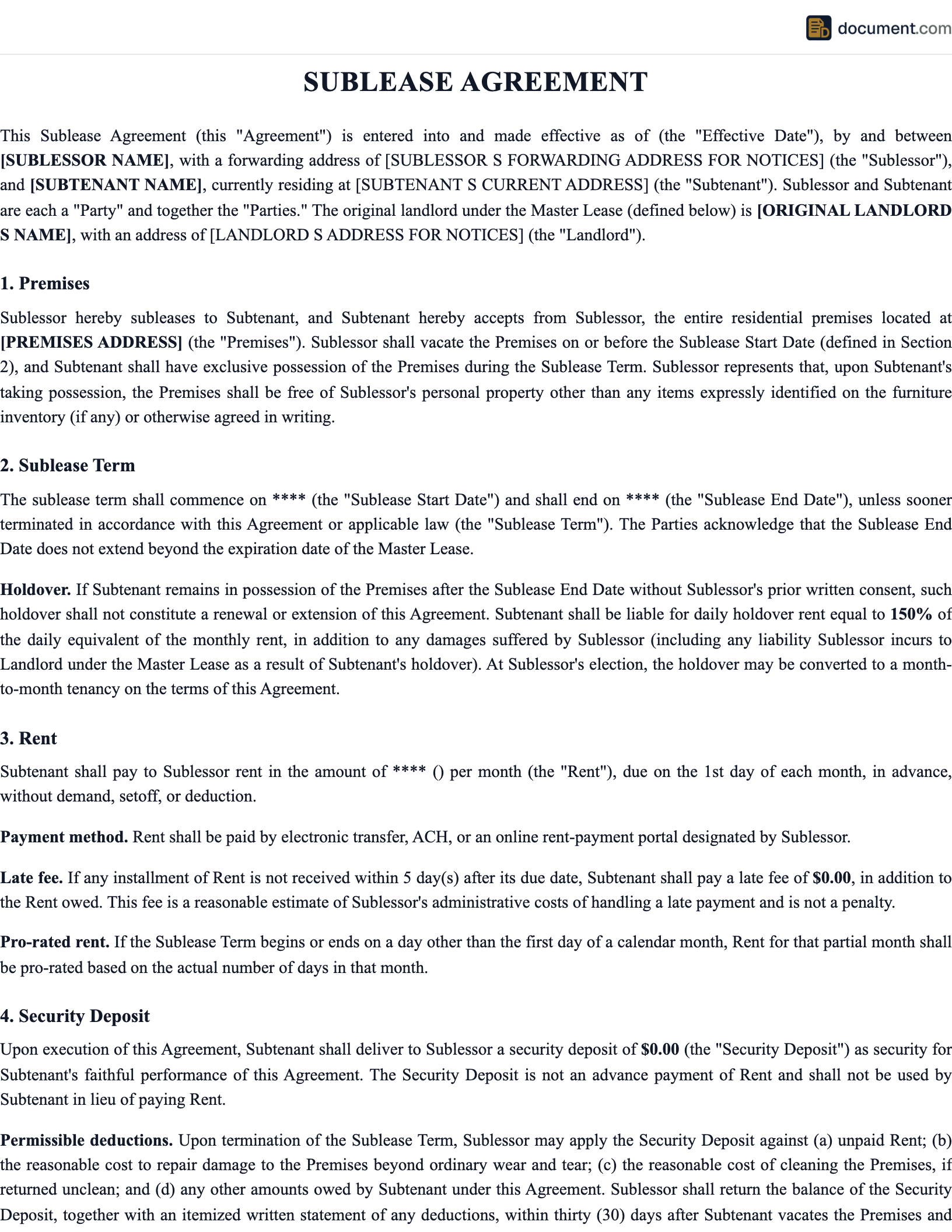
Below is a preview of our Nevada-specific sublease agreement. Your customized document will include all provisions required under NV law.
STATE OF NEVADA
SUBLEASE AGREEMENT
Residential Subletting Contract
SUBLESSOR (Original Tenant):
Name: [Sublessor Name]
Address: [Nevada Address]
SUBLESSEE (New Occupant):
Name: [Sublessee Name]
Current Address: [Address]
SUBLEASE TERMS
Start Date: [Date]
End Date: [Date]
Monthly Rent: $[Amount]
Security Deposit: $[Amount]
Nevada Sublease Agreement FAQ
Answers to common questions about sublease agreements in Nevada.
Other Nevada Lease Agreement Templates
Need a different type of lease agreement for Nevada? We offer state-specific templates for every type of rental arrangement.
Nevada Residential Lease
Standard rental agreements
Nevada Month-to-Month Lease
Flexible short-term rentals
Nevada Vacation Rental
Short-term vacation properties
Nevada Commercial Lease
Business and retail spaces
Nevada Roommate Agreement
Shared living arrangements
Nevada Rent-to-Own
Lease with purchase option
Nevada Equipment Lease
Equipment rental agreements
Nevada Land Lease
Land rental agreements
Nevada Room Rental
Individual room rentals
Create your Nevada Sublease Lease Agreement in under 5 minutes.
Answer a few questions and download a Nevada-compliant document, ready for the state agency.