
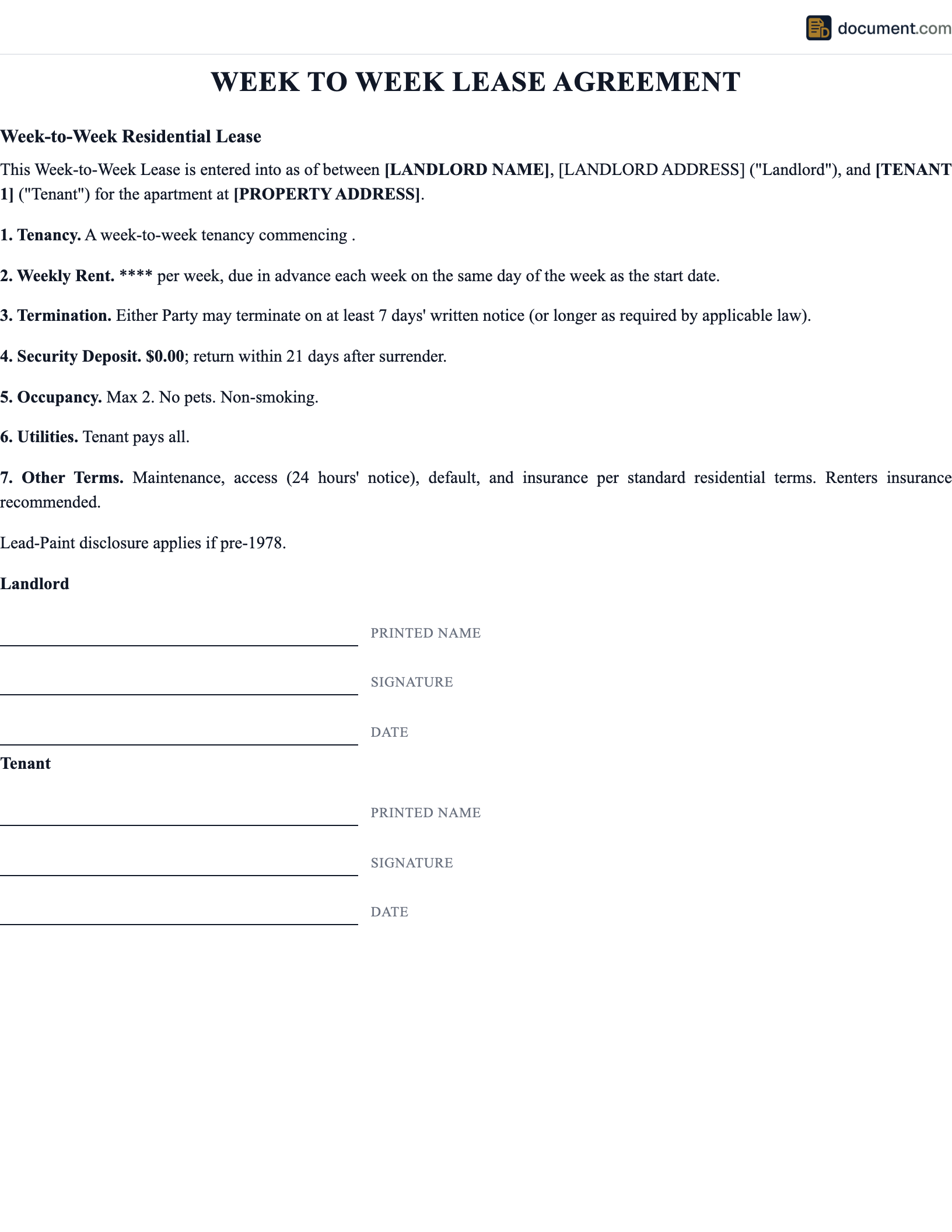



Why Mississippi Weekly Leases Are Different
Mississippi consistently ranks as one of the most landlord-friendly states in the country, and that regulatory posture shapes every aspect of a week-to-week tenancy. The state imposes no cap on security deposits, no limit on late fees, no rent-control authority at any level of government, and comparatively narrow habitability obligations. For landlords, this means broad contractual freedom; for tenants, it means the lease itself — not the statute book — is the primary source of protection.
Weekly leases fill a distinct niche in the Mississippi rental market. The state's five major military installations — Keesler Air Force Base near Biloxi, Columbus Air Force Base, Camp Shelby Joint Forces Training Center outside Hattiesburg, Naval Air Station Meridian, and the Stennis Space Center on the Gulf Coast — generate steady demand from service members who need flexible short-term housing during training rotations or while awaiting permanent quarters. The Gulf Coast casino corridor stretching from Biloxi through Gulfport to Bay St. Louis employs thousands of shift workers, many of whom prefer weekly rental arrangements that align with transient schedules. University towns like Oxford (Ole Miss), Starkville (Mississippi State), and Hattiesburg (University of Southern Mississippi) see weekly lease activity during summer sessions and athletic events. And in the Mississippi Delta's agricultural communities, seasonal laborers rely on week-to-week housing during planting and harvest cycles.
Hurricane vulnerability adds another dimension. After Hurricane Katrina destroyed or severely damaged over 65,000 housing units along the Gulf Coast in 2005, week-to-week leases became a critical tool for displaced families and recovery workers. Mississippi's coastal counties remain in a high-risk hurricane zone, and weekly leases allow both landlords and tenants to respond quickly when storms force evacuations or render properties uninhabitable. A well-drafted weekly lease should address what happens to rent obligations and deposit returns when a natural disaster strikes.
7 days
Termination Notice
No cap
Security Deposit
45 days
Deposit Return Window
3 days
Nonpayment Eviction Notice
Legal Requirements Under Mississippi's RLTA
The Mississippi Residential Landlord and Tenant Act (Miss. Code Ann. §89-8-1 et seq.) sets the baseline rules for all residential tenancies, including week-to-week arrangements. Despite its name, the RLTA is considerably thinner than comparable statutes in neighboring states like Tennessee or Louisiana, leaving many terms to private contract.
Habitability Standards — Narrower Than Most States
Under Miss. Code Ann. §89-8-23, landlords must comply with building and housing codes that materially affect health and safety, maintain common areas, and keep supplied systems — plumbing, electrical, heating, ventilation — in reasonable working order. However, Mississippi does not recognize a broad implied warranty of habitability in the way many states do. Tenants generally cannot withhold rent as a self-help remedy for habitability defects; instead, they must pursue remedies through the courts. For weekly tenants, this limited framework makes pre-move-in inspections critical, because once you take possession, your leverage to compel repairs is narrow compared to what renters in states like New York or California enjoy.
Lease Formation and Oral Agreements
Mississippi does not require week-to-week leases to be in writing — the statute of frauds generally applies only to leases exceeding one year. Oral weekly agreements are legally enforceable, but they create significant proof problems. Without a written lease, disputes over rent amounts, deposit terms, maintenance responsibilities, and termination conditions devolve into credibility contests. Given Mississippi's minimal statutory protections, a written agreement is the single most important safeguard for both parties. The lease contract effectively becomes the law of the tenancy because the RLTA fills so few gaps.
Mississippi Security Deposit Rules for Weekly Leases
Miss. Code Ann. §89-8-21 governs security deposit handling but does not limit the amount a landlord may collect. Mississippi is one of only a few states with no statutory deposit cap, which means landlords can — and sometimes do — require deposits that exceed several weeks' rent. For weekly tenants earning hourly wages in sectors like casino hospitality, food service, or seasonal agriculture, a large upfront deposit can be a significant barrier to housing access.
After the tenancy ends and the tenant surrenders possession, the landlord has 45 days to return the deposit along with an itemized statement of any deductions for damages beyond normal wear and tear. The 45-day window is one of the longest in the country — most states require return within 14 to 30 days. If the landlord wrongfully withholds the deposit, the tenant may recover the amount due plus reasonable attorney's fees by filing in justice court.
Protecting Your Deposit in a Weekly Tenancy
Because Mississippi places no cap on deposit amounts and allows 45 days for return, weekly tenants should take three precautions: (1) negotiate a deposit amount proportional to the weekly rent rather than accepting an arbitrary figure, (2) conduct a detailed move-in inspection with dated photographs and have the landlord sign the condition report, and (3) provide a forwarding address in writing when vacating so the 45-day clock starts clearly. Without a signed condition report, landlords hold most of the leverage in deduction disputes because Mississippi courts place the burden on the tenant to prove the damage was pre-existing.
Termination & Notice for Mississippi Weekly Leases
Miss. Code Ann. §89-8-19 requires that either party give written notice at least equal to the rental period to terminate a periodic tenancy. For a week-to-week lease, that means a minimum of seven days' notice, delivered before the start of the next rental period. The statute does not prescribe a specific delivery method, but hand delivery with a signed acknowledgment or certified mail provides the strongest proof of compliance.
- Seven days' written notice required under Miss. Code Ann. §89-8-19
- Notice must be delivered before the next weekly period begins
- No rent control — landlord may raise rent with seven days' notice
- SCRA protections override state notice periods for military tenants with PCS or deployment orders
- Use certified mail or hand delivery with written acknowledgment for proof
Mississippi Eviction Process for Weekly Tenants
The eviction process in Mississippi operates under Miss. Code Ann. §89-7-27 et seq. and unfolds through county or justice court. For nonpayment of rent, the landlord must serve a 3-day written notice demanding payment before filing suit. For other lease violations, a 30-day written notice is required, giving the tenant an opportunity to cure the breach. If the tenant neither pays nor cures, the landlord may file an unlawful-detainer action.
Mississippi's self-help eviction protections are more limited than those in many states. While a court order is technically required, the landlord's statutory lien on tenant property under Miss. Code Ann. §89-7-51 gives landlords leverage that tenants in more protective states do not face. This lien allows the landlord to retain possession of a tenant's personal property as security for unpaid rent. For weekly tenants — who may have few belongings and limited resources to hire an attorney — this can effectively function as a powerful pressure tool. Understanding these dynamics before signing a weekly lease is essential.
Eviction Timeline at a Glance
- • Nonpayment of rent: 3-day notice to pay or vacate
- • Other lease violations: 30-day notice with opportunity to cure
- • Court filing: county or justice court unlawful-detainer action
- • Hearing: typically scheduled within 7–14 days of filing
- • Writ of possession: issued if tenant does not vacate after judgment
Mississippi Weekly Lease Fees, Limits & Disclosures
| Item | Mississippi Rule |
|---|---|
| Termination Notice | 7 days (Miss. Code Ann. §89-8-19) |
| Security Deposit Cap | No statutory limit |
| Deposit Return Deadline | 45 days with itemized statement (§89-8-21) |
| Late Fee Cap | No statutory cap — must be reasonable |
| Rent Control | Prohibited statewide; no local authority |
| Nonpayment Eviction Notice | 3 days (§89-7-27) |
| Other-Violation Eviction Notice | 30 days with right to cure |
| Lead Paint Disclosure | Required for pre-1978 properties (federal) |
| Other Required Disclosures | Known material defects only |
| Landlord's Lien on Tenant Property | Permitted (§89-7-51) |
Other Mississippi Lease Agreement Types
A weekly arrangement may not suit every Mississippi renter. If you need more stability or a different structure, explore these state-specific alternatives.
Mississippi Residential Lease
Fixed-term agreement with greater rent stability
Mississippi Month-to-Month Lease
30-day periodic tenancy with more notice protection
Mississippi Sublease Agreement
Transfer occupancy rights to a subtenant
Mississippi Roommate Agreement
Divide rent, utilities, and responsibilities among co-tenants
Official Mississippi Resources
These government and nonprofit resources can help Mississippi landlords and weekly tenants understand their rights and resolve disputes.
Mississippi Week-to-Week Lease FAQ
Common questions about weekly rental agreements under Mississippi's Residential Landlord and Tenant Act, with citations to the governing statutes.
Create your Mississippi Week To Week Lease Agreement in under 5 minutes.
Answer a few questions and download a Mississippi-compliant document, ready for the state agency.