
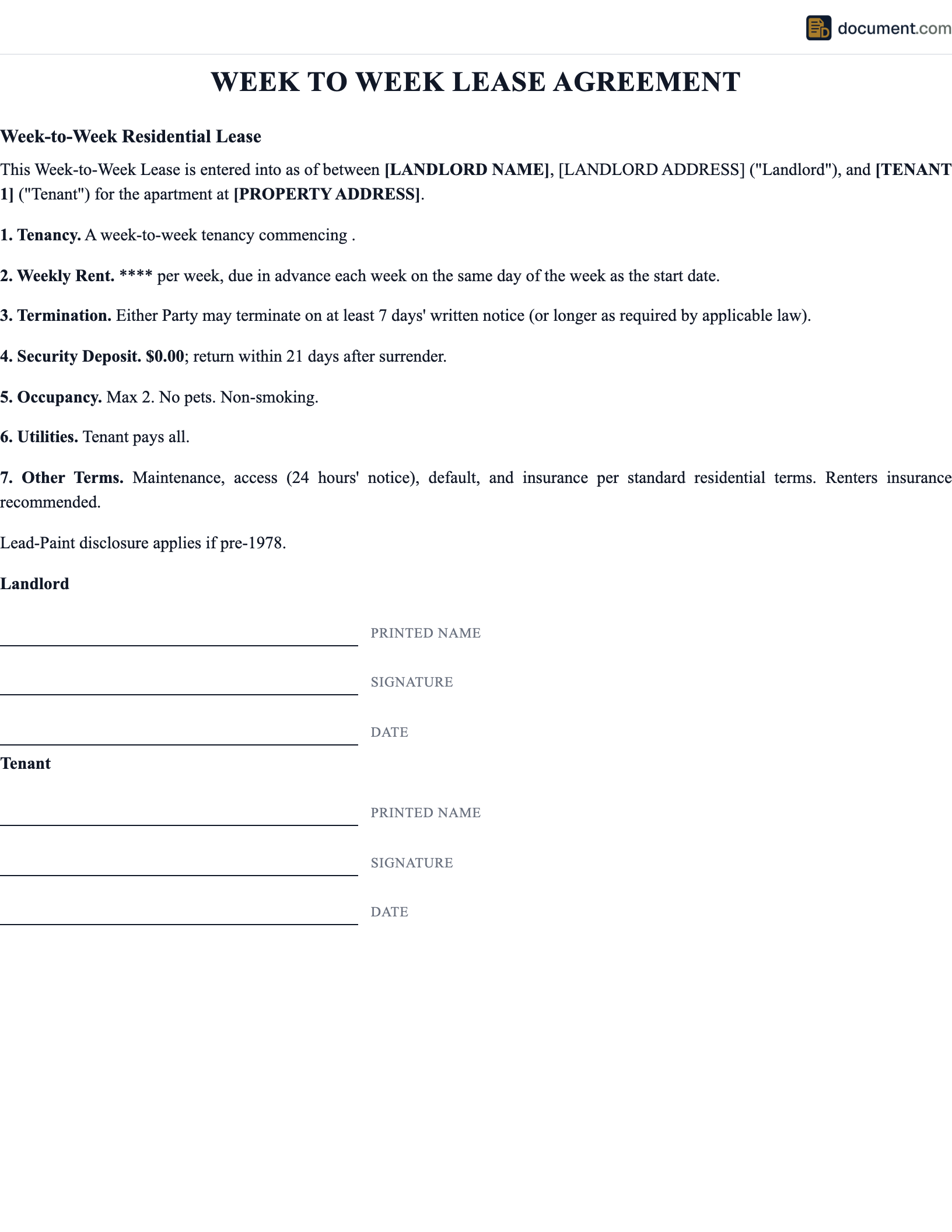



Illinois Week-to-Week Lease Overview
Illinois is one of the few states where a landlord's legal obligations can shift dramatically depending on which side of a municipal boundary a property sits on. The state itself lacks a comprehensive residential landlord-tenant act — instead relying on a patchwork of individual statutes such as the Security Deposit Return Act (765 ILCS 705/), the Security Deposit Interest Act (765 ILCS 710/), and the Forcible Entry and Detainer Act (735 ILCS 5/9-101 et seq.). Chicago fills that gap with its own sweeping Residential Landlord and Tenant Ordinance (RLTO), and Cook County layers on a separate countywide ordinance for unincorporated areas and many suburbs. A week-to-week lease drafted for a Peoria duplex may be dangerously incomplete for a Chicago three-flat, and vice versa.
Week-to-week tenancies in Illinois renew automatically every seven days until either party delivers written notice under 735 ILCS 5/9-207. These short-cycle arrangements are common across the state — temporary housing for university students in Champaign-Urbana, DeKalb, or Normal-Bloomington during summer sessions; transitional rentals for government workers relocating to Springfield; furnished units near military installations like Naval Station Great Lakes, Scott Air Force Base, or Rock Island Arsenal; and flexible options for workers moving between Chicago's job markets and the collar counties.
7 days
Notice Period (735 ILCS 5/9-207)
No cap
State Deposit Limit
3 legal layers
State / Cook Co. / Chicago
5-day notice
Non-Payment Eviction
Chicago RLTO vs. Illinois State Law
The single most important distinction in Illinois rental law is the divide between Chicago and everywhere else. The Chicago RLTO (Municipal Code 5-12) is a comprehensive tenant-protection framework that fundamentally alters the landlord-tenant relationship for properties within Chicago city limits. Landlords accustomed to the relatively light-touch state statutes frequently run into costly violations when they apply the same practices inside Chicago.
Under state law, security deposit interest is required only for buildings with 25 or more units (765 ILCS 710/). The Chicago RLTO eliminates that threshold entirely — every residential landlord in Chicago must pay annual interest on deposits, hold them in a federally insured interest-bearing account, and provide the tenant a written receipt identifying the financial institution, account number, and interest rate. A landlord who fails to comply forfeits the right to retain any portion of the deposit and may owe the tenant an amount equal to twice the deposit plus attorney's fees.
Chicago tenants also enjoy a statutory right to repair-and-deduct: after providing written notice of a code violation that materially affects health or safety, a tenant may arrange repairs and deduct the cost from rent if the landlord fails to act within a reasonable period. The RLTO further requires landlords to attach a city-published summary of tenant rights to every lease — including week-to-week agreements — and to disclose any pending building code violations before the tenant signs. Cook County's separate RLTO extends many of these protections to suburban Cook County, though with its own procedural nuances that landlords in places like Evanston, Oak Park, and Cicero must track independently.
Key Differences at a Glance
- Deposit interest: State law — 25+ unit buildings only. Chicago RLTO — all residential properties.
- Repair-and-deduct: Not codified statewide. Chicago RLTO — explicit statutory right with defined notice periods.
- Required attachments: State law — none specified for leases. Chicago RLTO — city-published tenant rights summary must be attached.
- Violation disclosure: State law — no requirement. Chicago RLTO — pending code violations must be disclosed before lease signing.
- Self-help eviction penalties: Prohibited statewide, but Chicago RLTO adds two months' rent in statutory damages.
Illinois Weekly Tenancy Requirements
Mandatory Disclosures
Every Illinois weekly lease must comply with federal lead-based paint disclosure rules for properties built before 1978. Beyond that, the Radon Awareness Act (420 ILCS 46/) requires landlords to disclose radon hazard information and provide the Illinois Emergency Management Agency's radon guide. Illinois law also mandates that landlords install and maintain carbon monoxide detectors in residential units, and the lease should confirm compliance. If utilities are shared or master-metered, landlords must disclose the allocation method before the tenant takes possession.
Habitability and the Jack Spring Doctrine
The Illinois Supreme Court's landmark decision in Jack Spring, Inc. v. Little (1972) established that every residential lease in Illinois carries an implied warranty of habitability — a promise that the premises are reasonably fit for human occupation. This warranty cannot be waived in the lease. For weekly tenancies, the practical effect is significant: landlords must keep plumbing, heating, electrical systems, and structural elements in working order throughout the tenancy, even though the lease cycle is only seven days. A material breach of habitability gives the tenant grounds for rent withholding or, in Chicago, the RLTO's repair-and-deduct remedy.
Retaliatory Eviction Protections
Under 765 ILCS 720/, landlords are prohibited from retaliating against tenants who report code violations, complain to government agencies, or exercise any legal right. Because week-to-week leases can be terminated on just seven days' notice, the risk of disguised retaliation is particularly acute. Illinois courts scrutinize short-notice terminations that follow a tenant complaint, and a finding of retaliation can void the termination and expose the landlord to damages. Chicago's RLTO adds a rebuttable presumption of retaliation if the landlord acts within a defined period after the tenant's protected activity.
Illinois Security Deposit Rules for Weekly Leases
Illinois imposes no statewide cap on the amount a landlord may collect as a security deposit, but the Security Deposit Return Act (765 ILCS 705/) tightly regulates what happens after the tenant moves out. The landlord must return the deposit within 30 days if no deductions are taken. If the landlord intends to claim deductions for damage beyond normal wear and tear, the deadline extends to 45 days, and the landlord must provide an itemized statement of damages along with paid receipts or estimates for the repair work. Failure to comply within these deadlines entitles the tenant to recover the full deposit plus twice the deposit amount in penalties.
The Security Deposit Interest Act (765 ILCS 710/) adds another layer for larger properties: landlords of buildings with 25 or more units must pay interest on deposits at a rate set annually by the State Comptroller, with interest paid or credited each year during the tenancy. In Chicago, the RLTO requires deposit interest for all properties regardless of unit count, held in a federally insured interest-bearing account. The landlord must give the tenant a receipt with the bank name, address, and deposit amount within the timeframes specified by the ordinance. Violations entitle the tenant to immediate return of the entire deposit.
Chicago Deposit Penalty Warning
Chicago landlords who fail to provide the required deposit receipt, hold deposits in a non-interest-bearing account, or miss the return deadline face automatic forfeiture of the deposit plus statutory damages of up to twice the deposit amount and reasonable attorney's fees. These penalties apply even if the tenant caused actual damage to the unit — procedural compliance is not optional under the RLTO.
Illinois Notice to Terminate Weekly Lease
Termination of a week-to-week tenancy in Illinois is governed by 735 ILCS 5/9-207, which requires at least seven days' written notice from either party. The notice must specify the date the tenancy will end, and that date must fall on or after the last day of the current weekly period. For non-payment of rent, a separate five-day demand notice is required under 735 ILCS 5/9-209 before the landlord can file a forcible entry and detainer action in circuit court.
- Seven days' written notice under 735 ILCS 5/9-207 — must be delivered before the start of the next weekly period
- Five-day demand notice for non-payment under 735 ILCS 5/9-209 before filing eviction
- Chicago RLTO imposes additional formatting and language requirements on termination notices
- Deposit return clock starts when tenant delivers possession — 30 days (no deductions) or 45 days (with itemized deductions)
Illinois Weekly Lease Fees & Limits
| Item | Illinois Rule |
|---|---|
| Termination Notice | 7 days (735 ILCS 5/9-207) |
| Security Deposit Cap | No statewide limit |
| Deposit Return — No Deductions | 30 days (765 ILCS 705/) |
| Deposit Return — With Deductions | 45 days + itemized statement |
| Deposit Interest (State) | 25+ unit buildings only (765 ILCS 710/) |
| Deposit Interest (Chicago) | All residential properties (RLTO) |
| Non-Payment Notice | 5-day demand (735 ILCS 5/9-209) |
| Lead Paint Disclosure | Required (pre-1978 properties) |
| Radon Disclosure | Required (420 ILCS 46/) |
| Rent Control | Not permitted statewide (50 ILCS 825/) |
Official Illinois Resources
Consult these government and legal resources for authoritative guidance on Illinois weekly tenancy law.
Other Illinois Lease Agreement Types
A weekly lease may not suit every Illinois rental situation. Longer-term arrangements carry different notice periods under Illinois statutes and may trigger additional Chicago RLTO provisions. Explore the alternatives below.
Illinois Residential Lease
Fixed-term lease with full RLTO compliance options
Illinois Month-to-Month Lease
30-day notice periodic tenancy under Illinois statute
Illinois Sublease Agreement
Subletting with landlord consent and RLTO considerations
Illinois Roommate Agreement
Co-tenant terms aligned with Illinois shared-tenancy rules
Illinois Week-to-Week Lease FAQ
Common questions about weekly tenancy law in Illinois, covering state statutes, Chicago RLTO obligations, and Cook County protections.
Create your Illinois Week To Week Lease Agreement in under 5 minutes.
Answer a few questions and download a Illinois-compliant document, ready for the state agency.