
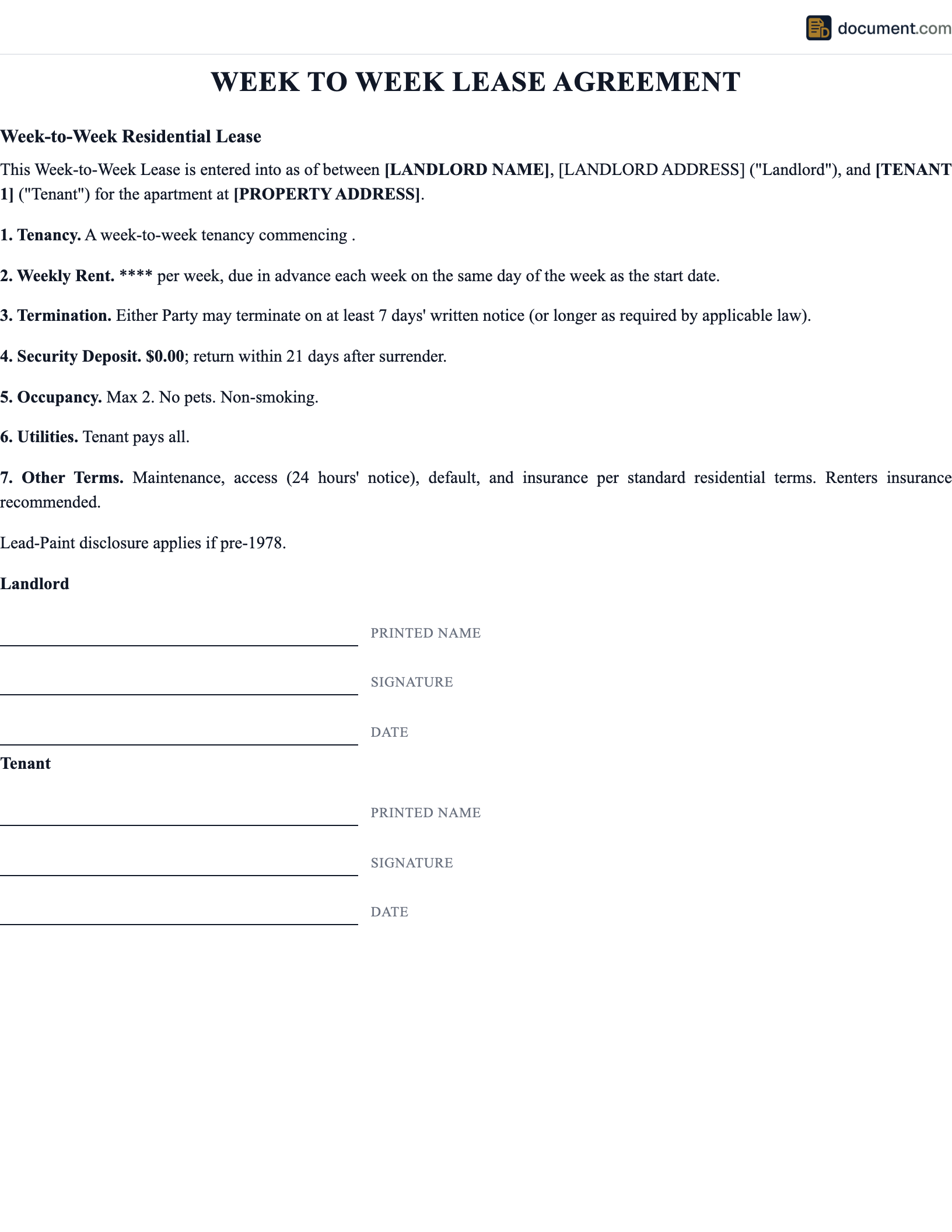



Florida Week-to-Week Lease Overview
Florida's rental landscape is shaped by forces that most other states never contend with. A massive tourism economy stretching from the theme parks of Orlando and Kissimmee through the beaches of Fort Lauderdale, Miami, and the Gulf Coast creates year-round demand for furnished weekly housing. Snowbird migration fills coastal apartments from October through April, and a network of major military installations — NAS Jacksonville, NAS Pensacola, MacDill AFB in Tampa, Patrick Space Force Base near Cape Canaveral, Eglin AFB, and Homestead ARB — generates a steady stream of servicemembers who need flexible short-term housing during PCS transitions and temporary duty assignments.
All of these arrangements fall under Part II of the Florida Residential Landlord and Tenant Act (F.S. §83.40 et seq.), which applies equally to weekly tenancies and year-long fixed-term leases. A week-to-week tenancy in Florida renews automatically every seven days until either the landlord or tenant delivers the written notice required by F.S. §83.57(3). The absence of a state income tax — a feature that draws both retirees and remote workers — intensifies rental competition in university towns like Gainesville and Tallahassee, resort corridors such as Key West and St. Petersburg, and suburban growth zones across the I-4 corridor.
Because Florida prohibits local rent control under F.S. §166.043 (except during a formally declared housing emergency), landlords set weekly rates purely by market conditions. This makes a well-drafted weekly lease essential: it locks in the agreed price for each renewal period and ensures both parties understand the statutory deposit, disclosure, and termination obligations that apply regardless of how short the tenancy may be.
7 days
Termination Notice (§83.57(3))
No cap
Deposit Amount (§83.49)
3-day pay or vacate
Non-Payment Notice (§83.56)
Radon + lead paint
Mandatory Disclosures
Florida Statutory Framework for Weekly Tenancies
The Landlord and Tenant Act (Part II, F.S. §83.40–83.682)
Part II of Chapter 83 governs every residential tenancy in Florida, from week-to-week vacation rentals in Panama City Beach to annual leases in Jacksonville suburbs. The statute sets baseline obligations that a lease cannot disclaim: the landlord's duty to maintain the premises under §83.51, the tenant's duty to use the dwelling in a reasonable manner under §83.52, and the procedural requirements for security deposits, evictions, and retaliatory conduct. A weekly lease must incorporate — or at a minimum not contradict — each of these provisions, because any lease clause that waives a tenant's statutory right is void under §83.47.
Habitability Under F.S. §83.51
Florida's habitability requirements carry particular weight in a state where extreme heat, humidity, and hurricane season create health and safety risks that landlords in cooler climates rarely face. Under §83.51(1), the landlord must maintain the roof, windows, doors, floors, steps, porches, exterior walls, foundations, and all other structural components in good repair. Plumbing must function, and the landlord must supply running water and reasonable heat — but in Florida the more pressing concern is air conditioning: while §83.51 does not explicitly list A/C as a required amenity, Florida courts have increasingly treated working cooling systems as essential to habitability given the state's subtropical climate. Garbage removal, extermination, and smoke detector maintenance round out the landlord's obligations. For weekly tenancies in high-humidity areas along the coast, mold prevention and adequate ventilation are recurring maintenance issues landlords should address proactively.
Rent Control Preemption
Under F.S. §166.043, no Florida county or municipality may impose rent control unless the local governing body declares a housing emergency by a majority-plus-one vote, and even then the measure expires automatically after one year. Because no Florida locality currently has active rent control, landlords offering weekly leases may adjust the rent for each new seven-day period after providing the required notice under §83.57(3). This flexibility benefits landlords in tourist-heavy markets like Orlando, Miami Beach, and the Florida Keys, where demand fluctuates with seasonal travel patterns.
Florida Security Deposit Rules for Weekly Leases
Florida imposes no statutory dollar cap on security deposits, so landlords may collect whatever amount the market supports — even for a one-week tenancy. However, F.S. §83.49 creates one of the most detailed deposit-handling frameworks in the country, and weekly landlords must follow every step regardless of how small the deposit may be.
Three Holding Options
Within 30 days of receiving a deposit the landlord must notify the tenant in writing which of three holding methods has been chosen: (1) a separate non-interest-bearing account at a Florida banking institution, (2) a separate interest-bearing account that pays the tenant either 5% simple interest annually or 75% of the annualized average interest rate (whichever the landlord selects), or (3) a surety bond posted with the clerk of the circuit court in the county where the property is located. The written notice must identify the bank name, address, and account type, or the surety company and bond amount. Failing to send this notice within 30 days does not forfeit the deposit, but it does expose the landlord to liability for any resulting interest owed.
Return Timelines
After the tenant vacates, the clock starts immediately. If the landlord has no claim against the deposit, the entire amount plus accrued interest must be returned within 15 days. If the landlord intends to deduct for damages beyond normal wear and tear, the landlord must send a written notice of intent to impose a claim by certified mail to the tenant's last known address within 30 days of move-out. The notice must describe each proposed deduction. The tenant then has 15 days from receipt to dispute the claim. Only after that 15-day objection window closes — or the dispute is resolved — may the landlord finalize deductions and return the remainder. Missing the 30-day notice deadline forfeits the landlord's right to deduct anything.
Weekly Lease Deposit Pitfall
The 30-day written notification requirement under §83.49(2) applies even when a weekly tenancy lasts only one or two weeks. Landlords who collect a deposit on Monday and see the tenant leave the following Monday still owe the written bank-account notice. In high-turnover vacation markets like Key West or Clearwater Beach, landlords frequently run afoul of this rule. A standardized notice template and a calendar reminder system can prevent costly compliance failures.
Terminating a Florida Weekly Tenancy & Eviction Process
Voluntary Termination Under §83.57(3)
Either party may end a week-to-week tenancy by delivering written notice at least seven days before the end of any weekly period. The notice should state the date the tenancy will terminate and be delivered by hand, by mail, or by posting on the premises if the tenant is absent. While §83.57(3) does not prescribe a specific delivery method, using certified mail or hand delivery with a signed acknowledgment creates an evidence trail that protects both sides if a dispute reaches county court.
Eviction for Non-Payment: The 3-Day Notice
When a weekly tenant fails to pay rent, the landlord must serve a three-day notice to pay or vacate under F.S. §83.56(3). Saturdays, Sundays, and legal holidays are excluded from the three-day count. The notice must identify the amount of rent due and inform the tenant that the lease will terminate if payment is not made within the notice period. If the tenant does not pay, the landlord files a complaint for eviction in the county court where the property is located. Florida allows expedited summary proceedings for residential evictions, but contested cases — particularly in large dockets like those in Miami-Dade, Broward, Hillsborough, or Orange County — can still take several weeks.
Non-Curable Lease Violations
For material lease violations, the landlord generally must serve a seven-day notice that gives the tenant an opportunity to cure. However, F.S. §83.56(2)(a) identifies certain violations — such as destruction, damage, or misuse of the landlord's or another tenant's property — that require only a seven-day unconditional quit notice with no right to cure. These provisions apply equally to weekly tenants.
- Seven days' written notice to end a weekly tenancy voluntarily (§83.57(3))
- Three-day notice for non-payment, excluding weekends and holidays (§83.56(3))
- Seven-day notice for curable lease violations with right to cure (§83.56(2))
- Self-help evictions — lockouts, utility shutoffs, property removal — are illegal (§83.67)
Required Disclosures in a Florida Weekly Lease
Radon Gas Disclosure
Florida is one of a handful of states that mandates a radon gas disclosure in every residential lease. F.S. §404.056(5) prescribes the exact statutory language that must appear in the agreement. The required text warns that radon is a naturally occurring radioactive gas that, when accumulated in a building in sufficient quantities, may present health risks, and advises the tenant that radon testing information is available from the county public health unit. Omitting this language does not automatically void the lease, but it exposes the landlord to liability if elevated radon levels are later discovered. Parts of central and north-central Florida — including areas around Gainesville, Ocala, and the Dunnellon corridor — have higher-than-average radon readings.
Lead-Based Paint Disclosure (Pre-1978 Properties)
Federal law requires landlords of properties built before 1978 to disclose known lead-based paint hazards and provide the EPA pamphlet "Protect Your Family From Lead in Your Home." This applies to weekly tenancies just as it does to annual leases. In Florida's older housing stock — bungalows in Tampa's Ybor City and Seminole Heights, Art Deco buildings in Miami Beach, historic neighborhoods in St. Augustine and Pensacola — lead paint disclosure is a practical concern, not just a formality.
Security Deposit Notice Language
As discussed above, F.S. §83.49 requires the landlord to deliver written notice of the deposit holding method within 30 days. The lease itself should also contain the statutory language informing the tenant of the right to receive interest (if the interest-bearing account option is chosen) and the procedures for claiming or disputing deductions after move-out.
Landlord Identity and Agent Disclosure
F.S. §83.50 requires the lease to identify the name and address of the landlord or the landlord's authorized agent. In Florida's large property-management market — where absentee owners often hire managers to handle vacation rentals in places like Destin, Sarasota, or the Orlando resort corridor — this disclosure ensures tenants know whom to contact for maintenance requests and legal notices.
Special Florida Considerations for Weekly Leases
Hurricane Season and Force Majeure
Florida's Atlantic hurricane season runs from June 1 through November 30, and weekly lease agreements should address what happens when a storm renders the property uninhabitable. Florida law does not automatically excuse rent during a natural disaster unless the premises are destroyed or materially damaged to the point of being unfit for occupancy. A well-drafted weekly lease should include a force majeure clause specifying whether the tenant's rent obligation is suspended if the property becomes uninhabitable due to hurricane damage, and what notice process applies if either party needs to terminate early after a declared emergency. Coastal properties in zones like Miami-Dade, Monroe County (the Keys), Lee County (Fort Myers), and the Panhandle are particularly vulnerable.
Condominium and HOA Rental Restrictions
Florida's condominium statute (F.S. Chapter 718) gives condo associations considerable power to restrict or ban short-term rentals. Many declarations impose minimum lease terms of 30, 60, or 90 days, effectively prohibiting week-to-week agreements. Following the 2021 amendment to F.S. §718.110(13), associations can now adopt new rental restrictions that apply even to existing unit owners if approved by a two-thirds vote of all voting interests. Homeowner associations governed by F.S. Chapter 720 may impose similar restrictions. Before advertising a condo or HOA-governed property for weekly rental, landlords must review the declaration, bylaws, and any recorded amendments to confirm that a seven-day tenancy is permitted.
Vacation Rental and Tourist Tax Obligations
Weekly rentals of six months or less may trigger Florida's transient rental tax obligations. The state levies a 6% sales tax on short-term rentals, and most counties impose a local tourist development tax (commonly called the "bed tax") that ranges from 2% to 6% depending on the county. In Orange County (Orlando), for example, the combined rate exceeds 12%. Landlords who regularly offer week-to-week furnished rentals in tourist-heavy areas must register with the Florida Department of Revenue and remit these taxes or face penalties. The weekly lease should specify whether the quoted rent includes applicable taxes or whether the tenant pays them separately.
Military Tenants and the SCRA
Florida hosts some of the nation's largest military communities. Servicemembers stationed at NAS Jacksonville, NAS Pensacola, MacDill AFB, Patrick Space Force Base, Eglin AFB, Hurlburt Field, or Homestead ARB frequently use weekly leases during PCS moves or temporary duty. The federal Servicemembers Civil Relief Act (SCRA) allows active-duty members who receive PCS or deployment orders to terminate any residential lease — including a week-to-week agreement — with 30 days' written notice accompanied by a copy of the orders. This federal right overrides the shorter seven-day state notice period and cannot be waived by a lease clause.
Florida Weekly Lease Rules at a Glance
| Item | Florida Rule |
|---|---|
| Termination Notice | 7 days' written notice (§83.57(3)) |
| Security Deposit Cap | No statutory limit (§83.49) |
| Deposit Holding | 3 options: non-interest account, interest account (5% or 75% avg rate), or surety bond |
| Deposit Return (No Claim) | 15 days after tenant vacates |
| Deposit Return (With Claim) | 30-day notice of intent + 15-day objection period |
| Non-Payment Notice | 3 days (excl. weekends/holidays) (§83.56(3)) |
| Radon Disclosure | Mandatory — exact statutory language (§404.056(5)) |
| Lead Paint Disclosure | Required for pre-1978 properties (federal) |
| Rent Control | Banned except in declared housing emergency (§166.043) |
| Late Fee Limit | Must be reasonable; no statutory formula |
Official Florida Resources
These government and official sources provide authoritative guidance on Florida landlord-tenant law and weekly rental obligations.
F.S. Chapter 83 — Full Text
Florida Legislature — Landlord and Tenant Act
Florida Bar — Landlord/Tenant Rights
Consumer guide on residential tenancy law
FL Attorney General — Landlord-Tenant
Office of the Attorney General consumer resources
FL Dept. of Revenue — Transient Rental Tax
Sales tax and tourist development tax information
Other Florida Lease Agreement Types
If a weekly tenancy does not fit your situation, Florida law supports several other rental arrangements — each with its own notice period and statutory requirements.
Florida Week-to-Week Lease FAQ
Answers to common questions about weekly tenancies under the Florida Residential Landlord and Tenant Act, with citations to relevant Florida Statutes.
Create your Florida Week To Week Lease Agreement in under 5 minutes.
Answer a few questions and download a Florida-compliant document, ready for the state agency.