
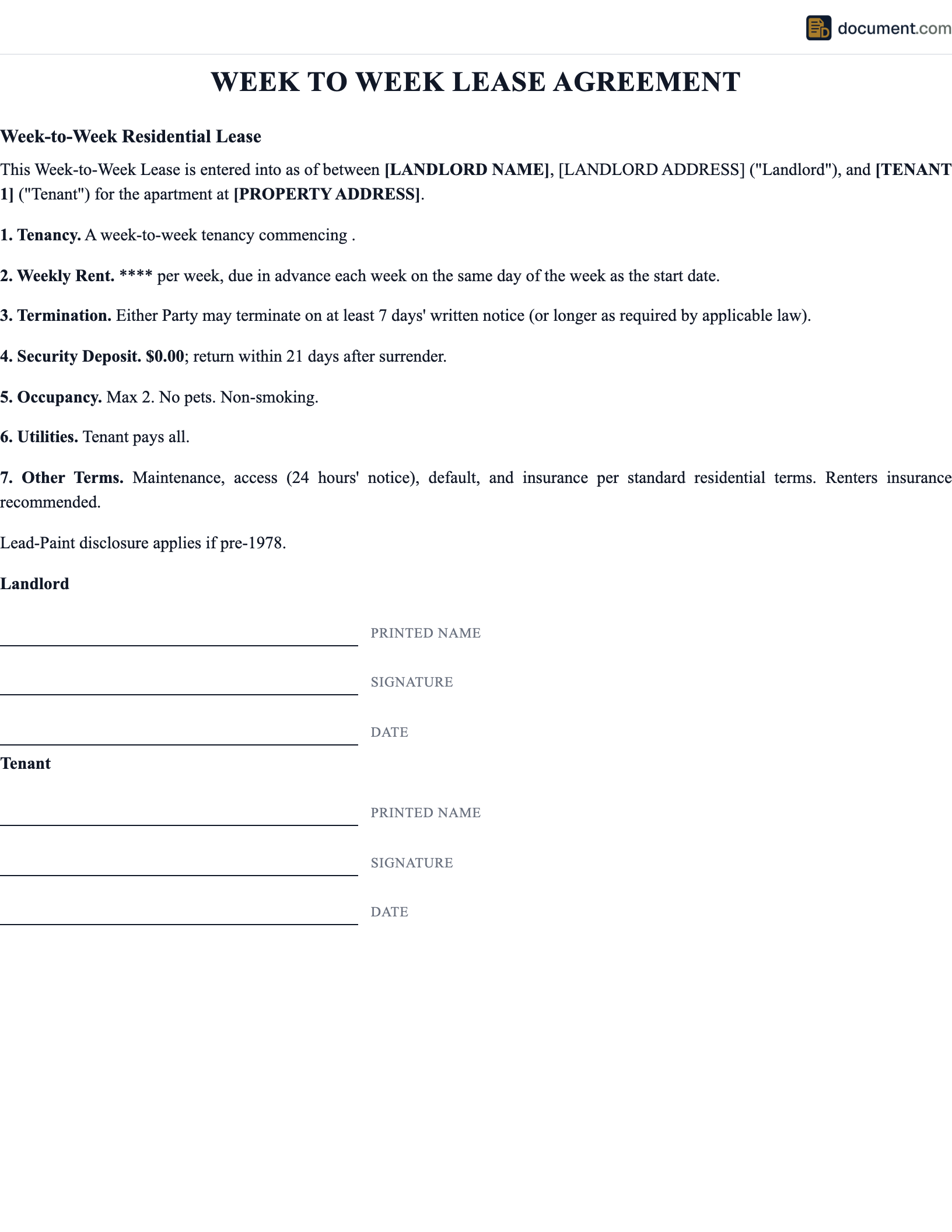



Colorado Week-to-Week Lease Overview
Colorado's rental landscape spans dense urban corridors along the Front Range — Denver, Aurora, Colorado Springs, Fort Collins — and seasonal resort economies in mountain towns like Aspen, Vail, Breckenridge, and Telluride. Week-to-week leases serve both ends of that spectrum: providing flexible short-term housing for seasonal ski industry workers, construction crews on Front Range development projects, military families arriving at Fort Carson or Buckley Space Force Base, and university students in Boulder or Fort Collins who need a bridge between semesters.
Colorado's landlord-tenant framework, anchored in C.R.S. §38-12-101 et seq., applies uniformly to all residential tenancies regardless of duration. A weekly tenant in a Denver studio has the same statutory protections as a family on a twelve-month lease in Lakewood. But Colorado's recent legislative wave — including the Warranty of Habitability Act reforms, HB 21-1121 late fee caps, and expanded eviction notice timelines — has changed the compliance picture substantially. Landlords who drafted their weekly lease templates before 2021 are almost certainly using outdated terms that could expose them to statutory penalties.
This page covers the specific Colorado statutes, disclosure rules, deposit regulations, and eviction procedures that apply to week-to-week tenancies. Because Colorado imposes no statutory cap on security deposits but allows treble damages for wrongful withholding, and because the state's rent control preemption means weekly landlords can raise rent freely, the lease document itself is the primary tool for setting clear expectations between the parties.
7 days
Notice Period
No cap
Security Deposit
3× damages
Wrongful Withholding
$50 / 5%
Late Fee Cap
Termination & Notice Under C.R.S. §13-40-107
Colorado's primary eviction and termination statute, C.R.S. §13-40-107, addresses notice requirements for periodic tenancies. For month-to-month tenancies, the statute explicitly requires written notice of at least one rental period. For weekly tenancies, Colorado courts apply the same one-rental-period principle — meaning seven days' written notice is required to terminate a week-to-week lease. The notice must be delivered before the start of the next weekly rental cycle.
Because the statute is less explicit about sub-monthly tenancies than some other states' laws, Colorado practitioners strongly recommend writing the exact notice period into the lease agreement itself. A clause stating “Either party may terminate this weekly tenancy by providing seven (7) days' written notice prior to the start of the next rental period” eliminates any ambiguity that could arise in a county court proceeding.
Notice should be delivered by one of the methods recognized under Colorado law: personal service, posting on the premises and mailing a copy, or any method the lease specifically authorizes. Email notice alone, without a lease provision permitting it, may not satisfy Colorado's delivery requirements. For landlords managing weekly rentals in resort areas where tenants may be transient, maintaining a reliable delivery method in the lease is critical.
Colorado Security Deposit Rules for Weekly Leases
Colorado's security deposit statute, C.R.S. §38-12-103, is unusual among U.S. states in two ways: it sets no maximum deposit amount, and it imposes treble damages for wrongful withholding. For a week-to-week lease, this creates a high-stakes dynamic. A landlord can collect two weeks' rent, a full month's rent, or any amount the tenant agrees to — but if the landlord fails to return the deposit properly, the financial exposure is three times the withheld amount plus the tenant's attorney fees.
The return deadline is one month after the tenant surrenders possession and the lease terminates, unless the lease extends the period to 60 days. For weekly tenancies with high turnover, landlords should build an efficient inspection-and-return workflow. The landlord must provide a written, itemized statement of any deductions, identifying each damaged item and its repair cost. Generic deductions like “cleaning fee — $200” without specifics invite disputes.
SB 21-173 added another layer: for leases of twelve months or longer, landlords must pay interest on security deposits at the rate set by the State Treasurer. While this provision does not apply to most weekly tenancies (which rarely extend a full year), landlords who retain a weekly tenant for an extended period through successive renewals should track whether the cumulative tenancy triggers the interest requirement.
Treble Damage Risk
If a Colorado landlord willfully retains a security deposit or fails to provide the required itemized statement within the statutory deadline, the tenant can sue under C.R.S. §38-12-103(3) for three times the amount wrongfully withheld, plus reasonable attorney fees and court costs. For a $1,500 deposit, that exposure could reach $4,500 plus legal costs. Always document property condition with timestamped photos at move-in and move-out, and mail the itemized statement via certified mail to create a paper trail.
Colorado Warranty of Habitability Act
The Warranty of Habitability Act, C.R.S. §38-12-501 et seq., was enacted in 2008 and underwent major strengthening in 2019. It applies to every residential rental in Colorado, including week-to-week arrangements. The Act prohibits lease clauses that waive a tenant's right to habitable conditions — a provision that directly affects weekly leases, where landlords might otherwise argue that the short-term nature of the arrangement limits their repair obligations.
Habitability conditions that landlords must maintain include working heating, plumbing, hot water, electricity, and sanitation systems; structural integrity of walls, floors, and roofs; and compliance with applicable building and housing codes. In Colorado's mountain communities, where winter temperatures routinely drop below zero, heating system failures can constitute an emergency habitability violation. The 2019 amendments gave tenants the right to withhold rent after providing written notice if the landlord fails to address material habitability defects within a reasonable time, and established that retaliation against a tenant who reports violations is prohibited.
For weekly rentals at high altitude — properties in Leadville (10,152 ft), Breckenridge (9,600 ft), or Telluride (8,750 ft) — landlords face additional practical habitability considerations. Frozen pipes, inadequate insulation, and malfunctioning wood-burning or pellet stoves can rapidly make a dwelling uninhabitable. Weekly lease agreements in these areas should identify the specific heating system, outline the tenant's obligations for basic maintenance (such as keeping the thermostat above a minimum temperature to prevent pipe freezing), and provide the landlord's emergency repair contact.
Fees, Late Charges & Colorado's Rent Control Preemption
Colorado's HB 21-1121 capped late fees at $50 or 5% of the past-due rent, whichever is greater, effective for leases entered into or renewed after the law took effect. This cap applies to weekly leases. For a weekly rent of $600, the maximum late fee would be $50 (since 5% of $600 equals $30, which is below the $50 floor). Landlords cannot impose the late fee until at least one day after rent is due, and any lease clause setting a higher fee is void.
On the rent-increase side, Colorado's rent control preemption under C.R.S. §38-12-301 prevents any municipality from enacting rent caps or rent stabilization ordinances. This gives weekly landlords broad discretion to adjust rent at each renewal period. In practice, this means a landlord in Denver's Capitol Hill neighborhood or Boulder's University Hill could raise rent every seven days with proper notice. Tenants negotiating a weekly lease should consider asking for a clause that limits rent increases to a fixed percentage per renewal or requires a longer notice period before any increase takes effect.
| Item | Colorado Rule |
|---|---|
| Termination Notice | 7 days (one rental period) |
| Security Deposit Cap | None — no statutory limit (C.R.S. §38-12-103) |
| Deposit Return Deadline | 1 month (or 60 days if lease specifies) |
| Wrongful Withholding Penalty | Treble damages + attorney fees |
| Late Fee Cap (HB 21-1121) | $50 or 5% of past-due rent, whichever is greater |
| Rent Control | Preempted statewide (C.R.S. §38-12-301) |
| Lead Paint Disclosure | Required for pre-1978 properties (federal) |
| Meth Contamination Disclosure | Required (state law) |
Required Disclosures for Colorado Weekly Rentals
Colorado imposes several disclosure obligations that apply to all residential tenancies, including week-to-week leases. Some are unique to Colorado's geography and history, making them easy to overlook if you're working from a generic multi-state lease template.
- Lead-based paint (federal): For any dwelling built before 1978, the landlord must provide the EPA lead hazard pamphlet and disclose known lead paint. Many older properties in Denver's Capitol Hill, Park Hill, and Five Points neighborhoods fall into this category.
- Methamphetamine contamination: Colorado law requires disclosure if a property was previously used as a meth lab or has tested positive for meth contamination. Properties that exceed state contamination thresholds must be professionally remediated before re-renting.
- Water supply source: For properties served by a private well rather than a municipal system, the landlord must disclose the source of the water supply. This is common in rural areas of the Eastern Plains, mountain properties outside town limits, and unincorporated parts of counties like Park, Teller, and Grand.
- Marijuana use: Although recreational marijuana is legal in Colorado, landlords have no obligation to permit its use on rental property. A weekly lease should clearly state whether marijuana smoking, vaping, or cultivation is prohibited, as the default under most insurance policies makes the landlord liable for fire or damage claims.
- Radon: Colorado has some of the highest radon levels in the nation, particularly along the Front Range and in mountain communities. While not a mandatory disclosure at the state level for rentals, the Colorado Department of Public Health and Environment recommends testing, and some municipalities have adopted local radon disclosure requirements.
Forcible Entry & Detainer: Colorado's Eviction Process
Evicting a weekly tenant in Colorado follows the Forcible Entry and Detainer (FED) process governed by C.R.S. §13-40-101 et seq. The process varies depending on the reason for eviction. For nonpayment of rent, the landlord must serve a written Demand for Compliance or Possession giving the tenant ten days to pay or vacate — a timeline extended from three days by HB 21-1117. For a substantial lease violation other than nonpayment, the landlord may serve a notice giving the tenant a reasonable time to cure the violation, or an unconditional notice if the violation is severe.
If the tenant does not comply with the demand, the landlord files an FED complaint in county court. Colorado requires at least seven days between the filing and the hearing. If the court enters judgment for the landlord, a writ of restitution is issued, and the county sheriff's office executes the physical removal. Landlords cannot engage in self-help evictions — changing locks, removing the tenant's belongings, or shutting off utilities — under C.R.S. §38-12-510. Doing so exposes the landlord to liability for actual damages plus attorney fees.
In Denver, Colorado Springs, and other high-volume jurisdictions, the FED docket is heavily scheduled. From the initial demand through sheriff enforcement, the process typically takes three to five weeks. Landlords operating weekly rentals with frequent tenant turnover should factor this timeline into their risk assessment — a non-paying weekly tenant can occupy the property for nearly a month during the legal process, and the lost rent may exceed the security deposit collected.
Resort & Ski Town Weekly Rentals in Colorado
Colorado's ski and resort economy creates a distinctive market for week-to-week leases. Towns like Aspen (Pitkin County), Vail (Eagle County), Breckenridge (Summit County), Telluride (San Miguel County), and Steamboat Springs (Routt County) see massive seasonal influxes of workers and visitors who need flexible short-term housing. During peak ski season, weekly rental demand far outstrips supply, and landlords may command premiums that are multiple times the off-season rate.
Local regulations add complexity. Many mountain municipalities have adopted short-term rental licensing requirements and impose lodging or accommodations taxes on stays shorter than 30 days. If a weekly lease in Breckenridge is structured more like a vacation rental — fully furnished, utilities included, no permanent resident — the town may classify it as a short-term rental subject to licensing, local taxes, and occupancy limits rather than a standard residential tenancy under state landlord-tenant law.
Military installations across Colorado also generate substantial weekly rental demand. Fort Carson (Colorado Springs), Buckley Space Force Base (Aurora), Peterson Space Force Base (Colorado Springs), Schriever Space Force Base (Colorado Springs), and the U.S. Air Force Academy all bring personnel who need temporary housing during PCS moves, training rotations, or TDY assignments. These tenants are protected by the federal Servicemembers Civil Relief Act (SCRA), which allows active-duty members to terminate a residential lease early with 30 days' written notice after receiving PCS or deployment orders. A well-drafted Colorado weekly lease should acknowledge SCRA rights to avoid disputes.
Official Colorado Resources
Verify current Colorado Revised Statutes, access tenant rights guides, and find local court information through these official state resources.
Other Colorado Lease Agreement Types
Week-to-week leases suit short-term and transitional situations, but Colorado landlords and tenants may need other arrangements depending on their circumstances.
Colorado Residential Lease
Fixed-term lease with full C.R.S. §38-12 compliance
Colorado Month-to-Month Lease
Periodic tenancy with one full rental period notice
Colorado Sublease Agreement
Transfer possession while retaining primary lease liability
Colorado Roommate Agreement
Shared-living terms for co-tenants in Boulder, Denver, and beyond
Colorado Week-to-Week Lease FAQ
Answers to common questions about Colorado weekly lease law, covering C.R.S. deposit rules, the Warranty of Habitability Act, recent legislative changes, and resort-town rental regulations.
Create your Colorado Week To Week Lease Agreement in under 5 minutes.
Answer a few questions and download a Colorado-compliant document, ready for the state agency.