
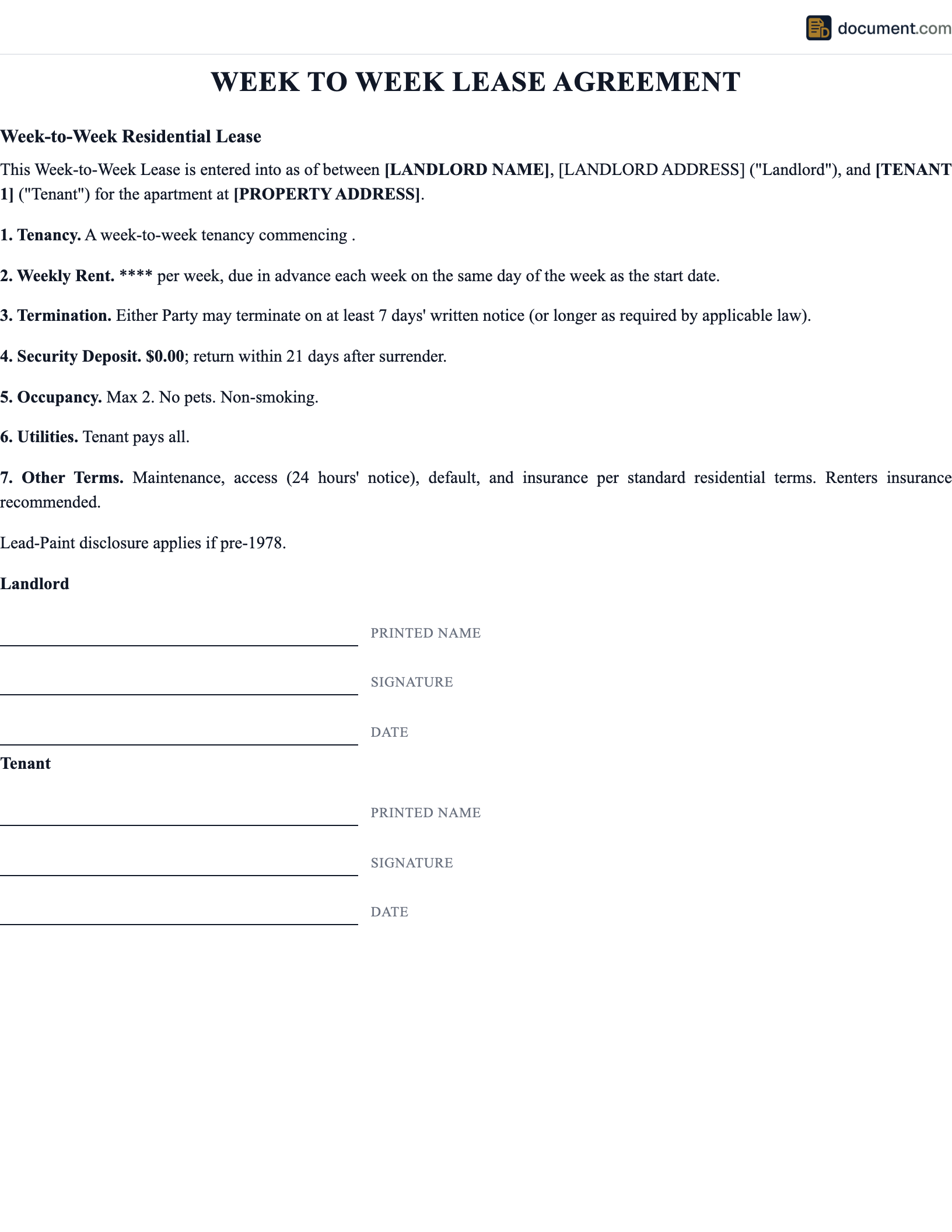



Alaska URLTA Weekly Tenancy Framework
Alaska adopted its version of the Uniform Residential Landlord and Tenant Act in AS §34.03.010 et seq., and that statute governs every residential tenancy in the state — including week-to-week arrangements. Weekly leases occupy a distinct niche in Alaska's rental market because the state's economy generates outsized demand for short-duration housing. Commercial fishing crews flooding into Kodiak, Dillingham, and Bristol Bay each summer need a place to sleep between runs. Oil field workers rotating through Prudhoe Bay, Deadhorse, and the North Slope often rent by the week in Fairbanks or Anchorage during their off-rotations. Military service members arriving at Joint Base Elmendorf-Richardson (JBER), Eielson Air Force Base near Fairbanks, or Fort Wainwright frequently use weekly leases while waiting for permanent housing assignments.
Beyond the workforce drivers, Alaska's geography creates practical realities that make weekly tenancies essential. Remote communities accessible only by bush plane or ferry — places like Bethel, Nome, Barrow (Utqiaġvik), and Unalaska — often have extremely limited housing stock. Weekly arrangements give both landlords and tenants the flexibility to respond to rapidly changing conditions, whether that means a fishing season ending early due to poor returns or a construction project extending into freeze-up. Despite the short-term nature of these leases, the full weight of Alaska's URLTA applies: landlords must maintain habitable premises, follow lawful eviction procedures through the court system, and respect deposit return timelines.
7 days
Termination Notice (AS §34.03.290)
2 months
Deposit Cap (1 mo. if rent > $2k)
No rent control
Statewide — No Municipal Cap
24-hour notice
Landlord Entry (AS §34.03.140)
Landlord Obligations & Habitability Under Alaska Law
Termination Notice Under AS §34.03.290(b)
AS §34.03.290(b) sets the termination framework for periodic tenancies in Alaska. For a week-to-week lease, the statute requires written notice at least equal to the interval between rent payments — a minimum of 7 days. The notice must be delivered before the start of the next weekly rental period. Neither party can unilaterally shorten this notice window through a lease clause, because URLTA treats it as a statutory floor. In practice, landlords in Anchorage or Fairbanks typically hand-deliver notices, but in remote communities where tenants may be at a fish camp or on the Slope, landlords should document alternative delivery methods carefully to avoid disputes about whether notice was properly served.
Habitability and Heating Requirements
AS §34.03.100 requires landlords to maintain rental premises in a condition fit for human habitation. In most states, this means working plumbing, electrical systems, and structural soundness. In Alaska, the practical stakes of habitability are dramatically higher. Fairbanks sees average January temperatures of -17°F, and communities north of the Arctic Circle like Utqiaġvik can remain below -20°F for weeks. A heating system failure in an Alaska winter is not a maintenance inconvenience — it is a life-threatening emergency that can cause frozen pipes, structural damage, and genuine danger to occupants. Weekly landlords must ensure heating equipment is inspected and operational before each tenancy begins. The landlord is also responsible for adequate insulation and weatherproofing, functioning smoke and carbon monoxide detectors (critical with fuel-oil heating systems common in rural Alaska), and compliance with local building codes that may impose stricter energy-efficiency standards in cold-climate zones.
Required Landlord Disclosures
Under AS §34.03.080, every Alaska landlord — including those offering weekly rentals — must disclose the name and address of the person authorized to manage the premises and to accept service of process and legal notices on the landlord's behalf. This is especially important in Alaska where out-of-state property investors may own rental units in Anchorage, Juneau, or the Mat-Su Valley but manage them through local agents. Additionally, federal law (42 U.S.C. §4852d) requires lead-based paint disclosure for any dwelling built before 1978. Many older buildings in downtown Juneau, Fairbanks' historic core, and Anchorage's original neighborhoods fall into this category.
Security Deposit Rules Under AS §34.03.070
Alaska's deposit statute contains a tiered cap that many landlords overlook. Under AS §34.03.070, the security deposit for any residential tenancy — including a week-to-week lease — is limited to two months' rent. However, if the monthly-equivalent rent exceeds $2,000, the cap drops to just one month's rent. For weekly landlords, this means calculating the monthly equivalent: a weekly rent of $600 translates to roughly $2,600 per month, which triggers the lower one-month cap. This tiered structure particularly affects furnished weekly rentals in Anchorage's midtown corridor and near JBER, where weekly rents for furnished units can easily push past the $500/week threshold.
After the tenant vacates, the landlord has 14 days to return the deposit if the tenant provides a written forwarding address, or 30 days if no forwarding address is given. The return must include an itemized statement of any deductions — typically for damages beyond normal wear and tear, unpaid rent, or cleaning costs that exceed ordinary turnover cleaning. Given the high turnover inherent in weekly leases, Alaska landlords should conduct thorough move-in and move-out inspections with photographic documentation. Courts in Anchorage and Fairbanks have consistently held landlords to strict compliance with AS §34.03.070's return timeline, and failure to return the deposit on time can result in the landlord forfeiting the right to claim any deductions.
Alaska Deposit Return Deadlines
The 14-day and 30-day return windows under AS §34.03.070 are strict. For weekly tenancies with rapid turnover, landlords should process inspections and deposit returns immediately after move-out. In remote communities where mail delivery can take a week or more, factor postal transit time into the deadline — the deposit must be postmarked or delivered within the statutory window, not merely calculated from when the landlord gets around to it. Keeping a pre-addressed, stamped envelope ready for each weekly tenant's deposit return is a practical safeguard.
7-Day Termination Notice & Eviction Process
Ending a week-to-week tenancy in Alaska requires strict adherence to the notice rules in AS §34.03.290(b). The 7-day written notice must be delivered before the next rental period begins. Landlords cannot rely on a text message or verbal conversation alone — Alaska courts require written notice that clearly identifies the premises, the termination date, and the reason (if the termination is for cause). For non-payment of weekly rent, the landlord must serve a separate 7-day notice to pay or quit under AS §34.03.220(b) before initiating eviction proceedings.
Delivery logistics present unique challenges in Alaska. In Anchorage and Fairbanks, personal service or posting on the door is straightforward. But for weekly rentals in remote areas — fishing lodges near Dillingham, oil-worker housing in Kenai, or cabins outside Juneau accessible only by floatplane — landlords need a documented delivery method. Certified mail is reliable where USPS delivers, but some Alaska communities rely on bush-plane mail drops that arrive only a few times per week. In those cases, landlords should consider designating an on-site manager authorized to hand-deliver notices, and the lease should specify an agreed-upon notice delivery method.
- Written 7-day notice required under AS §34.03.290(b) — verbal notice is insufficient
- Non-payment eviction requires separate 7-day pay-or-quit notice (AS §34.03.220(b))
- Self-help eviction — lock changes, utility shutoffs, property removal — is prohibited (AS §34.03.210)
- Unlawful detainer must be filed in Alaska District Court if tenant does not vacate after proper notice
- In remote areas, specify a notice delivery method in the lease to avoid service-of-process disputes
Alaska Weekly Lease Fees, Limits & Disclosures
| Item | Alaska Rule |
|---|---|
| Termination Notice | 7 days written (AS §34.03.290(b)) |
| Security Deposit Cap | 2 months' rent; 1 month if rent exceeds $2,000/mo (AS §34.03.070) |
| Deposit Return Deadline | 14 days with forwarding address; 30 days without |
| Rent Control | None — no statewide or municipal caps |
| Late Fees | No statutory cap; must be reasonable |
| Landlord Entry Notice | 24 hours minimum (AS §34.03.140) |
| Non-Payment Eviction Notice | 7-day pay-or-quit (AS §34.03.220(b)) |
| Lead Paint Disclosure | Required for pre-1978 properties (federal) |
| Manager/Agent Disclosure | Required — name & address (AS §34.03.080) |
Other Alaska Lease Agreement Types
A weekly lease may not suit every rental situation in Alaska. Longer-term tenancies carry different notice periods and may better serve tenants who plan to stay through an entire winter or beyond a single fishing season. Each of these Alaska-specific templates is built around the same URLTA framework.
Alaska Week-to-Week Lease FAQ
Common questions about weekly rental law in Alaska, answered with references to the specific URLTA statutes that apply.
Create your Alaska Week To Week Lease Agreement in under 5 minutes.
Answer a few questions and download a Alaska-compliant document, ready for the state agency.