



West Virginia Commercial Sublease Agreement Overview
A commercial sublease in West Virginia involves an existing tenant (the sublessor) re-renting all or part of their commercial space to a third party (the subtenant) for a period within the original prime lease term. West Virginia has no commercial sublease statute. The rights of all three parties, the landlord, the sublessor, and the subtenant, are governed entirely by the prime lease and the sublease agreement. Getting both documents right is the entire protection available to each party.
Commercial sublease activity in West Virginia tends to be concentrated in the state's office markets, particularly in Charleston, the state's capital and largest commercial hub. When businesses downsize or close, subleasing excess office space is often the quickest way to reduce occupancy costs. West Virginia's lower commercial rents mean that subleased space rarely generates a significant premium over the prime lease rate, making sublease economics more constrained than in higher-cost states.
All parties in a West Virginia commercial sublease have distinct risk exposures. The landlord wants to know the new occupant is creditworthy. The sublessor wants to reduce carrying costs while retaining the right to resume occupation if needed. The subtenant needs protection against losing the space if the sublessor defaults on the prime lease. A carefully structured sublease and, ideally, a landlord non-disturbance agreement address all three concerns.
Consent
Required from landlord
Full liability
Original tenant retains
No privity
Subtenant vs. landlord
Contract
Governs all terms
West Virginia Commercial Sublease Requirements
West Virginia commercial sublease law is contract law. There is no statute that creates default subletting rights for commercial tenants. Whether subleasing is permitted, what the consent process requires, and how the sublease must be structured all come from the prime lease document. Before approaching any prospective subtenant, the sublessor must read the assignment and subletting section of the prime lease thoroughly.
West Virginia Landlord Consent and Original Tenant Liability
West Virginia commercial subleases require written landlord consent per the prime lease terms. The original tenant remains fully liable to the landlord for rent and all other prime lease obligations regardless of the sublease. A subtenant default does not reduce the sublessor's liability to the landlord. The landlord can pursue the original tenant for unpaid rent even while the subtenant is occupying the space.
Sublessor (Original Tenant) Obligations
- Obtain Written Landlord Consent: West Virginia commercial prime leases almost always require written consent before subleasing; proceeding without it constitutes a default
- Continue Paying Prime Lease Rent: The sublessor must continue making prime lease payments on schedule regardless of whether the subtenant pays the sublease rent
- Screen the Subtenant: Conduct financial due diligence on the proposed subtenant before submitting the consent request to the landlord; West Virginia landlords have the right to reject financially unqualified subtenants
- Provide Prime Lease to Subtenant: The subtenant should receive a full copy of the prime lease and understand all the obligations that flow through to them under the sublease
Subtenant Obligations and Risks
- Pay Sublease Rent: Pay the agreed sublease rent to the sublessor on time; non-payment may trigger the sublessor to default on the prime lease, creating risk for the subtenant's occupancy
- Comply with Prime Lease Terms: The subtenant must observe all use restrictions and conduct requirements in the prime lease, not just the sublease document
- Understand Prime Lease Termination Risk: If the sublessor defaults and the prime lease is terminated, the sublease terminates too; seek a non-disturbance agreement from the West Virginia landlord to protect occupancy
- Vacate at Sublease End: The sublease cannot extend beyond the prime lease term; the subtenant must vacate at the agreed end date without exception
How to Prepare a West Virginia Commercial Sublease Agreement
A West Virginia commercial sublease involves three parties and two layered documents. These four steps cover the process from prime lease review through execution.
Review the Prime Lease and Obtain Landlord Consent
Read the prime lease assignment and subletting provisions before approaching any prospective subtenant. Identify whether consent is required, what criteria the landlord can apply when reviewing the proposed subtenant, and whether any fee is charged for consent processing. Submit the proposed subtenant's information to the West Virginia landlord in writing and secure written consent before signing any sublease commitment.
Draft the Sublease to Incorporate the Prime Lease
The sublease should identify all three parties, describe the subleased premises, set the sublease term and rent, and incorporate the prime lease by reference. Identify which prime lease obligations pass through to the subtenant and which remain solely the sublessor's responsibility. Attach the landlord consent letter and a full copy of the prime lease as exhibits to the sublease.
Address Prime Lease Termination Risk
For subleases longer than one year or where the subtenant is making improvements to the space, negotiate a non-disturbance agreement with the West Virginia landlord. This protects the subtenant's right to remain in the space if the sublessor defaults and the prime lease is terminated. Without this protection, the subtenant could lose the space with minimal notice.
Execute and Distribute Fully Signed Copies
The sublessor and subtenant both sign the sublease. Provide a fully executed copy to the landlord. Retain originals for all parties. If a non-disturbance agreement was negotiated, all three parties sign that document as well. Both the sublessor and subtenant should store copies of the prime lease, the consent letter, and the sublease throughout the sublease term.
West Virginia Commercial Sublease Fees and Costs
Costs in a West Virginia commercial sublease transaction come from multiple sources. The table below covers the main cost items for both sublessors and subtenants.
| Cost Item | Typical Range |
|---|---|
| Sublease Rent (West Virginia commercial) | $8 - $22 per sq ft per year (market-dependent) |
| Security Deposit | 1 - 2 months' sublease rent (negotiated) |
| Landlord Consent Processing Fee | $500 - $1,500 (if charged by West Virginia landlord) |
| Attorney Review (West Virginia) | $750 - $2,500 (sublessor or subtenant counsel) |
| Tenant Improvement Allowance (if negotiated) | Varies by space condition and sublease term |
Sample West Virginia Sublease Agreement
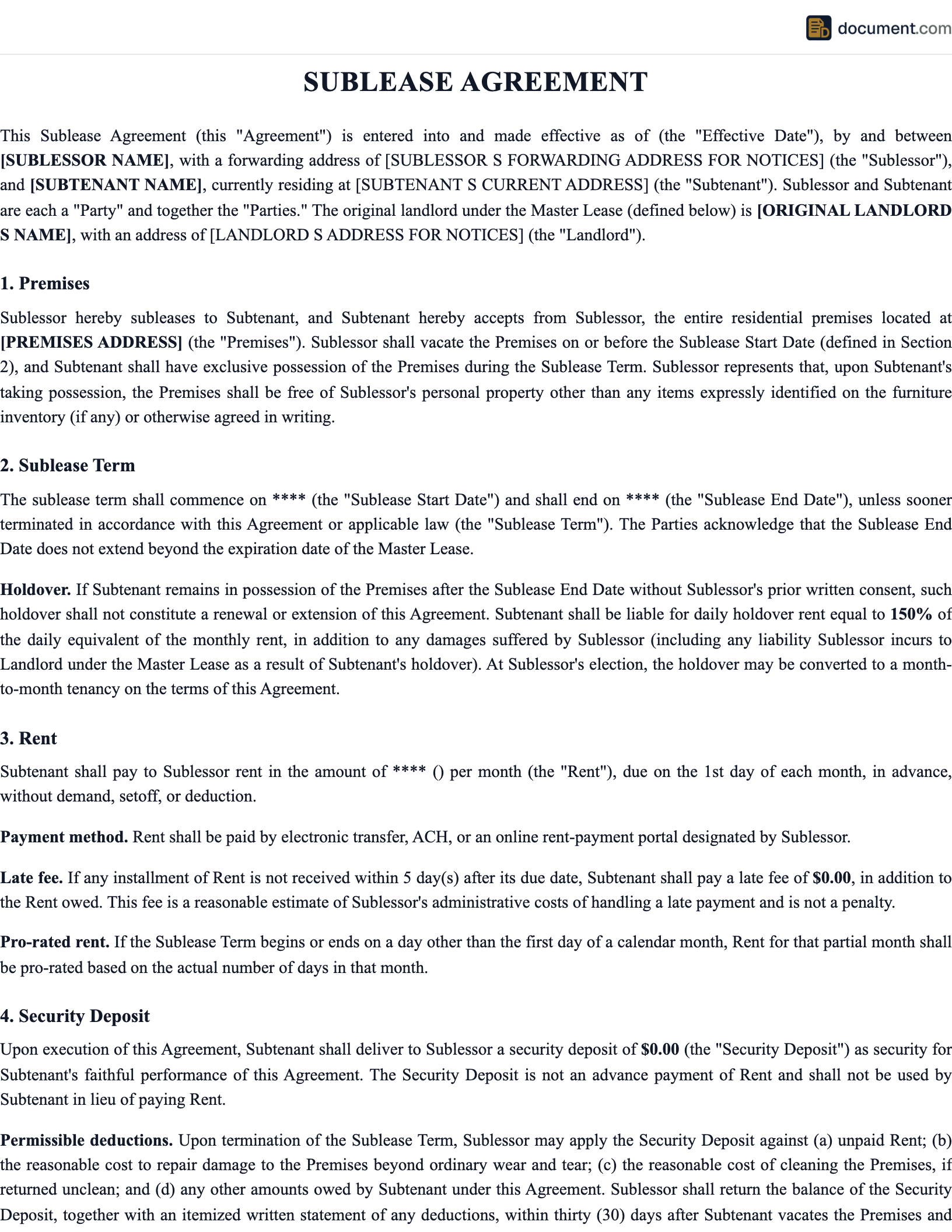
Below is a preview of our West Virginia-specific sublease agreement. Your customized document will include all provisions required under WV law.
STATE OF WEST VIRGINIA
SUBLEASE AGREEMENT
Residential Subletting Contract
SUBLESSOR (Original Tenant):
Name: [Sublessor Name]
Address: [West Virginia Address]
SUBLESSEE (New Occupant):
Name: [Sublessee Name]
Current Address: [Address]
SUBLEASE TERMS
Start Date: [Date]
End Date: [Date]
Monthly Rent: $[Amount]
Security Deposit: $[Amount]
West Virginia Sublease Agreement FAQ
Answers to common questions about sublease agreements in West Virginia.
Other West Virginia Lease Agreement Templates
Need a different type of lease agreement for West Virginia? We offer state-specific templates for every type of rental arrangement.
West Virginia Residential Lease
Standard rental agreements
West Virginia Month-to-Month Lease
Flexible short-term rentals
West Virginia Vacation Rental
Short-term vacation properties
West Virginia Commercial Lease
Business and retail spaces
West Virginia Roommate Agreement
Shared living arrangements
West Virginia Rent-to-Own
Lease with purchase option
West Virginia Equipment Lease
Equipment rental agreements
West Virginia Land Lease
Land rental agreements
West Virginia Room Rental
Individual room rentals
Create your West Virginia Sublease Lease Agreement in under 5 minutes.
Answer a few questions and download a West Virginia-compliant document, ready for the state agency.