



Texas Sublease Agreement Overview
A Texas sublease is a contract between a current tenant (the sublessor) and a new occupant (the subtenant) for use of leased space during a period within the remaining term of the original lease. Texas has no statute specifically governing subletting rights for commercial or residential leases. The prime lease controls whether subletting is allowed at all, and the sublease agreement itself governs the relationship between the sublessor and the subtenant.
Texas has active sublease markets in Dallas-Fort Worth, Houston, Austin, and San Antonio. On the commercial side, rapid growth and corporate expansions produce tenants who outgrow spaces mid-lease and need to sublet to avoid carrying vacant square footage. Austin's technology sector, Houston's energy industry, and the DFW financial and logistics markets all generate significant commercial sublease activity. On the residential side, Texas's large military presence and high residential mobility in its fast-growing metros create consistent subletting demand.
The most important structural feature of a Texas sublease is the absence of privity between the subtenant and the original landlord. The subtenant's only legal relationship is with the sublessor. This creates risk for both sides: the sublessor remains on the hook to the landlord regardless of what the subtenant does, and the subtenant has no direct rights against the landlord if the prime lease is terminated for reasons outside the subtenant's control.
Per lease
Subletting default
Yes
Consent required
Yes
Tenant remains liable
No statutory
Deposit rules
Texas Subletting Laws
Texas subletting is entirely contract-driven. There is no Texas statute that grants a tenant the right to sublet or that limits a landlord's ability to refuse consent. Understanding what the prime lease says and what the no-privity rule means for both the sublessor and the subtenant is more important than any general Texas legal principle.
Texas No-Privity Rule and Subtenant Risk
In Texas, a subtenant has no direct legal relationship with the original landlord. The landlord cannot sue the subtenant for unpaid rent, and the subtenant cannot enforce the landlord's maintenance and quiet enjoyment obligations against the landlord directly. If the prime lease is terminated because the sublessor defaults, the subtenant loses the right to occupy the space even if they have done nothing wrong. Texas commercial subtenants in DFW, Houston, or Austin should request a non-disturbance agreement from the landlord to protect against this risk.
Sublessor Obligations and Risks
- Obtain Written Landlord Consent: Texas prime leases almost universally require written landlord consent before any subletting; subletting without consent is a lease breach that can result in eviction of the sublessor
- Continued Liability to Landlord: The sublessor remains fully liable for all prime lease obligations including rent, maintenance, and compliance even after subletting to a Texas subtenant
- Subtenant Default Exposure: If the subtenant defaults, the sublessor must continue paying the landlord; screen Texas subtenants carefully and collect a security deposit sized to cover realistic default scenarios
- Prime Lease Compliance: Any sublease provision that conflicts with the prime lease terms is unenforceable; the sublease term cannot extend beyond the prime lease expiration
Subtenant Risks in Texas
- Sublessor Default Risk: If the sublessor fails to pay the landlord and the prime lease is terminated, the subtenant loses the right to occupy regardless of whether they have been current on sublease payments
- No Direct Landlord Relationship: The subtenant cannot enforce the landlord's obligations under the prime lease; rights flow only through the sublessor
- Non-Disturbance Agreement: Texas commercial subtenants in major DFW, Houston, or Austin office or retail properties should negotiate a non-disturbance agreement with the landlord, which protects the sublease from termination if the prime lease ends through no fault of the subtenant
- Term Limitations: The sublease cannot exceed the prime lease expiration date; verify the prime lease term and any renewal or extension rights before accepting a sublease in Texas
How to Fill Out a Texas Sublease Agreement
A Texas sublease involves three parties, two legal relationships, and a no-privity gap that both sides need to understand before the documents are signed. Working through the process in the right order avoids problems that are difficult to fix after the sublease is executed.
Review the Prime Lease and Seek Landlord Consent
Read the prime lease before contacting any prospective subtenant. Confirm whether subletting is permitted, what conditions apply, and what standard governs the landlord's right to consent. Submit a written consent request to the Texas landlord with the proposed subtenant's information and intended use. For commercial subleases in Dallas, Houston, or Austin, evaluate at this stage whether it is worth requesting a non-disturbance agreement from the landlord to protect the subtenant against prime lease termination risk.
Screen the Proposed Subtenant
The sublessor carries the full financial risk if the subtenant defaults, because the sublessor must continue paying the landlord under the prime lease regardless. Screen the subtenant's income, credit history, and references before drafting anything. For commercial Texas subleases in DFW or Houston, review the business's financial statements, intended use, and compliance with the prime lease use restrictions. Size the security deposit to cover at least two to three months of exposure.
Draft the Sublease Agreement
Include full legal names of sublessor, sublessee, and landlord; the property address; sublease start and end dates that do not exceed the prime lease expiration; monthly rent and payment terms; security deposit procedures; utility allocation; and the subtenant's obligation to comply with all applicable prime lease terms. Attach the prime lease and landlord consent letter as exhibits. Include a Texas-compliant default and notice provision that defines what happens if the subtenant fails to pay or vacate.
Execute, Document Condition, and Distribute
Both sublessor and sublessee sign and date the agreement. Texas subleases do not require notarization to be enforceable between the parties. Conduct a documented move-in inspection with photos to establish the condition of the premises. Distribute executed copies to both parties and the landlord. For commercial subleases in Texas exceeding one year, consider filing a memorandum of sublease with the county clerk to create a public record of the subtenant's possessory interest.
Landlord Consent for Subletting in Texas
Texas treats subletting as a contract matter. The table below summarizes the key rules that Texas sublessors and subtenants need to understand before entering into a sublease.
| Topic | Texas Rule |
|---|---|
| Statutory Subletting Right | No general statutory right to sublet; the Texas Property Code does not address subletting; the prime lease controls |
| Landlord Consent Standard | Depends on lease language; landlord may have sole discretion to withhold consent unless the lease specifies a reasonableness standard |
| Original Tenant Liability | Sublessor remains fully liable for all prime lease obligations after sublease is executed; no relief from liability without landlord agreement |
| Privity Between Subtenant and Landlord | No privity; landlord cannot collect rent from subtenant directly; subtenant cannot enforce landlord's prime lease obligations |
| Non-Disturbance Protection | Not automatic; commercial Texas subtenants should negotiate a non-disturbance agreement with the landlord to protect against prime lease termination |
| Security Deposit Cap | No statutory cap on security deposits in Texas subleases; amount is negotiated between sublessor and subtenant |
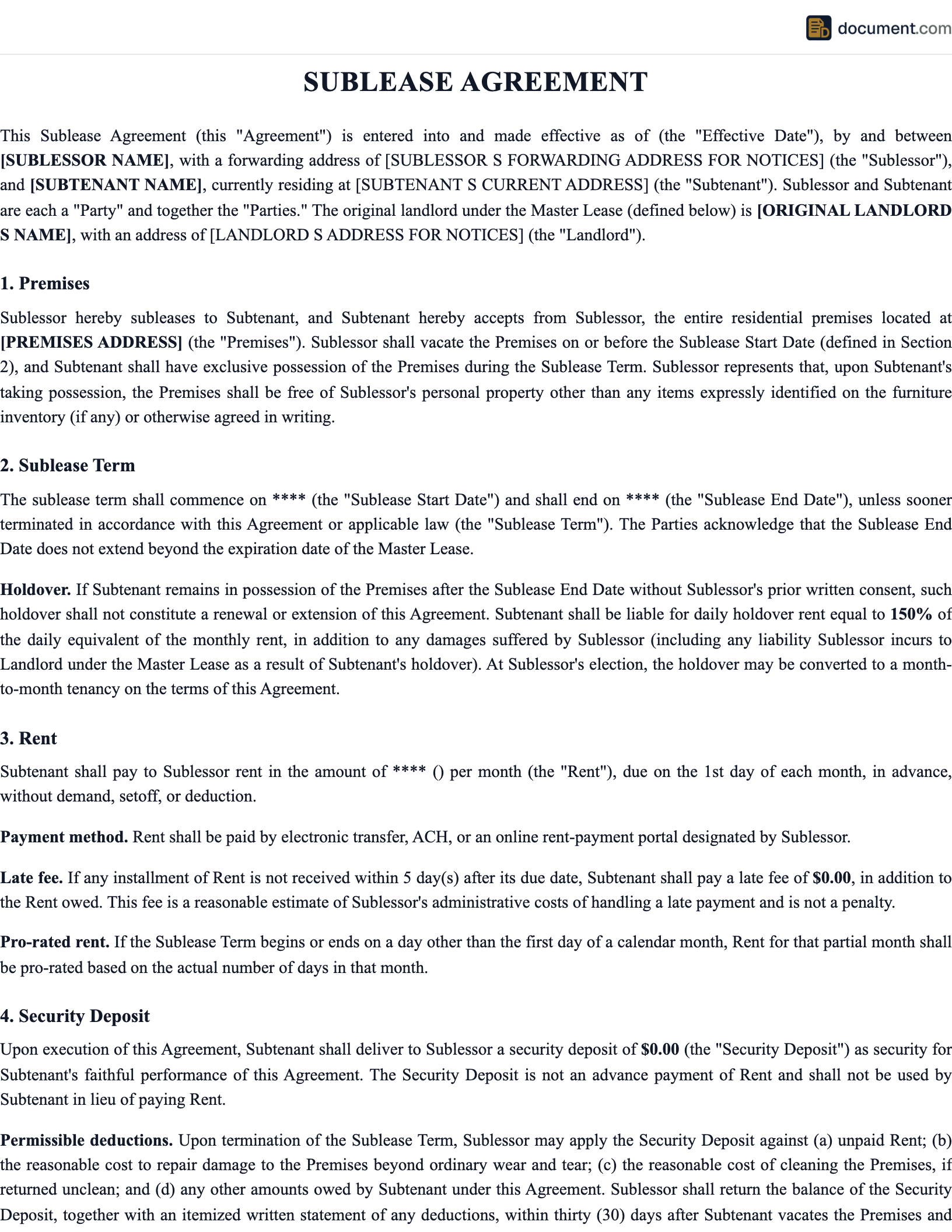
Sample Texas Sublease Agreement
Below is a preview of our Texas-specific sublease agreement. Your customized document will include all provisions required under TX law.
STATE OF TEXAS
SUBLEASE AGREEMENT
Residential Subletting Contract
SUBLESSOR (Original Tenant):
Name: [Sublessor Name]
Address: [Texas Address]
SUBLESSEE (New Occupant):
Name: [Sublessee Name]
Current Address: [Address]
SUBLEASE TERMS
Start Date: [Date]
End Date: [Date]
Monthly Rent: $[Amount]
Security Deposit: $[Amount]
Texas Sublease Agreement FAQ
Answers to common questions about sublease agreements in Texas.
Other Texas Lease Agreement Templates
Need a different type of lease agreement for Texas? We offer state-specific templates for every type of rental arrangement.
Texas Residential Lease
Standard rental agreements
Texas Month-to-Month Lease
Flexible short-term rentals
Texas Vacation Rental
Short-term vacation properties
Texas Commercial Lease
Business and retail spaces
Texas Roommate Agreement
Shared living arrangements
Texas Rent-to-Own
Lease with purchase option
Texas Equipment Lease
Equipment rental agreements
Texas Land Lease
Land rental agreements
Texas Room Rental
Individual room rentals
Create your Texas Sublease Lease Agreement in under 5 minutes.
Answer a few questions and download a Texas-compliant document, ready for the state agency.