
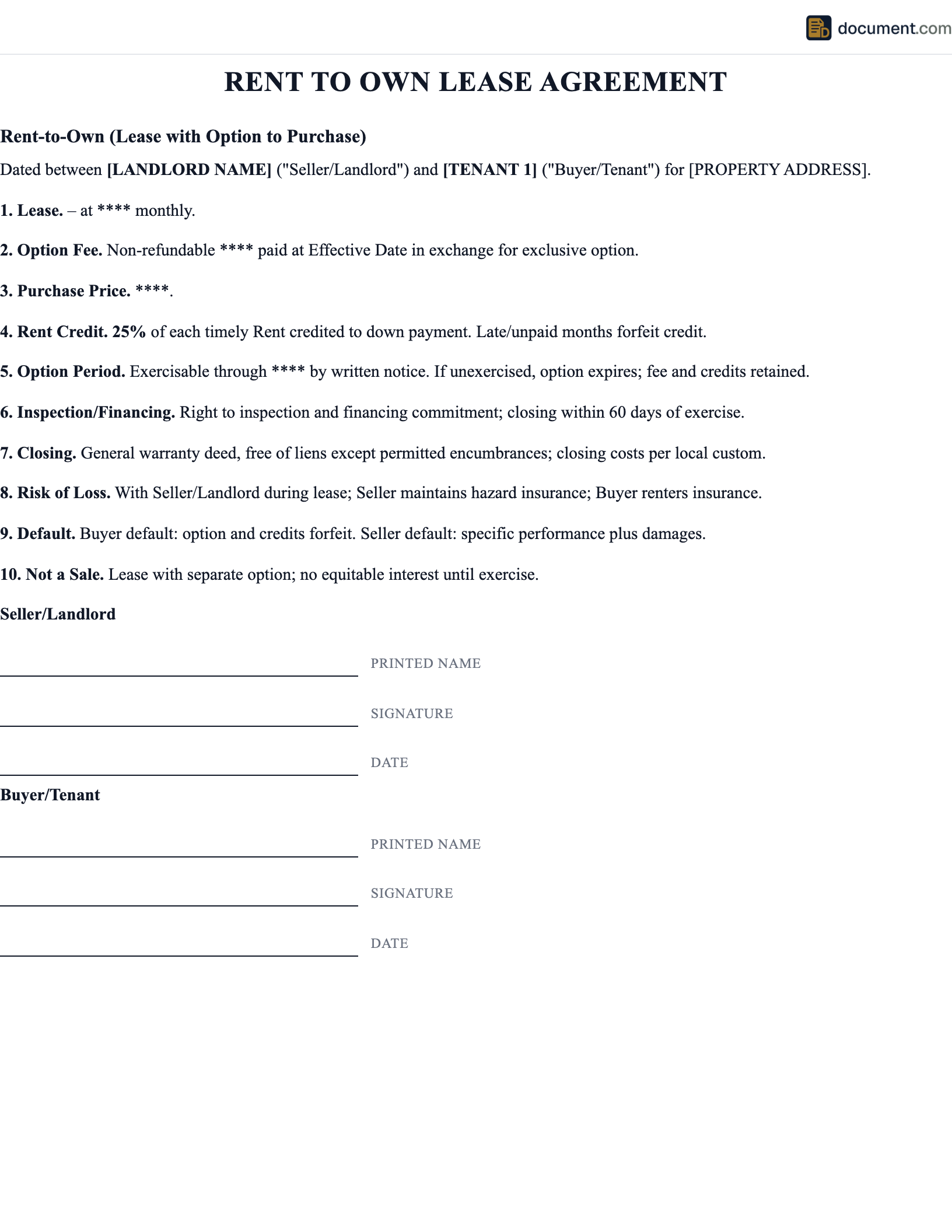



Texas Rent-to-Own Agreement Overview
Texas stands apart from most states with its comprehensive regulation of rent-to-own transactions under Property Code Chapter 5, Subchapter D (Sections 5.061-5.085). Originally enacted to address widespread abuses in colonias along the Texas-Mexico border — where sellers often collected years of payments without ever delivering title — the statute now applies statewide to executory contracts for the conveyance of residential property.
The Texas framework imposes duties on sellers that far exceed those in other states: mandatory pre-contract disclosures, annual accounting statements, restrictions on forfeiture, and a landmark requirement to convert executory contracts to recorded deeds of trust once the buyer has paid 40% of the purchase price or made 48 monthly payments. These protections make Texas one of the most tenant-buyer-friendly states for rent-to-own transactions.
Due to the complexity of Texas law, sellers who fail to comply with Chapter 5 face severe penalties, including liability for twice the amount paid by the buyer plus attorney fees. Both parties should consult with a Texas real estate attorney before entering into a rent-to-own arrangement.
Yes
Specific RTO Statute
1-5%
Option Fee Range
Tracked
Rent Credits
Required
Recording
Texas Property Code Chapter 5 — Rent-to-Own Regulations
Texas Property Code Chapter 5, Subchapter D is the primary statute governing rent-to-own and executory contracts. Here are the critical provisions every party must understand:
- Mandatory Disclosures (§ 5.069-5.070): Before execution, the seller must provide a survey or plat, copies of all liens and encumbrances, a tax certificate showing no delinquent taxes, insurance policy copies, and a specific statutory warning about the risks of executory contracts. The buyer has a 14-day right to cancel after receiving these disclosures.
- Recording Requirement (§ 5.076): The seller must record the executory contract or a memorandum of the contract in the county clerk's office within 30 days of execution. The seller bears the cost of recording. Failure to record is a statutory violation.
- Annual Accounting (§ 5.077): By January 31 each year, the seller must provide a detailed statement showing amounts paid, remaining balance, payments remaining, taxes and insurance paid on the buyer's behalf, and any other charges. Noncompliance allows the buyer to withhold up to 25% of each payment until the statement is provided.
- 40% / 48-Payment Conversion (§ 5.081): Once the buyer has paid 40% of the purchase price or made 48 monthly payments, the seller must transfer legal title by recorded deed and take back a purchase money deed of trust. This is the hallmark provision of the Texas statute.
- Default and Forfeiture Protections (§ 5.064): Upon default, the seller must give a 30-day written notice with opportunity to cure. Forfeiture is available only if the buyer has paid less than 40% of the purchase price. After 40%, the seller must use foreclosure proceedings, giving the buyer full foreclosure protections.
- No Prepayment Penalties (§ 5.074): The buyer may pay off the contract at any time without penalty. Any prepayment penalty provision is void.
- Penalties for Violation (§ 5.085): A seller who violates Subchapter D may be liable for liquidated damages of twice the total amount paid by the buyer, plus reasonable attorney fees. The buyer may also seek specific performance or cancellation with full refund.
Texas Sellers: Strict Compliance Is Non-Negotiable
Texas courts strictly enforce Chapter 5 requirements. Sellers who fail to provide mandatory disclosures, record the contract, deliver annual accounting statements, or convert to a deed of trust at the 40% threshold face liability for twice the buyer's total payments plus attorney fees. Multiple Texas court decisions have imposed these penalties. Consult a Texas real estate attorney before entering into any executory contract or lease-purchase arrangement.
How Rent-to-Own Works in Texas
Texas rent-to-own transactions involve more steps than most states due to the requirements of Property Code Chapter 5. Here is the required process.
Seller Provides Mandatory Pre-Contract Disclosures
Before execution, the seller delivers a survey/plat, copies of all liens, a tax certificate, insurance policies, and the statutory risk disclosure. The buyer has 14 days to review and cancel after receiving these documents
Execute and Record the Agreement
Both parties sign the executory contract. The seller must record the contract (or a memorandum) with the county clerk within 30 days. The option fee is paid at this time
Lease Period with Annual Accounting
The buyer pays monthly rent with credits applied toward the purchase price. The seller provides annual accounting statements by January 31 each year showing all payments, credits, and remaining balance
Mandatory Conversion at 40% or 48 Payments
When the buyer has paid 40% of the purchase price or made 48 monthly payments, the seller must transfer legal title by deed and take back a purchase money deed of trust for the balance
Final Payoff and Full Title Transfer
The buyer secures permanent financing, pays the remaining balance, and the deed of trust is released. The buyer has full legal and equitable title to the property. No prepayment penalties are allowed
Key Texas Rent-to-Own Agreement Terms
Texas Property Code Chapter 5 dictates many of the terms that must be included in a rent-to-own agreement. The following are both contractual terms and statutory requirements.
| Term | Texas Requirements |
|---|---|
| Option Fee | Typically 1-5% of purchase price. Must be clearly identified in the contract and reflected in the annual accounting statement. Credited toward purchase price at closing |
| Purchase Price | Must be stated in the contract. Determines the 40% conversion threshold. Texas does not restrict how the price is set, but it must be definite or determinable |
| Disclosures | Survey/plat, liens, tax certificate, insurance, statutory warning document, Seller's Disclosure Notice — all required before contract execution |
| Recording | Required within 30 days. Seller bears the cost. Must be recorded with the county clerk where the property is located |
| Annual Accounting | Due by January 31 each year. Must detail all payments, credits, balance, taxes, and insurance. Noncompliance allows buyer to withhold 25% |
| Conversion | Mandatory at 40% of purchase price paid or 48 monthly payments. Seller must transfer title by deed and take back deed of trust |
| Default Notice | 30-day written notice with opportunity to cure. Forfeiture only available below 40% threshold — above requires foreclosure proceedings |
| Prepayment | No prepayment penalty allowed under Texas law. Buyer can pay off at any time |
Texas Consumer Protections for Tenant-Buyers
Texas provides the strongest consumer protections of any state for rent-to-own tenant-buyers. These protections were enacted after widespread abuses were documented in executory contract sales in Texas colonias.
14-Day Right to Cancel
After receiving the mandatory disclosures, the buyer has 14 days to cancel the contract and receive a full refund of all payments made. This cooling-off period gives the buyer time to review disclosures with an attorney, obtain an independent property inspection, and verify the information provided by the seller.
Equity Protection Through Conversion
The 40%/48-payment conversion rule ensures that sellers cannot indefinitely hold executory contracts while collecting payments. Once converted to a deed with a deed of trust, the buyer has full ownership rights and the protections of Texas foreclosure law, including the right to cure, reinstatement rights, and the equity of redemption.
Anti-Forfeiture Protections
Texas law limits when forfeiture can be used. Before forfeiture, the seller must give 30 days notice and opportunity to cure. After the buyer has paid 40% or more, forfeiture is prohibited entirely — the seller must use foreclosure proceedings. This ensures that buyers who have built significant equity cannot lose their entire investment through a simple forfeiture.
Texas DTPA and AG Enforcement
The Texas Deceptive Trade Practices Act (DTPA) applies to rent-to-own transactions. Sellers who engage in deceptive or unconscionable conduct can face treble damages under the DTPA. The Texas Attorney General has actively pursued enforcement actions against predatory rent-to-own schemes, particularly in the Rio Grande Valley and other areas with vulnerable populations.
Sample Texas Rent-to-Own Agreement
Below is a preview of our Texas-compliant rent-to-own agreement, structured to meet all Property Code Chapter 5, Subchapter D requirements.
STATE OF TEXAS
EXECUTORY CONTRACT — LEASE WITH OPTION TO PURCHASE
Per Texas Property Code Chapter 5, Subchapter D
SELLER / OPTIONOR:
Name: [Owner Name]
Address: [Texas Address]
BUYER / OPTIONEE:
Name: [Buyer Name]
Address: [Current Address]
PROPERTY & TERMS
Property: [Texas Property Address]
County: [County]
Option Fee: $[Amount] Purchase Price: $[Amount]
Monthly Rent: $[Amount] Rent Credit: [%]%
40% Conversion Threshold: $[Amount]
Texas Rent-to-Own FAQ
Detailed answers about Texas Property Code Chapter 5 requirements, the conversion rule, forfeiture protections, and seller obligations.
Official Texas Resources
Texas government and legal resources for rent-to-own transactions.
Texas Property Code Chapter 5
Full text of the executory contract statute
Texas Attorney General — Consumer Protection
File complaints about deceptive rent-to-own practices
Texas Real Estate Commission (TREC)
State regulatory body for real estate transactions
Texas Law Help — Housing
Free legal resources for Texas tenants and homebuyers
Create your Texas Rent To Own Lease Agreement in under 5 minutes.
Answer a few questions and download a Texas-compliant document, ready for the state agency.