



Ohio Sublease Agreement Overview
A commercial sublease in Ohio occurs when a tenant holding an existing prime lease transfers some or all of the leased space to a subtenant for a period within the remaining prime lease term. The original tenant, now the sublessor, does not exit the prime lease. It remains fully bound to the landlord and occupies a middle position between the landlord and the subtenant.
Ohio's commercial sublease market is concentrated in Columbus, which has seen meaningful office space availability in the Short North, Easton, and downtown submarkets as hybrid work arrangements changed space requirements. Cleveland's downtown and Midtown corridors and Cincinnati's suburban office markets also see active sublease transactions, often driven by companies consolidating or relocating operations within Ohio.
There is no privity of contract between the subtenant and the landlord in an Ohio commercial sublease. The subtenant cannot enforce the landlord's building maintenance obligations directly, the landlord cannot collect rent from the subtenant in ordinary circumstances, and if the prime lease terminates, the subtenant loses its occupancy right unless a non-disturbance agreement has been separately negotiated with the landlord.
Contract
Governs all terms
Written
Consent required
Remains
Sublessor liable
None
Privity with landlord
Ohio Commercial Sublease Requirements
Ohio governs commercial subleases through contract law. No statute sets default sublease rights for commercial tenants, and Ohio courts enforce commercial lease terms as negotiated. Every right and obligation must be addressed in the prime lease and the sublease document itself.
No Privity Between Subtenant and Landlord in Ohio
In an Ohio commercial sublease, the subtenant has no direct legal relationship with the landlord. The subtenant cannot enforce the landlord's repair or maintenance obligations and has no right to remain in the space if the prime lease terminates. Ohio commercial subtenants taking on meaningful space or long-term commitments should negotiate a non-disturbance and attornment agreement directly with the landlord before signing any sublease.
Sublessor Obligations
- Review the Prime Lease: Confirm what the prime lease says about subletting rights, any required consent, and whether any use restrictions would affect the subtenant's planned operations in Ohio
- Obtain Written Landlord Consent: Secure written consent before executing the sublease; subletting without required consent is a prime lease default and can lead to termination in Ohio
- Remain Liable to Landlord: The sublessor stays bound by every prime lease obligation regardless of the sublease; subtenant default does not relieve the original tenant of any prime lease duty
- Provide Use and Restriction Information: Disclose all use restrictions, prohibited activities, operating requirements, and any co-tenancy or exclusivity provisions in the prime lease that affect what the subtenant can do in the space
Subtenant Key Considerations
- Review the Prime Lease: Read the full prime lease before signing the sublease; the subtenant takes the space subject to all prime lease obligations even without signing that document
- Assess Sublessor Financial Standing: If the sublessor defaults on the prime lease, the subtenant loses the space; Columbus, Cleveland, and Cincinnati sublease markets have seen cases of sublessor financial distress that displaced subtenants with limited recourse
- Negotiate a Non-Disturbance Agreement: Obtain written protection from the landlord that the subtenant will not be displaced if the prime lease terminates for reasons outside the subtenant's control
- Define Operating Expense Responsibilities: Confirm which expenses the subtenant pays directly versus which the sublessor absorbs, and document the allocation in the sublease rather than relying on assumed pass-through conventions
How to Fill Out an Ohio Commercial Sublease Agreement
Completing a commercial sublease in Ohio requires more than filling in blanks. The document must reflect the prime lease, address the no-privity issue, and define all economic terms between sublessor and subtenant clearly. Here is a practical sequence.
Review the Prime Lease for Subletting Restrictions
Before approaching any subtenant, the sublessor should read the prime lease consent clause completely. Identify whether landlord consent is required, whether the landlord has absolute discretion or a reasonableness obligation, and whether there are use restrictions that would limit who can occupy the space. Also confirm the remaining prime lease term and any pending renewal options so the sublease term can be set accurately and consistently.
Obtain Written Landlord Consent and Request an Estoppel Certificate
Submit the proposed subtenant's business information, intended use, and financial references to the Ohio landlord. Wait for written approval before executing any sublease documents. For subtenants making a meaningful commitment, request an estoppel certificate from the landlord confirming the prime lease is in good standing and free of unresolved defaults. Columbus, Cleveland, and Cincinnati institutional landlords are generally familiar with this process and will respond if asked properly.
Define the Economic Terms and Operating Expense Allocation
State the sublease rent, payment due date, security deposit amount, and any rent abatement period. Then address operating expenses: specify which costs the subtenant pays directly (utilities metered to the space, in-suite janitorial), which pass through from the prime lease to the subtenant, and which the sublessor absorbs. Ohio sublease disputes most commonly arise from ambiguous expense allocation language, so clarity here is worth the drafting effort.
Execute the Sublease and Distribute Fully Executed Copies
Both the sublessor and subtenant sign the sublease. If landlord consent is incorporated into the same document, the landlord signs as well. Provide fully executed copies to all parties. Attach the landlord consent letter and the prime lease as exhibits. Set reminders for rent due dates, option exercise deadlines, and the sublease expiration to ensure the sublessor can plan for the space before the term ends.
Landlord Consent and Subtenant Protections in Ohio
The table below summarizes how key commercial sublease issues are treated in Ohio, where contract law governs all substantive rights and no statute provides default commercial sublease protections.
| Topic | Ohio Rules |
|---|---|
| Subletting Right | Governed entirely by the prime lease; Ohio provides no statutory subletting right for commercial tenants |
| Landlord Consent | Required per most prime leases; Ohio imposes no reasonableness standard on commercial landlords absent a negotiated lease provision |
| Original Tenant Liability | Continues in full; the sublessor remains bound by all prime lease obligations after the sublease is executed |
| Privity Between Subtenant and Landlord | None; the subtenant has no direct legal relationship with the landlord absent a separate agreement |
| Non-Disturbance Protection | Not automatic; must be negotiated directly with the landlord; strongly recommended for Ohio subtenants making significant financial commitments |
Sample Ohio Sublease Agreement
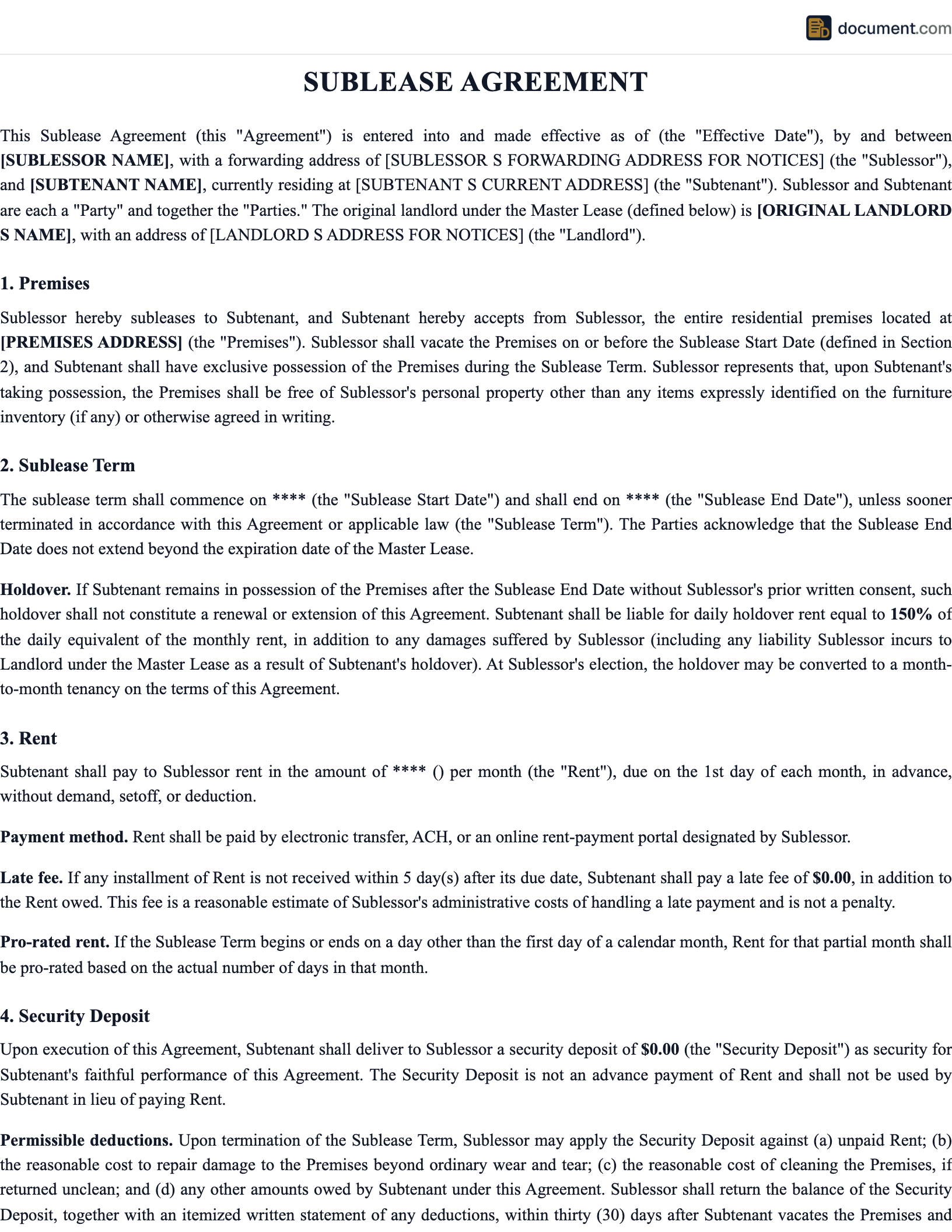
Below is a preview of our Ohio-specific sublease agreement. Your customized document will include all provisions required under OH law.
STATE OF OHIO
SUBLEASE AGREEMENT
Residential Subletting Contract
SUBLESSOR (Original Tenant):
Name: [Sublessor Name]
Address: [Ohio Address]
SUBLESSEE (New Occupant):
Name: [Sublessee Name]
Current Address: [Address]
SUBLEASE TERMS
Start Date: [Date]
End Date: [Date]
Monthly Rent: $[Amount]
Security Deposit: $[Amount]
Ohio Sublease Agreement FAQ
Answers to common questions about sublease agreements in Ohio.
Other Ohio Lease Agreement Templates
Need a different type of lease agreement for Ohio? We offer state-specific templates for every type of rental arrangement.
Ohio Residential Lease
Standard rental agreements
Ohio Month-to-Month Lease
Flexible short-term rentals
Ohio Vacation Rental
Short-term vacation properties
Ohio Commercial Lease
Business and retail spaces
Ohio Roommate Agreement
Shared living arrangements
Ohio Rent-to-Own
Lease with purchase option
Ohio Equipment Lease
Equipment rental agreements
Ohio Land Lease
Land rental agreements
Ohio Room Rental
Individual room rentals
Create your Ohio Sublease Lease Agreement in under 5 minutes.
Answer a few questions and download a Ohio-compliant document, ready for the state agency.