



Ohio Rent-to-Own Agreement Overview
Ohio does not have a dedicated rent-to-own statute, but the state provides significant protections through its recording system, the Ohio Residential Property Disclosure form (ORC 5302.30), and the Ohio Landlord-Tenant Act (ORC Chapter 5321). Ohio courts have consistently held that a properly recorded lease-option agreement creates an equitable interest in the property that can be specifically enforced.
Ohio's recording statutes play a central role in rent-to-own protection. When a lease-option or memorandum of option is recorded with the county recorder, it creates a cloud on the title that prevents the seller from conveying the property to a third party. Ohio follows a race-notice recording system under ORC Section 5301.25, making recording essential for protecting the buyer's interest.
The Ohio housing market — particularly Columbus (one of the fastest-growing metros in the Midwest), Cleveland, Cincinnati, and Dayton — has seen growing rent-to-own activity. Ohio is a judicial foreclosure state with a relatively long timeline (7-12 months), providing more time for tenant-buyers to protect their interests if the seller defaults on a mortgage.
Partial
Specific RTO Statute
1-5%
Option Fee Range
Optional
Rent Credits
Recommended
Recording Option
Ohio Rent-to-Own Laws — Equitable Interest & ORC Requirements
Ohio regulates rent-to-own through recording law, property disclosure requirements, landlord-tenant protections, and equitable doctrines.
- Recording Creates Equitable Interest (ORC § 5301.25): Ohio courts have held that recording a lease-option with the county recorder creates an equitable interest enforceable against the seller and subsequent purchasers with notice. The recorded option creates a cloud on the title preventing conveyance to third parties.
- Residential Property Disclosure (ORC § 5302.30): Sellers must complete Ohio's Residential Property Disclosure form covering structural defects, water damage, environmental hazards, boundary disputes, and material conditions. This must be provided before signing.
- Ohio Landlord-Tenant Act (ORC § 5321): During the lease period, landlords must maintain habitable premises, make timely repairs, and follow proper eviction procedures. Security deposits are limited to one month's rent and must be returned within 30 days.
- Statute of Frauds (ORC § 1335.05): Contracts for the sale of real property must be in writing. The rent-to-own agreement must be a signed written instrument identifying the property, stating the price, and including all material terms.
- Consumer Sales Practices Act (ORC § 1345): Prohibits unfair, deceptive, and unconscionable consumer sales practices. Predatory rent-to-own schemes involving misrepresentation or exploitative terms can be challenged under this broad statute.
Recording is Critical in Ohio
Ohio courts have consistently held that a recorded lease-option creates an enforceable equitable interest. However, an UNRECORDED option provides almost no protection against third-party sales or new liens. Recording with the county recorder is inexpensive (typically $28 for the first two pages) and is essential protection for the tenant-buyer's investment.
How Rent-to-Own Works in Ohio
Here is the typical process for an Ohio rent-to-own transaction.
Property Disclosure and Due Diligence
The seller completes Ohio's Residential Property Disclosure form. The buyer obtains a professional home inspection and reviews the title for liens and encumbrances
Draft and Execute the Written Agreement
The agreement must satisfy Ohio's Statute of Frauds — written, signed, with identified property, stated price, and all material terms including option fee, rent credits, and maintenance
Record with the County Recorder
Record the agreement or memorandum of option with the county recorder to create an equitable interest. Ohio recording fees are typically $28 for the first two pages plus $8 per additional page
Lease Period under Ohio Landlord-Tenant Act
ORC Chapter 5321 governs the relationship. Security deposit is capped at one month's rent. Landlord must maintain habitability. Rent credits accumulate per the agreement
Exercise the Option and Close
The buyer provides written notice, secures financing, and closes. Ohio's conveyance fee (varies by county, typically $1-$4 per $1,000) applies at deed recording. Option fee and rent credits are applied
Key Ohio Rent-to-Own Agreement Terms
Your Ohio rent-to-own agreement should address each of these terms.
| Term | Ohio Details |
|---|---|
| Option Fee | Typically 1-5%. Credited at closing. Non-refundable consideration for the option right |
| Purchase Price | Must be stated per Ohio Statute of Frauds. Locked at signing or determined by appraisal at exercise |
| Option Period | Usually 1-3 years. Columbus and Cincinnati markets may favor shorter periods due to appreciation |
| Rent Credits | Optional. Typically 10-25%. Clearly specify accumulation, forfeiture, and accounting provisions |
| Security Deposit | Capped at one month's rent. Returned within 30 days with itemized deductions. Separate from option fee |
| Maintenance | Landlord maintains habitability per ORC 5321.04. Additional maintenance allocated by agreement |
| Default & Forfeiture | Specify consequences. Ohio courts may apply equitable protections against forfeiture of recorded interests |
Ohio Consumer Protections for Tenant-Buyers
Key protections available in Ohio rent-to-own transactions.
Recorded Equitable Interest
Recording the option with the county recorder creates an equitable interest recognized by Ohio courts. This prevents third-party sales, provides standing in foreclosure, and protects the tenant-buyer's investment. One of Ohio's strongest protections.
Mandatory Property Disclosure
Ohio's Residential Property Disclosure form requires sellers to disclose known material defects. This gives tenant-buyers essential information before committing option money. Failure to disclose can result in liability for damages.
Consumer Sales Practices Act
ORC Chapter 1345 prohibits unfair and deceptive consumer sales practices. Rent-to-own transactions involving misrepresentation, hidden fees, or unconscionable terms can be challenged. The Ohio AG enforces consumer protection laws.
Landlord-Tenant Act Protections
ORC Chapter 5321 provides comprehensive protections during the lease: implied warranty of habitability, security deposit limitations, proper eviction procedures (3-day notice for non-payment), and prohibition on retaliatory eviction.
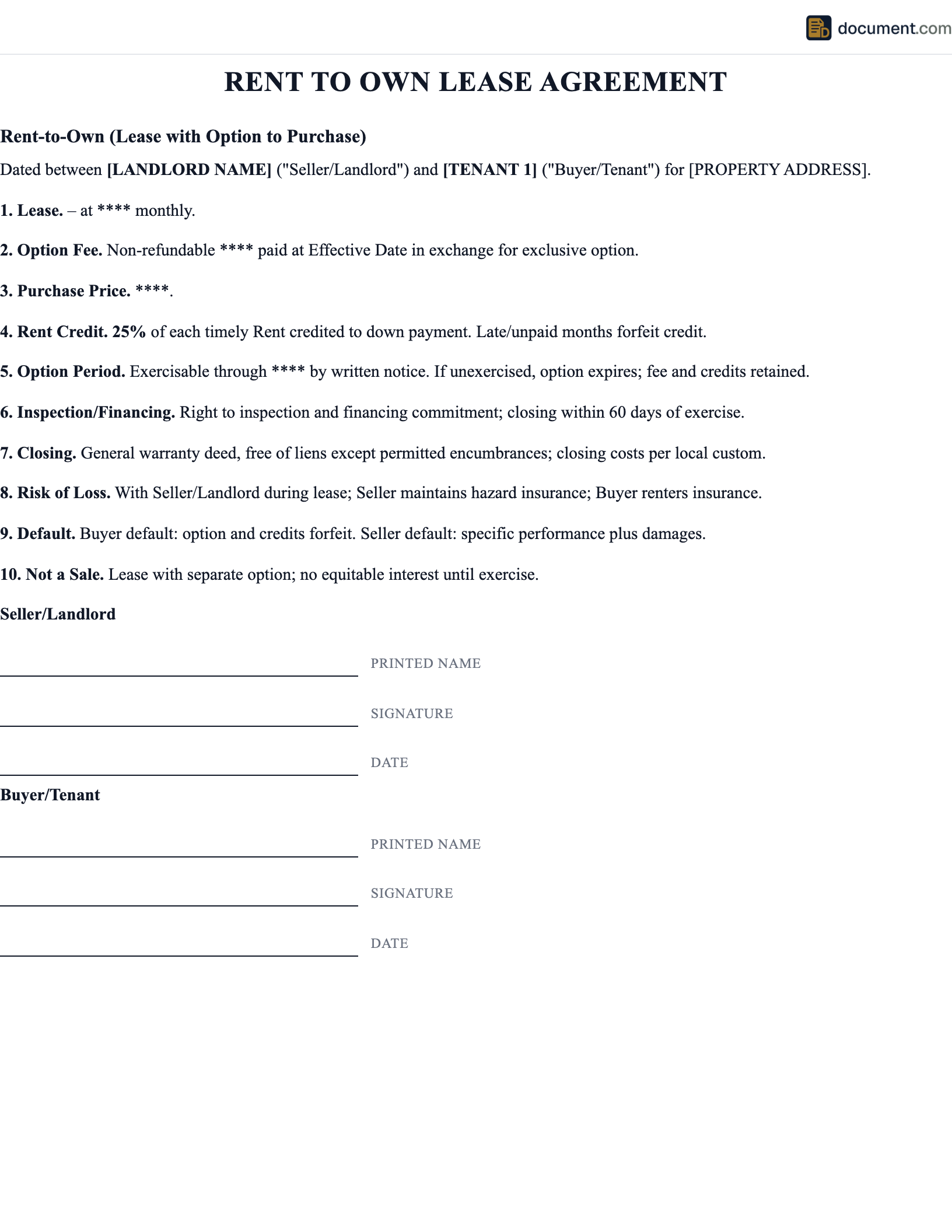
Sample Ohio Rent-to-Own Agreement
Below is a preview of our Ohio-compliant agreement.
STATE OF OHIO
RESIDENTIAL LEASE WITH OPTION TO PURCHASE
Ohio Contract Law & ORC Ch. 5321 Compliant
PROPERTY OWNER / OPTIONOR:
Name: [Owner Name]
Address: [Ohio Address]
TENANT-BUYER / OPTIONEE:
Name: [Tenant Name]
Address: [Current Address]
PROPERTY & TERMS
Property: [Ohio Property Address]
Option Fee: $[Amount] Purchase Price: $[Amount]
Monthly Rent: $[Amount] Rent Credit: [%]%
Ohio Rent-to-Own FAQ
Answers about Ohio equitable interest, property disclosure, recording, and the Consumer Sales Practices Act.
Official Ohio Resources
Ohio government and legal resources.
Create your Ohio Rent To Own Lease Agreement in under 5 minutes.
Answer a few questions and download a Ohio-compliant document, ready for the state agency.