



Connecticut Commercial Sublease Overview
A Connecticut commercial sublease allows an existing tenant to sublease all or a portion of leased commercial space to a subtenant for a period that does not extend beyond the original lease term. Unlike residential subleases, commercial subleases are governed entirely by contract law and the terms negotiated between the parties. Connecticut courts will enforce a commercial sublease as written, with minimal implied protections for either party.
The most important structural feature of a commercial sublease is the absence of privity between the subtenant and the landlord. The subtenant's only contractual counterparty is the sublessor. The original tenant retains full liability to the landlord under the prime lease regardless of who occupies the space. Connecticut businesses considering subleasing unused office space in Stamford, Hartford, or New Haven should understand this liability structure before entering negotiations with a prospective subtenant.
Commercial subleases in Connecticut typically arise when a tenant has taken more space than it currently needs, is relocating within the state, or wants to monetize below-market lease rates in a rising market. Because the sublessor remains on the hook to the landlord no matter what the subtenant does, a thorough subtenant qualification process and a well-drafted sublease are not optional steps.
Allowed with
Subletting default
Yes
Consent required
Yes
Tenant remains liable
2 months'
Deposit rules
Connecticut Commercial Sublease Requirements
Connecticut commercial subleases are governed by the prime lease and general contract law. There is no statute specifically regulating commercial subletting in Connecticut, so the rights and obligations of each party are determined almost entirely by what the prime lease says and what the sublease document provides.
Watch for Recapture Rights
Many Connecticut commercial leases contain recapture provisions that allow the landlord to terminate the prime lease when the tenant requests sublease consent. If your prime lease includes a recapture clause, requesting consent could result in losing the space entirely. Review this provision carefully with an attorney before notifying the landlord of any intent to sublease.
Sublessor (Original Tenant) Obligations
- Review the Prime Lease: Identify the assignment and subletting clause, consent standard, recapture rights, and any profit-sharing provisions before approaching a subtenant
- Obtain Written Consent: Request landlord consent in writing and document any conditions the landlord attaches to that consent
- Remain Liable to the Landlord: The sublessor continues to owe all prime lease obligations to the landlord regardless of the subtenant's performance
- Provide Prime Lease to Subtenant: Give the subtenant a complete copy of the prime lease so the subtenant can understand the obligations binding the subleased space
Subtenant Obligations and Protections
- Comply with Prime Lease: The sublease should incorporate all applicable prime lease terms; subtenant violations can cause sublessor defaults under the prime lease
- Seek a Non-Disturbance Agreement: Connecticut subtenants in substantial transactions should seek a direct agreement with the landlord protecting their possession if the prime lease terminates
- Verify Prime Lease Status: Before signing the sublease, confirm that the prime lease is in good standing with no existing defaults
- Confirm Sublease Term Does Not Exceed Prime Lease: The sublease must expire on or before the prime lease expiration date, or it will not be enforceable for the excess period
How to Complete a Connecticut Commercial Sublease
Commercial sublease transactions in Connecticut involve more complexity than residential subletting because the prime lease terms, landlord consent conditions, and the parties' respective liability exposure all require careful attention. Work through these steps in sequence.
Review the Prime Lease and Request Consent
Read the assignment and subletting clause in the prime lease before doing anything else. Note the consent standard, any recapture rights, profit-sharing obligations, and conditions on the landlord's approval. Submit a written consent request to the Connecticut landlord with the proposed subtenant's business information, financial statements, and intended use. Document the landlord's response and attach any conditions to the sublease as an exhibit.
Define the Subleased Premises
Identify the subleased space precisely by floor and suite number, square footage, and a floor plan exhibit if subleasing a portion of a larger space. If subleasing shared areas such as conference rooms or reception space, specify the scope and schedule of the subtenant's access rights. The description should be specific enough that a court could determine exactly what was subleased without additional testimony.
Set Financial Terms and Incorporate Prime Lease Obligations
Set the sublease base rent, payment schedule, and any rent escalation provisions. If operating expenses or CAM charges flow through from the prime lease, specify how the subtenant's pro-rata share is calculated and billed. Address tenant improvement obligations, security deposit amount and return conditions, and any above-market profit-sharing owed to the landlord. Attach a full copy of the prime lease as an exhibit and incorporate its terms by reference, subject to any modifications the parties negotiate.
Execute and Deliver to All Parties
Both sublessor and subtenant should execute the sublease with original signatures. Connecticut does not require commercial lease notarization for the agreement to be binding between the parties, but the original tenant should retain fully executed originals of both the sublease and the landlord's consent letter for the duration of the prime lease term. Deliver copies to the landlord as required by the prime lease, and keep the sublease with the prime lease in a single organized file.
Connecticut Commercial Sublease Key Terms
The table below summarizes the key structural features that define a Connecticut commercial sublease and distinguish it from a residential subletting arrangement.
| Topic | Connecticut Commercial Sublease Rule |
|---|---|
| Subletting Default Rule | Governed entirely by prime lease; most commercial leases require landlord consent before subletting is permitted |
| Landlord Consent Standard | Depends on the prime lease; may be "not unreasonably withheld" or may give landlord absolute discretion |
| Original Tenant Liability | Sublessor remains fully liable to the landlord under the prime lease regardless of sublease; there is no automatic release |
| Subtenant-Landlord Relationship | No privity of contract between subtenant and landlord; subtenant's rights run only through the sublessor unless a non-disturbance agreement is negotiated |
| Excess Rent Sharing | If the prime lease includes a profit-sharing clause, the sublessor must share above-market sublease income with the landlord, typically 50% after deducting out-of-pocket subletting costs |
Sample Connecticut Sublease Agreement
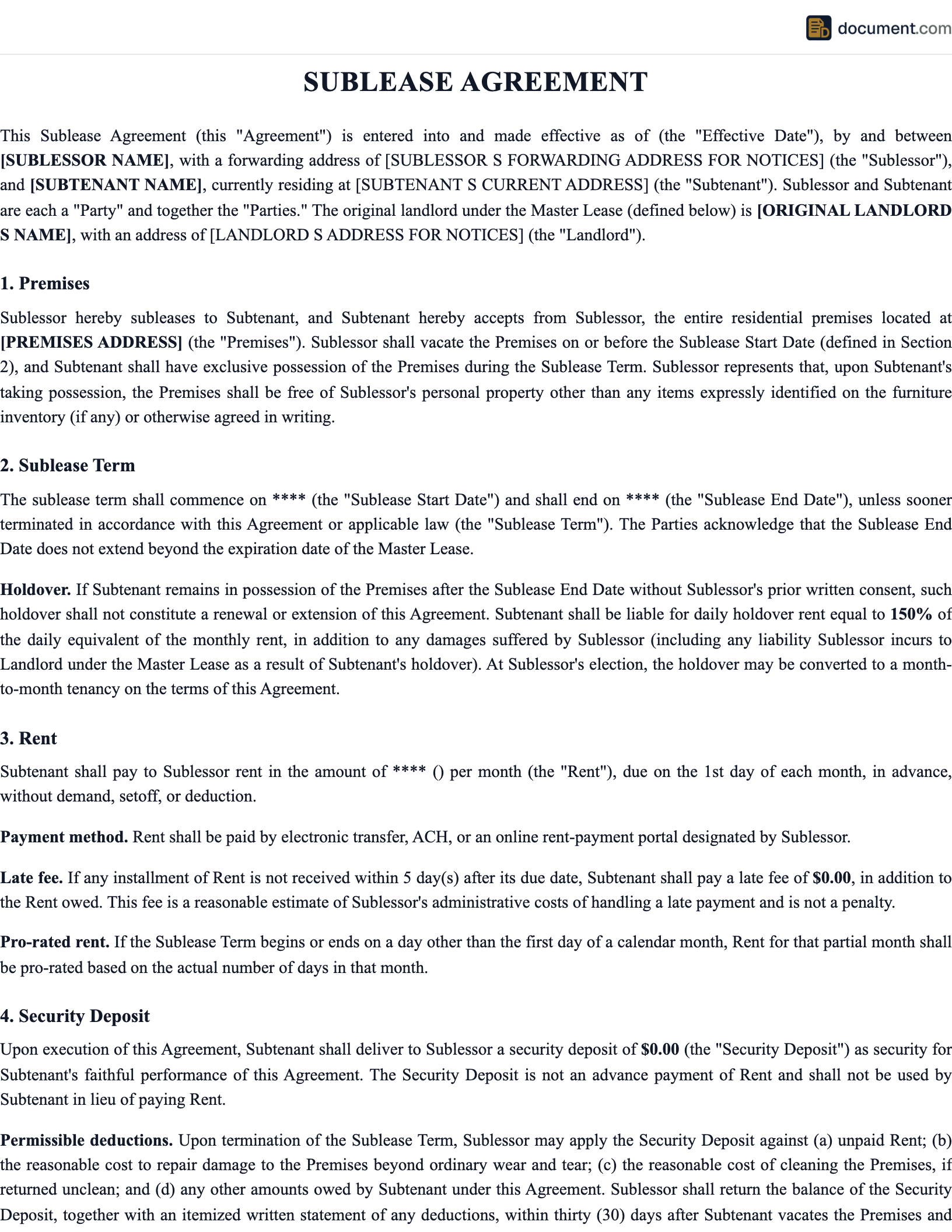
Below is a preview of our Connecticut-specific sublease agreement. Your customized document will include all provisions required under CT law.
STATE OF CONNECTICUT
SUBLEASE AGREEMENT
Residential Subletting Contract
SUBLESSOR (Original Tenant):
Name: [Sublessor Name]
Address: [Connecticut Address]
SUBLESSEE (New Occupant):
Name: [Sublessee Name]
Current Address: [Address]
SUBLEASE TERMS
Start Date: [Date]
End Date: [Date]
Monthly Rent: $[Amount]
Security Deposit: $[Amount]
Connecticut Sublease Agreement FAQ
Answers to common questions about sublease agreements in Connecticut.
Other Connecticut Lease Agreement Templates
Need a different type of lease agreement for Connecticut? We offer state-specific templates for every type of rental arrangement.
Connecticut Residential Lease
Standard rental agreements
Connecticut Month-to-Month Lease
Flexible short-term rentals
Connecticut Vacation Rental
Short-term vacation properties
Connecticut Commercial Lease
Business and retail spaces
Connecticut Roommate Agreement
Shared living arrangements
Connecticut Rent-to-Own
Lease with purchase option
Connecticut Equipment Lease
Equipment rental agreements
Connecticut Land Lease
Land rental agreements
Connecticut Room Rental
Individual room rentals
Create your Connecticut Sublease Lease Agreement in under 5 minutes.
Answer a few questions and download a Connecticut-compliant document, ready for the state agency.