
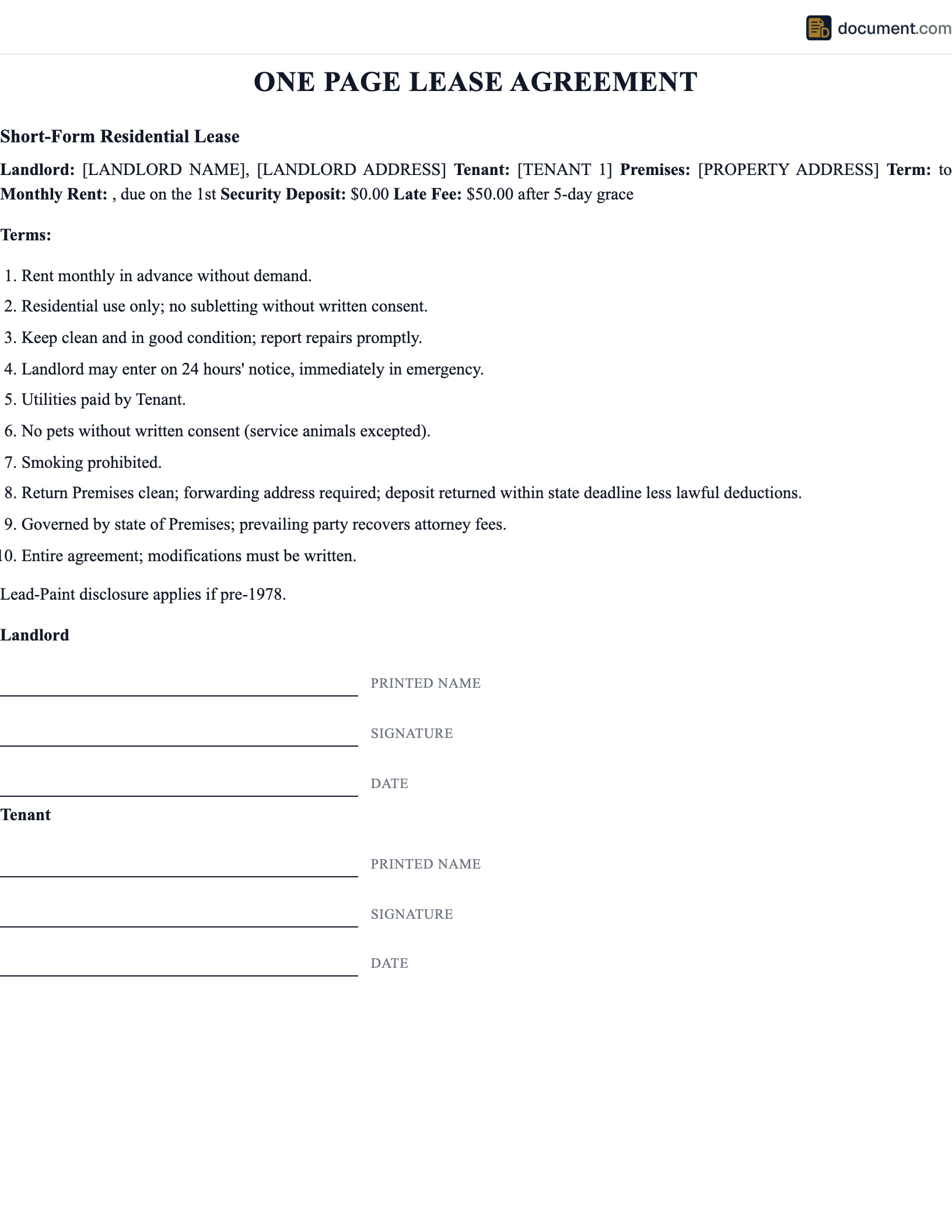



Hawaii One Page Lease Overview
A one-page lease in Hawaii is a streamlined rental agreement covering essential tenancy terms. Hawaii\'s landlord-tenant law is governed by the Residential Landlord-Tenant Code (HRS Chapter 521), which provides comprehensive tenant protections that apply statewide across all islands. Hawaii has some of the strongest tenant protections in the Pacific region, including a mandatory 1-month security deposit cap, required move-in condition reports, and an implied warranty of habitability.
Hawaii\'s rental market is among the most expensive in the United States, with median rents in Honolulu exceeding $2,000 for a one-bedroom apartment. The state\'s geographic isolation, limited buildable land, and high demand from military families (Hawaii hosts several major military installations including Pearl Harbor, Schofield Barracks, and Marine Corps Base Hawaii) create intense competition for rental housing. A one-page lease must account for Hawaii\'s unique cost dynamics, as even small ambiguities about utilities, parking, or fees can translate to significant financial disputes.
Hawaii requires a detailed move-in condition report (HRS § 521-42(c)) documenting the condition of the rental unit before the tenant takes possession. The landlord must provide this report and the tenant must have the opportunity to review and note any discrepancies. Additionally, Hawaii caps security deposits at 1 month\'s rent (HRS § 521-44(b)) — lower than most mainland states — and requires return within 14 days after the tenant vacates. These requirements apply to all lease formats including one-page agreements.
1 month\'s rent
Deposit Limit
14 days
Deposit Return
45 days
Termination (Landlord)
Hawaii Minimum Required Lease Terms
Under HRS § 521-21, a rental agreement establishes the terms and conditions of the tenancy. Hawaii\'s Statute of Frauds requires leases exceeding one year to be in writing. A valid one-page lease should include:
- Parties: Full legal names of landlord and all adult tenants; include military service branch and installation if applicable
- Premises: Complete address including island, city/town, and zip code; specify included parking (critical in Honolulu), storage, and lanai space
- Rent: Monthly amount, due date, and payment methods; Hawaii does not mandate a grace period
- Term: Start and end dates for fixed-term, or month-to-month designation; military clause for PCS orders is recommended
- Security deposit: Amount (capped at 1 month\'s rent under HRS § 521-44(b)) and return conditions
- Move-in condition report: Reference to the mandatory inspection report (HRS § 521-42(c))
- Signatures: All parties must sign; no notarization required
Hawaii Required Disclosures
Hawaii requires specific disclosures with any residential lease. These can be provided as addenda to the one-page lease.
- Lead-based paint (federal): Required for housing built before 1978 (42 U.S.C. § 4852d)
- Move-in condition report: Detailed report of the unit\'s condition at the start of tenancy (HRS § 521-42(c))
- Landlord/agent identity: Name and address of the owner and any agent authorized to manage the premises (HRS § 521-43)
- Tax information: General excise tax responsibilities related to rental income (recommended best practice)
- Condominium rules: If the unit is in a condominium, house rules and association regulations must be provided
Mandatory Move-In Condition Report
Hawaii law (HRS § 521-42(c)) requires landlords to provide a detailed move-in condition report documenting the state of the rental unit before the tenant takes possession. The tenant must have the opportunity to review and note discrepancies. This report is essential for resolving security deposit disputes. If the landlord fails to provide the report, it significantly weakens their ability to make deductions from the deposit. Even with a one-page lease, this inspection must be conducted and documented.
Enforceability and Default Rules in Hawaii
Hawaii recognizes a strong implied warranty of habitability under HRS § 521-42. The landlord must maintain the premises in a habitable condition, including compliance with health and safety codes, maintaining structural integrity, plumbing, electrical, and adequate weatherproofing. Given Hawaii\'s tropical climate, this includes protection from moisture, mold, and pest infestations. The warranty cannot be waived in the lease.
If the landlord fails to maintain habitability, Hawaii tenants have several remedies under HRS § 521-63 and § 521-64: they may give written notice requiring repair within a specified period, withhold rent, make repairs and deduct from rent (up to one month\'s rent), or terminate the lease. Hawaii also permits tenants to file complaints with the Office of Consumer Protection. The tenant\'s remedies are robust and enforceable even when the lease is silent on maintenance.
Hawaii\'s non-payment eviction process begins with a 5-business-day notice to pay or vacate (HRS § 521-68). If the tenant fails to pay, the landlord can file a summary possession action in District Court. The process typically takes 3-6 weeks. Month-to-month tenancies require 45 days\' notice for termination by the landlord (HRS § 521-71(a)) and 28 days by the tenant (HRS § 521-71(b)) — one of the longest landlord notice requirements in the nation.
Key Financial and Legal Details
| Item | Hawaii Rule |
|---|---|
| Security Deposit Maximum | 1 month\'s rent (HRS § 521-44(b)) |
| Deposit Return Deadline | 14 days after tenant vacates (HRS § 521-44(c)) |
| Late Fee Cap | No statutory cap; must be reasonable |
| Grace Period | No statutory requirement |
| Termination Notice (Landlord) | 45 days for month-to-month (HRS § 521-71) |
| Termination Notice (Tenant) | 28 days for month-to-month (HRS § 521-71) |
| Non-Payment Notice | 5 business days to pay or vacate (HRS § 521-68) |
| Landlord Entry Notice | 2 days (HRS § 521-53) |
Official Hawaii Resources
Other Hawaii Lease Agreement Types
Need a more comprehensive lease for Hawaii? Consider these full-length templates.
Hawaii One Page Lease FAQ
Common questions about simplified one-page lease agreements under Hawaii law.
Create your Hawaii One Page Lease Agreement in under 5 minutes.
Answer a few questions and download a Hawaii-compliant document, ready for the state agency.