



Hawaii Roommate Agreement Overview
Hawaii roommate agreements are enforceable contracts. Hawaii\'s small claims court handles disputes up to $5,000. Hawaii\'s high cost of living makes detailed expense-sharing provisions particularly important.
A roommate agreement in Hawaii is a private contract between people who share a rental property. It is separate from the lease with your landlord and covers how roommates split expenses, divide chores, handle guests, manage quiet hours, and resolve disputes. This document protects all roommates by making expectations explicit and enforceable.
Yes
Legally binding
$5,000
Small claims limit
Yes
Joint liability
No
Filed w/ landlord
Hawaii Legal Considerations for Roommates
Understanding Hawaii's legal framework helps you create a stronger roommate agreement and know your rights.
Important: Joint and Several Liability in Hawaii
In Hawaii, if all roommates are on the lease, each roommate is jointly and severally liable for the full rent amount. This means the landlord can pursue ANY roommate for the ENTIRE rent, not just their share. A roommate agreement establishes internal obligations so you can recover from a non-paying roommate in small claims court.
- Contract Enforceability: Hawaii courts enforce written roommate agreements as valid contracts between private parties
- Small Claims Court: Hawaii's small claims court handles disputes up to $5,000, covering most roommate disagreements
- Security Deposits: The landlord holds one deposit for the entire unit — your roommate agreement should document each person's share
- Lease vs. Agreement: Your roommate agreement does not modify the lease — it governs internal arrangements between co-tenants only
What to Include in Your Hawaii Roommate Agreement
A comprehensive Hawaii roommate agreement should cover every aspect of shared living to prevent disputes.
Rent & Expense Split
Each roommate's share of rent, utilities, internet, and other shared costs with payment deadlines
Chore Responsibilities
Cleaning schedule, assigned tasks, shared space standards, and consequences for not completing chores
Guest Policies & Quiet Hours
Overnight guest limits, advance notice rules, quiet hours (e.g., 10 PM-8 AM weeknights), and party policies
Food & Kitchen Rules
Shared vs. personal groceries, refrigerator space, cooking cleanup expectations, and appliance use
Parking & Storage
Assigned parking spots, guest parking rules, storage space allocation, and common area use
Move-Out & Dispute Resolution
Notice period (30-60 days), replacement responsibility, deposit handling, and dispute resolution steps
Splitting Expenses in Hawaii
The financial arrangement is often the most important part of a roommate agreement. Here's how to handle common expenses in Hawaii:
| Expense | Common Approach |
|---|---|
| Rent | Equal split, by room size, or by income — document each person's exact amount |
| Utilities | Equal split of electric, gas, water — name who manages each account |
| Internet / Cable | Equal split — one roommate holds the account, others reimburse |
| Security Deposit | Document each person's contribution — handle refunds internally at move-out |
| Groceries | Shared fund, split receipts, or each person buys their own — specify in agreement |
| Cleaning Supplies | Shared expense — rotate purchasing or split receipts equally |
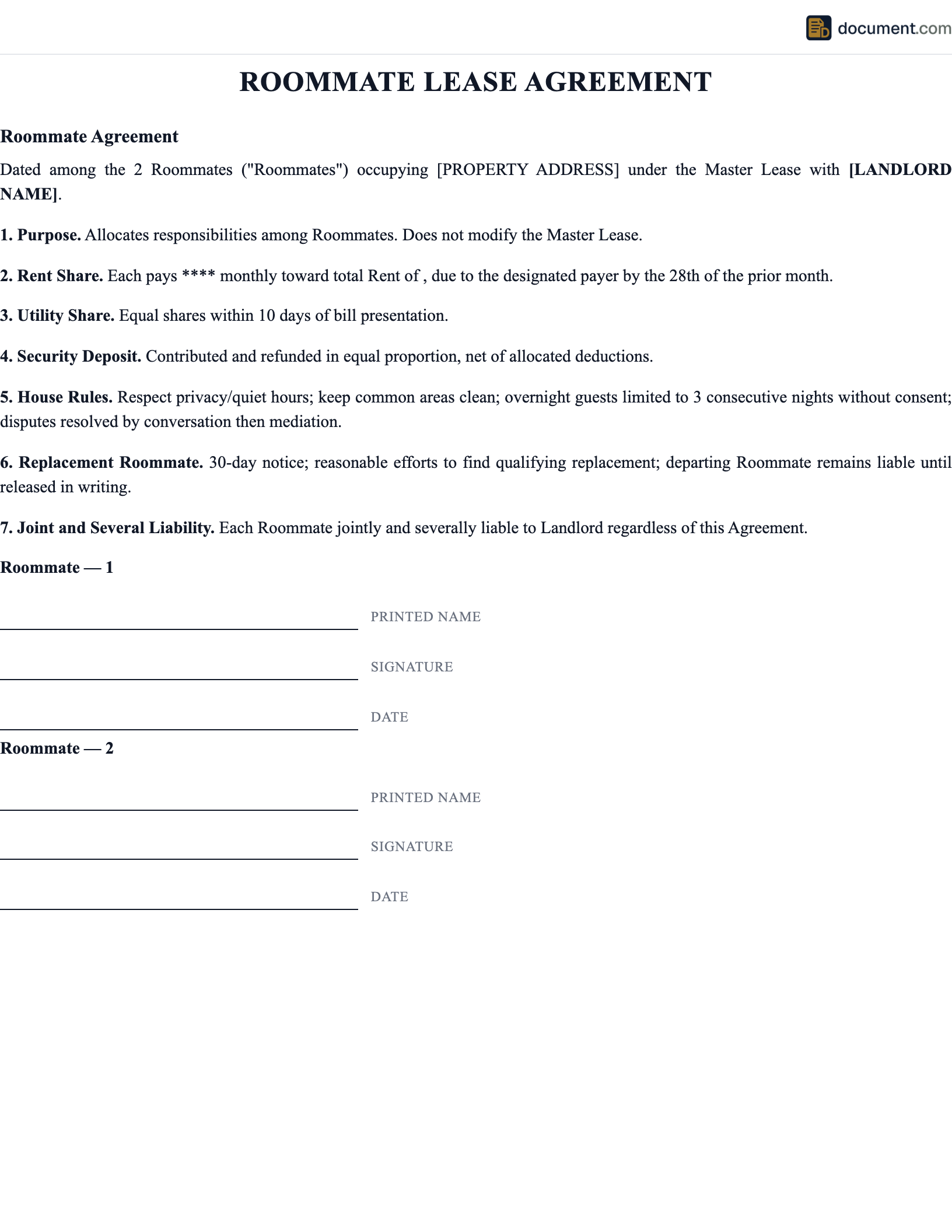
Sample Hawaii Roommate Agreement
Below is a preview of our Hawaii-specific roommate agreement template.
STATE OF HAWAII
ROOMMATE AGREEMENT
Private Agreement Between Co-Tenants
ROOMMATES:
1. [Name] — Room: [Room]
2. [Name] — Room: [Room]
PROPERTY
Address: [Hawaii Address]
RENT & EXPENSES
Total Rent: $[Amount]/month
Roommate 1: $[Share] Roommate 2: $[Share]
Hawaii Roommate Agreement FAQ
Answers to common questions about roommate agreements in Hawaii.
Create your Hawaii Roommate Lease Agreement in under 5 minutes.
Answer a few questions and download a Hawaii-compliant document, ready for the state agency.