



What Is a Real Estate Agent IC Agreement?
A real estate agent IC agreement is the written affiliation contract between a licensed brokerage and a licensed salesperson or associate broker. Every state real-estate licensing statute requires the agent to operate under a supervising broker (Cal. Bus. & Prof. Code § 10130; N.Y. Real Prop. Law § 440-a; Tex. Occ. Code § 1101.351; Fla. Stat. § 475.01), and the affiliation contract is the instrument that documents that supervisory relationship while preserving the agent's tax classification as an independent contractor under IRC § 3508. Without the written affiliation, the broker risks license-suspension exposure under state real-estate commission rules and the brokerage loses the federal § 3508 safe harbor.
Three legal regimes govern the relationship simultaneously. First, federal employment-tax law: IRC § 3508 treats the licensed agent as a nonemployee for FICA, FUTA, and federal income-tax-withholding purposes when the three statutory conditions are met (license, output-based compensation, written agreement reciting nonemployee status). Second, state real-estate licensing law: state commissions impose supervisory duties on the broker of record (recordkeeping retention typically 3 to 5 years, advertising compliance, trust-account oversight). Third, state worker-classification law: most states create statutory exemptions for licensed real-estate professionals from the general ABC or economic-realities test (Cal. Lab. Code § 2778; Fla. Stat. § 475.011; Mass. G.L. c. 112, § 87RR; N.Y. Real Prop. Law § 442-c).
The contract addresses the practical realities of the business. Commission splits and caps determine compensation flow at every closing. MLS membership and technology access determine the agent's ability to transact. E&O coverage determines who pays defense costs when a buyer claims failure-to-disclose. Advertising compliance determines who pays the fine when the agent runs an Instagram ad without the brokerage name in the disclosure (a violation in nearly every state). And listing-ownership clauses determine whether commissions on pending transactions follow the agent or stay with the brokerage on departure.
Broker of record and supervisory liability
Every brokerage must designate a broker of record (sometimes called designated broker or principal broker) under state licensing statutes. The broker of record carries personal license-discipline exposure for agent misconduct, including commingling of trust funds (Cal. Bus. & Prof. Code § 10145 imposes strict liability for trust-account violations), failure-to-disclose claims, and fair-housing violations. The IC agreement should require the agent to comply with brokerage policies, attend mandatory compliance training, submit advertising for pre-publication review where state rules permit, and immediately report any complaint, lawsuit, or regulatory inquiry. Brokers carry separate D&O coverage to protect against this exposure.
1099 vs W-2: why the IC model dominates
Roughly 87 percent of the 1.6 million licensed real-estate agents in the United States operate under IC agreements. The dominance is statutorily anchored: § 3508 was enacted in 1982 specifically to provide tax certainty for the industry. A handful of brokerages (Redfin is the most prominent) classify agents as W-2 employees with salaries and benefits, accepting the higher payroll-tax burden in exchange for tighter operational control. The W-2 model withholds income tax under IRC § 3402, pays the employer half of FICA (7.65 percent), pays FUTA on the first $7,000 of wages, and triggers state SUI obligations. Most brokerages and most agents prefer the IC model for the tax advantages and operational autonomy it provides.
IRS Safe Harbor
Compliant with IRC Section 3508 for statutory IC classification protection.
Commission Splits
Flexible split structures: traditional, 100% with fees, tiered, and cap models.
License Compliance
State licensing requirements, CE maintenance, and E&O insurance provisions.
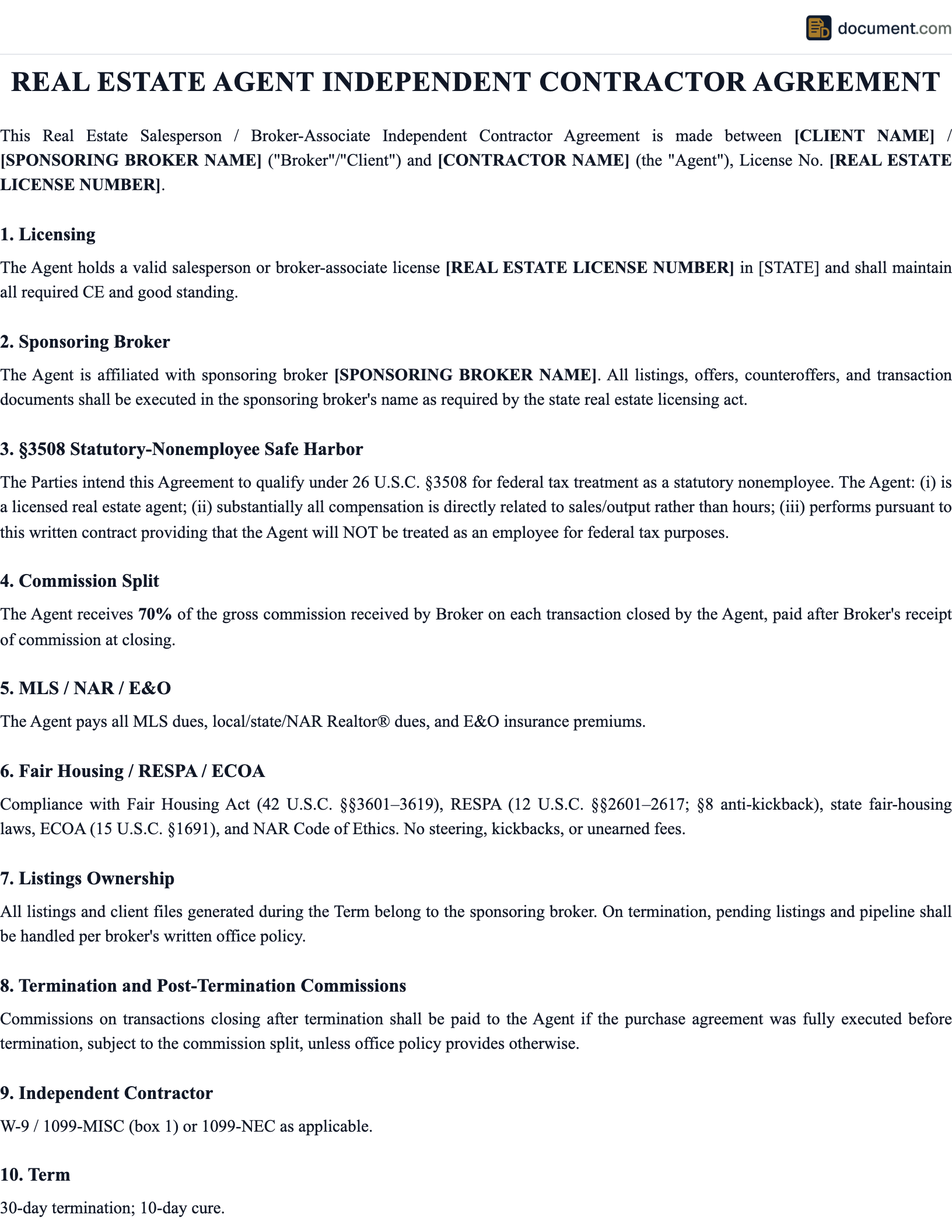
Real Estate Agent IC Agreement Form Preview
Real Estate Agent Independent Contractor Agreement
Broker-Agent Affiliation Agreement
Section 1: Parties
Section 2: Commission Split
Section 3: IC Status (IRS Safe Harbor)
Agent is an independent contractor and shall not be treated as an employee for federal tax purposes. Substantially all compensation is based on sales output, not hours worked.
Key Components
| Component | Description |
|---|---|
| Parties & Licenses | Brokerage entity, broker of record, agent name, and respective license numbers |
| IC Status & Safe Harbor | Express IC acknowledgment satisfying IRC 3508 requirements |
| Commission Structure | Split percentage, tiers, caps, desk fees, and per-transaction fees |
| Commission Payment | When commission is earned, when paid (at closing or after), and 1099 reporting |
| MLS & Technology | MLS access, CRM, transaction management, and technology fee allocation |
| E&O Insurance | Group or individual E&O coverage, minimum limits, and claims reporting |
| Advertising | Brokerage branding requirements, state advertising rules, and social media policies |
| Listings & Clients | Listing ownership, client file management, and lead distribution policies |
| License Maintenance | CE requirements, license renewal, disciplinary action notification |
| Termination & Transition | Notice period, pending transaction handling, post-departure commissions, and non-solicitation |
How to Create a Real Estate Agent IC Agreement
Identify the parties and licenses
Brokerage legal name and license number, broker of record name and license number, agent legal name and license number, and state of licensure.
Include the IRS safe harbor language
An express statement that the agent is an IC, compensation is based on sales output (not hours), and the agent will not be treated as an employee for federal tax purposes.
Define the commission structure
Split percentages, tiered thresholds, annual cap amount (if applicable), desk fees, per-transaction fees, and referral fee policies.
Set commission payment terms
When commission is earned (at closing), when paid (within X days of closing or brokerage receipt), and the process for disputed commissions.
Address E&O insurance and MLS access
Group vs. individual E&O, coverage minimums, MLS membership and fee allocation, and technology platform access.
Include advertising and compliance
Brokerage branding requirements, state advertising rules, fair housing compliance, and social media guidelines.
Add termination and transition provisions
Notice period, handling of active listings and pending transactions, post-departure commission entitlement, and non-solicitation of agents and clients.
Commission Structures
| Model | How It Works | Best For |
|---|---|---|
| Traditional Split | Brokerage takes 20-50% of each commission | New agents who need brokerage support |
| 100% + Desk Fee | Agent keeps 100%, pays monthly desk fee ($500-2,000) | High-producing agents |
| Tiered Split | Split improves as agent hits volume thresholds | Growing agents motivated by production |
| Cap Model | Agent pays split until cap reached, then 100% | Mid-to-high producers (e.g., Keller Williams) |
IRS Safe Harbor Rules (IRC Section 3508)
The IRS safe harbor for real estate agents is one of only two statutory safe harbors for independent contractor classification in the entire Internal Revenue Code. It provides certainty that is unavailable in most other industries.
Requirement 1: Licensed Professional
The agent must be a licensed real estate professional under state law.
Requirement 2: Output-Based Compensation
Substantially all compensation must be directly related to sales or other output, not hours worked. Commission-based pay satisfies this requirement.
Requirement 3: Written Contract
A written agreement must state that the agent will not be treated as an employee for federal tax purposes. This is the IC agreement itself.
State Law Note
The federal safe harbor applies only to federal tax classification. Some states apply their own worker classification tests for state tax, unemployment, and workers' comp purposes.
Frequently Asked Questions
Official Resources
NAR - National Association of Realtors
Industry standards, Code of Ethics, and professional resources for real estate agents.
IRS - Independent Contractor Defined
IRS guidance on worker classification and Section 3508 safe harbor.
ARELLO - Association of Real Estate License Law Officials
Directory of state real estate commissions and licensing requirements.
HUD - Fair Housing
Federal fair housing laws and advertising compliance for real estate professionals.
IRS - IRC Section 3508
Statutory safe harbor provisions for real estate agent IC classification.
NAR Code of Ethics
Professional ethics standards governing agent conduct and client relationships.
Create Your Real Estate Agent IC Agreement
Answer a few questions and download a professional broker-agent IC agreement compliant with IRS safe harbor rules.
Create DocumentNo account required. Free to create and preview.