



What Is a PR Independent Contractor Agreement?
A public relations independent contractor agreement binds a company and an outside communications professional (sole practitioner or boutique agency) as principal and contractor rather than employer and employee. The instrument controls the scope of representation, the retainer or project fee, the approval workflow for any external communication, the ownership of press releases and bylined articles under 17 U.S.C. § 201(d), competitive exclusivity, confidentiality reaching unreleased product launches and pre-announcement M&A activity, and the worker classification recital required to satisfy IRS Rev. Rul. 87-41 and the Department of Labor totality test under 29 C.F.R. Part 795. PR work touches the company at exactly the points regulators scrutinize most closely: SEC Reg FD selective-disclosure rules at 17 C.F.R. § 243.100, FTC endorsement guidelines at 16 C.F.R. Part 255, and state UDAP statutes governing influencer disclosure. The contract must allocate those risks before the consultant drafts a single pitch.
Roughly 40 percent of US PR professionals now operate as independent consultants or in shops of fewer than five staff, according to PRSA membership data. Companies hire boutique practitioners to secure senior-level execution without the overhead of a large agency, but the IC structure only holds up if the contract papers it correctly. A loose engagement letter that calls the relationship freelance while embedding the consultant in daily standups, dictating pitching strategy, and prohibiting outside work invites reclassification under the ABC tests in California (Cal. Lab. Code § 2775), Massachusetts (Mass. Gen. Laws ch. 149 § 148B), and New Jersey. Reclassification triggers back FICA, FUTA, state unemployment contributions, and penalties of up to 100 percent of unpaid taxes under IRC § 3509.
Scope of representation: media relations vs crisis vs thought leadership
Each PR workstream demands different staffing, response time, and pricing. Media relations is the steady-state retainer work: editorial calendar tracking, embargo negotiation, exclusive pitching to named reporters, weekly status calls, monthly placement reports. Crisis communications operate on a separate clock: 2-hour acknowledgment, 4-hour holding statement, 24/7 spokesperson availability, surge billing at 1.5x the standard rate. Thought leadership programs run on quarterly cycles: 4 to 6 ghostwritten bylines per executive per year, speaking opportunity pipeline, awards submissions (Inc. 5000, Fast Company Most Innovative, industry honors), analyst engagement (Gartner, Forrester, IDC). The contract should treat each workstream as a separate exhibit with its own deliverable count, hour allocation, and out-of-scope rate rather than a single retainer fee that masks effort.
Embargo, exclusivity, and Reg FD compliance
PR consultants regularly handle embargoed material (a pre-release of news under a journalist agreement to publish only after a stated time) and exclusives (one outlet receives the story before any other). Both arrangements depend on trust and a written confidentiality structure. The contract should authorize the consultant to negotiate embargoes, require written embargo terms with each journalist (date, time, time zone, asset list), and prohibit the consultant from offering exclusives without client written approval. For public-company clients, the contract should require legal-team review of any communication with a single reporter that conveys material non-public information; SEC Reg FD treats selective disclosure as a 1934 Act violation triggering Form 8-K within four business days. Influencer outreach must comply with the 2023 FTC endorsement guides, including #ad disclosure and substantiation files.
Media Relations
Structured media outreach with defined pitch targets and placement goals.
Confidentiality
Robust NDA provisions for pre-launch products, financials, and crisis scenarios.
Performance Metrics
KPI tracking for media impressions, placements, share of voice, and ROI.
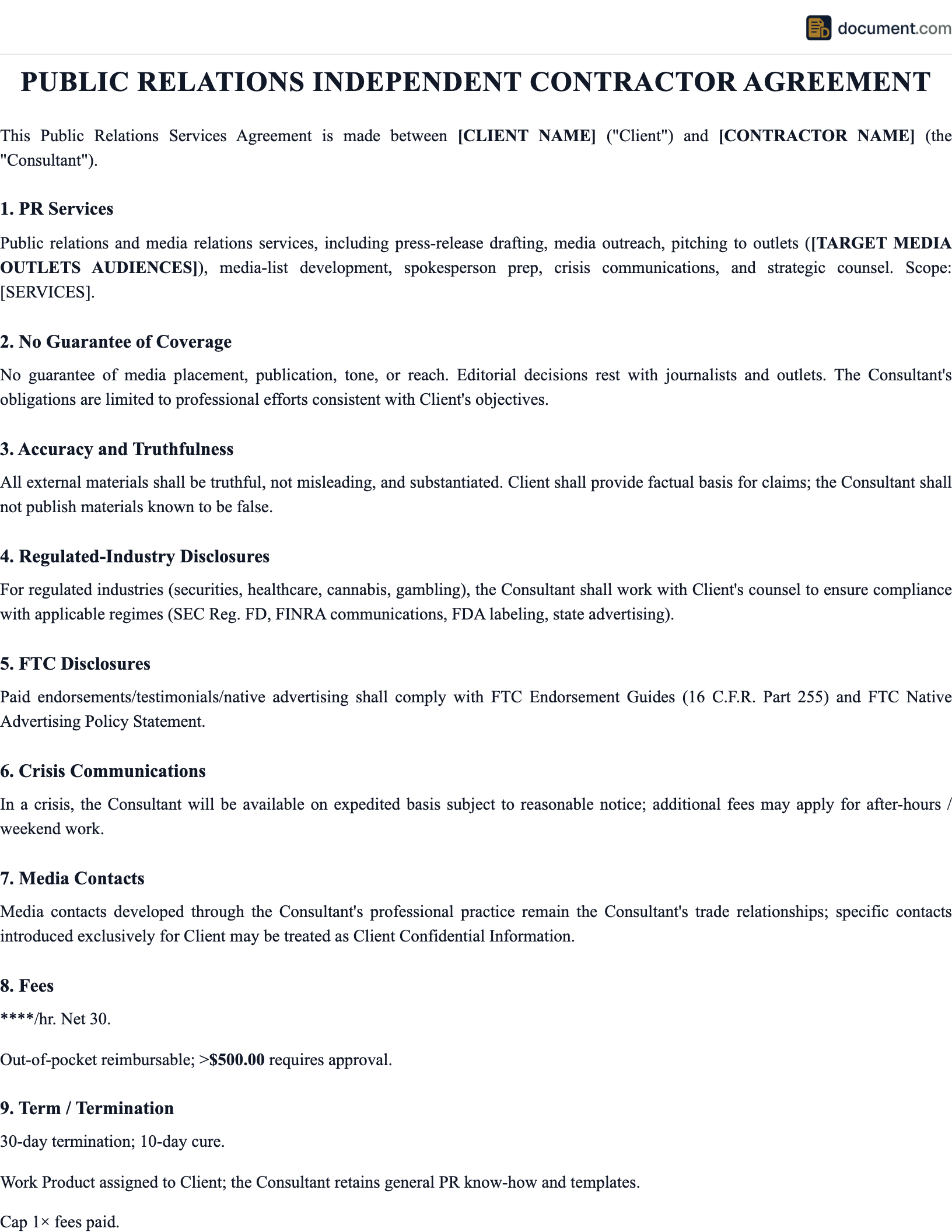
PR Agreement Form Preview
Public Relations Consulting Agreement
Independent Contractor - Strategic Communications
Section 1: Parties
Section 2: Scope of Services
Section 3: Retainer
Monthly retainer of $________ covering ______ hours of service. Additional hours billed at $______/hour with prior approval.
Key Components
Ten clauses do the load-bearing work. Scope of services enumerates deliverables by count, format, and outlet tier so that a press release deliverable becomes "two press releases per month, drafted within 5 business days of brief, distributed via Business Wire after client written approval, with 10 follow-up pitches to named tier-one and tier-two reporters." Retainer and billing fix the monthly fee, the included hour bank, the overage rate, expense pass-throughs (wire distribution, media database access, travel), and net-30 invoicing. Confidentiality covers unreleased product roadmap, M&A discussions, executive changes, financial forecasts, crisis scenarios, and litigation strategy with a survival period of 5 years post termination and perpetual protection for trade secrets under the federal Defend Trade Secrets Act, 18 U.S.C. § 1836.
IP assignment and kill fees
Press releases, media kits, bylined articles, ghostwritten op-eds, video scripts, social posts, and crisis statements are works of authorship under the Copyright Act. Because most PR copy does not fall within the nine work-for-hire categories at 17 U.S.C. § 101, the consultant retains copyright by default; the contract must include both a work-for-hire recital and a § 201(d) absolute assignment. Address pre-existing materials (templates, frameworks, media database) with a non-exclusive license back to the consultant. Kill fees compensate the consultant when a drafted release or ghostwritten article is killed before publication for reasons outside the consultant's control: the standard is 50 percent of the fee for content killed after first draft, 75 percent after revisions, 100 percent after final approval but pre-distribution. Kill fees protect the consultant's investment in research and drafting when a launch slips or strategy pivots.
| Component | Description |
|---|---|
| Scope of Services | Enumerated PR deliverables, monthly hours, and out-of-scope work process |
| Retainer & Billing | Monthly fee, included hours, overage rates, expense reimbursement, and payment terms |
| Confidentiality | NDA covering unreleased products, financials, crisis plans, and competitive intelligence |
| IP Ownership | Assignment of press releases, media kits, messaging documents, and content to client |
| Competitive Exclusivity | Prohibition on representing direct competitors during the engagement |
| Performance Reporting | Monthly reports with defined KPIs: impressions, placements, share of voice, sentiment |
| Crisis Communications | Crisis playbook development, surge availability, and separate billing for crisis work |
| Media List Ownership | Whether journalist contacts developed during the engagement belong to client or consultant |
| Approval Workflow | Client approval required before media outreach, press release distribution, and public statements |
| Termination & Transition | Notice period, successor agency briefing, campaign handoff, and minimum engagement term |
How to Create a PR Agreement
Define the scope of services
List every PR deliverable: media pitches, press releases, media monitoring, spokesperson training, event PR, crisis planning, content creation. Specify monthly quantities where applicable.
Set retainer and billing terms
Monthly retainer amount, included hours, overage hourly rate, expense policy (wire service fees, travel, media event costs), and net-30 payment terms.
Establish the approval workflow
Who approves press releases, media pitches, and public statements before distribution. Define turnaround times for client review (typically 2-3 business days).
Include confidentiality provisions
NDA covering pre-launch information, financial data, executive changes, crisis scenarios, competitive intelligence, and any information marked confidential.
Address IP and media list ownership
Assign all created content to the client. Define whether media lists and journalist relationships are the consultant's property or the client's.
Define performance metrics
Specify KPIs to track (impressions, placements, share of voice), reporting frequency (monthly), and any performance bonuses.
Add termination and transition provisions
30-60 day notice, minimum engagement term (6-12 months recommended), successor briefing obligation, and campaign status documentation.
Common PR Deliverables
Media Outreach
Targeted journalist pitches, editorial calendar monitoring, and relationship building with key reporters.
Press Releases
Drafting, client approval, wire distribution (PR Newswire, Business Wire), and follow-up pitching.
Crisis Communications
Crisis playbook development, rapid-response statements, media training, and post-crisis analysis.
Thought Leadership
Bylined articles, speaking opportunity sourcing, awards submissions, and executive visibility programs.
Media Monitoring
Daily/weekly coverage tracking, sentiment analysis, competitive share of voice, and monthly KPI reports.
Event PR
Pre-event media outreach, press invitations, day-of media coordination, and post-event coverage reporting.
Retainer vs Project Pricing
Pricing structure should track the work pattern, not the consultant's preference. Monthly retainers fit ongoing programs where the consultant must hold capacity for the client across 6 to 24 months: media relations, executive visibility, analyst engagement, regular product news cadence. Retainers run $3,000 to $25,000 for boutique programs and $25,000 to $75,000 for enterprise public-company work. The consultant carries the cost of unused hours one month against surge needs the next, but most contracts cap rollover at one month to prevent open-ended carry. Project fees fit bounded work: a Series B announcement, a CES launch, a conference keynote, a crisis response. Project fees protect both sides from scope creep by tying payment to defined milestones and asset deliveries.
Hybrid models and minimum-spend commitments
Many enterprise PR engagements layer a base retainer (steady-state press relations) over project fees (launches, events) and a crisis hourly rate. The contract should separate the three buckets so that crisis work does not silently deplete the retainer hour bank. Minimum-spend commitments give the consultant predictable revenue (and justify allocating senior counselor time) in exchange for preferred rates: a 12-month commitment of $300,000 might reduce the hourly overage rate from $400 to $325. Avoid performance-only pricing on outlet placements; FTC endorsement guides treat undisclosed pay-for-coverage arrangements as deceptive practices, and most reputable journalists refuse stories tied to the source's compensation structure.
| Factor | Monthly Retainer | Project Fee |
|---|---|---|
| Duration | Ongoing (6-12+ months) | Defined start/end dates |
| Scope | Broad, evolving program | Specific deliverables |
| Pricing | Fixed monthly fee | Lump sum or milestones |
| Best For | Ongoing visibility, media relations | Product launches, events, one-time needs |
| Revenue Predictability | High (for both parties) | Variable |
Frequently Asked Questions
Official Resources
PRSA - Public Relations Society of America
Professional standards, accreditation (APR), and ethics code for PR practitioners.
Institute for Public Relations
Research-based PR measurement, evaluation, and best practices.
PR Newswire
Press release distribution and media monitoring services.
IRS - Independent Contractor Defined
Worker classification guidance for PR consultants.
SBA - Hiring & Contracting
Resources for engaging independent PR consultants.
AMEC - International Association for PR Measurement
Global standards for PR measurement and evaluation (Barcelona Principles).
Create Your PR Agreement
Answer a few questions and download a professional public relations IC agreement tailored to your engagement.
Create DocumentNo account required. Free to create and preview.