
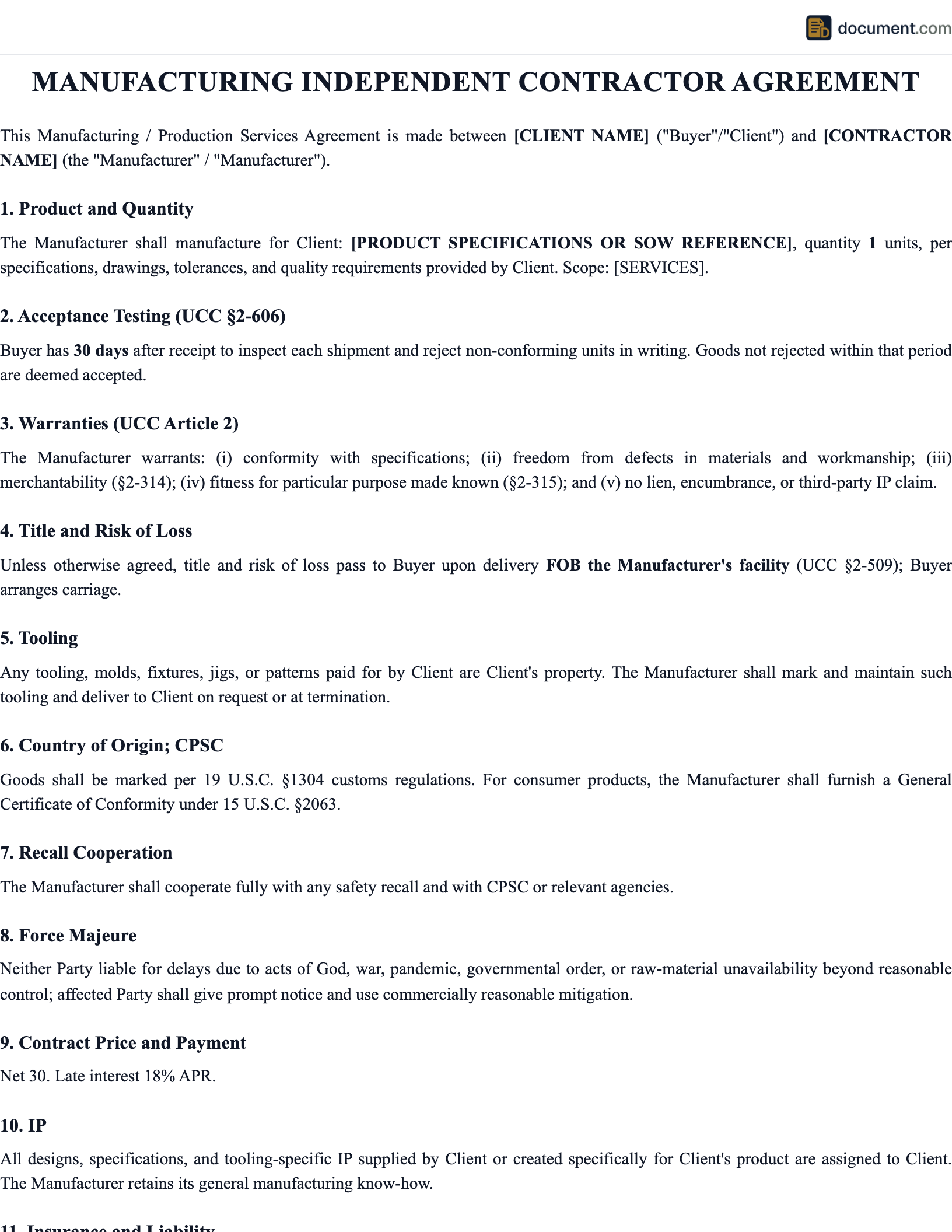



What Is a Manufacturing Contract?
A manufacturing contract is a legally binding agreement between a principal (the company that needs goods produced) and a contract manufacturer (the company that will produce them) that governs every aspect of the production relationship. The principal provides product specifications — engineering drawings, formulations, bill of materials, quality requirements — and the manufacturer agrees to produce the goods to those specifications at an agreed price, volume, and timeline.
Contract manufacturing has become the dominant production model across most industries. Rather than investing in factory infrastructure, equipment, and specialized labor, companies outsource production to specialized manufacturers who can achieve economies of scale, maintain regulatory certifications, and manage the operational complexity of production. The manufacturing contract is the legal framework that makes this outsourcing relationship work — it allocates risk, protects intellectual property, defines quality expectations, and creates accountability on both sides.
Without a comprehensive written agreement, both parties face significant exposure. The principal risks receiving defective goods with no contractual remedy, losing control of proprietary IP, and having no recourse when delivery deadlines are missed. The manufacturer risks scope creep, payment disputes, liability for product defects beyond their control (such as design defects in the principal's specifications), and the loss of a major customer without adequate termination notice. A well-drafted manufacturing contract addresses all of these scenarios before they become disputes.
Precise Specifications
Engineering drawings, tolerances, materials, and testing protocols.
IP Protection
Confidentiality, trade secret safeguards, and anti-reverse-engineering clauses.
Quality Assurance
ISO-referenced inspection protocols with AQL standards and audit rights.
Manufacturing Contract Form Preview
Contract Manufacturing Agreement
Production & Supply
Section 1: Parties
Section 2: Specifications
Section 3: Pricing & Volume
Per-unit price of $______ for orders of ______+ units. Volume discount of ___% applies to orders exceeding ______ units per quarter.
Key Components
| Component | Description |
|---|---|
| Product Specifications | Engineering drawings, BOM, materials, tolerances, and revision control process |
| Pricing & MOQ | Per-unit pricing, volume tiers, MOQ, and raw material escalation clauses |
| Quality Standards | ISO certification requirements, AQL levels, inspection protocols, and audit rights |
| Delivery & Shipping | Lead times, Incoterms, partial shipment policy, and late delivery penalties |
| IP & Confidentiality | IP ownership, trade secret protection, non-disclosure, and anti-reverse-engineering |
| Tooling Ownership | Mold, die, and fixture ownership, maintenance, insurance, and return obligations |
| Warranty | Defect warranty period, remedies (replacement, rework, credit), and exclusions |
| Product Liability | Indemnification, insurance requirements, and recall cost allocation |
| Force Majeure | Supply chain disruptions, natural disasters, regulatory changes, and pandemic provisions |
| Termination | For convenience (with notice), for cause, and wind-down obligations |
How to Create a Manufacturing Contract
Identify the parties and facility
Legal names of principal and manufacturer, manufacturing facility address, and any subcontractor restrictions.
Define product specifications
Attach engineering drawings, BOM, material specifications, tolerances, and the revision control process for specification changes.
Set pricing, MOQ, and payment terms
Per-unit price, volume discount tiers, MOQ, raw material escalation formula, payment terms (net 30-60), and currency.
Establish quality and inspection protocols
Required certifications (ISO, GMP), AQL levels, incoming/in-process/final inspection requirements, and audit rights.
Define delivery and shipping terms
Lead times, Incoterms, packaging specifications, partial shipment policy, and late delivery consequences.
Protect intellectual property
IP ownership confirmation, NDA provisions, anti-reverse-engineering, restrictions on producing similar products for competitors, and trade secret security measures.
Add warranty, liability, and termination
Defect warranty period and remedies, product liability indemnification, insurance minimums, force majeure, and termination for convenience and cause.
Quality Standards & Inspection
Quality control is the backbone of any manufacturing contract. The contract should reference specific quality management system standards and define the inspection framework at every stage of production.
Incoming Material Inspection
Raw materials and components inspected against specifications before entering production. Certificates of compliance and material test reports required from sub-tier suppliers.
In-Process Quality Checks
Statistical process control (SPC) monitoring at critical production stages. First-article inspection (FAI) for new production runs and after any tooling or process change.
Final Inspection & Testing
100% inspection or AQL sampling per ANSI/ASQ Z1.4 standards. Functional testing, dimensional verification, and cosmetic grading before shipment release.
Audit Rights
Principal retains the right to audit the manufacturer's facility, quality systems, and production records with reasonable advance notice (typically 5-10 business days).
Intellectual Property Protection
Protecting proprietary designs, formulations, and processes is one of the most critical functions of a manufacturing contract. The manufacturer gains intimate access to the principal's intellectual property through engineering drawings, CAD files, chemical formulations, production processes, and quality specifications. Without robust contractual protections, the manufacturer could use this knowledge to produce competing products, share it with other customers, or retain it after the contract ends.
IP Ownership Clause
Confirms all IP provided by the principal remains the principal's exclusive property.
Non-Disclosure Agreement
Prohibits disclosure of specifications, processes, and trade secrets to third parties.
Non-Compete Restriction
Prevents manufacturer from producing identical products for competitors during and after the term.
Return & Destruction
Requires return or certified destruction of all IP materials upon contract termination.
Frequently Asked Questions
Official Resources
ISO 9001 - Quality Management
International standard for quality management systems in manufacturing.
NIST Manufacturing Extension Partnership
Federal resources for small and medium manufacturers.
FDA - Medical Device GMP
Good Manufacturing Practice requirements for medical device manufacturers.
CPSC - Business & Manufacturing
Consumer Product Safety Commission manufacturing compliance resources.
ICC Incoterms
International shipping and delivery terms for manufacturing contracts.
SBA - Manufacturing Resources
Small Business Administration guidance for manufacturers.
Create Your Manufacturing Contract
Answer a few questions and download a comprehensive manufacturing agreement that protects your production relationship.
Create DocumentNo account required. Free to create and preview.