



What Is an Influencer Agreement?
An influencer agreement is a legally binding contract between a brand (or its marketing agency) and a social media content creator that governs a paid promotional partnership. The agreement establishes that the influencer is an independent contractor — not an employee — and sets out every material term of the collaboration: the specific content deliverables (Instagram posts, TikTok videos, YouTube integrations, blog articles, podcast mentions), the platforms and formats, the content approval process, the posting schedule, and the minimum period the content must remain live.
Beyond creative terms, the agreement addresses the legal and commercial infrastructure of the relationship: compensation structure (flat fees, affiliate commissions, performance bonuses, product gifting), payment timing and invoicing, content usage rights and licensing scope, exclusivity restrictions, FTC endorsement disclosure requirements, intellectual property ownership, morals clauses, confidentiality obligations, indemnification, and termination provisions. These contracts have become indispensable as the influencer marketing industry has matured from informal gifting arrangements into a multi-billion-dollar professional sector.
The stakes of operating without a written agreement are significant. Brands risk paying for content they cannot reuse in advertising because usage rights were never defined. Influencers risk not getting paid on time or having their content used far beyond what they intended. Both parties risk FTC enforcement actions if disclosure obligations are not contractually mandated and monitored. A well-drafted influencer agreement eliminates these ambiguities and creates an enforceable framework for a professional partnership.
FTC Compliant
Built-in disclosure requirements meeting federal endorsement guidelines.
Content Rights
Clear licensing terms for repurposing content across paid and organic channels.
Flexible Payment
Supports flat fees, affiliate commissions, performance bonuses, and hybrid models.
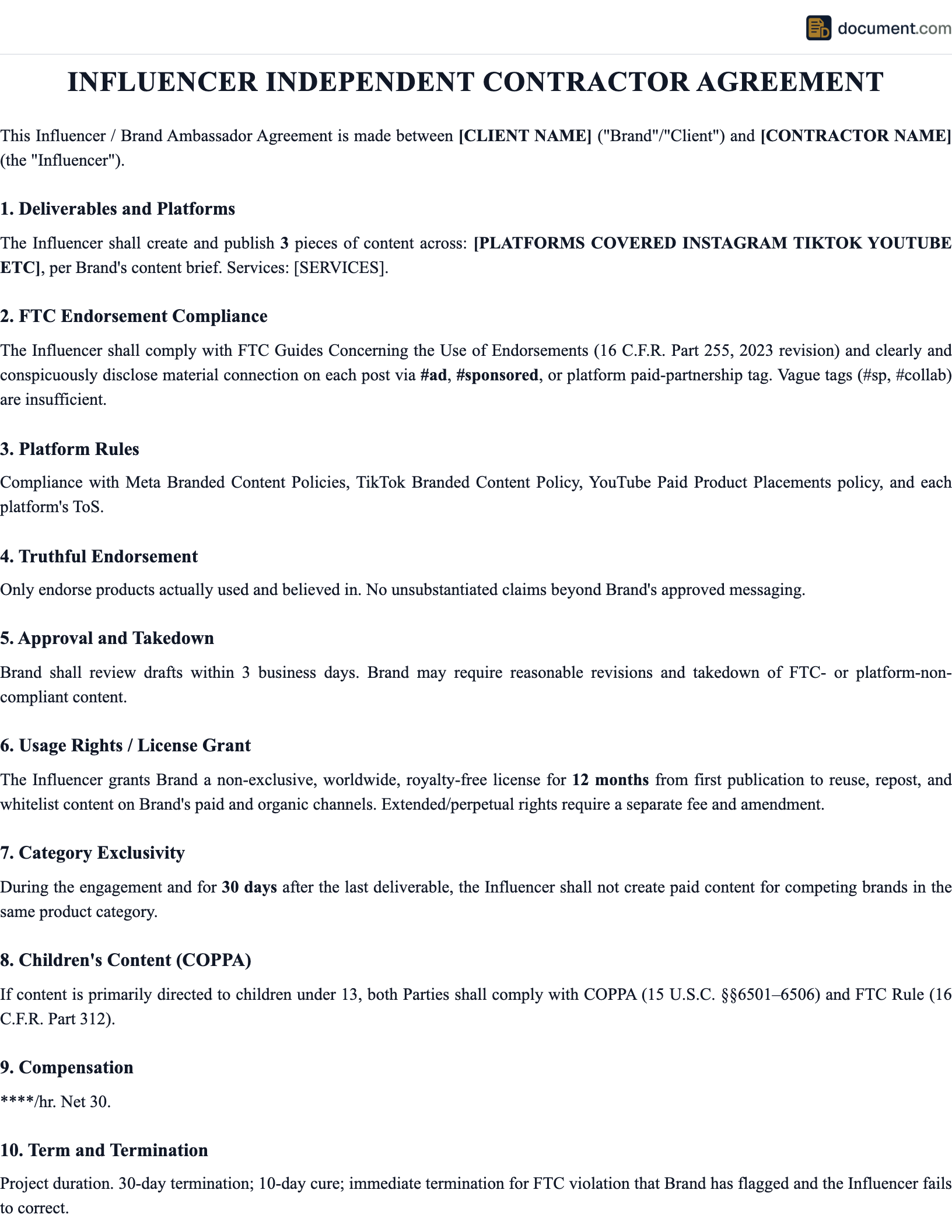
Influencer Agreement Form Preview
Influencer Collaboration Agreement
Brand Partnership Contract
Section 1: Parties
Section 2: Deliverables
Section 3: Compensation
Flat fee of $______ plus ___% affiliate commission on tracked sales through unique discount code.
Section 4: FTC Disclosure
Influencer shall include #ad or "Paid partnership with [Brand]" tag on all sponsored content per FTC Endorsement Guides.
Key Components
| Component | Description |
|---|---|
| Parties & Campaign Name | Legal names of brand and influencer, campaign identifier, and effective dates |
| Deliverables | Specific content pieces, platforms, formats, posting schedule, and minimum live duration |
| Content Approval | Draft submission deadline, brand review period, revision rounds, and deemed-approval timeline |
| Compensation | Fee structure, payment schedule, affiliate tracking, and production cost responsibility |
| Usage Rights | License scope, duration, permitted channels (organic, paid, retail), and sublicensing |
| Exclusivity | Competitive category definition, restricted platforms, and exclusivity window duration |
| FTC Compliance | Required disclosure format, placement, and brand's right to audit compliance |
| Morals Clause | Conduct standards, reputational triggers, and termination rights for either party |
| IP Ownership | Copyright retention by influencer with license grant, or full assignment with premium |
| Confidentiality | Pre-launch product details, campaign strategy, and compensation terms |
| Termination | For convenience with notice, for cause (material breach), and cure periods |
| Indemnification | Mutual indemnity for IP infringement, false claims, and FTC violations |
How to Create an Influencer Agreement
Identify the parties and campaign
Legal name of the brand entity, influencer's legal name and social media handles, campaign name, and effective dates.
Define deliverables in detail
List every content piece by platform and format: feed posts, Stories, Reels, TikToks, YouTube videos, blog posts. Include aspect ratios, minimum duration for video, and hashtag requirements.
Set the content approval workflow
Specify how many days before the posting date the influencer must submit drafts, how many business days the brand has to review, and how many revision rounds are included.
Establish compensation and payment terms
Define the fee structure (flat, affiliate, hybrid), payment milestones (e.g., 50% on signing, 50% on final post), invoicing requirements, and who bears production costs.
Negotiate usage rights and exclusivity
Specify where the brand can reuse content (organic social, paid ads, website, email, retail), for how long, and define the competitive exclusivity category and window.
Include FTC and legal provisions
Require FTC-compliant disclosures on every post, add a morals clause, confidentiality for pre-launch products, indemnification, and governing law.
Execute and distribute
Both parties sign, each retains a copy, and the brand's legal or marketing team calendars the key dates (draft due, review deadline, posting window, payment milestones).
FTC Disclosure Requirements
The FTC's Endorsement Guides (16 CFR Part 255) require that any material connection between an endorser and an advertiser be clearly and conspicuously disclosed. For influencer partnerships, this means every piece of sponsored content must include a disclosure that is impossible for viewers to miss. The FTC has specifically stated that disclosures buried among a sea of hashtags, placed only in the bio or "About" section, or visible only after clicking "more" do not meet the standard.
Use Clear Language
#ad, #sponsored, or "Paid partnership with [Brand]" — not vague terms like #collab, #ambassador, or #sp.
Place Prominently
At the beginning of the caption or superimposed on the video — not buried below the fold or at the end of a long description.
Disclose on Every Post
Each piece of content requires its own disclosure — a single disclosure on one post does not cover subsequent posts in a campaign.
Both Parties Are Liable
The FTC can take enforcement action against both the brand and the influencer for inadequate disclosures. The contract should allocate compliance responsibility.
Content Rights & Usage
Content usage rights are one of the most negotiated and commercially significant terms in any influencer agreement. The default under U.S. copyright law is that the influencer, as an independent contractor, owns the copyright to content they create. The brand receives only the rights explicitly granted in the contract. Usage rights are typically structured as a license rather than a full assignment, giving the brand permission to use the content in specified ways for a defined period.
| Usage Type | Description | Typical Duration |
|---|---|---|
| Organic Social | Reposting on brand's social accounts | 6-12 months |
| Paid Advertising | Boosted posts, display ads, social ads | 3-6 months (premium) |
| Website & Email | Brand website, landing pages, newsletters | 12-24 months |
| Retail & Packaging | In-store displays, product packaging | Negotiated per project |
| Full Assignment | Complete copyright transfer to brand | Perpetual |
Frequently Asked Questions
Official Resources
FTC Endorsement Guides
Federal Trade Commission guidance on social media endorsements and disclosures.
FTC Endorsement Rules (16 CFR 255)
Full text of the FTC's Endorsement Guides regulation.
IRS - Independent Contractor Defined
IRS guidance on worker classification for influencers operating as contractors.
U.S. Copyright Office
Federal copyright registration and content ownership resources.
DOL - Employment Relationship
Department of Labor guidance on independent contractor vs. employee status.
SBA - Hiring & Contracting
Small Business Administration resources for engaging independent contractors.
Create Your Influencer Agreement
Answer a few questions and download a professional influencer contract that protects both the brand and the creator.
Create DocumentNo account required. Free to create and preview.