
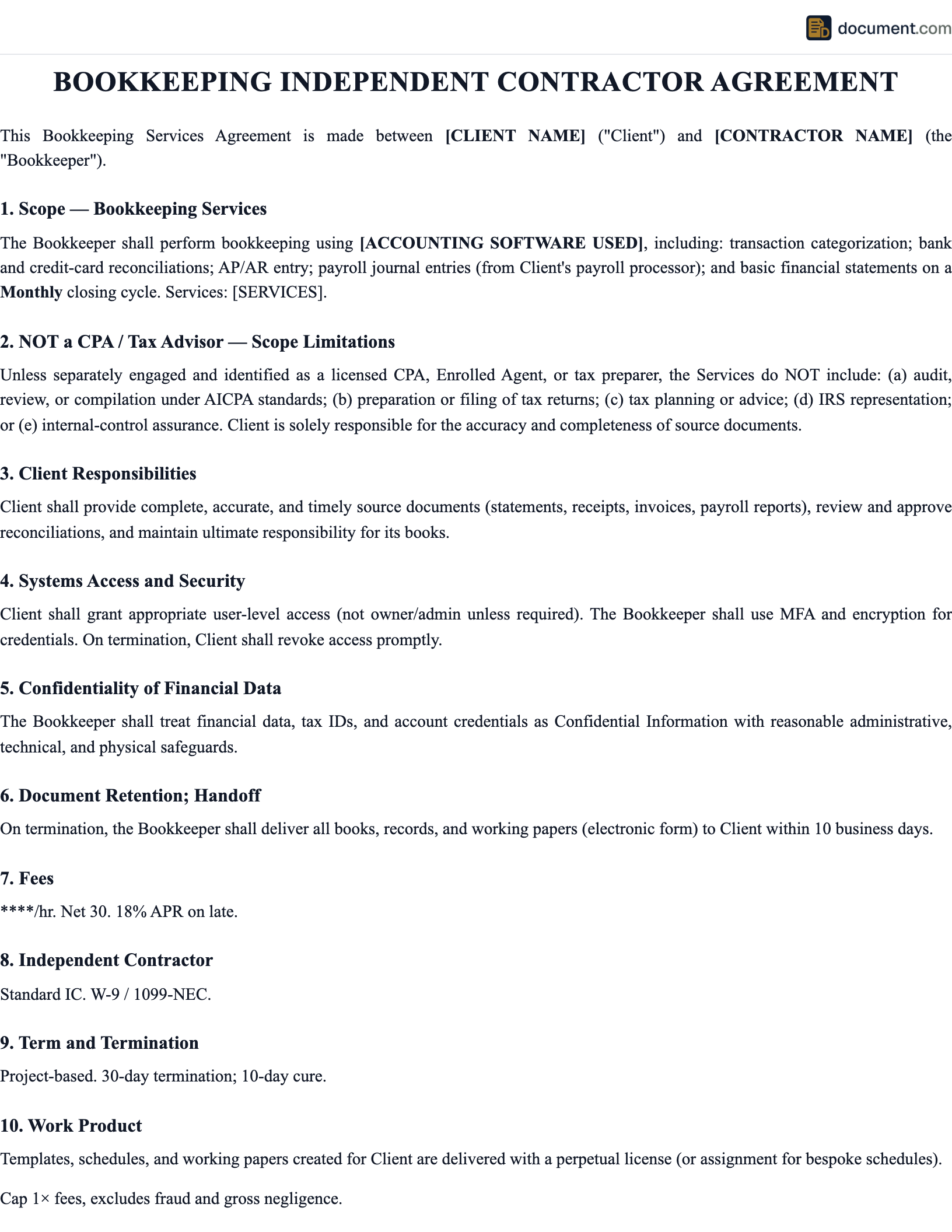



What Is a Bookkeeping Contract?
A bookkeeping contract is a written agreement between a business owner and an independent bookkeeper who will maintain the company's financial records, process transactions, and generate the reports that drive business decisions and tax compliance. The independent bookkeeping industry has expanded dramatically as cloud-based accounting platforms (QuickBooks Online, Xero, FreshBooks) have eliminated the need for an on-site bookkeeper, enabling freelance bookkeepers to serve clients remotely across state lines. This contract governs that remote, independent relationship and addresses the unique considerations of entrusting a contractor with full access to a business's financial infrastructure.
The bookkeeper's role sits at a critical intersection of a business's operations. They see every dollar coming in and going out, know the company's profit margins, have access to bank account information, handle payroll data including employee Social Security numbers and compensation, and often interact with the company's CPA, tax attorney, and financial institutions. This level of access creates both tremendous efficiency (one person can manage the entire financial back-office for a small business) and significant risk (data breaches, unauthorized transactions, embezzlement). A comprehensive bookkeeping contract addresses both sides by defining the scope of services precisely, establishing robust data security and confidentiality protocols, limiting the bookkeeper's authority to transactional activities (no check-signing, no funds transfers, no opening or closing accounts without written authorization), and creating accountability through regular reporting and reconciliation.
Unlike a CPA engagement letter — which is governed by professional accounting standards (AICPA, PCAOB) and typically involves attestation services (audits, reviews, compilations) — a bookkeeping contract covers the operational record-keeping layer. Most independent bookkeepers are not licensed CPAs and cannot perform attest functions. However, the bookkeeper's work product feeds directly into the CPA's tax preparation and advisory work, so the contract should define the handoff process: what reports the bookkeeper delivers to the CPA, in what format, and on what timeline. A clean year-end close delivered on time can save the client thousands in CPA fees; a sloppy one can cost even more.
Financial Accuracy
Defines reporting standards, reconciliation schedules, and error resolution.
Data Security
Covers access controls, encryption, and secure document handling.
Confidentiality
Protects sensitive financial data, bank information, and tax records.
Bookkeeping Contract Form Preview
Bookkeeping Services Agreement
Independent Contractor Engagement
1. PARTIES
This Agreement is entered into between ("Client") and ("Bookkeeper"), an independent contractor providing bookkeeping services.
2. SCOPE OF SERVICES
Bookkeeper shall provide the following services: transaction recording, bank reconciliation, accounts payable/receivable management, monthly financial statement preparation, and using accounting software.
3. DATA ACCESS AND SECURITY
Client shall provide Bookkeeper with user-level access to . Bookkeeper shall not have authority to initiate wire transfers, issue checks, or open/close bank accounts without prior written authorization from Client.
CLIENT SIGNATURE
BOOKKEEPER SIGNATURE
Key Components
| Component | Purpose | Key Details |
|---|---|---|
| Scope of Services | Defines exactly what the bookkeeper will do | Transaction entry, reconciliation, A/P, A/R, payroll coordination, financial statements |
| Software & Access | Governs technology and permissions | Platform (QBO, Xero), access level, bank feed permissions, integration access |
| Reporting Schedule | Sets deliverable timelines | Monthly close deadline, statement delivery dates, year-end package timing |
| Compensation | Documents fees and payment terms | Monthly retainer, hourly rate, per-transaction pricing, payment terms |
| Confidentiality | Protects sensitive financial data | Financial records, bank information, employee data, tax ID numbers, vendor pricing |
| Data Security | Ensures proper data handling | Encryption, secure file sharing, password management, two-factor authentication |
| Record Ownership | Clarifies who owns the financial data | Client ownership of all records, data transfer procedures, post-termination access |
| Liability Limits | Caps exposure for errors | Cap on liability (typically 12 months' fees), E&O insurance, carve-outs for fraud |
How to Create a Bookkeeping Contract
Define the Service Scope
List every financial task the bookkeeper will perform: daily transaction entry, weekly bank downloads, monthly reconciliations, A/P processing and bill payment, A/R invoicing and collections follow-up, payroll processing or coordination with a payroll service (ADP, Gusto, Paychex), sales tax tracking and filing, 1099 preparation, and monthly/quarterly financial statement generation. Be explicit about what is NOT included — tax return preparation, financial advisory, audit support, and CFO-level analysis are typically separate engagements.
Choose the Software and Set Permissions
Identify the accounting platform (QuickBooks Online is used by over 80% of small businesses), determine the access level the bookkeeper needs, and document who owns the subscription. Set up the bookkeeper as a standard user — not an admin — and restrict their permissions so they can enter transactions and generate reports but cannot issue checks, initiate bank transfers, or modify user access without authorization.
Establish the Reporting Schedule
Define deadlines for each reporting deliverable: monthly close (by the 10th-15th of the following month), bank reconciliation (monthly, attached to the close), financial statements (P&L, balance sheet, cash flow — monthly or quarterly), year-end package for the CPA (by January 31), and any industry-specific reports. Include the client's obligation to provide source documents by specific deadlines.
Set Compensation Terms
Choose between monthly retainer (predictable for both parties, common for ongoing bookkeeping), hourly rate ($30-75/hour depending on experience, location, and complexity), or per-transaction pricing (less common, used for high-volume operations). Specify the billing cycle, payment terms (Net 15 or Net 30), and any late payment penalties.
Draft Confidentiality and Data Security Provisions
Require the bookkeeper to protect all financial data with encryption, secure passwords, two-factor authentication on all financial accounts, and secure file-sharing platforms (no emailing spreadsheets with bank account numbers). Prohibit the bookkeeper from sharing financial data with anyone other than the client, their CPA, or their designated financial advisors.
Address Termination and Data Transfer
Specify the notice period (typically 30 days to allow for an orderly transition), the data transfer process (all records delivered in the accounting software plus exported backups in standard formats), the bookkeeper's obligation to cooperate with the successor, and the timeline for revoking all access credentials after termination.
Scope of Bookkeeping Services
The scope-of-services section is the most important part of a bookkeeping contract because it defines the boundary between what the bookkeeper will do and what falls outside their responsibility. An unclear scope leads to scope creep (the bookkeeper gradually takes on additional unpaid work), disputes over deliverables, and gaps in financial management where neither the bookkeeper nor the client realizes a critical task is unassigned.
At minimum, a bookkeeping engagement for a small business typically includes: recording all income and expense transactions in the accounting software; categorizing transactions according to the client's chart of accounts; reconciling all bank accounts, credit card accounts, and loan accounts monthly; managing accounts payable (entering bills, scheduling payments, maintaining vendor records); managing accounts receivable (generating invoices, tracking payments, following up on past-due accounts); preparing monthly profit and loss statements, balance sheets, and cash flow statements; tracking and remitting sales tax (if applicable); coordinating with the client's CPA on tax-related matters; and preparing the year-end financial package for tax preparation. Optional add-on services that should be priced separately include: payroll processing, inventory management, job costing, project profitability analysis, budgeting and forecasting, and financial dashboard reporting.
Unauthorized Practice of Accounting
In some states, certain activities — such as issuing financial statements for third-party use (lender submissions, investor presentations), preparing tax returns, or providing financial opinions — constitute the practice of public accounting and require a CPA license. The bookkeeping contract should clearly state that the bookkeeper is performing record-keeping services only and is not providing accounting opinions, audit or assurance services, or tax advice. Financial statements prepared by the bookkeeper should be labeled "management use only" or "unaudited" to avoid confusion.
Data Security & Access Controls
Data security is paramount in a bookkeeping engagement because the bookkeeper handles the most sensitive financial information a business possesses. A data breach involving bookkeeping records can expose bank account numbers, routing numbers, credit card data, employee Social Security numbers, vendor payment details, and financial performance metrics that competitors would love to access. The contract should establish minimum security standards that the bookkeeper must maintain throughout the engagement.
Essential data security provisions include: two-factor authentication (2FA) on all accounting software accounts and bank feed connections; encrypted storage for all financial documents (AES-256 encryption minimum); secure file-sharing platforms (client portals, encrypted cloud storage) rather than email for transmitting documents containing sensitive information; strong password policies (unique, complex passwords for each client's systems); device security (encrypted hard drives, automatic screen locks, remote wipe capability on laptops and mobile devices); network security (no accessing client financial systems over unsecured public Wi-Fi); and a data breach notification protocol (the bookkeeper must notify the client immediately upon discovering any unauthorized access to financial data).
The principle of least privilege should govern access controls: the bookkeeper should receive only the minimum access necessary to perform their defined services. They should be a standard user in the accounting software, not an administrator. They should have read-only access to bank feeds unless bill-pay functionality is specifically authorized. They should not have the ability to create new users, modify security settings, or export the entire database without the client's knowledge. Segregation of duties — ensuring that no single person can both authorize and execute financial transactions — is a foundational internal control that the contract should support.
Frequently Asked Questions
Official Resources
Authoritative resources on bookkeeping standards, financial record-keeping, and contractor compliance.
AICPA - American Institute of CPAs
Professional standards, ethics guidance, and resources for accounting and bookkeeping.
IRS - Managing Your Books
IRS guidance on record-keeping requirements, accounting methods, and business tax obligations.
QuickBooks ProAdvisor Program
Training, certification, and resources for bookkeepers using QuickBooks.
Xero Advisor Program
Certification and resources for bookkeepers and accountants using Xero.
SBA - Manage Your Finances
Small Business Administration guide to financial management and bookkeeping basics.
FTC - Protecting Personal Information
Federal Trade Commission guidance on safeguarding sensitive financial and personal data.
Create Your Bookkeeping Contract
Protect your financial data with a professional bookkeeping agreement covering scope, security, and accountability.
Create DocumentNo account required. Free to create and preview.