
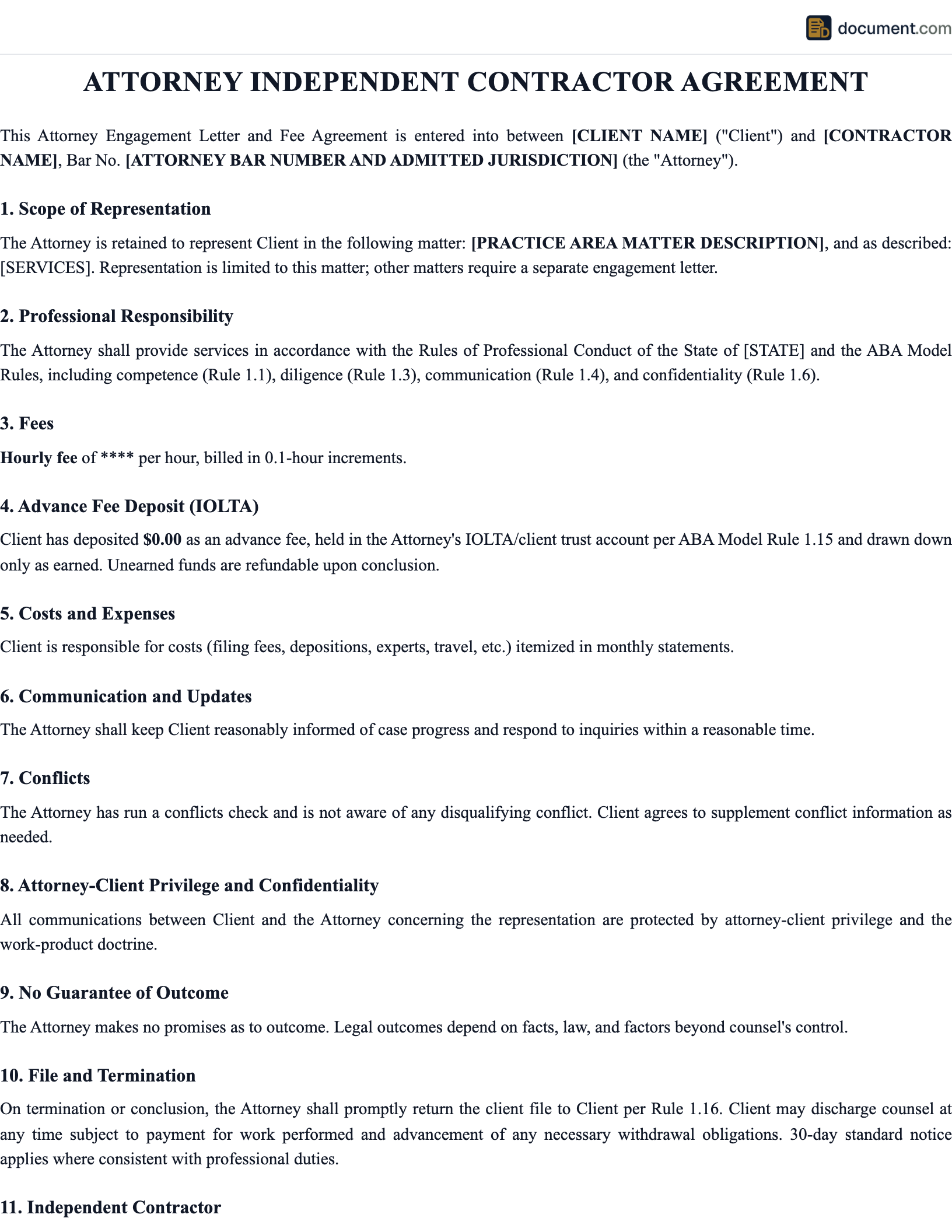



What Is an Attorney Representation Agreement?
An attorney representation agreement for independent contractors is a hybrid document that merges the foundational elements of a legal engagement letter with the structural provisions of an independent contractor agreement. It governs the relationship between a business or individual (the client) and a licensed attorney who will provide legal services without being employed by the client. This arrangement is standard in corporate legal departments engaging outside counsel, law firms hiring of-counsel or contract attorneys for overflow work, litigation support companies staffing document review projects, and startups retaining specialized legal talent they cannot afford to hire full-time.
The agreement occupies a unique regulatory space because it is governed simultaneously by contract law, tax law (IRS worker classification rules), and the Rules of Professional Conduct adopted by the state bar where the attorney is licensed. These three bodies of law sometimes pull in different directions: the ethical rules impose duties of competence, diligence, confidentiality, and loyalty that survive the termination of the contract; the tax rules require that the working relationship genuinely reflect independent contractor status; and the contract itself must be commercially reasonable and enforceable. A poorly drafted agreement can expose the hiring entity to IRS reclassification penalties, the attorney to bar discipline, and both parties to malpractice liability.
The core challenge in drafting this agreement is preserving the independence required for contractor classification while ensuring that the client retains appropriate oversight of the legal work. An attorney who uses the client's office, follows the client's work schedule, attends mandatory staff meetings, and works exclusively for one client looks like an employee to the IRS, regardless of what the contract says. Conversely, a client who exercises no oversight over the attorney's legal strategy may be unable to satisfy their own fiduciary duties (in the case of a corporate legal department) or may receive substandard legal services. The agreement must strike this balance explicitly.
Ethics Compliance
Addresses bar rules, conflicts, privilege, and professional duties.
Fee Transparency
Defines hourly, flat, contingency, or hybrid fee structures clearly.
Malpractice Coverage
Requires the attorney to carry professional liability insurance.
Attorney Representation Agreement Form Preview
Attorney Representation Agreement
Independent Contractor Engagement
1. PARTIES AND EFFECTIVE DATE
This Attorney Representation Agreement ("Agreement") is entered into as of by and between ("Client") and , Esq. ("Attorney"), a licensed attorney admitted to practice in the State of .
2. SCOPE OF REPRESENTATION
Attorney agrees to provide legal services to Client in connection with the following matter(s): . Attorney's representation is limited to the specific matter(s) described herein and does not extend to other legal issues unless separately agreed in writing.
3. INDEPENDENT CONTRACTOR STATUS
Attorney is an independent contractor and not an employee, partner, or agent of Client. Attorney retains sole control over the manner and means of performing the legal services, subject to the professional standards and ethical obligations governing the practice of law.
4. COMPENSATION AND BILLING
Client shall compensate Attorney as follows: . Attorney shall submit invoices and payment is due within days of receipt.
CLIENT SIGNATURE
ATTORNEY SIGNATURE
Key Components
A comprehensive attorney representation agreement must address legal, regulatory, and practical considerations that are unique to the practice of law. Here are the essential components:
| Component | Purpose | Key Considerations |
|---|---|---|
| Scope of Representation | Defines what legal matters the attorney will handle | Must be specific enough to prevent scope creep but flexible enough for matter evolution |
| Fee Arrangement | Establishes compensation structure and billing procedures | Must comply with Rule 1.5 fee-reasonableness standard; contingency fees require written consent |
| Conflict of Interest Protocols | Addresses concurrent and successive conflicts | Advance waivers are permitted but limited in scope; must identify foreseeable conflicts |
| Malpractice Insurance | Requires the attorney to maintain professional liability coverage | Specify minimum limits, additional insured status, and certificate of insurance timing |
| Confidentiality & Privilege | Protects attorney-client privilege and work product | Contractual confidentiality supplements but does not replace ethical duty under Rule 1.6 |
| Intellectual Property | Assigns ownership of legal work product to the client | Attorney retains right to use general legal knowledge; specific work product assigned |
| Termination & Withdrawal | Governs how either party can end the engagement | Attorney withdrawal subject to court approval in litigation; client files must be returned |
| Trust Account Handling | Specifies how retainer funds and client funds are held | IOLTA rules vary by state; unearned funds must be held in trust |
How to Draft an Attorney Representation Agreement
Drafting this agreement requires attention to three overlapping regulatory frameworks: contract law, tax classification law, and bar ethics rules. Follow these steps to create a compliant and enforceable agreement:
Verify Bar Admission & Standing
Confirm the attorney is licensed and in good standing in the jurisdiction(s) where legal services will be provided. Check the state bar's online directory for disciplinary history, verify active status, and confirm pro hac vice eligibility if the matter involves another state's courts.
Define the Scope of Representation
Describe the specific legal matter(s) the attorney will handle — e.g., 'defend Client in Smith v. Acme Corp., Case No. 24-CV-1234, in the U.S. District Court for the Southern District of New York.' Explicitly state what is excluded from the scope to prevent ambiguity.
Select the Fee Structure
Choose hourly, flat fee, contingency, or hybrid billing. Document the rate or fee amount, billing increment (typically 6 or 10 minutes for hourly), expense reimbursement categories, and retainer deposit requirements. Ensure the fee arrangement complies with Rule 1.5.
Address Conflicts and Concurrent Representation
Include a conflicts-check requirement, a disclosure obligation, and a mechanism for resolving conflicts that emerge during the engagement. If the attorney will represent other clients simultaneously, document the advance waiver (where ethically permissible) and any screening protocols.
Specify Insurance and Indemnification
Require the attorney to maintain malpractice insurance at specified limits, provide a certificate of insurance, and notify the client if coverage lapses or is canceled. Include mutual indemnification provisions covering breaches of the agreement.
Document Independent Contractor Status
Include clear language that the attorney controls the manner and means of performing the legal services, is not entitled to employee benefits, is responsible for self-employment taxes, and may work for other clients. Avoid provisions that create behavioral or financial control suggestive of employment.
Execute and Store the Agreement
Both parties should sign the agreement before the attorney begins work. Provide copies to both parties. If the engagement involves litigation, the agreement may need to be disclosed in fee applications or fee disputes. Store the agreement securely as part of the client file.
Attorney Fee Structures Compared
Selecting the right fee structure affects both the economic terms of the engagement and the IRS classification analysis. Here is how the four most common structures compare in the independent contractor context:
| Structure | Best For | IC Classification Impact | Ethics Considerations |
|---|---|---|---|
| Hourly Rate | Litigation, regulatory, advisory work | Neutral — common for both employees and contractors | Must be reasonable under Rule 1.5; document billing increments |
| Flat Fee | Contract drafting, entity formation, regulatory filings | Strong IC indicator — resembles project-based contractor payment | Must be earned on completion; refund rules vary by state |
| Contingency | Plaintiff-side litigation, collections, PI/insurance claims | Strong IC indicator — attorney bears financial risk | Prohibited in criminal and most family law cases; must be in writing |
| Hybrid / Blended | Complex matters with uncertain scope | Moderate — depends on success-fee component | Must clearly specify what triggers the bonus or success fee |
Ethics & Bar Rules for Contract Attorneys
Contract attorneys operate under the same ethical obligations as any practicing attorney, but the independent contractor structure creates additional compliance considerations that the agreement must address. The American Bar Association's Model Rules of Professional Conduct, adopted in some form by every U.S. jurisdiction, impose duties that cannot be waived or modified by contract. These include the duty of competence (Rule 1.1), requiring the attorney to possess the knowledge and skill necessary for the representation; the duty of diligence (Rule 1.3), requiring prompt and thorough attention to the client's matter; and the duty of communication (Rule 1.4), requiring the attorney to keep the client informed of significant developments.
The conflict-of-interest rules (Rules 1.7 through 1.10) are particularly complex for contract attorneys because they serve multiple clients simultaneously. Under Rule 1.7, a lawyer may not represent a client if the representation involves a concurrent conflict of interest — meaning the representation of one client is directly adverse to another client, or there is a significant risk that the representation will be materially limited by the lawyer's responsibilities to another client. For contract attorneys working with multiple law firms or corporate legal departments, identifying and managing conflicts requires systematic screening at the outset of each engagement and ongoing monitoring throughout the relationship.
The duty of confidentiality (Rule 1.6) applies not only during the engagement but indefinitely after it ends. Contract attorneys must maintain information barriers between their various clients, which becomes particularly challenging when the attorney works from a shared workspace or uses the same devices for multiple engagements. The agreement should require the attorney to implement reasonable data security measures, use separate files and communication channels for each client, and certify compliance with confidentiality protocols.
Unauthorized Practice of Law (UPL) Risk
If the contract attorney will provide legal services in a state where they are not admitted, they may need to seek pro hac vice admission (for litigation), temporary practice authorization (for transactional work), or practice under the supervision of a locally admitted attorney. The agreement should require the attorney to maintain proper licensing in every jurisdiction where services are performed.
Frequently Asked Questions
Official Resources
Authoritative resources on legal ethics, attorney engagement, and professional responsibility.
ABA Model Rules of Professional Conduct
Complete text of the Model Rules governing attorney ethics and conduct.
IRS - Worker Classification
IRS guidance on determining whether a worker is an employee or independent contractor.
ABA Ethics & Professional Responsibility
Ethics opinions, resources, and guidance on professional conduct issues.
ABA - State Court Directory
Links to every state bar and court system for verifying attorney licensing.
DOL Fact Sheet 13 - Employment Relationship
Department of Labor guidance on the economic reality test for worker classification.
ABA Model Rule 1.5 - Fees
Rules governing reasonable fees and fee arrangements in legal representation.
Create Your Attorney Representation Agreement
Generate a bar-compliant attorney representation agreement that defines scope, fees, conflicts, and professional obligations.
Create DocumentNo account required. Free to create and preview.