
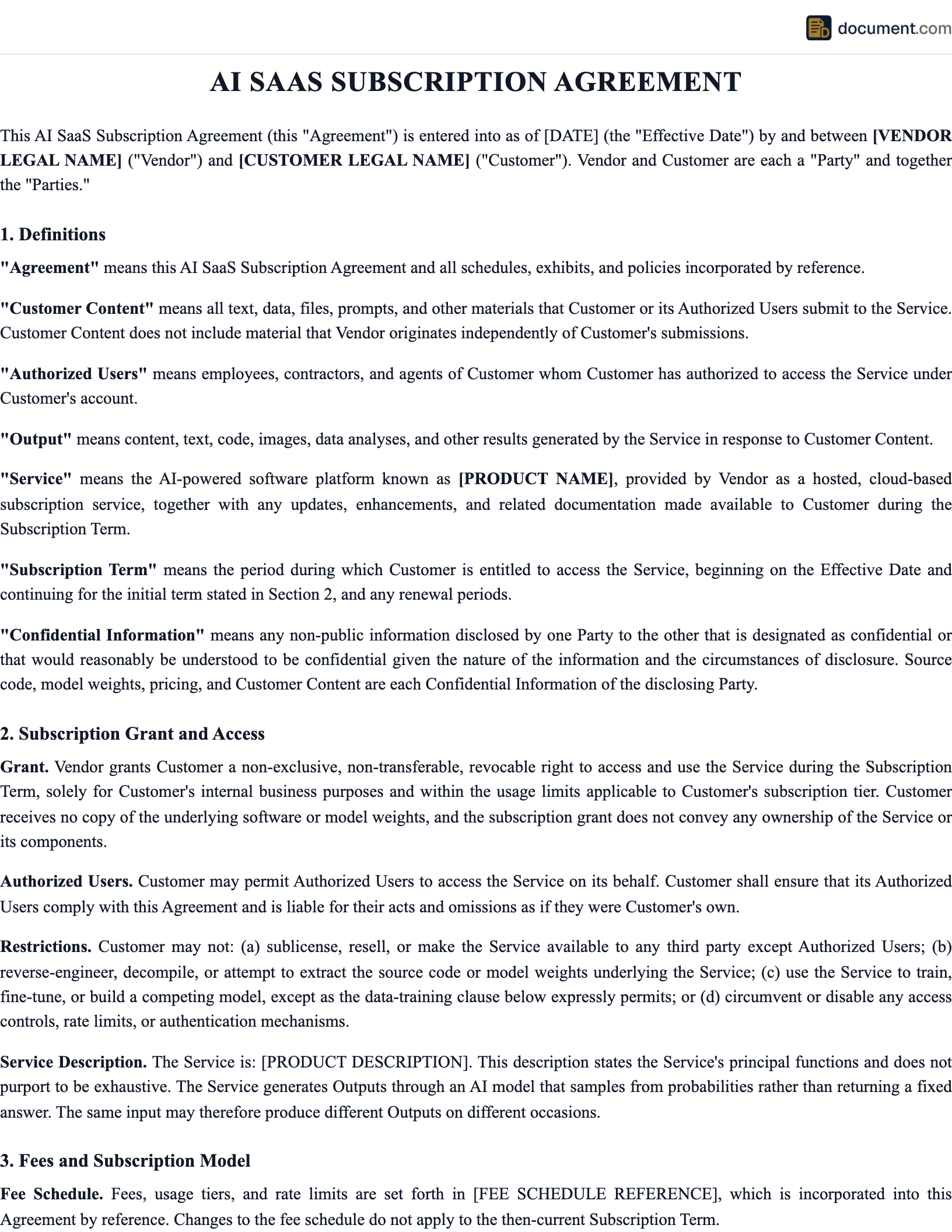



Key Takeaways
- •An AI SaaS subscription agreement is a standard software-as-a-service contract carrying four AI-specific add-ons: a data-training restriction, an output-ownership clause, an AI-aware indemnity, and transparency language tied to the EU AI Act.
- •The data-training clause is the most contested term. Market practice in 2026 is no training on paid customer content by default. Anthropic's commercial terms and OpenAI's enterprise and API terms both follow this, but you must put it in writing because consumer-tier defaults run the other way.
- •Purely AI-generated output cannot be copyrighted in the United States. After the Supreme Court denied review in Thaler v. Perlmutter on March 2, 2026, your agreement should assign whatever rights exist and warn the customer that registering a copyright requires meaningful human authorship.
- •Standard liability caps of twelve months of fees cover a fraction of a real loss. The 2025 average data-breach cost ran about $4.5 million. Negotiate a separate uncapped IP indemnity and a higher super-cap for data incidents.
- •EU AI Act Article 50 transparency duties bite on August 2, 2026, with a grace period to December 2, 2026 for machine-readable marking on systems already deployed. If your tool talks to EU users or generates content for them, build the disclosure into the contract now.
- •A complete package runs to more than one document: pair the subscription agreement with a GDPR Article 28 data processing agreement, an acceptable use policy, a service level agreement, and a current sub-processor list.
Reviewed for accuracy by the document.com legal team. Educational information, not legal advice.
What Is AI SaaS Subscription Agreement?
An AI SaaS subscription agreement is the contract under which a vendor licenses a hosted, AI-powered software product to a paying customer on a recurring basis. It does everything a normal software-as-a-service contract does, governing the subscription term, fees, renewal, support, uptime, and termination, and then it adds the clauses that exist only because artificial intelligence sits inside the product.
Strip away the AI and you have a familiar instrument. The vendor grants a non-exclusive, non-transferable right to access a cloud platform. The customer pays a recurring fee, per seat, per token, per outcome, or some hybrid of those. Nobody buys a copy of the software, so there is no perpetual license and no source code escrow in the usual case. The vendor keeps the code and the customer keeps its own data.
What makes this agreement its own animal is that the product processes the customer's prompts and content through a large language model or other machine-learning system and generates new material in response. That single fact reshapes four clauses a generic SaaS template handles badly: who can train on the customer's data, who owns the answers the model produces, who pays if an answer copies someone's protected work, and what the vendor must disclose to end users about the fact that they are talking to a machine.
Vendors and customers reach this contract from opposite directions. A vendor wants a defensible template it can sign across hundreds of accounts without renegotiating the core. A customer, often an enterprise buyer with a security team and outside counsel, wants the data-training restriction, the indemnity, and the data processing agreement nailed down before legal will approve the purchase. The body of this guide walks both sides through the terms that actually get fought over.
Why This Matters Now
The legal ground under AI contracts shifted hard between 2024 and 2026, and the agreements signed before that shift are now stale. The EU AI Act became law on August 1, 2024, and its transparency obligations under Article 50 reach full force on August 2, 2026. Any vendor whose tool interacts with or generates content for users in the European Union has to tell those users they are dealing with an AI system and mark AI-generated content in a machine-readable way.
The copyright picture also settled in ways that change drafting. In Bartz v. Anthropic, the Northern District of California held on June 23, 2025 that training on lawfully acquired books was transformative fair use, while retaining pirated copies was not, and the case resolved in a $1.5 billion settlement, the largest in AI copyright history. Days earlier, the court in Kadrey v. Meta dismissed part of the authors' claims on fair use grounds. Then on March 2, 2026 the Supreme Court declined to hear Thaler v. Perlmutter, leaving in place the rule that output generated without human authorship cannot be registered.
Regulators are not waiting either. The SEC named AI a top examination priority for 2026 and has already settled cases against companies that overstated what their AI could do, a practice the agency calls AI washing. The FTC continues to apply Section 5 of the FTC Act to unsubstantiated AI capability claims and to deceptive cancellation flows, even after a federal appeals court vacated its 2024 click-to-cancel rule on procedural grounds.
At the state level, Colorado's AI Act, SB 24-205, was pushed from its original February 1, 2026 start to June 30, 2026. California's AB 2013 training-data transparency law took effect January 1, 2026, and the CPRA rules on automated decision-making technology phase in through January 1, 2027. A contract drafted to last needs to anticipate all of this, not just the law on the day it is signed.
The Legal Backbone
EU AI Act, Article 50 transparency obligations
Regulation (EU) 2024/1689, the EU AI Act, entered into force on August 1, 2024. Article 50 is the piece that touches ordinary SaaS products most directly. It requires that a person interacting with an AI system, such as a chatbot, be told they are interacting with a machine unless that is obvious, and it requires AI-generated or AI-manipulated content to be marked in a machine-readable format. These duties apply from August 2, 2026. Systems already in deployment get until December 2, 2026 to add the machine-readable marking. If your product answers customers with an AI or produces text, images, audio, or video for them, you owe a disclosure and a label, and the contract should state which party, vendor or customer, implements each before those dates. Non-compliance can be treated as a deceptive practice under EU law. Confirm the current text and the European Commission's transparency guidelines before you rely on any specific implementation.
GDPR Article 28 and the data processing agreement
Whenever your AI platform processes personal data on behalf of an EU customer, the General Data Protection Regulation treats you as a processor and the customer as the controller. Article 28 requires a binding written data processing agreement. That DPA must say you act only on the controller's documented instructions, implement appropriate security, disclose and get approval for sub-processors (which for AI products means listing OpenAI, Anthropic, Google Cloud, or whoever sits underneath you), and help the customer respond to data-subject requests. Article 33 adds a 72-hour breach-notification clock to the supervisory authority. The European Data Protection Board's Opinion 28/2024, issued December 17, 2024, confirms that training a model on personal data is its own processing activity needing its own lawful basis, either consent or a documented legitimate-interest assessment. For GDPR purposes, training and inference are separate events, so the DPA has to treat them separately.
California CCPA/CPRA, AB 2013, and AB 1008
California's privacy regime now reaches AI directly. Under the CCPA as amended by the CPRA (Cal. Civ. Code 1798.100 et seq.), a vendor processing data on a business's behalf signs a service provider agreement and is barred from using that data for its own commercial purposes. AB 1008, effective January 1, 2025, clarified that personal information stays personal information even when it is embedded inside an AI system. AB 2013, effective January 1, 2026, requires developers of generative AI made publicly available in California to post documentation about the datasets used to train it. The CPRA rules on automated decision-making technology, covering notice, access, and opt-out for significant decisions in areas like employment, housing, insurance, and credit, phase in toward a January 1, 2027 compliance date. Build hooks for these into the agreement even if your current customer base is small.
Colorado AI Act (SB 24-205)
Colorado was the first state to pass a comprehensive AI law, SB 24-205, signed in 2024. It governs high-risk AI systems that make consequential decisions in employment, lending, education, housing, insurance, healthcare, and government services. Developers owe a duty of reasonable care against algorithmic discrimination and must disclose known risks. Deployers run annual impact assessments, disclose AI use before a decision, and give consumers a path to appeal an adverse decision with human review. The Colorado Attorney General has exclusive enforcement with a 60-day cure period, penalties run up to $20,000 per violation under the Colorado Consumer Protection Act, and there is no private right of action. The effective date moved from February 1, 2026 to June 30, 2026. If your AI feeds consequential decisions, a Colorado-touching customer will want contractual support for its deployer obligations.
US copyright law and AI output ownership
The US Copyright Office holds that a work generated entirely by AI without meaningful human authorship cannot be registered, and the courts have backed that position. In Thaler v. Perlmutter, the D.C. Circuit affirmed the denial of registration for an AI-authored image, and on March 2, 2026 the Supreme Court denied certiorari, ending the appeals. The practical consequence for your contract: you can assign or license whatever rights exist in the output, but you cannot promise the customer a registrable copyright in something the machine made on its own. The customer needs to contribute meaningful human creative input to claim copyright. On the training side, Bartz v. Anthropic and Thomson Reuters v. Ross Intelligence show the fair-use line is still being drawn, with general-corpus training treated more favorably than copying of structured, curated material like Westlaw headnotes. Both realities belong in the IP section of the agreement.
FTC Act Section 5 and auto-renewal rules
The Federal Trade Commission has no standalone AI statute. It applies Section 5 of the FTC Act, which prohibits unfair or deceptive acts, to two things that matter here. First, unsubstantiated AI claims: calling a product accurate, intelligent, or human-level without evidence invites an enforcement action, the conduct the agency labels AI washing. Second, subscription mechanics: the FTC's 2024 negative-option rule, the click-to-cancel rule, was vacated by a federal appeals court in 2025 on procedural grounds, but the underlying principle survives in FTC guidance and in state laws like California's Automatic Renewal Law. Cancellation must be as easy as sign-up, auto-renewal must be disclosed and affirmatively chosen, and a 2024 FTC study found 76% of the SaaS companies it reviewed used at least one dark pattern. Keep your renewal and cancellation terms clean.
The clauses that decide the deal
Every AI SaaS subscription agreement carries the ordinary SaaS skeleton: a grant of access, a fee schedule, a term, renewal and termination, warranties, limitation of liability, and the boilerplate at the back. I am going to spend almost no time on that skeleton because it is well understood. The clauses below are the ones that turn a generic template into a defensible AI contract, and they are the clauses enterprise legal teams red-line first.
Start with data training, because it is the term most likely to stall a deal. The question is whether the vendor may use the customer's prompts, uploaded content, and the model's outputs to improve or retrain its models. Market practice converged in 2026 on a clear answer for paid products: no training on customer content by default. Anthropic's commercial terms state plainly that it does not train on customer content from paid services, a default that covers the Claude API, Claude for Work, and its Bedrock and Vertex AI integrations. OpenAI clarified in 2025 that ChatGPT Enterprise, Team, and EDU data is not used for training and that API inputs are not trained on, with logs kept roughly 30 days for abuse monitoring. The catch is that consumer-tier defaults often run the opposite way, so you cannot assume the protection carries over. Put it in the contract. Spell out that customer content will not be used to train, fine-tune, or improve any model, name any narrow exception, and tie any opt-in to explicit written consent with a lawful basis if EU personal data is involved.
Output ownership comes next, and here you have to be honest about a limit you cannot draft around. The vendor should assign to the customer all of the vendor's right, title, and interest in the output, or grant a broad license if assignment is impractical. But the assignment can only convey rights that exist, and after Thaler v. Perlmutter, purely machine-generated output has no copyright in the United States. Say so. A good clause assigns whatever rights exist, disclaims any warranty that the output is protectable or registrable, and reminds the customer that meaningful human authorship is the price of a registrable copyright. Address derivative works and the customer's right to use, modify, and commercialize the output without further permission.
Then the indemnity, which is where the money lives. Traditional SaaS contracts cap total liability at twelve months of fees. For a $100,000 annual contract that is a $100,000 ceiling, against an average 2025 data-breach cost around $4.5 million. The cap covers a sliver of a real loss. AI makes this worse because output is non-deterministic: the same input can produce different results, so the vendor cannot guarantee an answer will never reproduce protected material. The market response is a tiered structure. Keep a general cap of twelve to twenty-four months of fees for ordinary breach. Carve out a higher super-cap, often two to three times annual fees or a fixed multi-million figure, for data incidents. And carve the third-party IP infringement indemnity out of the cap entirely, so it sits uncapped. Most vendors now offer a copyright shield for output infringement, but read the conditions: the protection usually depends on the customer keeping the vendor's guardrails in place and using the service as intended, and it usually excludes any warranty of output accuracy or fitness.
Usage limits and acceptable use round out the AI-specific core. AI products are metered in ways legacy SaaS is not, by requests per minute, tokens per minute, requests per day, and tokens per day, with per-token billing projected to reach 42% of AI SaaS revenue by 2026. The agreement should reference a published rate-limit schedule rather than burying numbers in the body, so you can update tiers without amending the contract. Pair it with a fair-use and acceptable-use policy that prohibits scraping, systematic extraction, training a competing model on your outputs, and generating illegal content, and that reserves the right to suspend an account for systematic abuse. The service level commitment deserves real attention in an AI context. Uptime alone falls short when a model can be available but wrong, so consider committing to accuracy or fallback behavior alongside the traditional 99.9% availability number, and publish a live status page the way Stripe and Notion do.
When You Need This
You sell or buy access to a hosted product that uses a large language model or other AI to generate text, code, images, audio, video, or decisions, on a recurring subscription rather than a one-time purchase.
You are a vendor onboarding enterprise customers whose security and legal teams will not approve a purchase until the data-training restriction, the indemnity, and a GDPR Article 28 data processing agreement are signed.
Your AI tool processes personal data of EU residents, which triggers GDPR processor obligations and a written DPA, or it interacts with or generates content for EU users, which triggers EU AI Act Article 50 disclosure duties from August 2, 2026.
Your customers operate in California and your product processes data on their behalf, which calls for a service provider agreement under the CCPA/CPRA and may implicate AB 2013 training-data documentation and the CPRA automated-decision-making rules.
Your AI feeds consequential decisions in employment, lending, housing, insurance, healthcare, education, or government services, where the Colorado AI Act and similar state frameworks impose developer and deployer duties your contract should support.
You need to update an AI SaaS contract written before 2025 that does not address the EU AI Act, the post-Thaler copyright reality, or the tiered-liability and copyright-shield norms that hardened during 2025 and 2026.
How to Fill Out AI SaaS Subscription Agreement
1. Set the parties, the service, and the subscription model
Name the vendor and the customer with full legal entity names and states of formation. Describe the AI service precisely enough to be enforceable: the product name, what it does, and the fact that it generates output using AI. Pick the pricing model and state it, whether per seat, per token, per outcome, or a hybrid, and attach the rate-limit and fee schedule by reference so you can update tiers without reopening the contract. Set the initial term, the renewal mechanic, and the notice period for non-renewal.
2. Draft the access grant and reservation of rights
Grant the customer a non-exclusive, non-transferable, revocable right to access and use the hosted service during the term, limited to the customer's internal business purposes and to the authorized user count or usage tier purchased. Reserve to the vendor all rights not expressly granted, including the underlying software, models, and any improvements. Confirm that the customer receives no copy of the software and no rights in the vendor's models or weights.
3. Write the data-training restriction
State that the vendor will not use customer content, including prompts, uploaded data, and outputs, to train, fine-tune, or improve any model, full stop, by default. If you allow an exception, make it opt-in, in writing, and conditioned on a lawful basis when EU personal data is involved. Address de-identified or aggregated data separately and define it tightly if you intend to use it. The customer's security team reads this clause first, so make it unambiguous.
4. Allocate output ownership honestly
Assign to the customer all of the vendor's right, title, and interest in the outputs generated for that customer, or grant a broad perpetual license if assignment is impractical. Add a sentence acknowledging that purely AI-generated output may not be protectable by copyright in the United States and that the customer should contribute meaningful human authorship to secure any registrable right. Disclaim any warranty that the output is original, non-infringing, or registrable. Cover the customer's right to modify and commercialize the output.
5. Build the tiered liability and indemnity structure
Set a general liability cap, commonly twelve to twenty-four months of fees. Add a separate, higher super-cap for data-security incidents, often two to three times annual fees or a fixed figure. Carve the third-party IP infringement indemnity out of the cap so it runs uncapped, and state the copyright-shield conditions clearly: the customer must keep guardrails in place and use the service as permitted. Exclude warranties of output accuracy and fitness for a particular purpose, in writing.
6. Attach the data processing agreement and sub-processor list
For any deal touching EU or, in practice, most enterprise personal data, append a GDPR Article 28 data processing agreement as a separate exhibit rather than burying processor terms in the body. The DPA should cover documented-instruction processing, security measures, the 72-hour breach-notification duty under Article 33, data-subject-request assistance, and post-termination return or deletion. Maintain a current sub-processor list naming every downstream AI provider, and commit to notice before adding a new one.
7. Add the transparency, acceptable use, and SLA terms
Include a transparency clause addressing EU AI Act Article 50: who discloses to end users that they are interacting with an AI, and who marks AI-generated content in machine-readable form, by August 2, 2026 (December 2, 2026 for already-deployed systems). Incorporate an acceptable use policy prohibiting scraping, systematic extraction, competing-model training, and illegal content. Set service levels that go beyond uptime where it matters, addressing accuracy or fallback behavior, and reference a live status page.
8. Clean up renewal, termination, and have counsel review
Make auto-renewal disclosed and affirmatively chosen, and make cancellation as easy as sign-up to stay clear of FTC Section 5 and state auto-renewal laws. Set a post-termination data-return or deletion window, commonly 30 to 90 days, consistent with the DPA. Then have a licensed attorney in the relevant jurisdiction review the whole package against current law before signing. This guide is general information, not legal advice, and AI law is moving quarter to quarter.
Key Terms Defined
- Data Processing Agreement (DPA)
- A binding written contract required by GDPR Article 28 whenever a processor handles personal data on a controller's behalf. It fixes the processor's instructions, security duties, sub-processor disclosures, breach-notification timing, and data-return obligations. For AI SaaS, it is a separate exhibit to the subscription agreement, not a paragraph inside it.
- Sub-processor
- A third party that processes personal data on behalf of the vendor, which in AI SaaS typically means the underlying model provider such as OpenAI, Anthropic, or Google Cloud. GDPR requires the vendor to disclose sub-processors and obtain the customer's approval, and most agreements commit to advance notice before adding a new one.
- Copyright shield
- A vendor commitment to defend and indemnify the customer against third-party copyright claims arising from AI output. Offered by major providers including OpenAI, Anthropic, Microsoft, and Google, the shield is usually conditioned on the customer keeping the vendor's content filters in place and using the service as permitted, and it generally excludes any warranty of output accuracy.
- Super-cap
- A liability ceiling set higher than the general cap for a specific category of harm, most often data-security incidents. Where a general cap might equal twelve months of fees, a super-cap might be two to three times annual fees or a fixed multi-million figure, reflecting the gap between standard caps and the roughly $4.5 million average cost of a 2025 data breach.
- Automated Decision-Making Technology (ADMT)
- Technology, including AI, that processes personal information to make or substantially facilitate a significant decision about a person, such as employment, housing, insurance, or credit. California's CPRA rules give consumers notice, access, and opt-out rights for ADMT in significant decisions, with compliance phasing toward January 1, 2027.
- Non-deterministic output
- The property of generative AI that the same input can yield different outputs on different runs because the model samples from probabilities rather than returning a fixed result. It matters for contracts because a vendor cannot guarantee that an output will never reproduce protected material, which is why output warranties are narrow and IP indemnities are negotiated separately.
Related Documents
AI SaaS subscription agreement vs. a generic SaaS subscription agreement
A generic SaaS subscription agreement governs recurring access to hosted software and handles the term, fees, uptime, and termination. The AI version keeps all of that and adds four clauses a generic template handles poorly or not at all: a data-training restriction, an output-ownership clause that accounts for the non-copyrightability of machine-generated work, an AI-aware tiered indemnity, and EU AI Act Article 50 transparency language. If you take a 2022 SaaS template and sign it for an AI product, those four gaps are where you get hurt.
AI SaaS subscription agreement vs. data processing agreement (DPA)
These are partners, not substitutes. The subscription agreement is the commercial contract: access, fees, term, IP, and liability. The DPA is the privacy contract required by GDPR Article 28, governing how personal data is processed, secured, disclosed to sub-processors, and deleted. In a complete package the DPA is a separate exhibit attached to the subscription agreement. A subscription agreement without a DPA leaves an enterprise customer non-compliant; a DPA without a subscription agreement has no commercial terms to attach to.
AI SaaS subscription agreement vs. an end-user license agreement (EULA)
A EULA licenses a copy of software, often installed locally and used in perpetuity once paid for, and it centers on permitted use of that copy. An AI SaaS subscription agreement grants no copy at all: the customer accesses a hosted service for a recurring fee, the vendor keeps the code and models, and access ends when the subscription ends. The AI contract also has to manage data flowing to and from the cloud and output generated in real time, concerns a traditional installed-software EULA never faced.
AI SaaS subscription agreement vs. acceptable use policy (AUP)
The subscription agreement is the deal; the AUP is the rulebook for how the service may be used. The AUP, often incorporated by reference, prohibits scraping, systematic extraction, training a competing model on outputs, and generating illegal content, and it sets the abuse-suspension triggers. Keeping the AUP separate lets the vendor update prohibited-use rules as the threat landscape shifts without renegotiating the core commercial terms, which is why mature AI vendors maintain it as its own document.
Legal Authorities & Sources
This page is grounded in primary law. The statutes and official resources below are the authorities behind the guidance above. Verify the current text of any statute before relying on it.
- EU AI Act, Article 50 (transparency obligations)
- EU AI Act full text and overview
- GDPR Articles 28-35 (processor obligations, security, impact assessments)
- European Data Protection Board, Opinion 28/2024 on AI models
- Colorado General Assembly, SB 24-205 (Colorado AI Act)
- California Attorney General, CCPA
- California Privacy Protection Agency
- Norton Rose Fulbright, update on AI copyright cases in 2026
- FTC, artificial intelligence guidance
- Anthropic, updates to consumer terms
- OpenAI service terms
- NIST AI Risk Management Framework
Frequently Asked Questions
Create your AI SaaS Subscription Agreement in minutes.
Answer a few questions and download a clear, attorney-drafted document that cites the controlling law and is ready to sign.