
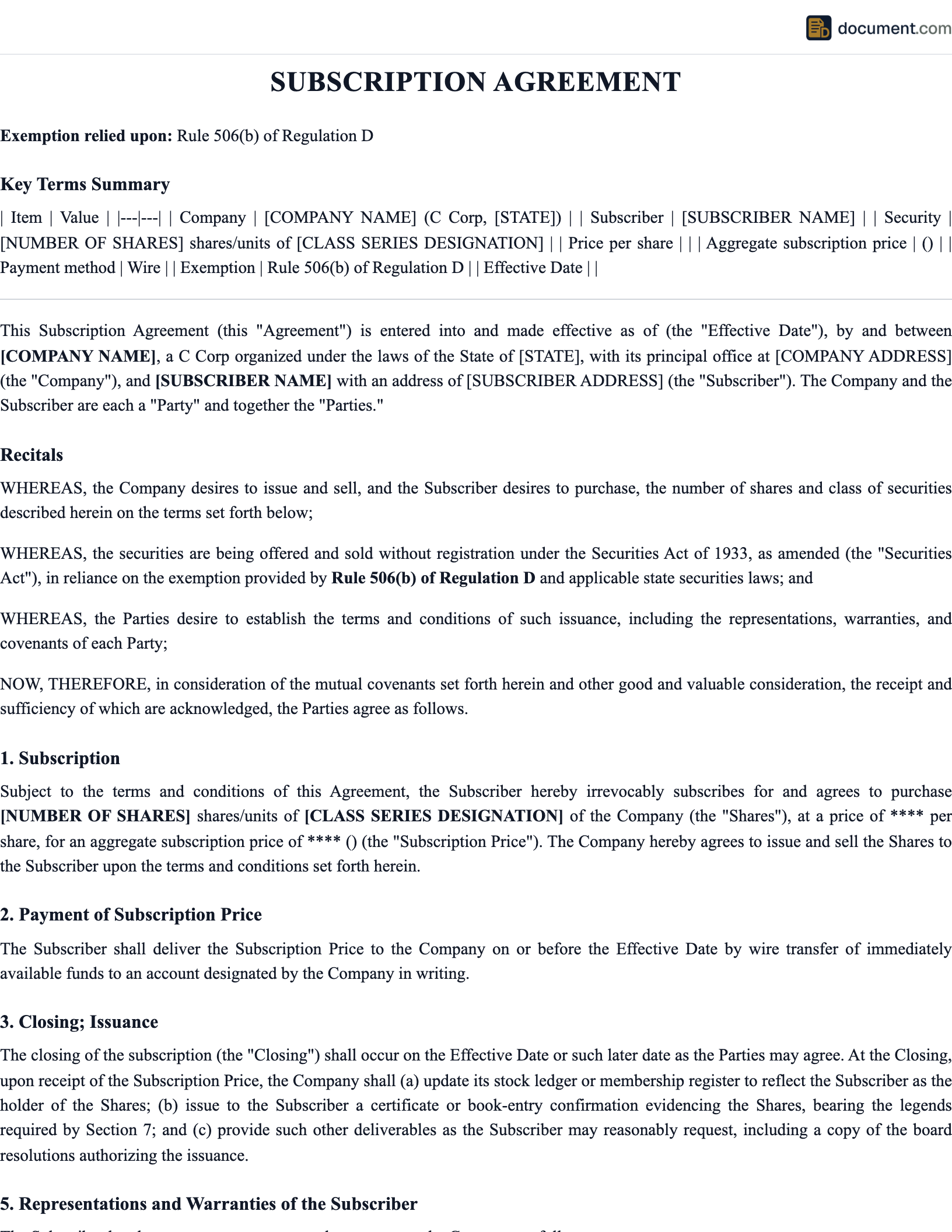



What Is a Subscription Agreement?
A subscription agreement is a contract between a service provider and a subscriber that establishes the terms of a recurring commercial relationship. The subscriber pays a periodic fee (monthly, quarterly, or annually) in exchange for ongoing access to a product, service, or platform. The agreement governs pricing, billing, renewal, cancellation, service levels, data rights, and liability for the duration of the subscription.
Subscription models have become the dominant revenue structure across software (SaaS), media, fitness, food delivery, professional services, and physical goods. The shift from one-time purchases to recurring subscriptions means businesses need contracts that address the unique legal issues of ongoing relationships: what happens when the service goes down, how prices change over time, when and how the subscriber can cancel, what happens to data after cancellation, and how auto-renewal is handled under increasingly strict state consumer protection laws.
For business-to-business (B2B) subscriptions, the agreement is typically a negotiated contract that includes service level commitments, data processing terms, security requirements, and enterprise-specific provisions like audit rights and custom SLAs. For business-to-consumer (B2C) subscriptions, the agreement often takes the form of terms of service with specific subscription provisions, and it must comply with state automatic renewal laws that require clear disclosure, affirmative consent, and easy cancellation.
Whether you are launching a SaaS platform, running a membership community, offering a subscription box, or providing recurring professional services, a well-drafted subscription agreement protects your revenue stream and gives your subscribers confidence in the relationship.
Auto-Renewal
Compliant auto-renewal terms that satisfy state consumer protection laws
Flexible Pricing
Flat-rate, usage-based, per-seat, and tiered pricing structures supported
Cancellation Rights
Clear cancellation terms, refund policies, and data export windows
Subscription Agreement Form Preview
Preview of the core sections in our subscription agreement template.
Subscription Agreement
SaaS Platform Subscription
Section 1: Parties
Section 2: Subscription Details
Plan: Enterprise (unlimited users)
Annual Fee: $24,000 ($2,000/month billed annually)
Initial Term: 12 months from Effective Date
Auto-Renewal: Successive 12-month terms unless cancelled 30 days prior
Section 3: Service Level
Types of Subscription Agreements
Subscription agreements vary based on the nature of the service and the business model.
SaaS Subscription Agreement
The most common type of subscription agreement in the B2B space. It governs access to cloud-hosted software on a recurring basis. Key provisions include the license scope (number of users, modules, API calls), uptime commitments, data security requirements, data processing terms (especially for GDPR compliance), integration with the subscriber's systems, support tiers, and the subscriber's right to export data at termination. SaaS agreements increasingly address AI features: whether the provider can use subscriber data to train machine learning models and who owns AI-generated outputs.
Membership Agreement
Used for gyms, clubs, professional associations, co-working spaces, and online communities. Membership agreements cover access rights, membership tiers, guest policies, facility rules, liability waivers, and cancellation procedures. Many states regulate health club memberships specifically, requiring a cooling-off period after signing (typically 3 to 5 business days), limiting contract duration, and requiring monthly payment options regardless of prepayment discounts.
Usage-Based Subscription Agreement
Pricing scales with the subscriber's consumption of the service. Common in cloud infrastructure (compute hours, storage GB, bandwidth), communications APIs (messages, minutes), and data services (records processed, API calls). The agreement needs precise definitions of billable units, measurement methodology, rate cards, volume discounts, minimum commitments (if any), overage charges, and the subscriber's ability to monitor and control usage in real time.
Recurring Services Agreement
Covers ongoing professional or managed services delivered on a subscription basis: managed IT, bookkeeping, marketing retainers, legal plans, and consulting engagements. These agreements combine elements of a subscription (recurring billing, auto-renewal, cancellation rights) with elements of a services agreement (scope of work, deliverables, professional standards, insurance). The scope of services should be detailed enough to prevent scope creep but flexible enough to adapt to the subscriber's evolving needs.
How to Create a Subscription Agreement: 8 Steps
Build a subscription agreement that works for both provider and subscriber by working through these critical decisions.
Define the Subscription Service
Describe what the subscriber receives: access to software, content, physical goods, or services. Specify the features, modules, or tiers included in the subscription. For SaaS, clarify the number of authorized users, API call limits, storage allocations, and any feature gates. For physical goods, describe the product, customization options, and shipping frequency.
Set Pricing and Payment Terms
Document the subscription fee, billing frequency, accepted payment methods, billing date, and what happens if payment fails (grace period, suspension, termination). Address price increases at renewal: will the price be fixed for the initial term only, subject to a cap (e.g., no more than 5% per year), or adjustable at the provider's discretion with advance notice? Specify whether there are early termination fees.
Draft Auto-Renewal and Cancellation Terms
If the subscription auto-renews, comply with applicable state automatic renewal laws. Provide clear disclosure of the auto-renewal terms, obtain affirmative consent, send a renewal reminder before the renewal date (many states require 30 to 60 days' notice), and offer a simple cancellation mechanism. Define how cancellation works: effective immediately, at the end of the current billing period, or at the end of the current term.
Establish Service Levels
For SaaS and digital services, define uptime commitments (e.g., 99.9% measured monthly), support response times by severity level, planned maintenance windows, and the remedy for missed SLAs (service credits, extended terms, or in severe cases, termination rights). Attach the SLA as an exhibit so it can be updated by mutual agreement without amending the entire contract.
Address Data Ownership and Privacy
State that the subscriber retains ownership of all data uploaded or generated through the service. Grant the provider a limited license to use subscriber data solely to deliver the service. Address data security (encryption, access controls, SOC 2 compliance), breach notification, data processing under GDPR and CCPA, and the subscriber's right to export and delete data at termination. Specify the data retention period after cancellation.
Allocate Intellectual Property Rights
The provider retains all IP in the service, platform, and technology. The subscriber receives a limited, non-exclusive, non-transferable license to use the service during the subscription term. Address any subscriber customizations, integrations, or configurations that incorporate subscriber IP. Clarify that aggregate, anonymized usage data may be used by the provider for product improvement and benchmarking.
Limit Liability and Include Disclaimers
Cap each party's aggregate liability at the fees paid during the 12 months preceding the claim (or the fees paid during the subscription term, whichever is less). Exclude consequential, incidental, and punitive damages. Carve out exceptions for breaches of confidentiality, data security incidents, IP infringement, and willful misconduct. Include a warranty disclaimer (the service is provided 'as is' to the extent permitted by law) with any express warranty limited to the SLA.
Include Governing Law and Dispute Resolution
Choose the governing law (typically the provider's home state for B2B, potentially the subscriber's state for B2C under consumer protection laws). Specify the dispute resolution mechanism: mandatory arbitration for consumer subscriptions (subject to enforceability challenges), litigation in a specified venue for enterprise agreements. Address class action waivers (enforceable in most federal circuits but subject to state law limitations) and jury trial waivers.
Key Components
A comprehensive subscription agreement covers all of these elements.
| Component | Description |
|---|---|
| Service Description | What the subscriber receives, including features, tiers, and usage limits |
| Pricing and Fees | Subscription fee, billing frequency, payment terms, and price escalation |
| Term and Renewal | Initial term, auto-renewal, renewal notice, and commitment periods |
| Cancellation | For convenience, for cause, effective date, refunds, and early termination fees |
| Service Levels | Uptime, support response times, maintenance windows, and SLA credits |
| Data Ownership | Subscriber retains data ownership; provider license limited to service delivery |
| Data Privacy | GDPR/CCPA compliance, data processing terms, and breach notification |
| Security | Encryption, access controls, SOC 2, and security incident response |
| IP License | Non-exclusive license to use service; provider retains all platform IP |
| Acceptable Use | Restrictions on misuse, unauthorized access, and compliance obligations |
| Indemnification | Mutual indemnity for IP infringement, data breaches, and negligence |
| Limitation of Liability | Cap on aggregate liability and exclusion of consequential damages |
| Termination Effects | Data export window, deletion timeline, surviving obligations |
| Governing Law | Choice of law, venue, and dispute resolution mechanism |
Legal Requirements and Considerations
Subscription agreements sit at the intersection of contract law, consumer protection, and data privacy. These are the key regulatory considerations.
State Automatic Renewal Laws
Over 25 states have enacted automatic renewal laws that regulate how businesses may use auto-renewal and continuous service provisions. California's Automatic Renewal Law (Bus. & Prof. Code 17600-17606) is the most stringent, requiring clear and conspicuous disclosure of auto-renewal terms before the consumer agrees, obtaining affirmative consent, providing a confirmation that includes the auto-renewal terms and cancellation policy, and offering a toll-free number, email, or other easily accessible cancellation mechanism. Non-compliance can make the renewal voidable and require full refunds. Similar laws exist in New York, Illinois, North Carolina, Oregon, Virginia, and many other states.
FTC Click-to-Cancel Rule
The FTC's Negative Option Rule (updated in 2024 as the "click-to-cancel" rule) requires that businesses offering subscriptions with automatic renewal or negative option features make it as easy to cancel as it was to sign up. If a consumer subscribed online, they must be able to cancel online without being required to call, chat, or visit in person. The rule also requires clear disclosure of material terms before obtaining billing information, express informed consent, and simple cancellation procedures. Violations can result in civil penalties and FTC enforcement actions.
Health Club and Gym Membership Laws
Many states have specific statutes regulating health club and fitness memberships that override general contract terms. These laws commonly provide a cooling-off period (3 to 5 business days after signing), limit initial contract terms (typically 12 to 36 months), require the provider to offer monthly payment options, allow cancellation for relocation or disability, require the provider to maintain a surety bond, and limit the enforceability of prepaid multi-year contracts. Check your state's specific health club membership statute before drafting a gym or fitness subscription agreement.
Data Privacy Compliance
- GDPR: If the service has EU subscribers, the subscription agreement needs a Data Processing Agreement (DPA) that defines the provider as a processor, specifies the categories of data processed, and includes the mandatory Article 28 provisions.
- CCPA/CPRA: If the service collects personal information from California residents, the agreement should address the provider's role as a service provider, restrict the provider's use of personal information, and require the provider to assist with consumer rights requests.
- State Privacy Laws: Virginia, Colorado, Connecticut, Utah, Texas, Oregon, Montana, and other states have enacted comprehensive privacy laws with varying requirements for service providers and data processors.
Sample Subscription Agreement
Condensed preview of our subscription agreement template.
SUBSCRIPTION AGREEMENT
[Service Name]
This Subscription Agreement is entered into between[Provider] and[Subscriber] for access to the [Service] platform.
1. SUBSCRIPTION
Provider grants Subscriber a non-exclusive, non-transferable right to access and use the Service during the Subscription Term for Subscriber's internal business purposes.
2. FEES AND PAYMENT
Subscriber shall pay the Subscription Fee of[$] per[period], due in advance on the first day of each billing period.
3. AUTO-RENEWAL
This Agreement will automatically renew for successive terms of equal duration unless either party provides written notice of non-renewal at least thirty (30) days before the end of the then-current term.
4. DATA OWNERSHIP
Subscriber retains all right, title, and interest in Subscriber Data. Provider shall not use Subscriber Data except as necessary to provide the Service.
5. CANCELLATION
Subscriber may cancel at any time by providing written notice. Cancellation is effective at the end of the current billing period. No refunds for partial periods.
Frequently Asked Questions
Common questions about subscription agreements, auto-renewal, and cancellation rights.
Official Resources
Authoritative sources on subscription law, auto-renewal compliance, and consumer protection.
FTC Negative Option Rule
Federal Trade Commission rules on automatic renewals and negative option marketing
California ARL
California Automatic Renewal Law (Bus. & Prof. Code 17600-17606)
FTC Click-to-Cancel
Business guidance on the FTC's click-to-cancel requirements for subscriptions
GDPR Resources
General Data Protection Regulation compliance resources for subscription services
California CCPA/CPRA
California Consumer Privacy Act guidance for subscription data handling
SOC 2 Overview
AICPA SOC 2 compliance framework for SaaS and subscription service security
Create your Subscription Agreement in under 10 minutes.
Answer a few questions and download a compliant, attorney-drafted document ready for your state.