



Key Takeaways
- •An AI model license agreement controls the model weights, the accompanying code, and the right to fine-tune and redistribute. It is the contract a developer or a buyer relies on when neither one wrote the original training pipeline.
- •There is no single industry standard. Apache 2.0 is a permissive open-source license with a patent grant; the RAIL family adds behavioral use restrictions; Meta's Llama Community License permits commercial use but cuts it off at 700 million monthly active users and bans using Llama to train rival models.
- •Under EU AI Act Article 53 (Regulation 2024/1689), providers of general-purpose AI models must keep technical documentation, publish a summary of training content, and maintain a copyright-compliance policy. Open-source models get a partial exemption, but not if they carry systemic risk.
- •The U.S. Copyright Office and Thaler v. Perlmutter hold that output created without meaningful human authorship cannot be registered, so a license should say who owns model output and not assume copyright protects it.
- •The agreement separates four distinct rights: using the model as-is, fine-tuning it, hosting it for others, and redistributing the weights. A free template that mentions only 'use' leaves the other three undefined.
- •This template covers permissive, copyleft, RAIL-style restricted, and proprietary commercial licensing, with fields for attribution, acceptable use, indemnity, warranty disclaimers, and termination.
Reviewed for accuracy by the document.com legal team. Educational information, not legal advice.
What Is AI Model License Agreement?
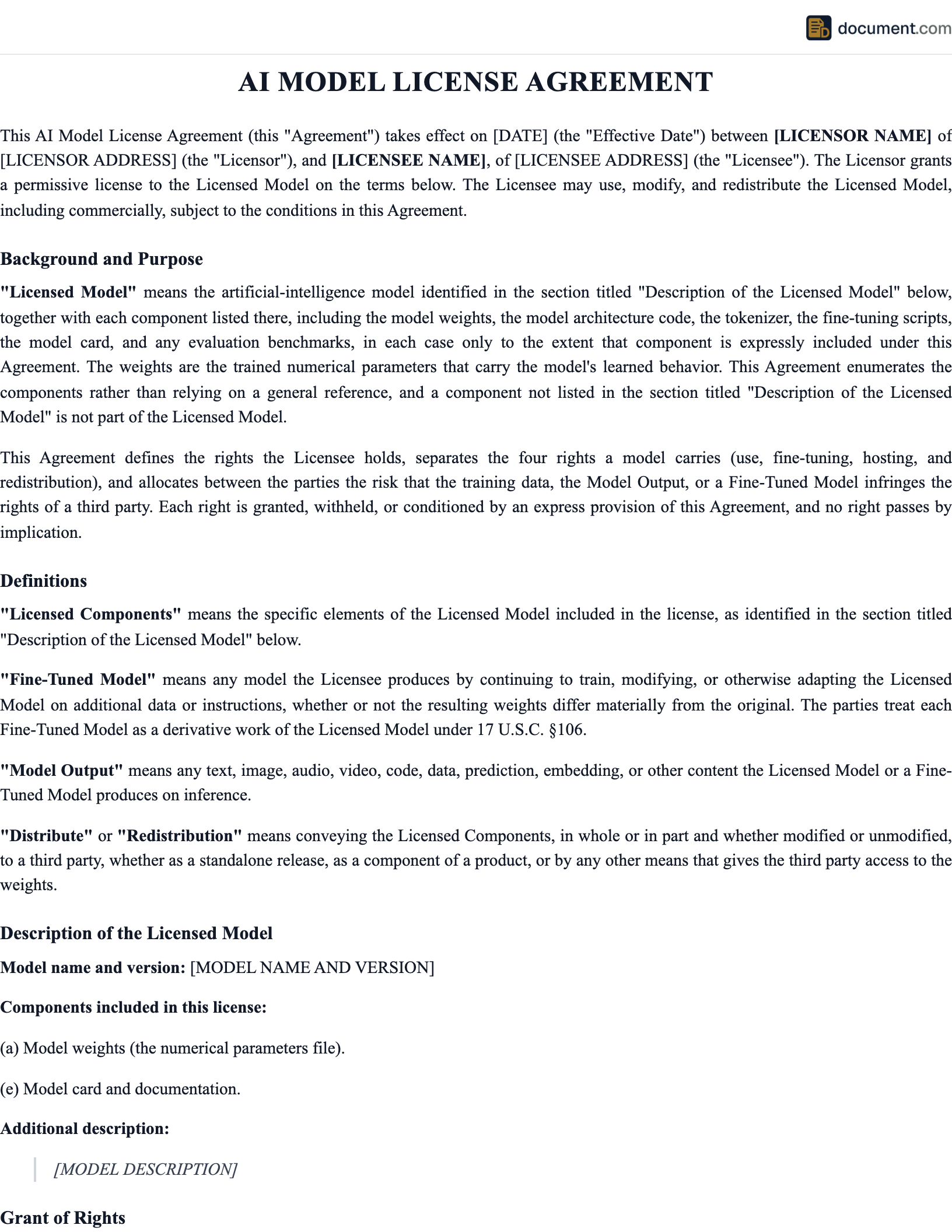
An AI model license agreement is the contract that grants and limits the right to use, fine-tune, host, and redistribute a trained artificial intelligence model, including its weights, configuration, and accompanying code. It does for a machine-learning model what a software license does for an application: it says who is allowed to do what with the thing, and what happens when they break the terms.
The asset being licensed is unusual. A trained model is not source code in the ordinary sense, and it is not a dataset. It is a large file of numerical parameters, the weights, produced by training a network on data. Those weights are what carry the model's behavior, and they are the thing a buyer actually wants. A good license names the weights explicitly, alongside the model architecture, the tokenizer or preprocessing code, model cards, and any fine-tuning scripts, so there is no later argument about whether the grant covered the part that matters.
The agreement also has to answer questions a traditional software license never faced. Who owns the text, images, or predictions the model generates? Can the licensee train a second model on the first model's outputs, or on the weights themselves? If the model was trained on copyrighted data, who carries that risk? These are live disputes in 2025 and 2026, and a license that ignores them is doing the licensee no favors.
Why This Matters Now
The licensing of AI models moved from a niche concern to a board-level one in a span of about two years. When Meta released Llama 2 in July 2023 and Llama 3 in April 2024 under its own Community License rather than a standard open-source license, it forced every company building on those weights to read the fine print. The license permits commercial use, but it withdraws that permission for any product with more than 700 million monthly active users, and it forbids using Llama or its outputs to improve any other large language model. A startup that builds on Llama and then succeeds wildly can find its license cut off precisely when the model matters most.
Around the same time, the open-source community split over whether a model license should restrict behavior at all. The Responsible AI License, or RAIL, family, used by Stability AI for Stable Diffusion and by BigScience for the BLOOM model, attaches a list of prohibited uses to an otherwise permissive grant: no surveillance, no generating disinformation, no medical advice without a professional in the loop, and so on. Purists argue these restrictions disqualify RAIL from being 'open source' under the Open Source Initiative definition, which forbids use restrictions. The debate is unsettled, and it directly affects which license a project can adopt.
Regulators arrived next. The European Union's AI Act, Regulation 2024/1689, entered into force in 2024, and its obligations for providers of general-purpose AI models began applying from August 2025. Article 53 requires those providers to maintain technical documentation, publish a summary of the content used for training, and keep a policy for complying with EU copyright law. The Act carves out an exemption for models released under a genuine free and open-source license, but the exemption disappears the moment a model is classified as carrying systemic risk.
On ownership, the U.S. Copyright Office issued guidance in 2023 and a multi-part report on copyright and artificial intelligence in 2025, and the federal courts backed the central point in Thaler v. Perlmutter, where the D.C. Circuit confirmed in 2025 that a work generated autonomously by a machine, with no human author, cannot be registered. So a company cannot assume copyright protects what its licensed model produces, and the license has to allocate ownership of output by contract rather than rely on copyright law to do it automatically.
The Legal Backbone
There is no AI-specific licensing statute. You are building on software and copyright law.
No statute in the United States governs AI model licenses as such. The agreement rests on ordinary contract law, on the copyright the licensor may hold in the code and model card, and on the licensor's ability to set conditions on access to a thing it controls. That is the same legal foundation a software license stands on. What changes is the subject matter. Because the weights themselves may or may not be copyrightable, a careful license grants rights under copyright where it exists and grants a contractual permission to use the weights regardless, so the licensee is covered either way.
Apache License 2.0: permissive, with a patent grant and an attribution duty.
Apache 2.0 is the most common permissive license for AI code and many model releases. It lets the licensee use, modify, and redistribute the work, including commercially, with no copyleft obligation to open-source derivative works. Two clauses matter for AI. Section 3 grants a patent license from each contributor, and it terminates automatically if the licensee sues anyone alleging the work infringes a patent. Section 4 requires that redistributions keep the license, the copyright notices, and any NOTICE file. Apache 2.0 says nothing about behavioral restrictions or model output, which is why projects layer RAIL-style terms or a separate use policy on top of it.
RAIL and behavioral use restrictions.
The Responsible AI License family takes a permissive grant and bolts on a schedule of prohibited uses. The OpenRAIL-M variant used for BLOOM and Stable Diffusion lets the licensee use and adapt the model freely, including commercially, but voids the license for enumerated harmful uses and requires the licensee to pass those same restrictions down to anyone it redistributes to. The restrictions flow with the model, the way a real-covenant runs with land. This is the mechanism behind 'responsible AI' licensing, and it is also why the Open Source Initiative does not recognize RAIL as open source: clause 6 of the OSI definition forbids restrictions on fields of use.
The Llama Community License: commercial, but conditional.
Meta's Llama Community License, governing Llama 2, 3, 3.1, 3.2, and 3.3, reads like an open-source license until you reach the conditions. It grants a worldwide, non-exclusive, royalty-free right to use, reproduce, distribute, and create derivative works of the Llama materials. Then it adds limits no OSI-approved license contains: a redistribution attribution requirement ('Built with Llama'), a ban on using Llama or its outputs to improve any other large language model, and the 700-million-monthly-active-user ceiling, above which the licensee must request a separate license that Meta may grant or refuse in its sole discretion. A company building a product on Llama needs to know all of these before it scales.
EU AI Act Article 53: documentation, training-data summaries, and a copyright policy.
For providers of general-purpose AI models, Regulation 2024/1689 Article 53 imposes affirmative duties that a license should reference where the model is offered in the EU. The provider must maintain technical documentation of the model's training and testing (Annex XI), provide downstream documentation to those integrating the model (Annex XII), put in place a policy to comply with EU copyright law, including honoring the text-and-data-mining opt-out under Article 4(3) of Directive (EU) 2019/790, and publish a sufficiently detailed summary of the training content using the AI Office template. Models released under a genuine free and open-source license are exempt from the documentation and downstream-documentation duties, but not from the copyright policy and training-summary duties, and the exemption falls away entirely for models with systemic risk.
Copyright ownership of model output: human authorship required.
The U.S. Copyright Office's 2023 registration guidance and its 2025 report on copyright and AI both hold that copyright protects only material with meaningful human authorship. In Thaler v. Perlmutter, the courts agreed that a work an AI system generated on its own cannot be registered. For a license, this has a concrete effect. The licensor cannot promise the licensee a copyright in raw model output, because that copyright may not exist. The license should instead assign or grant whatever rights do exist, disclaim a guarantee of copyrightability, and let the parties allocate ownership of output as a contractual matter.
Four rights, not one: use, fine-tune, host, and redistribute
Free model-license templates fall apart because they treat 'license to use the model' as a single grant. In practice a model carries at least four distinct rights, and most disputes happen at the seam between them. Name each one and the license holds up; leave them blurred and you have invited a fight.
The first right is use. The licensee runs the model as delivered, sends it inputs, and gets outputs back, for internal purposes or to power a product. A use-only grant is the narrowest one. It says nothing about whether the licensee can change the model or pass it on.
The second right is fine-tuning, and it is where the real value and the real risk sit. Fine-tuning means continuing to train the model on the licensee's own data so it specializes for a task. The fine-tuned model is a derivative work of the original weights. Who owns it? The Llama license lets you fine-tune and keep the result, but forbids using Llama outputs to train a non-Llama model. Apache 2.0 lets you fine-tune and even close-source the result. A proprietary license might forbid fine-tuning altogether, or allow it but claim ownership of the resulting weights. The agreement has to pick one of these and say so in plain words.
The third right is hosting, sometimes called the service or deployment right. Running a model behind an API for third parties is a different thing from using it internally. Some licenses, especially source-available ones modeled on the SSPL, treat offering the model as a managed service as the one thing they most want to control, because that is how a cloud provider would compete with the licensor. If the licensee plans to host the model for customers, the license must grant that expressly.
The fourth right is redistribution: handing the weights, modified or not, to someone else. This is where attribution clauses, copyleft obligations, and the RAIL pass-through restrictions bite. Apache 2.0 lets you redistribute if you keep the notices. OpenRAIL requires you to carry the use restrictions forward to your recipient. The Llama license requires the 'Built with Llama' notice and forbids redistribution to anyone over the user ceiling. A license silent on redistribution leaves the licensee guessing whether it can ship the weights at all.
On top of these four rights sit the cross-cutting terms that determine who carries risk: the warranty disclaimer (almost every model ships 'as is' with no promise it is accurate or non-infringing), the indemnity (who pays if the model's training data turns out to infringe someone's copyright), the acceptable-use policy (the behavioral limits), and termination (what triggers the loss of the license and whether the licensee must delete the weights). A template that covers the four rights but ignores indemnity is leaving the most expensive question for last.
When You Need This
You trained a model and want to release it to others, commercially or open-source, with clear limits on what they may do with it. The license is what converts your model from a private asset into a distributable product without giving away rights you meant to keep.
You are a company adopting an open-weight model such as Llama, Mistral, or a Stable Diffusion checkpoint, and you need a written record of the license terms you are relying on before you build a product on it. Read the user ceiling and the no-train-rival-models clause first.
You are licensing a proprietary model to a single enterprise customer under a negotiated commercial agreement, with a fee, a defined field of use, and an indemnity, rather than a public open-source release.
You are fine-tuning someone else's base model and want to document that you have the right to do so and that you own the fine-tuned result. Pair this with your data licenses and any AI Voice and Likeness Release covering training data that includes real people.
You are a marketplace, platform, or reseller distributing third-party models and need a pass-through license that carries the upstream restrictions to your end users. RAIL-style use restrictions must flow downstream or you break the upstream license.
You operate in or sell into the EU and need your model documentation, training-data summary, and copyright policy to line up with EU AI Act Article 53 before the model goes out the door.
How to Fill Out AI Model License Agreement
1. Identify the parties and the model
Enter the full legal name and address of the licensor (the party that owns or controls the model) and the licensee (the party receiving rights). Describe the licensed model precisely: its name and version, the architecture, and which components are included, the weights, the tokenizer or preprocessing code, the model card, and any fine-tuning scripts. The weights are the asset, so name them explicitly.
2. Choose the license type
Select the model that fits your goal: permissive (Apache 2.0 style, modify and redistribute freely, keep notices), copyleft or source-available (derivatives must stay open or service use is restricted), RAIL-style restricted (permissive grant plus a schedule of prohibited uses that flows downstream), or proprietary commercial (a negotiated grant to one customer for a fee). This choice sets the default for every clause that follows.
3. Grant the four rights, one at a time
State separately whether the licensee may (a) use the model as delivered, (b) fine-tune or otherwise create derivative models, (c) host the model as a service for third parties, and (d) redistribute the weights. For each, say yes, no, or yes-with-conditions. Do not let a single 'right to use' sentence stand in for all four.
4. Allocate ownership of derivatives and output
Specify who owns a fine-tuned model the licensee produces and who owns the model's output. Because copyright may not protect raw output (Thaler v. Perlmutter), grant the licensee a clear contractual right to use and commercialize the output rather than promising a copyright that may not exist. If the licensor wants to claim ownership of fine-tuned weights, say so here.
5. Set the acceptable-use policy and attribution
List the prohibited uses if you are using a RAIL-style or responsible-AI grant: surveillance, generating unlawful or deceptive content, regulated advice without human review, and so on. State the required attribution (for example a 'Built with [Model]' notice on redistribution) and require the licensee to pass any use restrictions down to its own recipients.
6. Add the warranty disclaimer and indemnity
Most model licenses disclaim all warranties and deliver the model 'as is,' with no promise of accuracy, fitness, or non-infringement. Decide who indemnifies whom if the training data is later alleged to infringe copyright or if the model is used unlawfully. For a commercial license to an enterprise, a negotiated IP indemnity from the licensor is common; for an open-source release, the licensor typically gives none.
7. Address compliance and training-data provenance
If the model is a general-purpose AI model offered in the EU, reference the EU AI Act Article 53 duties: technical documentation, the public training-content summary, and the copyright-compliance policy. State what training data the model was built on and confirm the licensor had the rights to use it, or disclaim that the licensee must satisfy itself on provenance. This is where many disputes start.
8. Set term, termination, and signatures
State how long the license lasts and what ends it: a material breach, a patent suit against the licensor (the Apache 2.0 trigger), crossing a user ceiling, or violating the acceptable-use policy. Say what the licensee must do on termination, typically stop using and delete the weights. Both parties sign and date. For a high-value commercial license, have counsel review before signing.
Key Terms Defined
- Model weights
- The numerical parameters produced by training a neural network, stored as a file. The weights carry the model's learned behavior and are the core asset an AI model license grants rights to. A license that does not name the weights may not actually cover the part the licensee wants.
- Fine-tuning
- Continuing to train an existing model on new, narrower data so it specializes for a task. A fine-tuned model is a derivative work of the base model, which is why the license must say whether fine-tuning is allowed and who owns the result.
- Permissive license
- A license, such as Apache 2.0 or MIT, that allows use, modification, and redistribution, including in closed-source commercial products, with minimal conditions, usually just preserving the copyright and license notices. It imposes no copyleft duty to open-source derivatives.
- RAIL (Responsible AI License)
- A license family that combines a permissive grant with a list of prohibited behavioral uses that must be carried downstream to any recipient. Used for models like BLOOM and Stable Diffusion. Because it restricts fields of use, the Open Source Initiative does not classify RAIL as open source.
- General-purpose AI model (GPAI)
- Under EU AI Act Regulation 2024/1689, a model trained on broad data that can perform a wide range of tasks and be integrated into many systems. Providers of GPAI models carry Article 53 documentation, training-summary, and copyright-policy duties, with a partial exemption for genuinely open-source models that do not pose systemic risk.
- Acceptable-use policy
- The schedule of behaviors the license forbids, such as surveillance, generating disinformation, or providing regulated advice without human oversight. In a RAIL-style license these restrictions are binding terms that void the grant if breached and must be passed to downstream users.
Related Documents
AI Model License Agreement vs End-User License Agreement (EULA)
A EULA governs the use of a finished software application by an end user: install limits, no reverse engineering, no resale. An AI model license governs the model artifact itself, the weights and code, and the rights to fine-tune, host, and redistribute it, which a EULA never contemplates. If you are shipping a desktop or mobile app, you want a EULA. If you are releasing or licensing the trained model, you want a model license. The two frequently coexist when a model is embedded in an application.
AI Model License Agreement vs Software Licensing Agreement
A general software licensing agreement covers source code or compiled binaries and the right to use and modify them. A model license is a specialized form of it for the AI case, adding clauses a code license has no reason to include: ownership of model output, the right to train another model on this one, training-data provenance and indemnity, and acceptable-use restrictions. Start from a licensing agreement only if your asset is conventional code; reach for the model-specific version once weights and training are in play.
AI Model License Agreement vs Subscription / SaaS Agreement
A subscription agreement grants access to a hosted service the customer never possesses, billed over time, and the provider keeps full control of the underlying model. A model license transfers possession of, or rights in, the model itself. If your customers will only ever call your API, a subscription agreement is the right tool. If they receive the weights, or the right to deploy the model on their own infrastructure, you need a license.
AI Model License Agreement vs Work for Hire Agreement
A work-for-hire agreement settles ownership of a deliverable a contractor creates for you, so the commissioning party owns it from the start. A model license governs an existing model owned by the licensor and granted to others. They pair naturally: if you hire a vendor to build or fine-tune a model, the work-for-hire agreement fixes who owns the result, and a model license then governs how that owner lets others use it.
AI Model License Agreement vs Data Licensing / Training-Data Agreement
A data license grants the right to use a dataset, including to train a model. A model license grants rights in the trained model that the data produced. They sit on either side of the training step. A complete AI project usually needs both: a data license that confirms you could lawfully train on the inputs, and a model license that governs how the resulting weights are used and shared.
Legal Authorities & Sources
This page is grounded in primary law. The statutes and official resources below are the authorities behind the guidance above. Verify the current text of any statute before relying on it.
- Apache License, Version 2.0 (full text, Apache Software Foundation)
- Meta Llama 3 Community License Agreement
- Responsible AI Licenses (RAIL) initiative
- EU AI Act, Article 53 (obligations for providers of general-purpose AI models)
- EU Artificial Intelligence Act, Regulation 2024/1689 (full text, EUR-Lex)
- U.S. Copyright Office, Copyright and Artificial Intelligence
- Open Source Initiative, The Open Source Definition
Frequently Asked Questions
Create your AI Model License Agreement in minutes.
Answer a few questions and download a clear, attorney-drafted document that cites the controlling law and is ready to sign.