
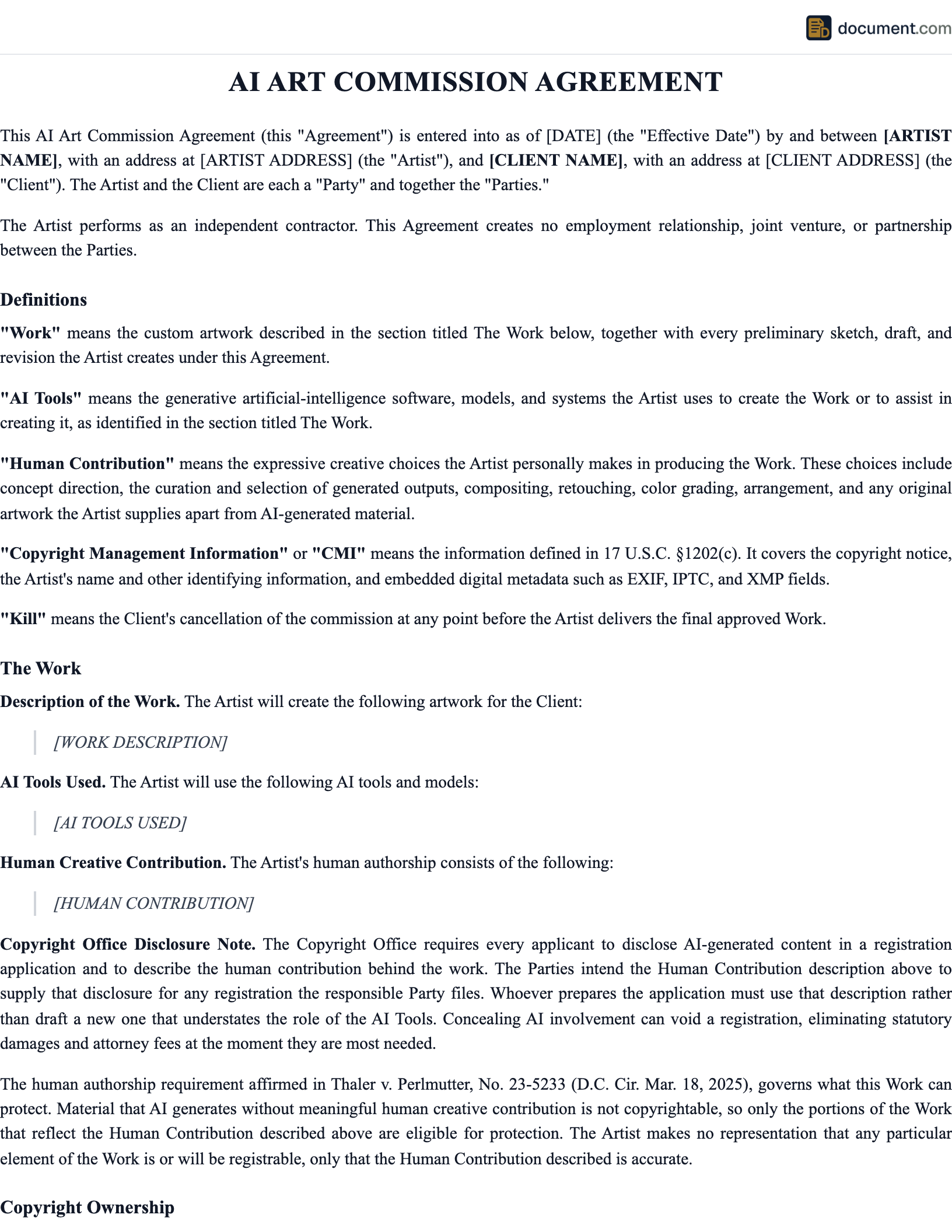



Key Takeaways
- •Paying for art does not buy the copyright. Under 17 U.S.C. 201, copyright vests in the human author the moment the work is fixed. The commissioner only gets ownership through a signed assignment or, in narrow cases, a written work-made-for-hire agreement.
- •Purely AI-generated images cannot be copyrighted at all. The D.C. Circuit affirmed the human authorship requirement in Thaler v. Perlmutter, and the Supreme Court declined to revisit it on March 2, 2026. Only the human-authored parts of a piece get protection.
- •Disclosure is now mandatory for registration. The Copyright Office requires applicants to disclose AI-generated content and describe the human contribution. Hiding AI involvement can get a registration cancelled, which strips you of statutory damages.
- •Detailed prompts are not authorship. The Copyright Office's January 2025 Part 2 report concluded that prompts function as instructions, so a prompt-only workflow yields nothing copyrightable. Curation, editing, and creative arrangement are where protection starts.
- •The contract is your strongest tool on training data. Whether AI training infringes copyright is still unresolved in U.S. courts (Andersen v. Stability AI is set for trial September 8, 2026). A flat contractual ban on using the artwork to train AI stands on its own as a contract term, whatever the copyright answer turns out to be.
- •A kill fee and capped revision rounds protect the artist from spec work and scope creep, and they make the deal predictable for the client paying the bill.
Reviewed for accuracy by the document.com legal team. Educational information, not legal advice.
What Is AI Art Commission Agreement?
An AI art commission agreement is a written contract that governs custom artwork created with the help of generative AI tools, fixing who owns the copyright, which AI tools were used, how the piece may be used, and who answers for an infringement claim. It is a commission agreement adapted for one hard fact: when a machine does part of the drawing, ordinary copyright assumptions stop working.
A traditional commission contract assumes a human painted the thing, so the only real question is whether the artist keeps the copyright or transfers it. An AI-assisted commission adds a prior question. Is any of this even copyrightable? The answer depends on how much a person actually contributed. That answer controls what the contract can promise. It also decides whether the work can be registered and whether an infringement suit would have anything to enforce.
The agreement does the ordinary commission work of price, deliverables, revisions, and timeline. It also carries clauses you will not find in a 2015 art contract: a disclosure of the specific models used (Midjourney, DALL-E, Stable Diffusion, or a custom model), a description of the human's creative role for registration purposes, a restriction on feeding the finished work into AI training systems, and an indemnity structure that splits responsibility between the artist's human contributions, the client's reference materials, and the AI tool itself.
Do not confuse this document with a stock-image license or a platform terms-of-service grant. When you buy an output from OpenAI's API, OpenAI assigns you its interest by contract but warrants nothing about third-party claims. A commission agreement is negotiated between two named parties for one specific job, and it can allocate risks that a click-through license simply pushes onto you.
Why This Matters Now
The ground rules changed fast between 2023 and 2026, and a contract drafted on the old assumptions is now a liability. In March 2023 the Copyright Office announced that applicants must disclose AI involvement. In 2023 it refused or limited registration in three watched cases: Zarya of the Dawn, Theatre D'opera Spatial, and SURYAST. By January 2025 it issued a formal Part 2 report holding that prompts alone are not authorship.
On March 18, 2025 the D.C. Circuit decided Thaler v. Perlmutter, affirming that the Copyright Act requires a human author 'in the first instance.' The Supreme Court denied certiorari on March 2, 2026, so that rule is settled until Congress changes the statute. If your agreement promises the client a registrable copyright in a fully AI-generated image, you are promising something that does not exist.
The training-data fight is live and expensive. In Andersen v. Stability AI, Judge Orrick let direct and induced infringement claims past a motion to dismiss in August 2024, and trial is set for September 8, 2026. Across the Atlantic, the UK High Court handed down Getty Images v. Stability AI on November 4, 2025, rejecting Getty's secondary copyright claims because model weights are not stored copies. Until the courts settle it, a clear contract is the only instrument that reliably allocates this risk.
Regulators are circling training data. California AB 2013 already requires AI developers to post training-data disclosure summaries. The proposed California AB 412 would require training-data verification tools and add civil liability for non-disclosure. The EU AI Act took full effect on August 2, 2025 with training-data transparency mandates. Clients and artists who want to commercialize work safely need an agreement that anticipates these rules rather than ignoring them.
Demand is rising while the rules are in flux. Upwork reported 109% year-over-year growth in AI-related skill demand as of February 2026. Commission volume and the money behind it keep growing, and much of that work is still papered with templates that predate the case law.
The Legal Backbone
17 U.S.C. 201: copyright vests in the author, not the buyer
Section 201(a) says copyright in a work vests initially in 'the author or authors of the work.' For a commissioned piece, the author is the artist, not the person who paid. Section 201(b) creates the work-made-for-hire exception, but for an independent contractor it applies only if the work falls into one of nine enumerated categories AND the parties sign a written agreement saying it is for hire. Most commissioned art does not fit those categories, so a buyer who wants ownership needs a written assignment under 201(d) instead. Section 201(d) also lets you transfer individual exclusive rights separately, so you can assign commercial reproduction while the artist keeps display or portfolio rights. Writing a check buys you a copy of the work; the copyright stays with the artist until a signed instrument transfers it. Confirm the current statute text, because details get amended.
The human authorship requirement: Thaler v. Perlmutter
In Thaler v. Perlmutter, No. 23-5233 (D.C. Cir. March 18, 2025), the D.C. Circuit affirmed that the Copyright Act of 1976 requires a human author. Stephen Thaler had tried to register 'A Recent Entrance to Paradise,' generated entirely by his DABUS system with no human input, and listed the machine as author. The court read 'numerous provisions' of the Act and held human authorship is required as a matter of statutory law. The Supreme Court denied review on March 2, 2026, leaving the decision intact. For a commission, any element produced by AI with no meaningful human creative contribution is in the public domain from birth. You cannot assign, license, or register what the law refuses to protect.
Copyright Office 2025 guidance: prompts are instructions, not authorship
The Copyright Office's Part 2 report on copyrightability, issued January 29, 2025, drew the operating lines. Works produced entirely by AI are not copyrightable. Prompts, even long and creative ones, are treated as instructions and do not by themselves create authorship. But where a human inputs their own copyrightable work and it remains perceptible in the output, the human authors that portion. And copyright protects minimally creative human modifications: selection, coordination, and arrangement of AI output, plus retouching, compositing, color grading, and layout that reflect real creative judgment. The Office also requires applicants to disclose AI-generated content. Non-disclosure can void a registration if infringement is later litigated, which is the worst possible time to lose your statutory remedies.
17 U.S.C. 1202(b): copyright management information and metadata
Section 1202(b) makes it unlawful to intentionally remove or alter copyright management information, things like the copyright notice, the artist's name, and embedded metadata, where the person knows or has reasonable grounds to know that removal will induce, enable, facilitate, or conceal infringement. This is a double-scienter standard: you need intentional removal plus knowledge of infringement facilitation. Statutory damages run from $2,500 to $25,000 per violation. Note the open question: in Andersen v. Stability AI, the court dismissed the section 1202 claims with prejudice in August 2024, and whether AI training that strips metadata violates 1202 is unresolved. For a commission agreement, the safe move is a contractual clause forbidding the client from stripping notices and metadata, which gives you a breach-of-contract remedy independent of the unsettled statute.
License versus assignment under 201(d)
An assignment is a complete transfer of copyright ownership and must be in a signed writing. After assignment the new owner can register the work and sue infringers, and the artist loses control. A license is a grant of permission to use the work for specified purposes while the artist keeps the copyright; it can be exclusive (only the client may exercise the granted rights) or non-exclusive. Because 201(d) lets exclusive rights move separately, you can build hybrids: an exclusive license for one product line, with derivative-works and AI-training rights expressly reserved to the artist. Mere commissioning transfers nothing absent one of these written instruments.
What a strong AI art commission agreement actually contains
Start with the ownership decision, because everything else hangs on it. You have three workable models and each one trades control for cost. A full assignment moves all right, title, and interest to the client, who can then register and enforce; the artist gives up everything after delivery, which is why a higher fee usually accompanies it. An exclusive license lets the client be the only party using the work for defined purposes (commercial reproduction, display, derivatives) while the artist keeps the underlying copyright. A limited license with carve-outs keeps the most control with the artist: the client gets a narrow, named use and the artist reserves derivatives, portfolio display, resale, and the right to forbid AI training. Pick one, write it precisely, and do not leave ownership 'to be discussed.'
Then confront copyrightability head-on, because an assignment of a public-domain image is worthless. The agreement should describe the human creative role in concrete terms: who chose the concept, who directed and curated the generations, who edited, composited, and color-graded. This language is exactly what the Copyright Office wants in a registration, and it is your evidence if a registration is challenged. A clean clause reads like a credit line: concept, composition, and color grading by the artist; background generated with Stable Diffusion v3 from the artist's prompts and then retouched and arranged by the artist. A generic recital of the human role will not support a registration or survive a challenge to one.
AI disclosure runs in two directions. Before the work starts, the artist discloses which models will be used and warns the client that AI-generated elements carry latent infringement risk because the training data may include copyrighted images; the client acknowledges this in writing. After delivery, the disclosure feeds the registration application, where the parties identify AI-generated versus human-created portions. Bury this and you risk the cancellation scenario the Copyright Office has warned about.
Add the training-data restriction even though the underlying copyright law is unsettled. A flat clause saying the client may not use the artwork as training data for any AI system, generative or otherwise, without a separate written license and fee, is enforceable as contract regardless of how Andersen v. Stability AI turns out. The Andersen plaintiffs had no such contractual protection; their work was scraped into the LAION dataset without consent and their remedy now depends on unsettled copyright theories. A commissioning party who wants downstream freedom can negotiate and pay for it. Silence should default to a prohibition.
Build the indemnity in layers that track who controlled what. The artist indemnifies the client for the artist's own human-created contributions. The client indemnifies the artist for client-supplied prompts, reference images, and specifications. Where an AI provider offers any warranty (most disclaim them), push that indemnity upstream so the provider answers for its training-data infringement. Be honest with the client about the gap: OpenAI's terms say it will not assert copyright over your output, which protects you from OpenAI, not from a third party who claims the output copies their work.
Specify usage rights as a checklist, not a paragraph of generalities. Private display, public display, commercial reproduction, digital distribution, derivative works, resale of the original, and attribution format should each be marked in or out. Two line items deserve special attention: derivative works (does the client get to make spin-offs, or just use the delivered piece?) and AI training (almost always a separate, paid right). List prohibited uses too, including any restriction on using the artist's name or style to train a model.
Close with the operational clauses that prevent disputes. Cap revisions and define what counts as minor versus a major redirect, with a surcharge for the latter. Set a kill fee tied to the stage of cancellation so the artist is not doing unpaid spec work. Protect the copyright notice and metadata contractually. Choose a governing law, with California or New York the usual picks for their developed art and AI-disclosure frameworks, and pick a forum, noting that the federal Copyright Claims Board handles claims under $30,000 for a $100 filing fee, which is far cheaper than district court for small commissions.
When You Need This
You are commissioning custom artwork from a freelancer or studio that will use Midjourney, DALL-E, Stable Diffusion, or a custom model, and you need to actually own or exclusively control the result.
You are an artist who works AI-assisted and wants to keep your copyright, your portfolio rights, and a veto over your work being scraped into a training set.
You intend to commercialize the piece (merchandise, prints, packaging, a brand identity) and need a registration that will survive a challenge, which means documenting the human contribution now rather than after a dispute.
You are a brand or agency buying creative work from a platform freelancer and the platform's terms of service leave IP ownership to be negotiated at the project level, which is most of them.
You want a contractual ban on AI-training reuse that holds up even though the copyright question is still in litigation, so you are not depending on the outcome of Andersen v. Stability AI.
You are allocating infringement risk on a high-value job and need a layered indemnity that distinguishes the artist's edits from the client's reference images from the AI tool's training data.
How to Fill Out AI Art Commission Agreement
1. Identify the parties and the work with precision
Name the artist and the client in full, with addresses and a status line confirming the artist is an independent contractor, not an employee. Describe the deliverable concretely: dimensions, file formats, color space, number of final pieces, and the use case. A loose description of the work invites loose rights, so specify whether you are buying one image, a set, or a campaign.
2. Disclose the AI tools and the human creative role up front
List every AI model that will be used by name and version (for example Stable Diffusion v3, Midjourney v6). Then state, in plain credit-line terms, what the human will contribute: concept, prompt engineering, curation of generations, compositing, retouching, color grading, and arrangement. This dual disclosure is your foundation for both registration and risk warnings. Have the client sign an acknowledgment that AI-generated elements carry latent third-party infringement risk.
3. Choose and write the ownership model
Pick full assignment, exclusive license, or limited license with carve-outs, and use a signed writing as Section 201(d) requires. For an assignment, transfer 'all right, title, and interest in and to the Work, including all copyright and derivative rights.' For a license, name the permitted uses, the territory, the term, and whether it is exclusive. Do not rely on work-made-for-hire language for fine art; it usually fails the statutory category test, so a contractual assignment is the cleaner instrument.
4. Spell out usage rights and prohibited uses as a checklist
Mark each right in or out: private display, public display, commercial reproduction, digital distribution, derivative works, resale of the original, and attribution format. List prohibited uses, including using the artist's name or signature style without consent. Treat AI training as its own line item that is excluded by default and available only under a separate paid license.
5. Insert the AI-training restriction and metadata protection
Add a clause barring the client from using the Work as training data for any AI system, generative, discriminative, or hybrid, absent a separate written license and fee, and require the client to pass that restriction into any downstream license. Add a copyright-management-information clause forbidding removal or alteration of the copyright notice, artist attribution, watermarks, and embedded EXIF, IPTC, and XMP metadata, referencing 17 U.S.C. 1202(b).
6. Build the layered indemnity and warranties
Have the artist indemnify the client for the artist's human-created contributions, and the client indemnify the artist for client-supplied prompts, references, and specifications. Where an AI provider offers a warranty, flow it through; where it disclaims (the norm), say so plainly and cap the artist's liability. State honestly that no party warrants the AI tool's training data is infringement-free unless the provider has agreed otherwise in writing.
7. Set revisions, kill fee, payment, and timeline
Cap revision rounds (for example two after the sketch is approved), define minor versus major changes, and surcharge major redirects. Add a kill fee that scales with the stage: a percentage before sketch, more after sketch approval, full fee after completion, with all rights reverting to the artist on a kill. Set a deposit, milestone payments, and the delivery schedule, and require revision requests within a fixed window after delivery.
8. Pick governing law, forum, and the registration path
Choose California or New York for their developed art and AI-disclosure frameworks unless another forum fits the parties better. Decide the dispute path: the Copyright Claims Board for claims under $30,000 at a $100 filing fee, mediation or arbitration for confidentiality, or federal court when you need an injunction. Finally, before commercializing, register the work with the Copyright Office and describe the human contribution in detail, disclosing the AI-generated portions.
Key Terms Defined
- Work made for hire
- A statutory rule under 17 U.S.C. 201(b) where the commissioning party is treated as the author. For an independent contractor it applies only if the work fits one of nine enumerated categories AND the parties sign a written for-hire agreement. Most fine art and illustration falls outside those categories, so buyers usually need an assignment instead.
- Assignment
- A complete transfer of copyright ownership from the artist to another party. It must be in a signed writing under Section 201(d). After assignment the new owner can register and sue infringers, and the artist keeps no rights unless specific ones are carved out and reserved.
- Exclusive license
- A grant letting only the licensee use the work for specified purposes while the artist keeps the underlying copyright. Because Section 201(d) lets exclusive rights move separately, you can grant an exclusive license for one use and reserve others, such as derivatives or AI training, to the artist.
- Copyright management information (CMI)
- Identifying information attached to a work, including the copyright notice, the artist's name, and embedded metadata like EXIF, IPTC, and XMP. Section 1202(b) prohibits intentionally removing or altering CMI where the person knows it will facilitate infringement, with statutory damages from $2,500 to $25,000 per violation.
- Human authorship requirement
- The rule, affirmed in Thaler v. Perlmutter and applied by the Copyright Office, that copyright protects only works authored by a human. Material generated by AI with no meaningful human creative contribution is not copyrightable, so only the human-authored portions of an AI-assisted piece receive protection.
- Training data
- The images and other material used to train a generative AI model. Whether training on copyrighted works infringes is unresolved in U.S. courts (the issue is central to Andersen v. Stability AI). California AB 2013 already requires developers to publish training-data summaries, and the EU AI Act mandates training-data transparency.
- Kill fee
- A pre-agreed payment owed to the artist if the client cancels before completion, usually scaled to the stage of work. It compensates the artist for spec work and, on a kill, typically returns all rights to the artist so the unfinished piece becomes a reusable asset.
Related Documents
AI art commission agreement vs. standard art commission agreement
A standard art commission agreement assumes a human created the work and focuses on the ownership choice, fee, revisions, and delivery. The AI version keeps all of that and adds the questions a 2015 contract never asked: which models were used, what the human actually contributed for copyrightability and registration, whether the finished piece can be fed into AI training, and how infringement risk splits between the artist's edits, the client's references, and the AI tool. If the artwork involves any generative AI, the standard template leaves you exposed on exactly the issues most likely to cause a dispute.
Full assignment vs. exclusive license vs. limited license
Full assignment moves all copyright to the client, who can register and enforce, while the artist keeps nothing absent a carve-out; it usually carries the highest fee. An exclusive license lets only the client use the work for named purposes while the artist keeps ownership and can reserve derivatives, portfolio use, and AI-training rights. A limited license with carve-outs keeps the most control with the artist and gives the client a narrow, defined use. Clients lean toward assignment, artists toward licensing, and the price should reflect which one you choose.
Commission agreement vs. platform terms of service (OpenAI, Midjourney, Stability AI)
A platform's terms are a one-to-many click-through that you cannot negotiate. OpenAI assigns you its interest in DALL-E output by contract but warrants nothing against third-party claims. Midjourney ties commercial rights to your membership tier. Stability AI does not clearly assign output and warrants nothing about its training data. A commission agreement is negotiated between two named parties for one job, so it can do what a platform license will not: allocate infringement risk, restrict AI-training reuse, require disclosure, and document the human authorship you will need to register the work.
Legal Authorities & Sources
This page is grounded in primary law. The statutes and official resources below are the authorities behind the guidance above. Verify the current text of any statute before relying on it.
- 17 U.S.C. 201, Copyright Ownership (Cornell LII)
- Thaler v. Perlmutter, No. 23-5233 (D.C. Cir. Mar. 18, 2025)
- U.S. Copyright Office AI Policy Hub
- Copyright Office Part 2: Copyrightability Report (Jan. 29, 2025)
- Getty Images v. Stability AI, [2025] EWHC 2863 (Ch) (UK High Court)
- Andersen v. Stability AI and DMCA Section 1202 (Skadden)
- California AB 2013 Training Data Disclosure (Crowell & Moring)
Frequently Asked Questions
Create your AI Art Commission Agreement in minutes.
Answer a few questions and download a clear, attorney-drafted document that cites the controlling law and is ready to sign.