
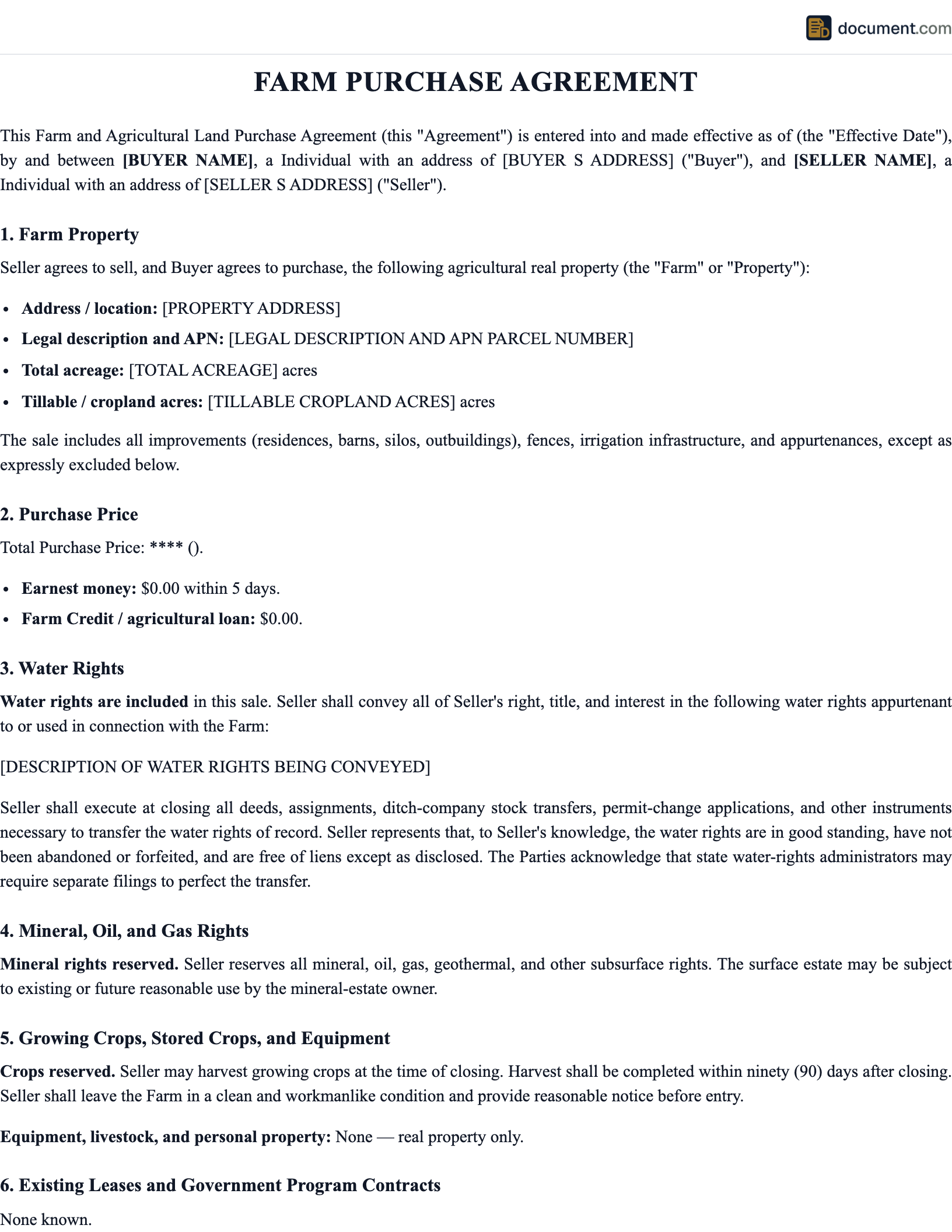



What Is a Farm Purchase Agreement?
A farm purchase agreement is a specialized real estate contract designed for the sale of agricultural property, including farmland, ranch land, orchards, vineyards, and related improvements. While it shares the basic framework of a standard purchase agreement — identifying parties, property, price, and closing terms — a farm purchase agreement must address numerous agricultural-specific issues that residential contracts simply do not cover.
Agricultural land transactions involve a layer of complexity absent from other real estate deals. Water rights may be the most valuable component of the property. Mineral rights may have been previously severed and sold separately. Growing crops represent a time-sensitive asset that must be allocated between buyer and seller. Conservation easements and USDA program enrollments can permanently restrict how the land is used. Farm equipment, irrigation systems, livestock, and stored grain may or may not be part of the deal.
Using a generic real estate purchase agreement for a farm transaction creates serious risk of overlooking critical provisions. A proper farm purchase agreement ensures that both parties understand exactly what is being transferred, what rights are being retained, and how the unique aspects of agricultural property are handled at closing.
Agricultural Specific
Covers water, mineral rights, crops, and farm infrastructure
USDA Compliance
Addresses CRP enrollment, conservation easements, and FSA loans
Environmental Protections
Soil testing, contamination assessments, and wetland compliance
Unique Considerations for Farm Sales
Farm purchases involve considerations that buyers and sellers of residential or commercial property rarely encounter. Addressing these issues upfront prevents costly disputes after closing.
Existing Farm Leases
Many farms are operated by tenant farmers under multi-year leases. The purchase agreement must address whether existing leases survive the sale, terminate at closing, or are renegotiated. Tenant notice requirements vary by state and lease terms.
Irrigation Infrastructure
Center pivots, drip systems, wells, pumps, and water storage facilities represent significant value. The agreement must specify which irrigation components are included and their condition at closing.
Government Programs & Subsidies
Farms enrolled in CRP, EQIP, CSP, or other USDA programs have specific transfer requirements. Some contracts are assignable; others require new applications. Base acres and payment yields affect future subsidy eligibility.
Fencing & Boundary Issues
Agricultural properties often have fence-line disputes, prescriptive easements from adjacent operators, and road access issues. A current survey and boundary agreement should be part of the due diligence process.
Water Rights & Mineral Rights
Water and mineral rights are often the most valuable — and most contentious — aspects of a farm purchase. These rights may have been previously severed from the surface estate and require separate investigation and transfer procedures.
Water Rights
Critical for irrigated farmland. The type and extent of water rights can make or break the farm's productivity.
- Riparian rights (eastern states) vs. appropriation (western states)
- Groundwater permits and well registrations
- Irrigation district membership and assessments
- Priority dates and annual allocation volumes
Mineral Rights
Subsurface rights may include oil, gas, coal, gravel, and other extractable resources.
- Verify whether mineral rights were previously severed
- Review existing mineral leases and royalty agreements
- Surface access rights for mineral extraction
- Environmental impact of prior or active mining/drilling
Soil Testing & Environmental Due Diligence
The productivity and value of farmland is directly tied to soil quality. Environmental contamination from prior agricultural or industrial use can create significant liability for the buyer.
Critical: Test Before You Buy
Under CERCLA (the federal Superfund law), a buyer of contaminated property can be held liable for cleanup costs regardless of whether they caused the contamination. The “innocent purchaser” defense requires that you conducted appropriate environmental due diligence before acquiring the property. Phase I and Phase II environmental site assessments are strongly recommended for any agricultural land purchase.
| Assessment | What It Covers | Typical Cost |
|---|---|---|
| Soil Nutrient Test | NPK levels, pH, organic matter, micronutrients | $200-$500 |
| Phase I ESA | Historical land use, visual inspection, records review | $1,500-$4,000 |
| Phase II ESA | Soil sampling, groundwater testing, lab analysis | $5,000-$20,000 |
| Wetland Delineation | Identifies regulated wetlands affecting land use | $2,000-$8,000 |
Crop Prorations & Growing Season Timing
The timing of a farm sale relative to the growing season creates unique allocation issues. Standing crops, planted inputs, and harvest proceeds must all be addressed in the purchase agreement.
Pre-Planting Sale
Buyer receives bare land and makes all planting decisions. Seller may owe buyer for any fertilizer or herbicide already applied. Simplest scenario for prorations.
Mid-Season Sale
Most complex. Parties must allocate planting costs, input expenses, crop insurance, and expected harvest value. Often resolved through a fixed crop credit to the seller.
Post-Harvest Sale
Seller retains all crop proceeds. Buyer should verify that stored grain has been removed and that no crop liens exist on the property from unpaid input suppliers.
Tenant-Operated Farm
If a tenant farmer is operating the land, the existing lease governs crop ownership. The purchase agreement must address lease assignment, tenant notification, and rent prorations.
Key Components of a Farm Purchase Agreement
Beyond standard real estate purchase terms, a farm purchase agreement should include these agricultural-specific provisions:
| Component | Description |
|---|---|
| Legal Description & Survey | Meets-and-bounds or section/township/range description with current survey |
| Water Rights Schedule | Detailed listing of all water rights, permits, and irrigation entitlements |
| Mineral Rights Reservation | Whether mineral rights are included, excluded, or partially reserved |
| Equipment & Fixtures List | Itemized inventory of farm equipment, buildings, and fixtures included in sale |
| Crop Proration Terms | Allocation of growing crops, input costs, and harvest proceeds |
| Environmental Contingency | Right to conduct soil testing and environmental assessments before closing |
| USDA Program Disclosure | Current enrollment in CRP, EQIP, CSP, and other government programs |
Frequently Asked Questions
Find answers to common questions about farm purchase agreements, water rights, and agricultural land transactions.
Create your Farm Purchase Agreement in under 10 minutes.
Answer a few questions and download a compliant, attorney-drafted document ready for your state.