


Motor Vehicle Purchase Agreement: identify the transaction
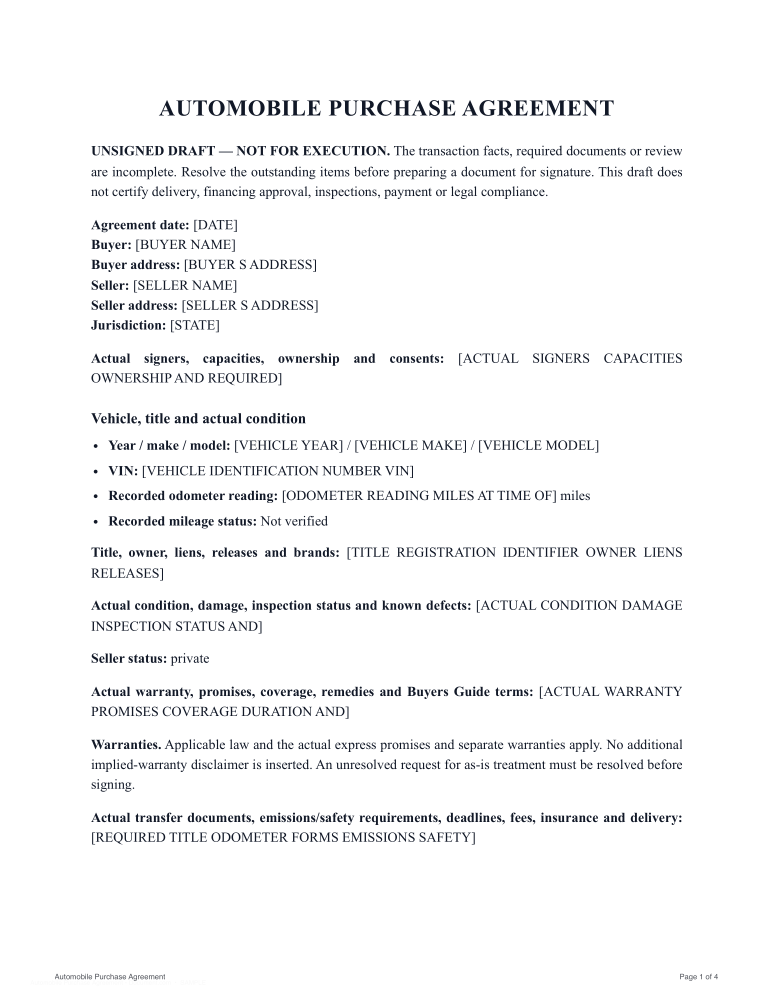
A purchase agreement records a buyer’s and seller’s actual obligations, conditions and closing arrangements. It does not itself prove payment, complete an inspection, approve financing or transfer a title that requires a separate instrument.
Identify the exact parties and signers, capacities, ownership, required consents and notice contacts. Select the document matching the property or interest being acquired. Describe exceptions and unknown facts openly instead of converting unanswered questions into representations.
Record the actual vehicle sale
Identify the year, make, model, VIN, title and owner, liens, title brands, odometer reading and actual mileage status. Describe the known condition, defects and inspection status; do not certify an inspection that did not happen.
Specify price, deposit, receipt status, payment/delivery conditions, risk of loss, taxes and filing duties. Use the actual state title and secure odometer process. A purchase agreement is neither the title nor a substitute for all required mileage certification fields.
Warranty treatment is an explicit choice. A seller’s written consumer-product warranty or service contract can prevent an implied-warranty disclaimer; state consumer and used-vehicle rules may impose additional limits. This general disclaimer workflow does not determine special consumer-vehicle exceptions in Massachusetts, Maine or Maryland.
Title, warranty and dealer documents
Check the actual transfer deadline, emissions/safety records, taxes, insurance and registration requirements with the responsible vehicle agency. Vehicle type, age, seller status and transaction location affect the requirements.
For covered dealer transactions, supply the required Buyers Guide and preserve its controlling warranty terms. Maine and Wisconsin have state substitutes for the federal Used Car Rule. A private-party sale still has applicable state title, disclosure and consumer obligations.
A sample contains placeholders and no proof of payment, delivery, title, mileage accuracy or warranty review. Unverified mileage or unresolved warranty treatment keeps the generated document unsigned.
Applicable requirements
Confirm the rules for the actual transaction, property, parties, entity and closing location. A selected state does not establish an exemption, deliver a notice or approve a document.
Confirm the scope and any statutory exceptions before treating a disclosure as inapplicable. Identify local requirements and the actual transfer/closing instruments. The linked disclosure source addresses its stated subject; it is not a complete certification of every rule governing the transaction.
Review the complete package before signing
Record actual notice contacts, agreed dispute procedure, default/cure terms, attachments, required approvals and execution formalities. Arbitration, a jury waiver, prevailing-party fees and automatic deposit forfeiture are not preselected.
Select unsigned draft while facts, mandatory records or review are incomplete. Signature fields appear only after the required answers and completion checks. The user’s completion selection records their answer; it is not independent legal approval.
Read the generated document and its actual attachments together. A missing state form, title, lender certificate, signature or delivery is not supplied by checking a completion box. Use the required separate official or professionally prepared instruments where the transaction calls for them.
Common questions
Primary sources
Choose the transaction state
Create your Automobile Purchase Agreement in under 10 minutes.
Answer a few questions and download a compliant, attorney-drafted document ready for your state.