



Key Takeaways
- •A prompt IP assignment agreement transfers all right, title, and interest in prompts and prompt libraries from the author (employee, contractor, or prompt engineer) to the company, in writing, as 17 U.S.C. 204 requires for any copyright transfer to be valid.
- •For most prompt libraries, trade secret protection under the Defend Trade Secrets Act (18 U.S.C. 1839) is the stronger shield. It lasts indefinitely as long as you keep the prompts secret, and it covers the value of the library, not just the literal wording.
- •Copyright covers a prompt only as far as its exact wording. A sufficiently creative prompt can qualify as a literary work, but the protection stops at the literal text; it never reaches the idea, the underlying method, or anything the AI generates from the prompt.
- •The U.S. Copyright Office held in January 2025 that prompts alone do not give a human enough control over the output to claim authorship of AI-generated text or images. The prompt may be protectable; the output usually is not.
- •Employees who write prompts inside the scope of their job already give the employer ownership automatically under the work-made-for-hire rule. Contractors do not. Without a signed assignment, the contractor keeps the copyright.
- •Registering a prompt with the Copyright Office publishes its text and destroys its trade secret status. You generally pick one path or the other for any given prompt, not both.
Reviewed for accuracy by the document.com legal team. Educational information, not legal advice.
What Is Prompt & Prompt-Library IP Assignment Agreement?
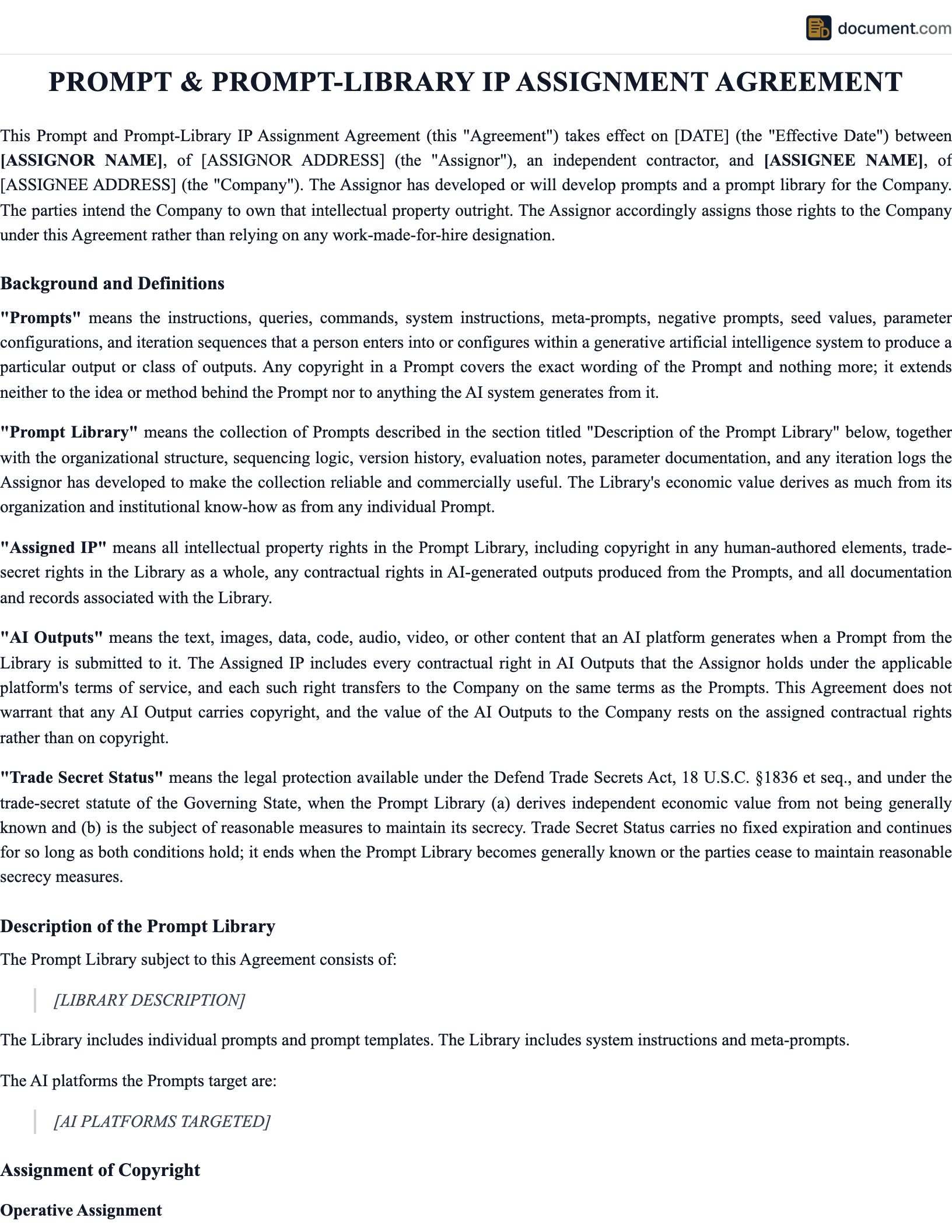
A prompt IP assignment agreement is a written contract that transfers ownership of prompts and prompt libraries from the individual who created them to the company, so the business holds the intellectual property rights rather than the author. Prompts are the instructions a person types into a generative AI system such as ChatGPT, Claude, or Midjourney to get a useful result. A prompt library is a curated collection of those instructions, often tuned over months of trial and error, that produces consistent and valuable output for a specific business task.
The agreement does two jobs at once. It assigns whatever copyright exists in the prompt text, and it locks down the prompts as confidential trade secrets so a departing employee or contractor cannot walk out the door with them. Those are different legal mechanisms with different rules, and a well-drafted assignment uses both because each one alone leaves a gap.
Why bother assigning something as small as a few sentences of instruction? Because a refined prompt library is frequently the most valuable AI asset a company owns. The model is a commodity that anyone can rent. The prompts that make the model reliably do your specific job are not. A pricing-analysis prompt that took an engineer three months to dial in is a competitive advantage, and the law will protect it only if you have documented who owns it and taken steps to keep it confidential.
This page explains the statutes and the recent case law that govern prompt ownership in plain English, then walks through how to draft the agreement field by field. It is general legal information, not legal advice, and the law in this area is moving fast. Confirm the current rules and your own state's trade secret statute with a licensed attorney before you rely on any template.
Why This Matters Now
Prompt engineering went from a curiosity to a line item on the balance sheet in about two years. Companies now pay people specifically to build prompt libraries, and the question of who owns those libraries when the engineer leaves has become a live dispute rather than a hypothetical.
The U.S. Copyright Office settled a key question in January 2025. In Part 2 of its Copyright and Artificial Intelligence report, the Office concluded that a prompt by itself does not give the human enough control over the expression to claim authorship of what the AI produces. That ruling reframed prompts as instructions, valuable instructions worth protecting, but not a backdoor to owning AI output.
The federal courts reinforced the human-authorship rule the same year. In Thaler v. Perlmutter, decided March 18, 2025, the D.C. Circuit held that an AI system cannot be a copyright author because the Copyright Act is built around human authors. The Supreme Court declined to review that decision in March 2026, so it stands as binding circuit precedent.
The financial stakes around AI and copyright stopped being abstract in September 2025, when Anthropic settled the Bartz class action for a minimum of $1.5 billion, the largest copyright settlement in U.S. history. The case turned on the difference between lawfully acquired training material and pirated material. For any company building a prompt or content pipeline, that distinction is now a documented liability risk, not a law review footnote.
Trade secret enforcement has its own federal teeth. Since the Defend Trade Secrets Act took effect on December 11, 2016, a company whose prompts are misappropriated can sue in federal court for damages and an injunction, but only if it took reasonable measures to keep the prompts secret in the first place. A signed assignment plus an NDA is part of how you prove you did.
The Legal Backbone
Trade secret status: 18 U.S.C. 1839(3) and the DTSA
The Defend Trade Secrets Act defines a trade secret broadly enough to cover a prompt library. Under 18 U.S.C. 1839(3), a trade secret includes 'all forms and types of financial, business, scientific, technical, economic, or engineering information,' including methods, techniques, processes, and procedures, whether tangible or intangible. A prompt is a method or technique for getting value out of a model, so it fits. Protection attaches only when the information is actually secret, the owner takes reasonable measures to keep it secret, and the information derives independent economic value from not being generally known. The civil remedy lives at 18 U.S.C. 1836, which since December 11, 2016 has given trade secret owners a federal private right of action for misappropriation, with damages and injunctive relief available.
State trade secret law: California Civil Code 3426
Most states protect trade secrets under a version of the Uniform Trade Secrets Act, adopted in 46 states. California's adoption sits at Civil Code 3426 and following. The state and federal frameworks mirror each other, with one wording difference worth knowing: the UTSA asks whether the owner made 'reasonable efforts' to maintain secrecy, while the DTSA says 'reasonable measures.' Courts treat them as functionally similar and judge reasonableness against industry norms, the sensitivity of the information, and the resources available to the company. A solo consultant is held to a different standard than a Fortune 500 legal department, but everyone has to do something.
Copyright in the prompt text: 17 U.S.C. 101 and 204
A prompt can be a literary work eligible for copyright if its wording is original and creative enough. Two sections of the Copyright Act drive the assignment. Section 101 defines 'work made for hire,' which is how an employer automatically owns work an employee creates within the scope of employment, no signature required. Section 204 is the statute of frauds for copyright: any transfer of exclusive copyright rights has to be in a written instrument signed by the owner, or it is void. That second rule is why a handshake or an email is not enough to move a contractor's prompt copyright to your company. You need a signed assignment.
The work-made-for-hire trap for contractors
Here is the part that catches companies off guard. For employees, prompts written on the job belong to the employer from the moment of creation under the work-for-hire rule. For independent contractors, the default flips: the contractor keeps the copyright unless a signed agreement says otherwise. You cannot fix this by simply calling the contractor's work 'work made for hire,' because that label only works for nine specific categories of commissioned work listed in 17 U.S.C. 101, and prompts are not one of them. The reliable fix is an explicit assignment of copyright that satisfies 17 U.S.C. 204, drafted separately from any work-for-hire language. Whether someone counts as an employee or a contractor in the first place is decided by a multi-factor agency test the Supreme Court set out in Community for Creative Non-Violence v. Reid, 490 U.S. 730 (1989), looking at control, payment method, benefits, tax treatment, and who supplies the tools.
What the Copyright Office said about prompts in 2025
In January 2025, after reviewing more than 10,000 public comments from 50 states and 67 countries, the Copyright Office published Part 2 of its AI report. The headline finding for prompt owners: prompts alone do not provide sufficient human control over the way an idea is expressed to support authorship of the AI's output. The Office called human authorship the 'bedrock' of copyrightability. Two qualifications matter. First, the Office expressly left open that a prompt itself may be copyrightable as an independent literary work if it is creative enough. Second, in a mixed work that blends human and AI material, the human-authored portions can still be protected. If you register anything containing AI-generated content, you have to disclose that fact and explain the human contribution, or the registration will be refused.
The human-authorship line in the courts
Thaler v. Perlmutter is the controlling authority on AI authorship. Dr. Stephen Thaler tried to register artwork generated entirely by his 'Creativity Machine,' listing the machine as author. The D.C. Circuit affirmed the refusal on March 18, 2025, reasoning that the Copyright Act's provisions on ownership, inheritance, and duration all presume a human author who can own property and has a lifespan. The court was careful to say it was not banning copyright for human-guided AI assistance; copyrightability still depends on where you draw the line between human and machine contribution. The Supreme Court denied review in March 2026, leaving the ruling in force.
Trade secret or copyright: which one actually protects a prompt
The instinct is to copyright a valuable prompt. For most prompt libraries, that instinct is wrong, or at least incomplete. Copyright and trade secret protect different things in different ways, and the right choice depends on what you are actually trying to defend.
Start with what copyright in a prompt does and does not cover. If your prompt is original and creative enough to qualify as a literary work, copyright protects the exact sequence and wording of that prompt. It does not protect the idea behind the prompt, the technique, or the way you use it. A competitor who reads your prompt, understands the approach, and writes their own prompt that accomplishes the same thing has not infringed anything. Worse, copyright gives you nothing on the output side. Under Thaler and the Copyright Office's 2025 guidance, the text or image the AI generates from your prompt is generally not copyrightable at all, because no human authored it. So copyright on a prompt is thin: it covers the literal words and stops there, with nothing left over for the result.
Trade secret protection is built differently, and for prompts it is usually the better fit. It does not care whether your prompt is creative. It protects the economic value of keeping the prompt secret, which means it can cover the whole library, the way the prompts are organized, the parameter settings, the sequencing, and the institutional knowledge of which prompt to use when. Protection lasts as long as the secret holds, with no fixed expiration. A competitor who independently develops the same prompt, or reverse-engineers it from your public output, has done nothing wrong, but a competitor who takes your prompts through a departing employee or a hack has misappropriated a trade secret and can be sued under the DTSA.
The catch with trade secret protection is that it is fragile. It exists only as long as the information stays secret. One careless disclosure can destroy it. If an employee pastes your proprietary prompt into a free public chatbot, or posts it on a forum, or a competitor finds it through legitimate means, the secret can become 'generally known' and the protection evaporates. So the assignment agreement is only half the job. The other half is the set of reasonable measures you take to keep the prompts confidential: access controls, NDAs, enterprise tools instead of free public platforms, and clear internal policy on what may never be typed into an outside model.
There is a genuine tension between the two regimes, and it forces a choice. Registering a copyright in a prompt requires depositing the prompt's text with the Copyright Office, where it becomes part of the public record. That publication destroys any trade secret status, because the prompt is no longer secret. So for a high-value prompt you want to keep, you generally do not register it; you protect it as a trade secret and keep it locked down. For a prompt you are publishing anyway, a book of marketing prompts you sell, for instance, copyright registration on the compilation can make sense because secrecy is off the table already.
Most companies should use the assignment agreement to capture both forms of protection in one instrument, then decide later which one to actually enforce for any given prompt. The assignment language transfers 'all copyright, trade secret, and other intellectual property rights' so you are not boxed in. The confidentiality provisions and your operational safeguards preserve the trade secret option. The copyright assignment preserves the registration option if you ever want it. You keep both doors open and walk through whichever one the situation calls for.
A practical word about contractors versus employees, because it changes the drafting. If a prompt engineer is a W-2 employee writing prompts on the clock, the copyright is already yours by operation of law, and the agreement mostly serves to confirm ownership, impose confidentiality, and add a backstop assignment for anything that falls outside the scope of employment. If the engineer is a 1099 contractor or an outside agency, you own nothing by default. The signed assignment is the only thing standing between you and a former contractor who claims the prompt library is theirs. Get it signed before the work starts, not after.
When You Need This
You hired or contracted a prompt engineer, a marketing operations specialist, or a developer to build prompts or a prompt library for your business, and you want the company to own the result.
You are bringing on an independent contractor or agency to do AI-related work, and you need a signed assignment because contractors keep their copyright by default.
Your team has developed an internal prompt library that produces consistent, valuable output, and you want to lock it down as a trade secret before anyone leaves.
An employee or contractor with access to your prompt library is departing, and you need confirmation in writing that the prompts stay with the company and that confidentiality obligations survive their exit.
You are raising money, selling the business, or going through due diligence, and a buyer or investor wants clean documentation that the company actually owns its AI assets.
You are about to share prompts with a vendor, consultant, or development partner and want assignment plus confidentiality terms in place before disclosure.
You want to combine the assignment with an NDA and an internal AI use policy so you can demonstrate the reasonable measures that trade secret protection under the DTSA and your state UTSA requires.
How to Fill Out Prompt & Prompt-Library IP Assignment Agreement
1. Identify the parties and the relationship
Name the company (the assignee) and the individual or entity assigning the rights (the assignor), with legal names and addresses. State plainly whether the assignor is an employee or an independent contractor, because that determines whether you are confirming automatic ownership or creating it from scratch. For a contractor, this is the difference between owning the prompts and not owning them, so do not leave it ambiguous.
2. Define the assigned work precisely
Describe exactly what is being assigned: the prompts, prompt libraries, prompt templates, parameter configurations, system instructions, and related materials created during the engagement, including all modifications and derivative works. Avoid a one-line description. The broader and more concrete the definition, the harder it is for a departing author to later claim that some particular prompt fell outside the deal. Include language capturing work created on company time, with company resources, or relating to company business.
3. Write the assignment clause itself
Use an irrevocable present-tense assignment, not a promise to assign later. A phrase like 'Assignor irrevocably assigns to Company all right, title, and interest, including all copyright, trade secret, and other intellectual property rights, in the prompts and prompt libraries described above' transfers the rights on signature. This is the operative provision that satisfies the written-instrument requirement of 17 U.S.C. 204. Without it, a copyright transfer from a contractor is void.
4. Add representations and warranties
Have the assignor represent that they actually own the rights they are assigning, that the prompts are original to them, and that the assignment does not violate any other agreement, such as a prior employer's IP clause. This protects the company if it later turns out the engineer copied prompts from a former job. Pair it with an indemnity if the stakes warrant it.
5. Build in the confidentiality and trade secret provisions
This is what preserves the trade secret option, so do not treat it as boilerplate. Require the assignor to keep the prompts confidential, prohibit disclosing or using them outside the engagement, and prohibit entering proprietary prompts into public or free-tier AI platforms. Acknowledge in the document that the prompts are trade secrets under the DTSA and applicable state law. The agreement is itself one of the 'reasonable measures' a court will look for.
6. Cover further assurances and moral rights
Include a further-assurances clause requiring the assignor to sign any additional documents needed to perfect or record the assignment later, including a power of attorney to do so if they become unreachable. To the extent your jurisdiction recognizes moral rights under 17 U.S.C. 106A, have the assignor waive attribution and integrity rights to the extent the law permits, so they cannot later object to how the prompts are modified or used.
7. State the consideration
Recite what the assignor receives in exchange for the assignment. For an employee, base employment is often enough, but for an assignment signed after employment began, or for a contractor, state a specific additional consideration so the transfer is clearly supported. A token amount plus the engagement fee is common. The point is to avoid a later argument that the assignment was unsupported and therefore unenforceable.
8. Set survival, governing law, and signatures
Make the assignment and the confidentiality obligations survive termination of the relationship indefinitely. Choose a governing-law state, ideally one whose trade secret statute you understand. Then get it signed by both parties. Section 204 requires the copyright owner's signature, and a signature from both sides removes any doubt. Get it signed before work begins; a retroactive assignment is far weaker than one in place from day one.
Key Terms Defined
- Prompt
- The instruction a person enters into a generative AI system to produce an output. Legally, a prompt can be a literary work eligible for narrow copyright if it is creative enough, and a trade secret if it has economic value and is kept confidential.
- Prompt library
- A curated, organized collection of prompts tuned to produce reliable output for specific business tasks. The library's structure, sequencing, and parameter settings often carry more economic value than any single prompt, which is why trade secret protection over the whole library tends to matter most.
- Work made for hire
- Under 17 U.S.C. 101, work an employee creates within the scope of employment, which the employer owns automatically from creation. For contractors it applies only to nine enumerated categories of commissioned work, and prompts are not among them, so contractor prompts require an explicit assignment instead.
- Trade secret
- Information that is secret, kept secret through reasonable measures, and valuable because it is not generally known, as defined in 18 U.S.C. 1839(3). Protection lasts as long as secrecy holds and is enforceable in federal court under the Defend Trade Secrets Act and in state court under the Uniform Trade Secrets Act.
- Assignment of copyright
- A written, signed transfer of copyright ownership from one party to another. Required by 17 U.S.C. 204 for any exclusive transfer; an unsigned or oral copyright assignment is void. This is the mechanism that moves a contractor's prompt copyright to the company.
- Reasonable measures
- The steps a trade secret owner must take to keep information secret in order to qualify for protection, judged against industry norms and the sensitivity of the information. For prompts this includes NDAs, signed assignments, access controls, and policies barring entry of proprietary prompts into public AI platforms.
Related Documents
Prompt IP Assignment vs. Non-Disclosure Agreement
An NDA restricts what someone may disclose or use, but it does not transfer ownership of anything. A prompt IP assignment actually moves the copyright and trade secret rights to the company. You typically need both: the assignment establishes who owns the prompts, and the NDA plus confidentiality terms keep them secret so trade secret protection survives. An NDA alone leaves you with confidential prompts you may not actually own.
Prompt IP Assignment vs. Work-for-Hire Agreement
A work-for-hire agreement relies on the doctrine in 17 U.S.C. 101, which works automatically for employees but fails for contractor prompts because prompts are not an enumerated commissioned-work category. A prompt IP assignment uses an explicit transfer of rights that works regardless of employment status, which is why it is the safer instrument for contractors and agencies. Many companies use work-for-hire language plus a backstop assignment in the same document.
Prompt IP Assignment vs. Prompt Licensing Agreement
An assignment transfers ownership permanently; the company ends up owning the prompts outright. A licensing agreement keeps ownership with the creator and grants someone else the right to use the prompts under defined terms, such as commercial or internal use only. Use an assignment when you want to own a contractor's or employee's prompts. Use a license when you are the prompt owner letting third parties use your library while keeping the rights yourself.
Prompt IP Assignment vs. Proprietary Information and Inventions Agreement
A PIIA is a broad employment instrument that bundles confidentiality and assignment of all inventions and IP an employee creates, covering far more than prompts. A standalone prompt IP assignment is narrower and targeted, useful for a specific engagement or a contractor where a full PIIA would be overkill. If you are hiring an employee whose whole job is AI work, a PIIA may be the better umbrella; for a discrete prompt project, the focused assignment is cleaner.
Legal Authorities & Sources
This page is grounded in primary law. The statutes and official resources below are the authorities behind the guidance above. Verify the current text of any statute before relying on it.
- 18 U.S.C. 1839: Defend Trade Secrets Act definitions (Cornell LII)
- 18 U.S.C. 1836: DTSA civil remedy for misappropriation (Cornell LII)
- 17 U.S.C. 101: Copyright definitions, including work made for hire (Cornell LII)
- 17 U.S.C. 204: Execution of copyright transfers (Cornell LII)
- California Civil Code 3426 et seq.: Uniform Trade Secrets Act (California Legislature)
- U.S. Copyright Office: Copyright and Artificial Intelligence Part 2: Copyrightability Report (Jan. 2025)
- Thaler v. Perlmutter, No. 23-5233: D.C. Circuit opinion (Mar. 18, 2025)
- U.S. Copyright Office: Artificial Intelligence Initiative hub
- NPR: Anthropic settles authors' copyright class action for at least $1.5 billion (Sept. 5, 2025)
Frequently Asked Questions
Create your Prompt & Prompt-Library IP Assignment Agreement in minutes.
Answer a few questions and download a clear, attorney-drafted document that cites the controlling law and is ready to sign.