
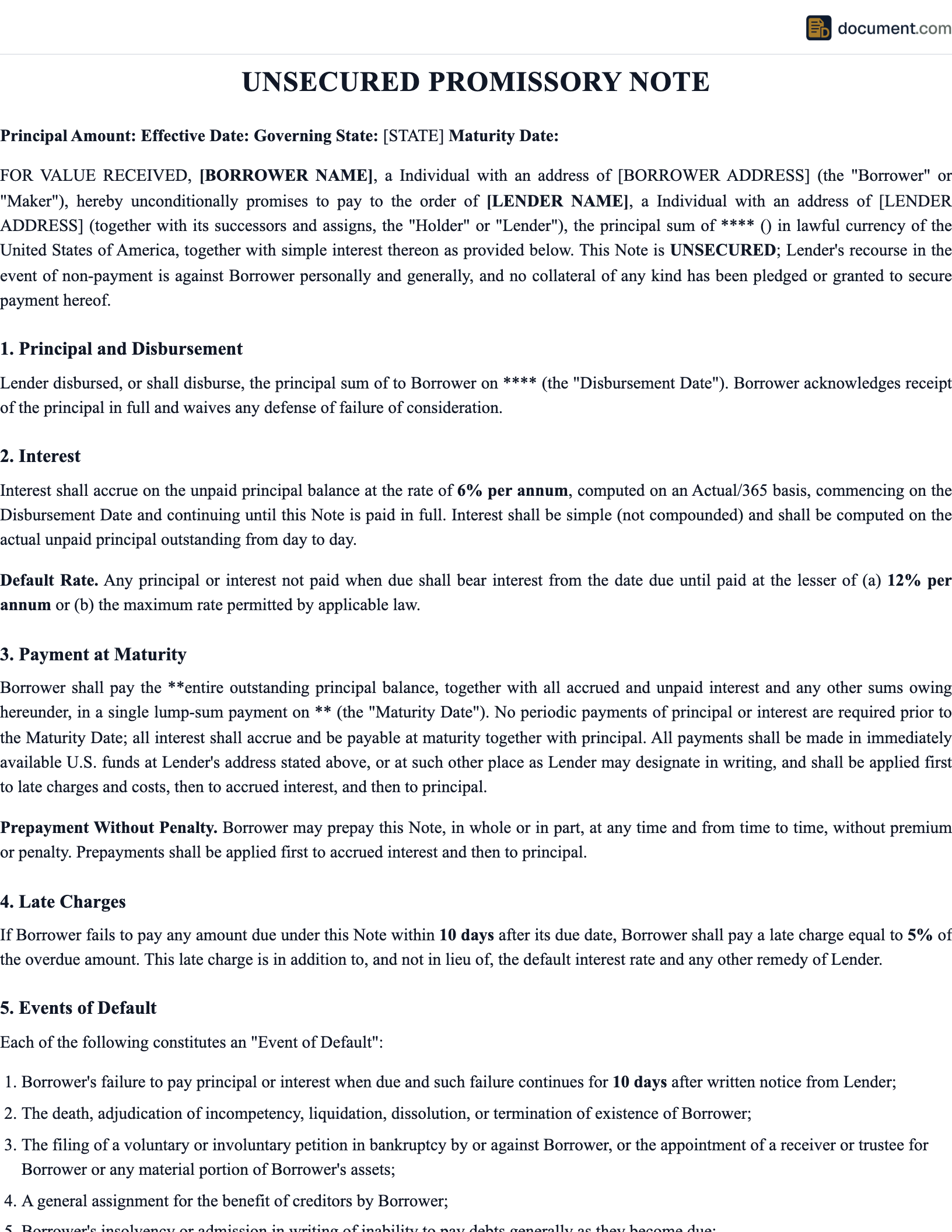



New Jersey Unsecured Promissory Note Overview
An unsecured promissory note in New Jersey is a loan agreement where the borrower promises to repay without pledging any collateral. The lender relies on the borrower's creditworthiness and the legally enforceable promise to pay. The maximum interest rate in New Jersey is 6% (default).
6% default rate; 16% general usury cap; 30% criminal usury; no cap for business loans. Unsecured notes carry more risk for the lender, so interest rates are typically higher than secured notes. However, the rate must still comply with New Jersey's usury laws.
If the borrower defaults, the lender's primary remedy is filing a lawsuit within New Jersey's statute of limitations (6 years (oral and written)). The small claims court limit in New Jersey is $5,000, which is ideal for smaller unsecured loans.
6% (default)
Usury rate cap
6 years
Statute of limitations
$5,000
Small claims limit
25%
Max garnishment
New Jersey Legal Requirements
New Jersey has specific requirements for unsecured promissory notes:
Important: New Jersey Usury Laws
New Jersey's maximum interest rate is 6% (default). 6% default rate; 16% general usury cap; 30% criminal usury; no cap for business loans. Exceeding this limit may void the interest or result in penalties.
- Written Agreement: Must be in writing, signed by borrower, clearly stating loan terms
- Compliant Interest Rate: Must not exceed New Jersey's 6% (default) usury cap
- No Collateral Statement: Explicitly state that the note is unsecured with no collateral pledged
- Default Provisions: Events of default, cure period, acceleration clause, and collection remedies
- Personal Guarantee: Recommended for business borrowers to protect the lender
- Governing Law: Specify New Jersey law as the governing jurisdiction
Collection Remedies in New Jersey
If a borrower defaults on an unsecured promissory note in New Jersey, the lender has several collection options:
Send a Formal Demand Letter
Written notice demanding payment within a specified timeframe, creating a paper trail
File in Small Claims Court ($5,000 limit)
Fast, affordable, no attorney required for amounts within the limit
File a Civil Lawsuit
For amounts above small claims limits, file in New Jersey civil court
Enforce the Judgment
Up to 10% of gross salary. Bank account levies and property liens also available
Statute of Limitations in New Jersey
The statute of limitations for collecting on a promissory note in New Jersey is 6 years (oral and written). After this period, the lender loses the right to file a lawsuit to enforce the note.
| Aspect | New Jersey Rule |
|---|---|
| Usury Rate | 6% (default) |
| Statute of Limitations | 6 years (oral and written) |
| Small Claims Limit | $5,000 |
| Garnishment Rules | Up to 10% of gross salary |
Sample New Jersey Unsecured Promissory Note
Below is a preview of our New Jersey-specific unsecured promissory note template.
STATE OF NEW JERSEY
UNSECURED PROMISSORY NOTE
No Collateral Loan Agreement
LENDER:
Name: [Lender Name]
Address: [New Jersey Address]
BORROWER:
Name: [Borrower Name]
Address: [New Jersey Address]
LOAN TERMS
Principal: $[Amount]
Interest: [Rate]% per annum (max 6% (default) in NJ)
This note is UNSECURED. No collateral has been pledged.
New Jersey Unsecured Promissory Note FAQ
Answers to common questions about unsecured promissory notes and collection procedures in New Jersey.
Official New Jersey Resources
Use these official resources for New Jersey lending laws and court procedures.
Other New Jersey Promissory Note Types
Need a different type of promissory note for New Jersey?
Create your New Jersey Unsecured Promissory Note in under 5 minutes.
Answer a few questions and download a New Jersey-compliant document, ready for the state agency.