
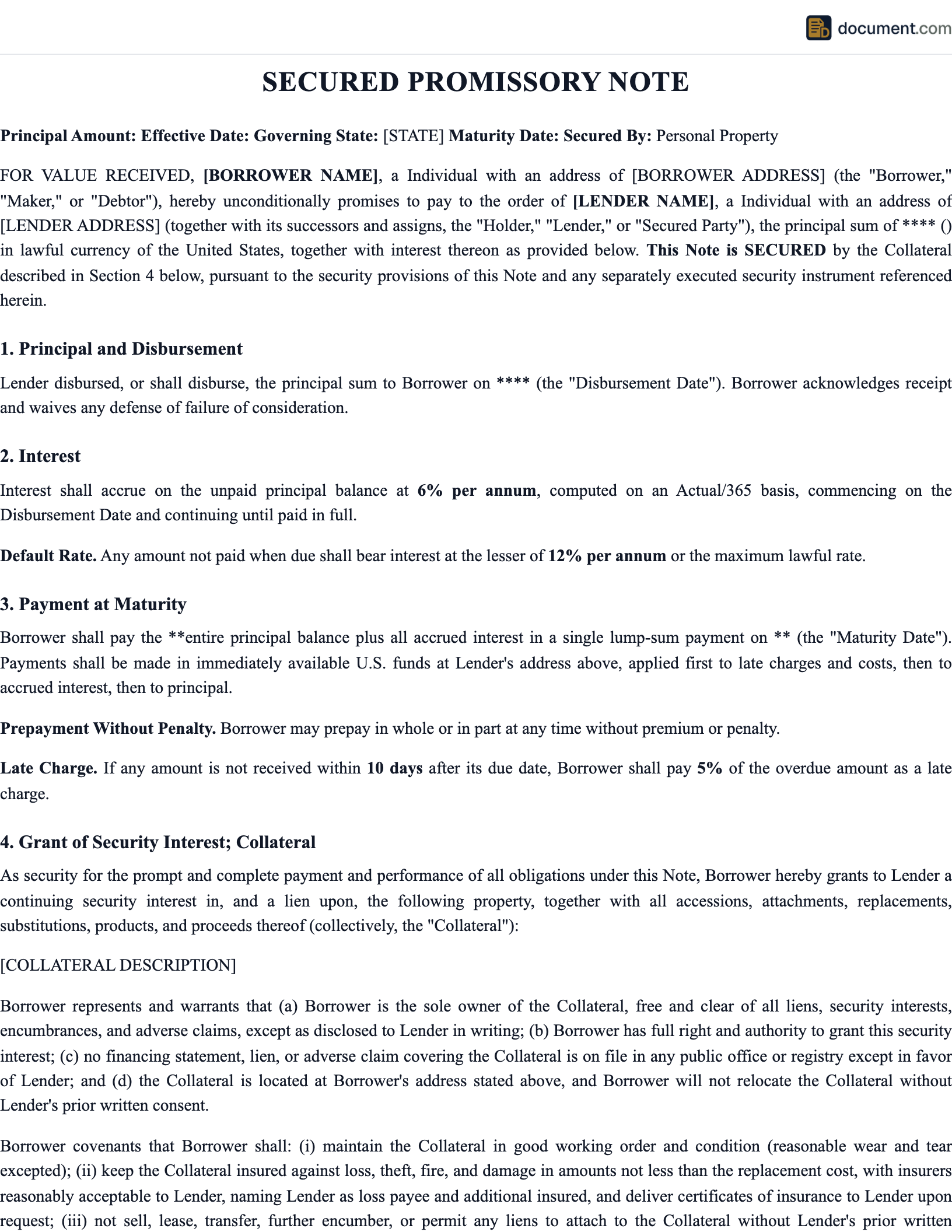



California Secured Promissory Note Overview
A secured promissory note in California is a loan agreement where the borrower pledges specific collateral to guarantee repayment. California law governs the creation, perfection, and enforcement of security interests under the Uniform Commercial Code (UCC) as adopted by the state. The maximum interest rate for most loans in California is 10% (non-exempt lenders).
10% per annum for non-exempt personal loans; no cap for banks, credit unions, licensed lenders, or real estate brokers arranging loans. Lenders should verify that the agreed-upon interest rate complies with California's usury laws before finalizing the note. Charging interest above the legal limit can result in severe penalties, including forfeiture of interest and potential civil liability.
For secured notes involving real property in California, non-judicial (deed of trust, most common) and judicial foreclosure applies. Understanding your state's foreclosure process is critical because it determines the timeline, costs, and lender's rights in the event of borrower default.
10% (non-exempt lenders)
Usury rate cap
Secretary of State
UCC filing office
Non-judicial
Foreclosure type
No (for non-judicial foreclosure)
Deficiency judgment
California Legal Requirements
California has specific requirements for secured promissory notes. Here's what you need to ensure your note is enforceable under CA law:
Important: California Usury Laws
California's maximum interest rate is 10% (non-exempt lenders). 10% per annum for non-exempt personal loans; no cap for banks, credit unions, licensed lenders, or real estate brokers arranging loans. Exceeding the legal limit may void the interest portion of your note or result in civil penalties.
Essential Elements
- Written Agreement: The note must be in writing, signed by the borrower, and clearly state the loan terms
- Compliant Interest Rate: Must not exceed California's 10% (non-exempt lenders) usury cap
- Collateral Description: Specific, identifiable description of all pledged property
- Security Agreement: Grant of security interest signed by the borrower (debtor)
- UCC-1 Filing: Filed with the Secretary of State, UCC Division for personal property collateral
- Default Provisions: Clear events of default, cure periods, and remedies including foreclosure/repossession rights
UCC Filing in California
To perfect a security interest in personal property in California, the lender must file a UCC-1 financing statement with the Secretary of State, UCC Division. This public filing puts other creditors on notice and establishes the lender's priority in the collateral.
Prepare the UCC-1 Form
Include the debtor's exact legal name, secured party name, and detailed collateral description
File with the Secretary of State
Submit online or by mail with the required filing fee
Monitor and Renew
UCC-1 filings last 5 years; file a continuation statement before expiration
Terminate After Payoff
File a UCC-3 termination statement when the loan is fully repaid
California Foreclosure & Repossession
California uses non-judicial (deed of trust, most common) and judicial foreclosure for real property collateral. For personal property (vehicles, equipment, inventory), the lender generally has the right to repossess the collateral without court action, provided it can be done without breaching the peace.
Regarding deficiency judgments in California: No (for non-judicial foreclosure); Yes (for judicial foreclosure). The lender must follow California's specific procedures for disposing of collateral in a commercially reasonable manner, providing proper notice to the borrower before any sale.
| Aspect | California Rule |
|---|---|
| Foreclosure Type | Non-judicial (deed of trust, most common) and judicial |
| Deficiency Judgment | No (for non-judicial foreclosure); Yes (for judicial foreclosure) |
| Statute of Limitations | 2 years (oral), 4 years (written contracts) |
| Usury Rate | 10% (non-exempt lenders) |
| UCC Filing Office | Secretary of State, UCC Division |
Sample California Secured Promissory Note
Below is a preview of our California-specific secured promissory note. Your customized document will include all terms compliant with CA law.
STATE OF CALIFORNIA
SECURED PROMISSORY NOTE
Collateral-Backed Loan Agreement
LENDER (Secured Party):
Name: [Lender Name]
Address: [California Address]
BORROWER (Debtor):
Name: [Borrower Name]
Address: [California Address]
LOAN TERMS
Principal: $[Amount]
Interest: [Rate]% per annum (max 10% (non-exempt lenders) in CA)
Collateral: [Description]
California Secured Promissory Note FAQ
Answers to common questions about secured promissory notes, UCC filings, and collateral requirements in California.
Official California Resources
Use these official resources to verify California requirements, file UCC documents, and access state legal information.
Other California Promissory Note Types
Need a different type of promissory note for California? We offer state-specific templates for every type.
Create your California Secured Promissory Note in under 5 minutes.
Answer a few questions and download a California-compliant document, ready for the state agency.