



Key Takeaways
- •California now protects a deceased person's digital replica for 70 years after death under Civil Code 3344.1, as amended by AB 1836 effective January 1, 2025, with statutory damages of the greater of $10,000 or actual harm.
- •New York's posthumous right runs only 40 years (Civil Rights Law 50-f, amended by S.8391, effective December 11, 2025) and damages are the greater of $2,000 or actual loss, so the same family can have very different leverage depending on domicile.
- •If your will says nothing about AI recreation, silence becomes the answer for you. Your heirs and executor inherit the publicity right and may license your voice to a company like ElevenLabs without ever knowing you would have objected.
- •On May 27, 2026, the Stan Lee estate licensed his voice and likeness to ElevenLabs for AI cameos and a narrated book club, the clearest signal yet that posthumous AI replicas are now a real estate asset, not a hypothetical.
- •Texas requires the heir or assignee to register the publicity claim with the Secretary of State within one year of death to secure priority, a deadline that silently destroys leverage if missed.
- •A likeness executor can be the same person who administers your estate or a separate, tech-literate appointee, and the directive should state plainly whether commercial AI use is permitted, restricted to family, or flatly forbidden.
Reviewed for accuracy by the document.com legal team. Educational information, not legal advice.
What Is Posthumous Digital Likeness Directive?
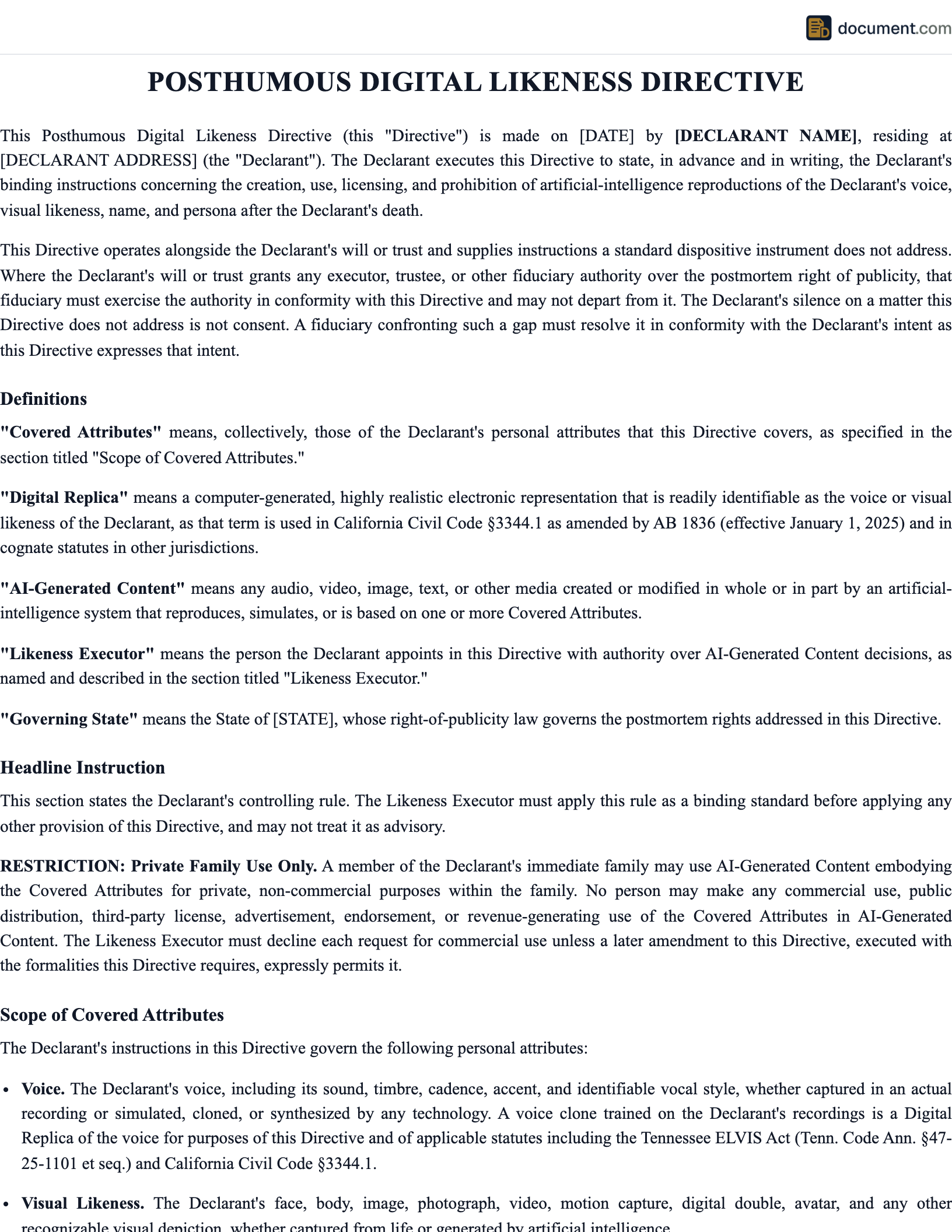
A posthumous digital likeness directive is a written estate-planning instrument in which you say, in advance and in your own words, whether artificial intelligence may recreate your voice, face, and persona after you die, who controls that decision, and on what terms. It converts a default legal right, the postmortem right of publicity, into a set of explicit instructions your fiduciary must follow instead of guessing.
The directive does two practical jobs. It grants someone, usually called a likeness executor or digital executor, the authority to approve, license, restrict, or refuse AI-generated content built from your voice and image. It also records your actual wishes, so that a grieving family is not left arguing over whether you would have wanted a synthetic version of yourself narrating audiobooks, appearing in advertisements, or speaking lines you never said. Because no federal statute comprehensively governs this, the directive draws its enforceable backbone from state right-of-publicity law, which now varies enormously from one jurisdiction to the next.
Why This Matters Now
For most of the last century the postmortem right of publicity was an entertainment-lawyer concern: who could sell a poster of a dead movie star. Generative AI collapsed that distinction. A few minutes of recorded audio is now enough to clone a voice convincingly, and a handful of photographs can drive a video avatar that moves and speaks. The legislatures noticed. Tennessee passed the Ensuring Likeness Voice and Image Security Act, the ELVIS Act, effective July 1, 2024, the first state law written specifically for AI voice cloning. California followed with AB 1836, New York with S.8391, and Illinois with HB 4875 and HB 4762. The map of who is protected, for how long, and against whom changed in roughly eighteen months.
The commercial side moved just as fast. ElevenLabs raised a $500 million Series D in February 2026 at an $11 billion valuation and began signing estates: Michael Caine, Liza Minnelli, the John Wayne estate, and on May 27, 2026, Stan Lee. The Stan Lee Universe venture licensed his professionally recorded voice for a narrated 'Book Club of the Month' and put his likeness on a marketplace for AI cameos. Run the situation backward and the gap is obvious. The George Carlin estate had to sue in 2024 after a podcast generated a fake Carlin standup special; the matter resolved with a permanent takedown, but only because someone went to court. A directive is the difference between your family setting the terms in advance and your family litigating them after the fact.
The Legal Backbone
California Civil Code 3344.1, amended by AB 1836 (70-year postmortem right)
California gives the longest runway in the country. Civil Code 3344.1 already recognized a deceased personality's right of publicity for 70 years after death; AB 1836, effective January 1, 2025, extended it to AI by creating a private cause of action against anyone who produces, distributes, or makes available a 'digital replica' of a dead person's voice or likeness in an expressive work without prior consent from the rights holder. The statute defines a digital replica as a 'computer-generated, highly realistic electronic representation that is readily identifiable as the voice or visual likeness of an individual.' Damages are the greater of $10,000 or actual damages plus profits. The statute carves out news, public affairs, sports broadcasts, comment, criticism, scholarship, satire, and parody; those uses are not infringements. So if you are domiciled in California, your estate controls your synthetic self for seven decades, but if a filmmaker puts you in a documentary or a comedian parodies you, your family's sign-off is never required.
Tennessee ELVIS Act (first AI-specific voice statute)
The ELVIS Act, effective July 1, 2024, was the first state law to name AI directly. It amended Tennessee's existing Personal Rights Protection Act to make 'voice' an explicitly protected property right and to prohibit the unauthorized creation and distribution of AI-generated voice clones and visual likenesses. Two features make it sharp. It reaches technology providers whose product's 'primary purpose or function' is producing unauthorized replicas, not just the end user who hits publish. It also adds criminal exposure: a violation can be charged as a Class A misdemeanor alongside the civil claim. Tennessee keeps the same fair-use exceptions as California and adds 'self-representation.' Because the right is descendible, a directive that names Tennessee law gives a musician's or narrator's estate unusually strong tools.
New York Civil Rights Law 50-f, amended by S.8391 (40-year postmortem right)
New York protects a deceased person's voice and visual likeness against simulation in a 'computer-generated, highly realistic electronic representation,' but only for 40 years after death rather than 70. S.8391, effective December 11, 2025, requires written consent from the heirs, executors, or assignees before a readily identifiable digital replica may be exploited. Damages run to the greater of $2,000 or actual damages. The shorter term and lower statutory floor matter in planning: a New York domiciliary's family has a real but thinner stick than a Californian's, which is one reason domicile and choice-of-law language belong in the directive rather than left to chance.
Texas Property Code Chapter 26 and Illinois HB 4875 / HB 4762
Texas recognizes a descendible, transferable postmortem right of publicity for 50 years after death. The catch is procedural: if the right was not transferred before death it vests in the surviving spouse and children or grandchildren, and to secure priority the holder generally must register the claim with the Texas Secretary of State within the first year after death. Miss that window and enforcement gets harder. Illinois, effective January 1, 2025, enacted HB 4875 and HB 4762, creating a private right of action for unauthorized digital replicas and naming the deceased's executor, administrator, heirs, and devisees as rights holders. Like Tennessee, Illinois extends liability to technology providers whose primary purpose is producing an identifiable person's photograph, voice, or likeness.
Federal floor: the TAKE IT DOWN Act
There is no comprehensive federal right-of-publicity statute, so the postmortem framework remains state law. The one federal piece in force is the TAKE IT DOWN Act, Public Law 119-12, signed May 19, 2025, which criminalizes non-consensual intimate deepfakes (up to two years of imprisonment, three years where a minor is depicted) and requires covered platforms to remove flagged content within 48 hours of a valid notice, with a compliance deadline of May 2026. It is a narrow, harm-specific tool rather than a general license-control regime. A directive should reference it as a backstop against the worst abuses while relying on state publicity law for the licensing and consent questions that estate planning actually turns on. This page is general information, not legal advice; confirm the current statute and term in your state of domicile with counsel before signing.
Post-Mortem Right of Publicity by State
Whether your wishes about an AI recreation survive you depends on your state post-mortem right of publicity, which the estate controls. The table below shows, for all fifty states and DC, the governing statute, the post-mortem term, and any AI-specific provision. A long post-mortem term plus an AI provision gives a directive the most force.
| State | Statute or basis | Post-mortem term | AI / digital replica |
|---|---|---|---|
| Alabama | Ala. Code § 6-5-772 | 55 years | None |
| Alaska | Common law only | Common law | None |
| Arizona | A.R.S. §12-761 (soldiers/military only); Common law right of... | Soldiers only | No explicit AI-specific language in A.R.S |
| Arkansas | Ark. Code Ann. §§ 4-75-1101 et seq. (Frank Broyles Publicity Rights... | 50 years | AI digital replica provisions added via HB1071 (signed February 25, 2025, effective... |
| California | Cal. Civ. Code §§ 3344 (living persons) and 3344.1 (deceased... | 70 years | Digital replica provisions in §3344 (via SB 683, signed October 10, 2025, effective... |
| Colorado | Common law only | Common law | None |
| Connecticut | Common law only | Common law | None |
| Delaware | Common law only | Common law | HB 353 (Amelia Kramer Act) addresses synthetic media/deepfakes for minors and... |
| District of Columbia | Common law only | None | None |
| Florida | Fla. Stat. § 540.08 | 40 years | None |
| Georgia | Common law only | Common law | Georgia 'No Fakes' bill (HB 566) failed to advance in 2025 legislative session; no... |
| Hawaii | Hawaii Revised Statutes Title 26, Chapter 482P (HRS § 482P-1 et seq.) | 70 years | None |
| Idaho | Common law only | Common law | Idaho has enacted targeted deepfake legislation: House Bill 575 (explicit deepfakes),... |
| Illinois | 765 ILCS 1075 (Right of Publicity Act), as amended by HB 4875... | 50 years | HB 4875 (effective January 1, 2025) explicitly prohibits unauthorized digital replicas |
| Indiana | Indiana Code Title 32, Article 36, Chapter 1 (IC § 32-36-1 et seq.) | 100 years | None |
| Iowa | Common law only | Common law | Senate File 2243 and House File 2240 address synthetic media involving minors and... |
| Kansas | No recognized right | None | None |
| Kentucky | KY Rev. Stat. § 391.170 | 50 years | None |
| Louisiana | La. Rev. Stat. Ann. § 51:470.1 et seq. (Allen Toussaint Legacy Act) | 50 years | Digital replica defined in § 51:470.2 as computer-generated or electronic reproduction of... |
| Maine | Common law only | Common law | None |
| Maryland | Common law only | Common law | None |
| Massachusetts | Mass. Gen. Laws Ann. ch. 214, § 3A | None | Massachusetts HB 4744 (enacted 2024, Chapter 118 of Acts of 2024) addresses... |
| Michigan | Common law only | Common law | Michigan House Bills 4047 and 4048 (Protection from Intimate Deep Fakes Act, signed... |
| Minnesota | Common law only | Common law | Minnesota Statute 617.262 (enacted 2023, amended 2024) criminalizes nonconsensual... |
| Mississippi | Common law only | Undefined (no court... | No AI-specific provision; Mississippi has not enacted HB 768 or an ELVIS Act |
| Missouri | Common law only | Common law | None |
| Montana | Common law only | Common law | None |
| Nebraska | Neb. Rev. Stat. §20-202 (with post-mortem survival under §20-208) | Indefinite | None |
| Nevada | Nev. Rev. Stat. §597.770 et seq. (specifically §597.790) | 50 years | None |
| New Hampshire | Common law only | Common law | Deepfake law (H.B |
| New Jersey | Common law only | 50 years | Deepfake law (A3540/S2544 signed 2025) - separate from ROP, establishes civil/criminal... |
| New Mexico | Common law only | Common law | None |
| New York | N.Y. Civ. Rights Law §§50, 51, 50-f | 40 years | N.Y |
| North Carolina | Common law only | Common law | None |
| North Dakota | No recognized right | None | None |
| Ohio | Ohio Rev. Code §2741 (Chapters 2741.01-2741.09) | 60 years | None |
| Oklahoma | Okla. Stat. tit. 12 §1448 (deceased); Okla. Stat. tit. 12 §1449... | 100 years | Oklahoma HB 1364 (synthetic intimate content; 2024-2025) |
| Oregon | Common law only | Common law | Oregon HB 2299 addresses synthetic intimate imagery but not voice cloning specifically... |
| Pennsylvania | 42 Pa.C.S. §8316 (right of publicity); 18 Pa.C.S. §4101.1 (digital... | 30 years | 18 Pa.C.S |
| Rhode Island | R.I. Gen. Laws §9-1-28 (commercial use); R.I. Gen. Laws §9-1-28.1... | None | None |
| South Carolina | Common law only | Unclear (common law... | None |
| South Dakota | S.D. Codified Laws § 21-64 et seq. | 70 years | None |
| Tennessee | Tenn. Code Ann. § 47-25-1101 et seq. (ELVIS Act 2024) | 10 years | ELVIS Act - Tenn |
| Texas | Tex. Prop. Code § 26.001 et seq. | 50 years | None |
| Utah | Utah Code § 45-3 (Abuse of Personal Identity Act), as amended by SB... | 70 years | Yes |
| Vermont | Common law only | Common law | None |
| Virginia | Va. Code § 8.01-40 (civil); Va. Code § 18.2-216.1 (criminal) | 20 years | None |
| Washington | Wash. Rev. Code § 63.60.010 et seq. (amended by SB 5886, effective... | 10 years | RCW 63.60 amended 2026 to include 'forged digital likeness' - digital representations... |
| West Virginia | Common law only | Common law | None |
| Wisconsin | Common law only | Common law | None |
| Wyoming | Common law only | Common law | None |
Compiled from primary state statutes and verified against legislative sources in 2026. Post-mortem terms and AI-specific provisions change frequently; confirm current law for your state.
What a directive actually controls that a will alone does not
A standard will disposes of property. The postmortem right of publicity is property, so by default it passes to your residuary beneficiaries or whomever your will names, and from there your heirs can do almost anything the local statute permits, including signing a voice-licensing deal. That is the quiet problem. Most wills drafted before 2024 never contemplated a synthetic version of the testator, so they grant no guidance at all. The people who inherit the right are free to monetize it, and they may genuinely believe they are honoring you by keeping your voice 'alive,' even if you would have found the whole idea repellent. A directive fixes the ambiguity at the source by stating the rule before anyone has to interpret your silence.
The directive operates on three levers a bare will leaves untouched. It appoints a likeness executor with named authority to approve or refuse AI-generated content, and it can make that person someone other than your general executor, which matters when the right person to weigh a deepfake offer is your tech-literate niece rather than the sibling handling your bank accounts. It sets the standard of use: forbidden entirely, limited to private family remembrance, or licensable commercially subject to written approval and a defined revenue split. You can require human curation, meaning a real person reviews and finalizes anything generated in your voice before release, so the estate is never on autopilot. And it funds the machinery. Hosting an AI model, paying for storage, and maintaining a marketplace listing cost money every month, so a directive often pairs with a small digital maintenance fund or trust earmarked for those recurring fees rather than leaving the executor to pay out of pocket.
One opinion, stated plainly: the families who will suffer most are the ones who assumed this was a celebrity problem. Voice cloning works on a retired schoolteacher's voicemail greeting as well as it works on a movie star. The cost of writing down your wishes is an afternoon; the cost of not writing them down is a courtroom, or worse, a synthetic you saying things you never would have said, with no one holding a document that says otherwise.
When You Need This
You have recorded media of yourself, voicemails, videos, interviews, podcasts, audiobooks, enough that an AI model could plausibly clone your voice or face
You hold any commercial value in your voice or likeness now or might later, as a performer, narrator, influencer, executive, author, coach, or public figure
You feel strongly, in either direction, about whether a synthetic version of you should exist after death and want that wish to bind your family
You are updating a will or trust drafted before 2024 that says nothing about digital replicas or AI recreation
You live in or own a domicile in California, New York, Texas, Illinois, or Tennessee, where the postmortem AI framework is now explicit and the terms differ sharply
You want to name a separate, tech-savvy likeness executor rather than burden your general executor with AI-licensing decisions
You are weighing a real licensing opportunity, such as an ElevenLabs-style estate deal, and need pre-death authorization and terms in writing
How to Fill Out Posthumous Digital Likeness Directive
1. Identify your domicile and governing law
State where you are domiciled and which state's right-of-publicity statute governs, because the term and remedies differ: 70 years in California, 50 in Texas, 40 in New York. If you split time between states, name the controlling jurisdiction explicitly so your executor is not litigating choice of law.
2. Choose your core instruction: grant, restrict, or forbid
Select the headline rule. 'Forbid' bars any AI recreation of your voice or likeness. 'Restrict' permits private, non-commercial family use only. 'Grant' allows commercial licensing subject to approval. Write the chosen standard in unambiguous language, for example: no commercial use of my voice or likeness without the written consent of my likeness executor.
3. Appoint a likeness executor and a successor
Name the person with authority over AI-likeness decisions, and name at least one successor. Note whether this is the same individual as your estate executor or a separate appointee. Choose someone trustworthy and comfortable with technology, since they will evaluate model quality, licensing offers, and takedown demands.
4. Define approval criteria and prohibited uses
Spell out what the executor may approve and what is off-limits. Common prohibitions include political content, endorsements you never gave, sexual or intimate depictions, and any output not reviewed and finalized by a human before release. List any approved uses, such as a memorial video or an authorized audiobook narration.
5. Set licensing and revenue terms
If you permit commercial use, state whether third-party licensing (an ElevenLabs-style marketplace, for instance) is allowed, who negotiates it, the minimum acceptable terms, and how revenue is distributed among beneficiaries or a charity. If you forbid third-party licensing, say so directly.
6. Fund ongoing technical costs
Allocate a digital maintenance fund or direct your trustee to cover recurring costs: model hosting, storage, subscriptions, and platform fees. Estimate a monthly figure so the executor is not forced to abandon your wishes for lack of money.
7. Cross-reference your will or trust and a digital asset inventory
Tie the directive into your dispositive instrument. Reference a separate digital asset inventory that lists accounts and stored media but, critically, contains no passwords in the will itself. Include RUFADAA fiduciary-access authorization so your executor can lawfully reach the underlying recordings and accounts.
8. Execute under your state's formalities and register where required
Sign, witness, and notarize per your state's requirements; remote online notarization and electronic wills are valid in a growing number of states but not all, so confirm yours. In Texas, calendar the one-year Secretary of State registration deadline. Store originals where your executor can find them and review the directive every few years as the law keeps moving.
Key Terms Defined
- Postmortem right of publicity
- The property right to control commercial use of a deceased person's name, voice, image, and persona, which passes to heirs or assignees and lasts a fixed term set by state law: 70 years in California, 50 in Texas, 40 in New York.
- Digital replica
- As defined in statutes like California's AB 1836, a computer-generated, highly realistic electronic representation that is readily identifiable as the voice or visual likeness of a specific individual. The term targets AI-generated clones, not generic look-alikes.
- Likeness executor
- The person you appoint to control AI-recreation decisions about your voice and likeness after death. May be the same as your estate executor or a separate, technically literate appointee with authority to approve, license, restrict, or forbid synthetic content.
- ELVIS Act
- Tennessee's Ensuring Likeness Voice and Image Security Act, effective July 1, 2024, the first state law written specifically for AI voice cloning. It makes voice a protected property right and reaches technology providers whose primary purpose is producing unauthorized replicas.
- RUFADAA
- The Revised Uniform Fiduciary Access to Digital Assets Act, adopted in 47 states, which lets you authorize your executor or trustee to access, manage, and dispose of digital assets, including the recordings and accounts an AI model would draw on.
- Digital maintenance fund
- Money set aside in a will or trust to cover the recurring costs of preserving and operating a posthumous digital likeness, such as AI model hosting, storage, and platform subscription fees, so the executor can carry out your wishes.
Related Documents
Last Will and Testament
The will is the foundation that disposes of your property, including the postmortem right of publicity itself. But a standard will rarely addresses AI recreation, so it leaves your synthetic self to default rules. Pair the directive with your will so the will grants authority and the directive supplies the instructions; one without the other leaves a gap.
Living Trust
A revocable living trust can hold and manage your likeness rights and a digital maintenance fund across your life and beyond, avoiding probate for those assets. The directive's instructions can be embedded in the trust's terms, with the trustee directed to honor your approval criteria and fund the ongoing technical costs of any authorized AI likeness.
AI Voice and Likeness Release
A release governs use of your voice and likeness while you are alive, for example authorizing a company to train a model now. The directive governs what happens after death. The two work together: a release you sign during life can pre-authorize a posthumous deal, and the directive sets the terms and approval process your estate must follow.
Legal Authorities & Sources
This page is grounded in primary law. The statutes and official resources below are the authorities behind the guidance above. Verify the current text of any statute before relying on it.
- California Civil Code 3344.1 (legislative text)
- California AB 1836 bill text
- Vanderbilt Law School: Why Tennessee's ELVIS Act Is the King of AI Protections
- Skadden: Two Newly Enacted New York Laws Will Regulate AI
- Right of Publicity: Texas statute summary
- Variety: Stan Lee Voice and Likeness Licensed to AI Company ElevenLabs
- ElderLawAnswers: AI and the Digital Afterlife, a 2026 Estate Planning Primer
Frequently Asked Questions
Create your Posthumous Digital Likeness Directive in minutes.
Answer a few questions and download a clear, attorney-drafted document that cites the controlling law and is ready to sign.