



What Is a Personal Property Rental Agreement?
A personal property rental agreement is a contract between the owner of a movable item and a person who wants to use that item temporarily in exchange for payment. It covers everything that is not real estate: vehicles, equipment, tools, electronics, furniture, recreational gear, event supplies, and any other tangible property that can be physically handed over and returned. The agreement establishes the rental period, the rental fee, the condition of the property at the time of delivery, the renter's obligations during the rental period, and the terms for returning the property.
The peer-to-peer rental economy has grown significantly, with individuals renting out everything from power tools and camping gear to camera equipment and party supplies. Online platforms have made it easier than ever to connect owners with renters, but these platforms often use standardized terms that may not adequately protect either party. A custom rental agreement tailored to the specific property, the rental duration, and the parties' needs provides far better protection than a generic click-through agreement.
From a legal perspective, renting personal property creates a relationship known as a "bailment." The owner (bailor) temporarily transfers possession of the property to the renter (bailee), who is obligated to use the property only for the agreed purpose, exercise reasonable care, and return it in the same condition (accounting for normal wear and tear). The rental agreement documents the terms of this bailment and provides a framework for resolving disputes about damage, late returns, non-payment, or misuse.
Our attorney-reviewed templates cover every type of personal property rental, from a neighbor borrowing a lawn mower for the weekend to a small business renting out its idle equipment to generate additional revenue. Each template includes condition documentation checklists, deposit terms, insurance provisions, and damage liability clauses customized for the type of property being rented.
Condition Documentation
Photo and written records of the property's condition before and after rental
Deposit Protection
Clear terms for security deposits, deductions, and refund timelines
Liability Clarity
Defined responsibility for damage, loss, theft, and insurance coverage
Personal Property Rental Agreement Form Preview
Below is a visual preview of the sections and fields in a personal property rental agreement. Your completed document will be customized for your specific property type and rental terms.
Personal Property Rental Agreement
Equipment / Item Rental Contract
Section 1: Parties
Section 2: Property Description
Section 3: Rental Terms
Section 4: Signatures
Owner Signature / Date
Renter Signature / Date
Types of Personal Property Rental Agreements
Different types of personal property require different rental terms. Equipment rentals need maintenance and operating instructions, vehicle rentals need insurance verification, and event equipment rentals need setup and teardown provisions. Choose the type that best fits your situation.
Equipment Rental Agreement
For renting heavy equipment, power tools, construction machinery, or industrial equipment
Vehicle Rental Agreement
For private-party rental of cars, trucks, trailers, boats, RVs, or recreational vehicles
Event Equipment Rental
For renting tables, chairs, tents, AV equipment, or decorations for events and parties
Photography/Film Equipment Rental
Specialized agreement for cameras, lenses, lighting, and production equipment
General Personal Property Rental
Flexible agreement for renting any personal property between private parties
Rental Agreement vs Lease vs Loan
When one person temporarily uses another person's property, the arrangement can take several legal forms. Understanding the differences helps you choose the right document.
Comparing Your Options
Rental Agreement
- - Short-term use (days to weeks)
- - Payment for use period
- - Owner retains ownership
- - Property returned at end
- - Security deposit common
Lease Agreement
- - Long-term use (months to years)
- - Regular periodic payments
- - May include purchase option
- - Lessee may handle maintenance
- - More complex terms
Loan / Lending
- - No payment exchanged
- - Informal arrangement
- - Limited legal protection
- - Relies on good faith
- - Common between friends/family
Recommendation: Even if you are lending property for free, use a written agreement. A rental agreement with a $0 rental fee still documents the condition of the property, establishes liability for damage, and sets a return date. This protects both parties and preserves the relationship.
How to Create a Personal Property Rental Agreement: A 6-Step Guide
A solid rental agreement protects both the owner and the renter. Follow these six steps to create an agreement that covers all the bases.
Describe the Property in Detail
The more specific your property description, the better protected both parties are. Include the item name, brand, model, serial number, color, and any distinguishing features. For vehicles, include the VIN, license plate number, mileage, and fuel level. For equipment, record the operating hours, attachments, and accessories included. For electronics, note the firmware version, battery condition, and any included cables or accessories. A vague description like 'one drill' is an invitation for disputes. A precise description like 'DeWalt DCD771C2 20V MAX Cordless Drill, S/N 20241234, with two batteries, charger, and carrying case' leaves nothing to argue about.
Document the Condition Thoroughly
Take time-stamped photographs and video of the property from every angle before the renter takes possession. Note every scratch, dent, stain, or imperfection in writing. For mechanical items, test every function and document the results. Both parties should review and sign the condition report. When the property is returned, repeat the process and compare the return condition to the delivery condition. Any discrepancies are the renter's responsibility unless the agreement specifies otherwise. This documentation is your primary evidence if a damage dispute ends up in small claims court.
Set Rental Terms and Pricing
Establish the rental period (specific start and end dates and times), the rental rate (hourly, daily, weekly, or flat fee), the payment method and timing (paid in advance, at return, or on a schedule), and any additional fees (delivery, pickup, fuel surcharge, cleaning fee). Be explicit about what happens if the renter wants to extend the rental period and how extensions are priced. Include a late return fee structure so the renter understands the cost of keeping the property past the agreed return time.
Determine Security Deposit and Insurance
Set a security deposit that reflects the property's value and the risk of damage. Specify whether the renter must provide proof of insurance covering the rented property, or whether the owner's insurance will apply. Clearly state the conditions under which the deposit will be partially or fully withheld (damage beyond normal wear, missing accessories, cleaning costs, late return). Specify the timeline for returning the deposit after the property is returned in acceptable condition.
Define Use Restrictions and Renter Obligations
Spell out what the renter can and cannot do with the property. Common restrictions include: the property must not be sublet or loaned to a third party, the property must not be taken outside a defined geographic area, the property must be stored in a covered or climate-controlled space when not in use, the renter must follow all manufacturer operating instructions, and the renter must not modify, alter, or repair the property without the owner's written consent. For vehicles, specify authorized drivers and require a valid driver's license.
Sign the Agreement and Exchange the Property
Both the owner and the renter should sign the agreement before the property changes hands. Exchange copies of the signed agreement, the condition report with photos, and the security deposit. For high-value items, consider having the agreement notarized. Provide the renter with any operating instructions, manuals, or safety information relevant to the property. Confirm the return date, time, and location. Keep the owner's copy of the agreement, condition report, and deposit receipt in a safe place until the rental is complete and the deposit has been returned.
Key Components of a Personal Property Rental Agreement
A comprehensive rental agreement covers every aspect of the transaction, from property identification to dispute resolution. Below are the essential components.
| Component | Description |
|---|---|
| Party Identification | Full legal names, addresses, phone numbers, and ID information for both owner and renter |
| Property Description | Detailed description including make, model, serial number, color, and all included accessories |
| Condition Report | Written and photographic documentation of the property's condition at delivery and return |
| Rental Period | Specific start date/time and end date/time for the rental |
| Rental Fee | Amount, rate basis (hourly/daily/weekly), payment method, and when payment is due |
| Security Deposit | Amount, payment method, conditions for deductions, and refund timeline |
| Insurance Requirements | Which party provides insurance and minimum coverage amounts |
| Use Restrictions | Permitted and prohibited uses, geographic restrictions, and authorized users |
| Maintenance Obligations | Renter's responsibility for cleaning, fueling, and basic upkeep during rental |
| Damage Liability | Who pays for damage, how damage is assessed, and the process for filing claims |
| Late Return Terms | Fees, penalties, and consequences for returning the property past the agreed date |
| Indemnification | Renter's obligation to hold the owner harmless for injuries or damage during use |
| Dispute Resolution | Agreement to resolve disputes through mediation, arbitration, or small claims court |
Legal Requirements for Personal Property Rental Agreements
Personal property rental agreements are governed by general contract law and, for certain transactions, by Article 2A of the Uniform Commercial Code (UCC), which specifically addresses leases of personal property. While the legal requirements are less prescriptive than those for real estate leases, several elements are important for enforceability.
UCC Article 2A and Bailment Law
The Uniform Commercial Code Article 2A governs leases of personal property in most states, including short-term rentals. It provides default rules for lease formation, performance, warranties, and remedies. Bailment law also applies, establishing the renter's duty to exercise reasonable care over the property and return it in the condition received (less normal wear and tear). Your rental agreement can modify many of these default rules, which is why a well-drafted agreement is important. Without one, the default statutory rules apply, and they may not match what either party intended.
Essential Elements for Enforceability
- Written Agreement: While oral rental agreements can be valid for short-term transactions, written agreements are strongly recommended and may be required under the statute of frauds for rentals involving significant value or lasting more than one year.
- Clear Property Identification: The agreement must identify the property being rented with sufficient specificity that there is no ambiguity about what is being rented.
- Mutual Assent: Both parties must agree to the terms. For written agreements, both parties must sign. No one can be forced into a rental agreement through fraud, duress, or misrepresentation.
- Consideration: The rental fee serves as consideration. Even a nominal fee (or explicit documentation of a no-fee arrangement) establishes the contractual relationship.
- Lawful Purpose: The property must be rented for a lawful purpose. An agreement to rent property for an illegal activity is void and unenforceable.
Sample Personal Property Rental Agreement
Below is a condensed preview showing the structure and language of our personal property rental agreement template. Your completed document will be customized for the specific item and rental terms.
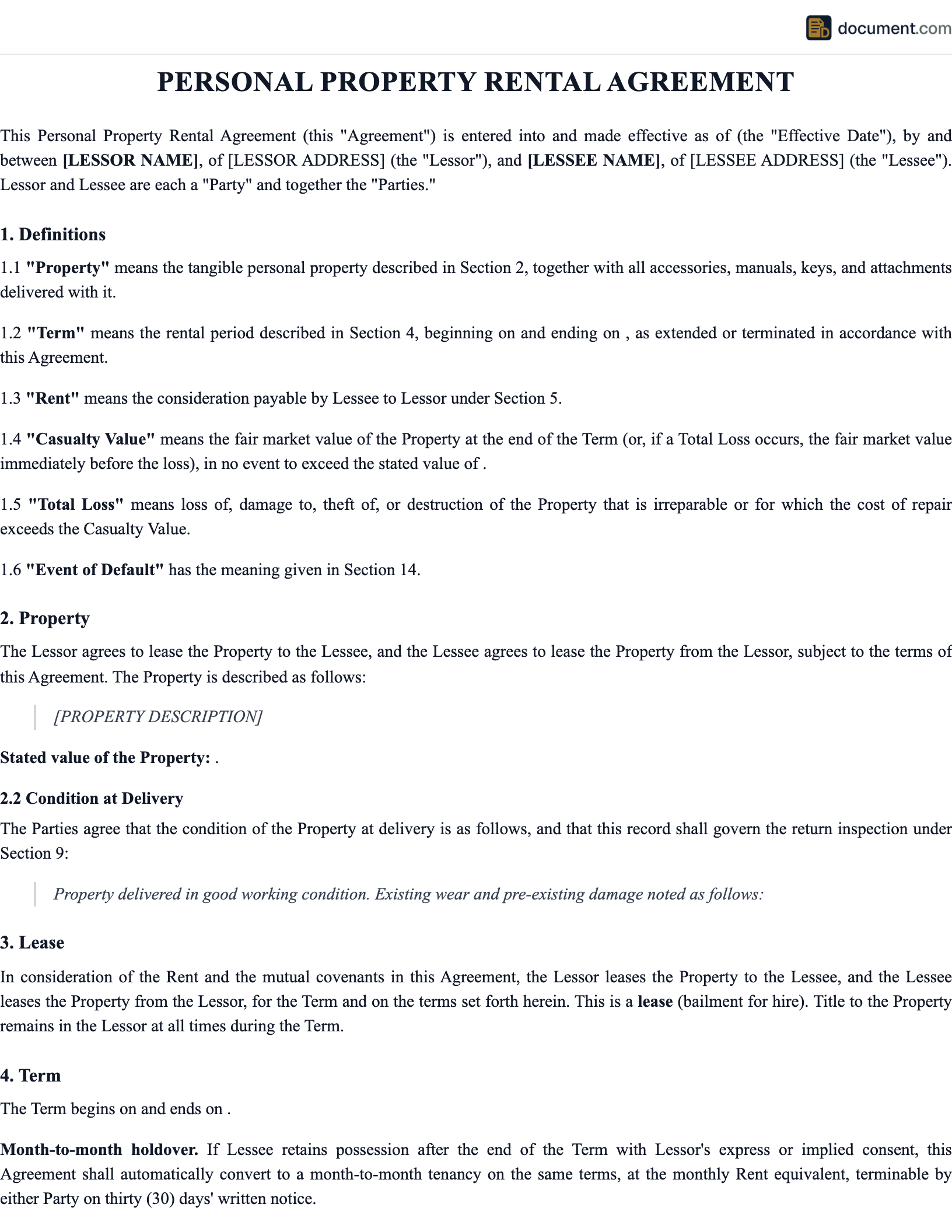
PERSONAL PROPERTY RENTAL AGREEMENT
Agreement #: [Number]
This Personal Property Rental Agreement ("Agreement") is entered into on[Date] by[Owner Name]("Owner") and[Renter Name]("Renter").
1. PROPERTY DESCRIPTION
The Owner agrees to rent to the Renter the following personal property:[Item Description], Serial/ID Number: [S/N], together with the accessories listed in Schedule A. The property's condition at delivery is documented in the Condition Report attached as Schedule B...
2. RENTAL PERIOD AND FEE
The rental period begins on [Start] and ends on [End]. The rental fee is $[Amount] per[day/week], payable [in advance / upon return]...
3. SECURITY DEPOSIT
The Renter shall pay a security deposit of $[Amount] before taking possession of the property. The deposit will be returned within[7/14] days after the property is returned in acceptable condition, less any deductions for damage, cleaning, or late fees...
4. RENTER OBLIGATIONS
The Renter agrees to: use the property only for its intended purpose, exercise reasonable care in the use, handling, and storage of the property, not modify, alter, or attempt to repair the property without the Owner's written consent, return the property in the same condition as received (less normal wear and tear), and comply with all applicable laws and regulations regarding the use of the property...
Frequently Asked Questions
Find answers to common questions about personal property rental agreements, security deposits, insurance, damage liability, and return conditions.
Official Resources
For additional information on personal property rentals, bailment law, and consumer protection, consult these official and reputable sources.
UCC Article 2A - Leases
Full text of Uniform Commercial Code provisions governing personal property leases
FTC Consumer Protection
Federal Trade Commission resources on consumer rights in rental transactions
Nolo - Contract Law
Free legal information on contract basics, including rental agreements
SBA Business Finance
Small Business Administration guidance on equipment rental and leasing
Insurance Information Institute
Insurance guidance for personal property rental transactions
LawHelp.org
Free legal aid resources by state for contract and property disputes
Create your Personal Property Rental Agreement in under 10 minutes.
Answer a few questions and download a compliant, attorney-drafted document ready for your state.