



What Is a Real Estate Partnership Agreement?
A real estate partnership agreement is a binding written contract between two or more investors who have joined together to own, operate, develop, or profit from real property. It is the single most important document in any shared real estate investment because it determines who owns what, who decides what, how money flows, and what happens when things change — which, in real estate, they always do. Unlike a generic business partnership agreement, a real estate partnership agreement must address property-specific issues: how title is held, who can sign a mortgage, how tenants are managed, how capital calls work when a roof fails, and how the property is ultimately sold or refinanced.
Real estate partnerships come in many forms. Two friends pooling money to buy a rental duplex, a group of doctors investing together in a medical office building, a sponsor raising capital from passive investors to acquire a 200-unit apartment complex, a pair of contractors partnering on a fix-and-flip, a family forming a long-term holding partnership for a generational real estate portfolio — all of these are real estate partnerships, and all of them need a written agreement. The scale of the deal changes the level of sophistication required, but the core provisions remain the same.
Most modern real estate "partnerships" are actually structured as multi-member LLCs taxed as partnerships rather than as general partnerships. This gives the partners limited liability protection while preserving pass-through taxation. The governing document is then called an operating agreement rather than a partnership agreement, but the substantive provisions are essentially identical. Whether you call your document a partnership agreement, operating agreement, or joint venture agreement, it must address the same key issues.
The stakes of getting this document right are high. Real estate is illiquid, involves leverage, and generates cash flow over long time horizons. Disputes between partners can paralyze a property, trigger default on the mortgage, and destroy years of equity. A good partnership agreement prevents disputes by answering questions in advance: Who decides? Who pays? Who gets paid? What if we disagree? A cheap, template-based agreement written and signed at the start of a deal costs almost nothing and can prevent six-figure disasters later.
Liability Protection
When structured through an LLC, protect your personal assets from tenant and vendor claims
Clear Profit Waterfall
Define exactly how operating cash flow, refinance proceeds, and sale proceeds are split
Dispute Prevention
Capital call, buy-sell, and deadlock provisions keep disputes from killing the deal
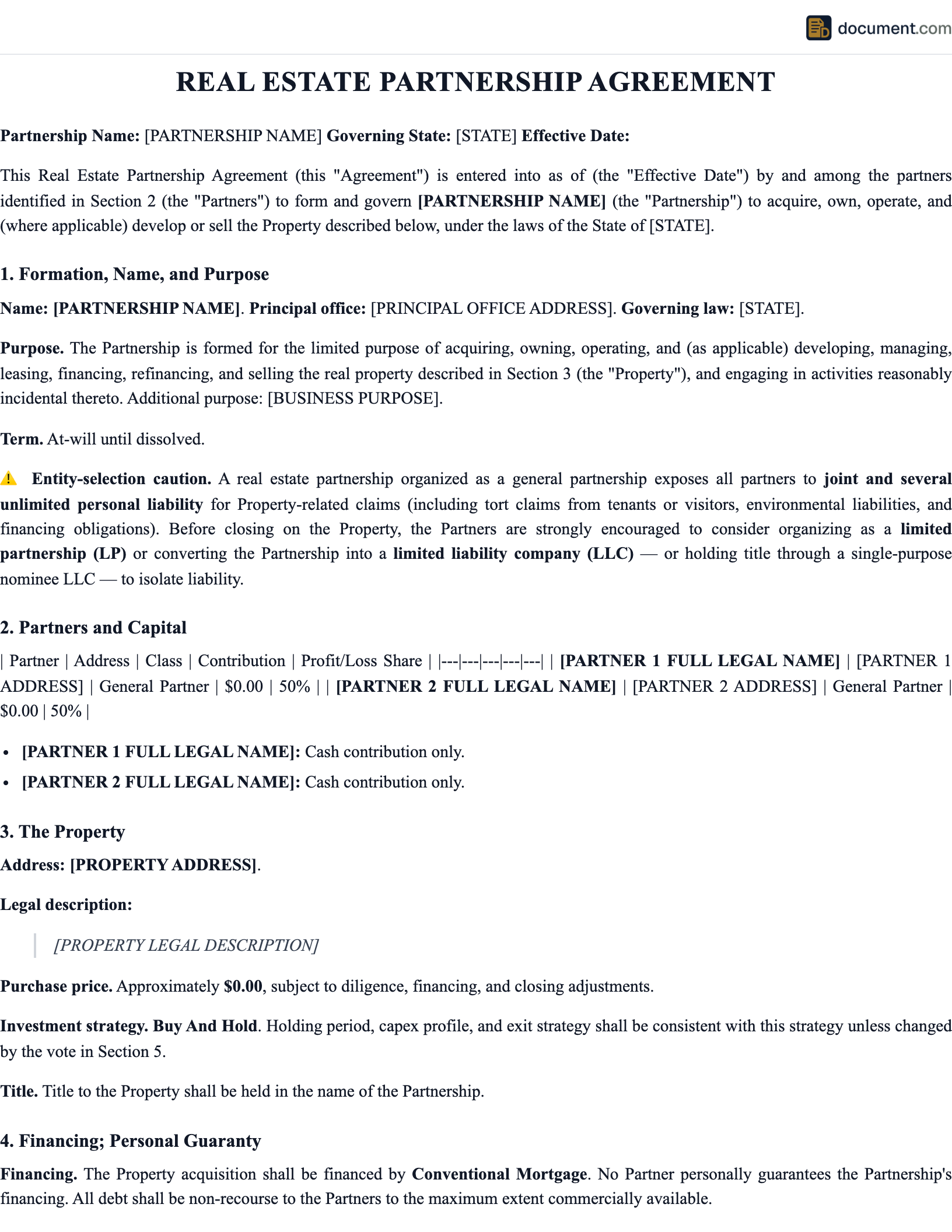
Real Estate Partnership Form Preview
Preview of the sections in our real estate partnership agreement template.
Real Estate Partnership Agreement
Investment, Operation & Exit Terms
Section 1: Property & Partners
Section 2: Capital Contributions
Section 3: Profit Waterfall
1. Return of capital contributions
2. 8% preferred return on unreturned capital
3. 70/30 split of remaining proceeds (investors/sponsor)
Section 4: Execution
Partner Signature
Notary Public
Types of Real Estate Partnerships
Real estate partnerships come in many forms. The right structure depends on whether you are doing a single deal or building a long-term portfolio, whether all partners are active, and how capital is being raised.
Single-Property Joint Venture
Two or more investors partner to acquire, hold, and resell one specific property
Rental Property Partnership
Ongoing partnership to own and operate income-producing residential or commercial rentals
Fix-and-Flip Partnership
Short-term partnership to acquire, renovate, and quickly resell properties for profit
Development Partnership
Ground-up construction, subdivision, or large-scale real estate development project
Syndication / Passive Investor Deal
Sponsor partners with passive capital investors to acquire a larger property
Land Banking Partnership
Hold undeveloped land for long-term appreciation or future development
Commercial Property Partnership
Own and operate office, retail, industrial, or mixed-use commercial real estate
Short-Term Rental (STR) Partnership
Own and operate vacation rentals, Airbnb, or short-term rental properties
Choosing Your Entity Structure
The legal entity that holds your real estate matters almost as much as the partnership agreement itself. Here's how the common options compare.
| Structure | Liability | Tax Treatment | Best For |
|---|---|---|---|
| General Partnership | Unlimited personal | Pass-through (Form 1065) | Rarely — only very small, low-risk deals |
| Limited Partnership (LP) | Limited for LPs; unlimited for GP | Pass-through | Syndications with sponsor and passive investors |
| LLC (multi-member) | Limited for all members | Pass-through by default | Most real estate partnerships — the standard |
| Tenancy in Common | Unlimited personal | Each TIC reports on own 1040 Schedule E | 1031-exchange buyers who want independent tax treatment |
How to Create a Real Estate Partnership
Align on deal terms before signing anything
Have an honest conversation with your partners about contributions, roles, profit splits, decision-making, and exit expectations. Write down the key terms before engaging a lawyer or drafting documents.
Choose your legal structure
For almost all modern real estate deals, a multi-member LLC is the right choice. Form the LLC in the state where the property is located (or in Delaware with foreign registration in the property state).
Draft the partnership / operating agreement
Use our template to draft a complete agreement. Include capital contributions, profit waterfall, capital call rules, management authority, transfer restrictions, buy-sell, exit, and tax allocations.
Take title in the entity name
The deed should transfer title from the seller to the LLC or partnership entity — not to the partners individually. Coordinate with the title company before closing.
Obtain financing and document guarantees
If the loan requires personal guarantees, the partnership agreement should address how guarantor partners are protected and compensated.
Open a dedicated partnership bank account
Never commingle partnership funds with personal or other business funds. Open a separate bank account in the entity's name with the EIN.
Keep detailed records
Maintain a capitalization table, capital account ledger, meeting minutes, and annual financial statements. Work with a CPA experienced in real estate for tax planning and compliance.
Key Components
Property description
Legal description, address, APN, and intended use of the property.
Capital contributions
Each partner's initial capital, including cash, property, or services contributed, plus any commitment for future contributions.
Percentage interests
Ownership percentages that drive voting rights, profit allocations, and distributions.
Profit and loss allocation
How operating profits, losses, depreciation, and tax credits are allocated — often different from cash distributions.
Distribution waterfall
Order in which cash flow, refinance proceeds, and sale proceeds are distributed to partners.
Capital calls
When and how partners are required to contribute additional capital, and consequences of failure.
Management authority
Who can make day-to-day decisions and which decisions require partner approval or unanimous consent.
Management fees
Whether any partner earns a management fee, construction management fee, or acquisition fee, and how it is calculated.
Transfer restrictions
Limits on selling, pledging, or transferring partnership interests, including right of first refusal and tag-along rights.
Buy-sell provisions
Mechanisms for buying out a departing, defaulting, or deadlocked partner, including valuation method and payment terms.
Exit strategy
When and how the property will be sold, refinanced, or continued, and what triggers an exit decision.
Dispute resolution
How partner disputes will be resolved — negotiation, mediation, arbitration, or litigation — and which jurisdiction controls.
Financing & Capital Calls
Real estate partnerships almost always involve debt financing. A typical value-add deal might have 25–30% equity and 70–75% bank debt. The partnership agreement must address financing issues in detail because loans, personal guarantees, and capital calls are among the most common sources of partner disputes.
Initial financing. Specify who has authority to negotiate and sign the acquisition loan, what loan terms require partner approval (interest rate caps, LTV limits, recourse vs. non-recourse), and whether any partner is required to personally guarantee the loan. For loans under $1 million, personal guarantees from at least one creditworthy partner are the norm.
Capital calls.The agreement should specify (1) the circumstances that authorize a capital call — typically operating shortfalls, major repairs, refinancing fees, or property tax arrears; (2) how much notice is required; (3) each partner's pro rata share; and (4) the consequences of failure to fund. Common default remedies include dilution at a penalty rate, loans from other partners at 12–18% interest, and forced buyout at a discount.
Refinancing. Clarify whether refinance decisions require unanimous consent or majority approval, and how cash-out refinance proceeds are distributed (usually to return partner capital first, then split per waterfall).
Exit & Buy-Sell Provisions
Every real estate partnership ends eventually. The partners either sell the property, refinance and recycle capital, or one partner exits and the others continue. The partnership agreement must anticipate each of these scenarios.
- Right of first refusal. If a partner wants to sell their interest, other partners get first right to purchase at the offered price before a third-party sale.
- Appraisal buyout. Interest value is determined by an independent appraiser. Common for planned exits (retirement, death, disability).
- Shotgun clause. One partner sets a price; the other must either buy at that price or sell at that price. Strong incentive to set a fair price.
- Drag-along rights. If a majority wants to sell the property, minority partners can be dragged along and forced to sell their interests on the same terms.
- Tag-along rights. If a majority partner is selling to a third party, minority partners can tag along and sell their interests on the same terms.
- Mandatory sale date. The property must be sold (or refinanced) by a specified date unless partners agree otherwise — prevents one partner from holding the property hostage forever.
Tax Considerations
Real estate partnerships create significant tax opportunities — and pitfalls. Always work with a CPA experienced in real estate taxation before structuring the deal.
- Pass-through taxation. Partnership income, losses, and credits flow through to partners via Schedule K-1. The partnership itself pays no federal income tax.
- Depreciation. Residential buildings depreciate over 27.5 years, commercial over 39. Cost segregation studies can accelerate depreciation on fixtures and land improvements.
- Passive activity losses. Rental losses are generally passive and can only offset passive income, unless a partner qualifies as a real estate professional.
- Section 1031 exchanges. Partnerships can defer gain on the sale of investment property by exchanging into like-kind replacement property. Individual partners cannot do a "drop and swap" without careful planning.
- Depreciation recapture. Depreciation taken during ownership is taxed at up to 25% on sale.
- Special allocations. Partnerships can allocate tax items disproportionately to economic interests if the allocation has "substantial economic effect" under IRC § 704(b). This is the basis for the sponsor promote structure.
Legal Requirements
- Entity formation. If using an LLC or LP, file the formation document with the Secretary of State where the property is located.
- Written agreement. While some states allow oral partnership agreements, always use a comprehensive written agreement.
- Proper title. The deed must transfer title to the entity, not the individual partners.
- Securities law. If the deal involves raising capital from passive investors, the interests may be securities under federal and state securities laws, requiring Regulation D exemption filings and accredited investor verification.
- State licensing. Some property management activities may require a real estate broker's license, depending on the state.
- Tax filings. Federal Form 1065, state partnership returns in each state where property is held, and K-1s to each partner.
Sample Real Estate Partnership Agreement
REAL ESTATE PARTNERSHIP AGREEMENT
This Real Estate Partnership Agreement is entered into as of [Date] by and between the undersigned partners (the "Partners") with respect to the real property located at [Property Address] (the "Property").
1. FORMATION AND PURPOSE
The Partners hereby form a partnership for the purpose of acquiring, holding, operating, and ultimately selling or refinancing the Property for investment purposes.
2. CAPITAL CONTRIBUTIONS
Each Partner shall contribute the amount set forth on Schedule A in exchange for the Percentage Interest set forth therein. Partners shall not be required to make additional contributions except pursuant to a Capital Call under Section 5.
3. DISTRIBUTIONS
Available Cash shall be distributed quarterly in the following order: (a) to repay any Partner loans with interest; (b) to return unreturned Capital Contributions; (c) to pay the 8% Preferred Return on unreturned Capital Contributions; and (d) thereafter, 70% to Investor Partners and 30% to the Sponsor, pro rata within each class.
4. MANAGEMENT
The [Managing Partner] shall have day-to-day authority over operations, subject to Major Decisions requiring unanimous consent, including: sale of the Property, refinancing, material capital expenditures exceeding $[Amount], and admission of new partners.
5. CAPITAL CALLS
If the Managing Partner determines that additional capital is required, the Managing Partner shall deliver a Capital Call Notice specifying the amount and each Partner's pro rata share. Partners shall fund within 30 days. Failure to fund shall result in dilution of the non-funding Partner's Percentage Interest at 150% of the pro rata dilution rate...
6. TRANSFER RESTRICTIONS
No Partner may sell, pledge, or transfer any Percentage Interest without the prior written consent of all other Partners, subject to the Right of First Refusal set forth in Section 7.
7. EXIT
The Partnership shall sell or refinance the Property on or before [Target Exit Date] unless otherwise agreed by Partners holding a majority of Percentage Interests.
Frequently Asked Questions
Official Resources
IRS - Partnerships
Federal tax rules for partnerships and real estate investors
IRS - Section 1031 Exchanges
IRS guidance on like-kind exchanges for real estate
SEC - Regulation D 506(b)
SEC rules for private placements and real estate syndications
HUD - U.S. Department of Housing
Federal housing regulations, fair housing, and landlord-tenant guidance
Nareit - Real Estate Investment Trusts
Industry association for REITs and publicly traded real estate
NASS - Secretary of State Directory
Find your state's entity formation and filing office
IRS Publication 527
Residential rental property tax guide
SBA - Business Structures
SBA guide to choosing the right entity for real estate
Create your Real Estate Partnership Agreement in under 10 minutes.
Answer a few questions and download a compliant, attorney-drafted document ready for your state.