



What Is a Partnership Amendment?
A partnership amendment is a written legal document that modifies one or more specific terms of an existing partnership agreement. Rather than tearing up the original agreement and drafting a new one every time the partners want to update a provision, an amendment surgically changes only the sections the partners want to revise while leaving the rest of the agreement fully intact. The amendment identifies the original agreement by name and date, references the exact sections being changed, sets forth the new language, and is signed by the partners whose consent is required under the amendment clause of the original agreement.
Partnership amendments are one of the most common business documents used by general partnerships, limited partnerships (LPs), and limited liability partnerships (LLPs). Businesses change over time: partners come and go, capital accounts shift, profit-sharing arrangements need to reflect new contributions, managing authority is reassigned, and the scope of the business evolves. An amendment is the right tool whenever the underlying structure of the partnership is staying the same but one or more discrete terms need to change.
A properly drafted amendment will: (1) clearly identify the original partnership agreement by title, effective date, and the names of the original partners; (2) recite the reason for the amendment in a short background section; (3) specify exactly which sections, paragraphs, or provisions are being modified, added, or deleted; (4) set forth the new language verbatim; (5) confirm that all other provisions of the original agreement remain in full force and effect; (6) state the effective date of the amendment; and (7) be signed by the partners whose consent is required. Each of these elements is important — a sloppy amendment that fails to identify which sections are being changed can create ambiguity that ends up in litigation.
Common triggers for a partnership amendment include admitting a new partner, buying out a withdrawing partner, recapitalizing the business, updating profit-and-loss allocations to reflect new contributions or roles, changing the managing partner or decision-making rules, expanding or restricting the business purpose, updating the registered office or DBA, modifying buy-sell provisions, and adding or removing restrictions on transfers of partnership interests. Because so many life-of-business events require an amendment, every partnership should understand how the amendment process works before the need arises.
Surgical Changes
Modify only the sections you need to change without rewriting the entire agreement
Clear Paper Trail
Create a documented history of every change the partners have ever agreed to
Dispute Prevention
Prevent future disagreements by memorializing every partner-approved change in writing
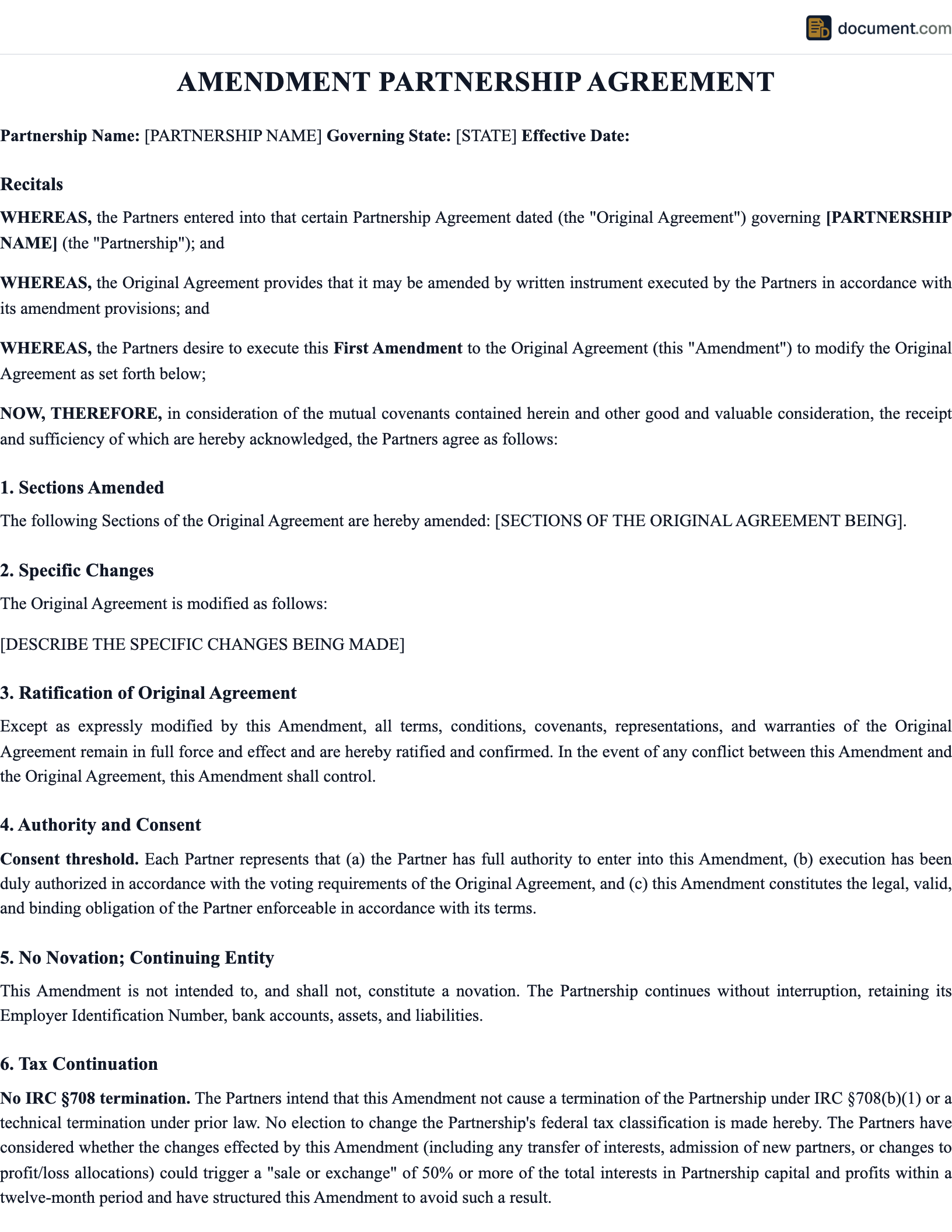
Partnership Amendment Form Preview
Below is a visual preview of the sections and fields included in a standard partnership amendment. Your completed document will be fully formatted, professionally styled, and customized for the specific provisions you are amending.
Amendment to Partnership Agreement
First Amendment
Section 1: Original Agreement
Section 2: Partners
Section 3: Provisions Being Amended
Section 4: Execution
Partner Signature
Notary Public
When to Amend Your Partnership Agreement
Not every conversation among partners requires a formal amendment. Use an amendment whenever the partners are changing something that was written into the original agreement — because a written agreement can only be changed by a written instrument. The following situations are the most common triggers.
Admitting a new partner
When the partnership takes on a new partner, the amendment should document the new partner's capital contribution, profit/loss allocation, voting rights, and the dilution of existing partners' interests. The new partner must sign the amendment and agree to be bound by the original agreement as amended.
A partner withdraws or retires
When a partner leaves, an amendment documents the buyout price, payment terms, release of liability, redistribution of the departing partner's interest among the remaining partners, and any updates to managing authority or signing rights.
Profit or loss allocations change
If one partner is taking on more responsibility, contributing additional capital, or performing work that justifies a larger share of profits, update the allocation formula by amendment. Retroactive allocation changes can cause tax complications, so coordinate with your accountant on the effective date.
Management structure changes
Changing the managing partner, updating decision-making thresholds, reallocating signing authority, or shifting from a partner-managed to a committee-managed structure all require a written amendment.
Business purpose or scope expands
If the partnership is moving into new markets, product lines, or geographies that are outside the original "purpose" clause, amend the purpose provision to cover the expanded scope and avoid arguments that the new activity is ultra vires.
Types of Partnership Amendments
While every amendment is unique, the most common categories are listed below. Our template supports all of these and can be adapted to any provision in your original agreement.
Profit & Loss Allocation Change
Modify how partnership profits, losses, and distributions are divided among partners
Capital Contribution Amendment
Document new capital contributions, loans, or changes to partner equity accounts
Admission of New Partner
Add a new partner, document buy-in terms, and allocate ownership interest
Withdrawal of Partner
Remove a withdrawing or retiring partner and redistribute their interest
Management & Voting Rights
Update decision-making authority, voting thresholds, or managing partner designations
Name or Business Purpose Change
Amend the partnership name, DBA, registered address, or scope of business
Dissolution Trigger Amendment
Modify events that trigger dissolution or wind-up of the partnership
Buy-Sell Provision Update
Update valuation methods, rights of first refusal, or transfer restrictions
Amendment vs. Restatement vs. New Agreement
Partners sometimes confuse amendments with restatements and new agreements. Each has a specific use case, and choosing the right tool matters for clarity and enforceability.
| Tool | Use When | Effect |
|---|---|---|
| Amendment | You are changing one or a few specific provisions | Original agreement remains in effect except for the amended sections |
| Amended & Restated Agreement | You have multiple accumulated amendments or want one clean document | Replaces the original and all prior amendments with a single integrated document |
| New Partnership Agreement | The business is fundamentally restructuring (e.g., GP to LP) | Terminates the original and establishes a new legal framework, sometimes a new entity |
How to Create a Partnership Amendment
Creating a valid partnership amendment is straightforward if you follow a clear process. The key is to be precise about what is changing and to follow the amendment procedures in the original agreement.
Read your original agreement's amendment clause
Find the section of your original partnership agreement that describes how amendments are made. Look for the vote required (unanimous, supermajority, or simple majority), any notice requirements, and whether the amendment must be in writing and signed.
Identify exactly what you are changing
Pull out your original agreement and mark each specific section, subsection, or schedule that needs to change. Write down the old language and the new language side by side so nothing is ambiguous.
Draft the amendment
Use our template to draft the amendment. Include the original agreement's title and date, a short recitals section explaining why you are amending, the specific language being changed, a confirmation that everything else remains in effect, and the effective date.
Hold a partner meeting or circulate for written consent
If your agreement requires a meeting or written consent, follow that process. Document the vote in meeting minutes or written consent resolutions signed by each consenting partner.
Have all required partners sign
Circulate the final amendment for signature by the partners whose consent is required. Each partner should sign, print their name, and date their signature. Consider having signatures notarized.
File with the state if required
If you are an LP or LLP and the amendment changes information on the original state registration (name, address, registered agent, general partners), file a Certificate of Amendment with the Secretary of State.
Distribute and store the signed amendment
Give every partner a signed copy of the amendment. Store the original with the original partnership agreement in a secure location — digital and physical. Notify your accountant, bank, and any third parties who relied on the original agreement.
Key Components of a Partnership Amendment
Every properly drafted partnership amendment should include these core components. Missing any one of them can create ambiguity or make the amendment harder to enforce.
Title and amendment number
E.g., "First Amendment to the Partnership Agreement of Cedar Ridge Holdings." Numbering amendments sequentially (First, Second, Third) avoids later confusion.
Reference to the original agreement
Identify the original agreement by full title, effective date, and the names of the original partners so there is no question which document is being amended.
Recitals (background)
Short 'WHEREAS' clauses that explain the context and purpose of the amendment. Not legally required but highly recommended for clarity.
Amendment provisions
The operative language: exactly which sections are being changed, added, or deleted, with the precise new wording quoted.
Ratification clause
A statement that all other provisions of the original agreement remain in full force and effect, so nothing is accidentally nullified.
Effective date
The date the amendment takes effect, which may be the signing date, a future date, or a retroactive date if agreed by all partners.
Signature block
Signature lines for every partner whose consent is required, with space for printed names, dates, and (if applicable) title or capacity.
Notary acknowledgment
Optional but strongly recommended, especially for amendments that change capital, ownership, or real estate holdings.
Voting & Approval Rules
Every partnership amendment must be approved by the partners in the manner required by the original partnership agreement. If the original agreement is silent on amendments, your state's partnership statute controls — and in almost every state that has adopted the Revised Uniform Partnership Act (RUPA), the default rule is that amendments to the partnership agreement require unanimous consent of all partners.
Common amendment voting thresholds you may find in partnership agreements include: (1) unanimous consent — all partners must agree; (2) supermajority — e.g., partners holding at least two-thirds or three-quarters of the capital interests; (3) majority of partners by number — simple majority count; (4) majority by capital interest — weighted by each partner's share of contributed capital; and (5) special approval requirements for certain types of changes (e.g., unanimous consent to change profit allocations or to admit a new general partner, but a simple majority for administrative matters).
Before drafting an amendment, confirm three things: (1) what vote the amendment clause requires; (2) how that vote must be documented (meeting minutes, written consent, or both); and (3) whether any partner has an absolute veto right over the specific type of change being made. Some provisions — notably those that would increase a partner's personal financial obligations or decrease their rights without consent — typically require that specific partner's individual approval even if the overall amendment clause sets a lower threshold.
Legal Requirements
To be enforceable, a partnership amendment must meet several legal requirements that vary by state and by the type of partnership being amended.
- Written form. Almost every partnership agreement requires amendments to be in writing, and most state statutes default to the same rule. Oral amendments are extremely risky and often unenforceable.
- Proper authority. The partners signing the amendment must have the authority to do so under the original agreement and state law.
- Required vote. The amendment must be approved by the vote specified in the original agreement (or by unanimous consent if the agreement is silent).
- Signatures of required partners. Every partner whose consent is required must sign. Electronic signatures are valid in all 50 states under the E-SIGN Act and state UETA adoptions.
- Clear identification of changes. The amendment must unambiguously identify which sections are being modified and what the new language says.
- State filing (where applicable). For LPs and LLPs, a Certificate of Amendment must be filed with the Secretary of State when the amendment changes publicly registered information.
- Consistency with law. An amendment cannot eliminate fiduciary duties, eliminate the duty of good faith and fair dealing, or violate other mandatory rules of your state's partnership statute.
Sample Partnership Amendment
Below is a condensed preview of our partnership amendment template. Your completed amendment will be fully customized for the specific provisions you are changing.
FIRST AMENDMENT TO PARTNERSHIP AGREEMENT
of [Partnership Name]
This First Amendment (the "Amendment") to the Partnership Agreement of [Partnership Name] (the "Partnership"), dated as of [Original Agreement Date] (the "Original Agreement"), is entered into as of [Effective Date] by and among the undersigned partners.
RECITALS
WHEREAS, the Partners entered into the Original Agreement to govern the operations of the Partnership; and
WHEREAS, the Partners desire to amend the Original Agreement to reflect changes in profit allocation and the admission of a new Partner;
NOW, THEREFORE, in consideration of the mutual covenants contained herein, the Partners agree as follows:
1. AMENDMENT OF SECTION 4.1 (PROFIT AND LOSS ALLOCATION)
Section 4.1 of the Original Agreement is hereby deleted in its entirety and replaced with the following: "Profits and losses of the Partnership shall be allocated among the Partners in proportion to their respective Percentage Interests as set forth on Schedule A, as amended."
2. ADMISSION OF NEW PARTNER
[New Partner Name] is hereby admitted as a Partner of the Partnership, effective as of the Effective Date, with a capital contribution of $[Amount] and a Percentage Interest of [%].
3. RATIFICATION
Except as expressly modified by this Amendment, all terms and provisions of the Original Agreement shall remain in full force and effect, and are hereby ratified and confirmed by the Partners.
4. GOVERNING LAW
This Amendment shall be governed by and construed in accordance with the laws of the State of [State].
5. COUNTERPARTS
This Amendment may be executed in counterparts, each of which shall be deemed an original and all of which together shall constitute one and the same instrument...
Frequently Asked Questions
Answers to common questions about amending partnership agreements, voting requirements, filing rules, and execution.
Official Resources
For authoritative information on partnership law, amendments, and state filing requirements, consult these official and reputable resources.
IRS - Partnerships
Federal tax information for partnerships, including Form 1065 and Schedule K-1
ULC - Uniform Partnership Act
Uniform Law Commission resources on RUPA and state adoption status
SBA - Business Structures
U.S. Small Business Administration guide to partnerships and other entities
ABA - Business Law Section
American Bar Association resources on partnership law and governance
NASS - Secretary of State Directory
National Association of Secretaries of State — find your state filing office
Cornell Law - Uniform Partnership Act
Full text of the Uniform Partnership Act with annotations
Nolo - Partnership Legal Encyclopedia
Free legal information on forming and amending partnerships
IRS - Form 1065
Partnership return of income and instructions
Create your Amendment Partnership Agreement in under 10 minutes.
Answer a few questions and download a compliant, attorney-drafted document ready for your state.