



What Is a Release of Personal Guarantee?
A release of personal guarantee is a written legal instrument by which a creditor — typically a bank, equipment lessor, landlord, or trade vendor — formally discharges an individual guarantor from any further responsibility for repaying or performing the underlying obligation. When a business owner, officer, or investor signs a personal guarantee, they place their personal assets at risk in support of company debt. A release is the document that returns those personal assets to a status where they cannot be reached by the creditor, no matter what subsequently happens to the borrower.
Personal guarantees are everywhere in commercial finance. Lenders demand them because they dramatically improve recovery prospects in the event of default and because they align the guarantor's incentives with prudent management of the borrower. Small business loans through the SBA 7(a) program require personal guarantees from any individual owning 20 percent or more of the borrower. Commercial real estate lenders frequently require carve-out guarantees covering fraud, environmental liability, and waste. Equipment leases, vendor credit lines, and franchise agreements often demand personal guarantees as a condition of doing business. Once signed, the guarantee can follow the guarantor for years — sometimes decades — until it is formally released.
The legal effect of a release depends entirely on its drafting. A narrow release may discharge only specified obligations, leaving the guarantor exposed for related liabilities. A broad release discharges all obligations of the guarantor under the guarantee, whether known or unknown, present or future, and is typically accompanied by a covenant not to sue and a waiver of any unknown claims (sometimes referred to as a Section 1542 waiver in California and similar provisions in other states). For maximum protection, the release should also include the lender's acknowledgment that the guarantee has been surrendered and is of no further force or effect.
A release becomes effective on the date specified in the document, which may be the signing date or a later date conditioned on certain events such as closing of a refinancing, receipt of payment, or substitution of new collateral. The guarantor should retain the executed original in permanent records, request a copy of the original guarantee marked "released" or "cancelled," and update any personal financial statements that previously listed the guarantee as a contingent liability.
Personal Asset Protection
Removes the lender's ability to reach personal assets like home equity, savings, and wages
Clean Exit
Provides a clean break when selling a business or stepping away from operations
Borrowing Capacity
Eliminates a contingent liability that constrains personal credit applications
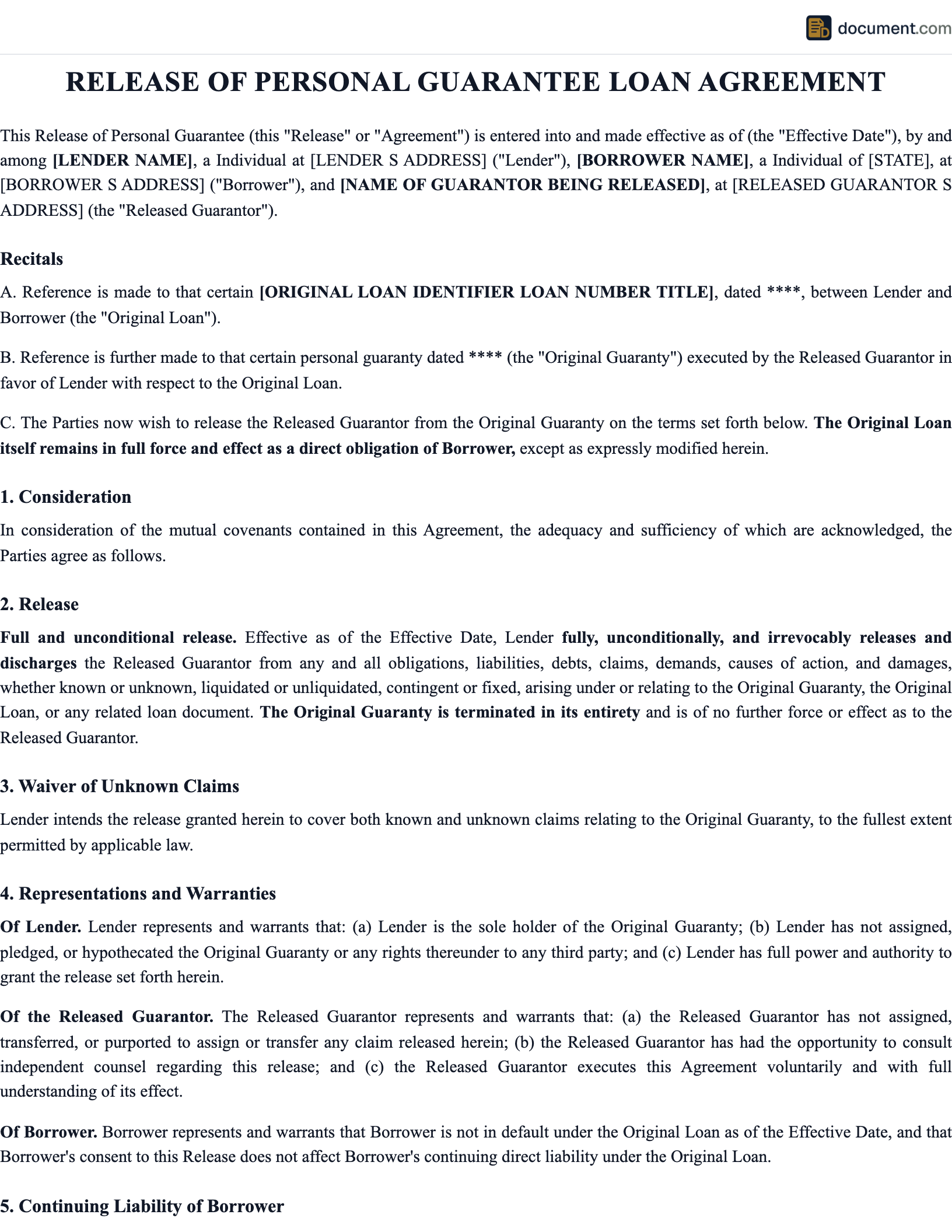
Release of Personal Guarantee Form Preview
The following preview illustrates the structure and fields included in our release template. The finished document is fully formatted, customized to your specific guarantee, and ready for execution.
Release of Personal Guarantee
Discharge of Guarantor Liability
Section 1: Parties
Section 2: Original Guarantee
Section 3: Scope of Release
Section 4: Consideration
Section 5: Execution
Authorized Lender Signature
Notary Public
When You Need a Release of Personal Guarantee
A release is appropriate any time the original justification for the personal guarantee no longer applies. Below are the most common situations in which guarantors should affirmatively pursue a release rather than allow the guarantee to remain in place by inertia.
Sale of the Business
If you are selling your business or your interest in it, you must obtain releases from every creditor whose loans you have personally guaranteed. The buyer typically agrees to indemnify the seller for these obligations, but indemnification is no substitute for an actual release — if the buyer later defaults, an indemnity will not stop the lender from coming after you.
Departure from the Company
When an owner, officer, or investor leaves the business — whether through resignation, retirement, redemption of equity, or otherwise — they should request a release from any guarantees signed during their tenure. Many guarantors discover years later that they remain on the hook for debts of a company they have not been involved with for a decade.
Loan Refinancing or Payoff
When the original loan is refinanced or paid off in full, the underlying obligation no longer exists, but the guarantee may continue to secure other obligations to the same lender. A release ensures that the guarantor is formally discharged in connection with the payoff.
Substitution of Collateral or Co-Guarantor
A guarantor can sometimes be released by substituting other collateral acceptable to the lender — such as a letter of credit, a deposit account pledge, or a stronger replacement guarantee from a more creditworthy party.
Improvement in Borrower's Financial Profile
Many lenders include "burn-off" clauses in their guarantee documents that automatically release the guarantee once the borrower achieves specified financial benchmarks. Even without an automatic burn-off, lenders will often consider releasing a guarantee when the borrower has demonstrated several years of strong performance.
Workout or Settlement
In a workout scenario where the borrower is unable to pay the loan in full, the lender may agree to release the guarantor in exchange for a discounted lump-sum payment, a structured payment plan, or the surrender of specific assets. This is often the only practical way to resolve a guarantee that has been triggered by default.
Release vs. Termination vs. Novation
These three concepts are frequently confused but have meaningfully different legal consequences. Choosing the wrong instrument can leave a guarantor exposed even after months of negotiation.
| Instrument | Effect on Past Obligations | Effect on Future Obligations |
|---|---|---|
| Release | Discharged in full | Discharged in full |
| Termination | Generally remain in place | No further obligations accrue |
| Novation | Replaced by a new obligation with a new obligor | Borne entirely by the new obligor |
| Indemnity | Guarantor remains liable to lender; indemnitor must reimburse | Same — does not bind the lender |
How to Create a Release of Personal Guarantee
The process of obtaining and documenting a release involves both negotiation and careful drafting. Below is the recommended workflow.
Locate the Original Guarantee
Pull the original guarantee document and any related credit agreements, security agreements, and intercreditor agreements. Confirm the exact legal name of the lender, the date of the guarantee, and the obligations it covers. The release should reference these details precisely.
Confirm the Underlying Obligation Status
Request from the lender a current payoff statement, loan history, and confirmation of any other obligations of the borrower that the guarantee may secure. You cannot evaluate the scope of the release without understanding the full universe of obligations.
Submit a Written Release Request
Send a formal written request to the lender's account officer explaining the basis for the request — sale of business, departure from company, refinancing, loan paydown, or other event. Include current financial statements for the borrower if the lender will rely on borrower credit alone going forward.
Negotiate Consideration
Be prepared to offer something of value: a release fee, principal paydown, substitute collateral, an updated guarantee from a stronger party, additional financial reporting covenants, or a combination. Lenders rarely release guarantees for free.
Draft the Release
Use a comprehensive form that includes (a) identification of the parties and original guarantee, (b) recital of consideration, (c) operative release language discharging the guarantor, (d) covenant not to sue, (e) waiver of unknown claims, (f) representations regarding authority to sign, and (g) governing law and dispute resolution provisions.
Review by Counsel
For any meaningful obligation, have the release reviewed by an attorney before signing. Small drafting variations can determine whether you walk away clean or remain on the hook for years.
Execute and Notarize
Both the lender and the guarantor should sign the release, with signatures notarized for evidentiary value. If multiple guarantors are being released, each should sign their own counterpart.
Mark the Original Cancelled
Request that the lender mark the original guarantee 'cancelled' or 'released' and provide a copy to you. Some lenders will return the original guarantee document with cancellation stamped across each page.
Record if Required
If the underlying obligation was secured by real property and the original guarantee was recorded, record the release with the appropriate county recorder's office to clear title.
Update Your Records
File the executed release in your permanent records, update any personal financial statements that previously listed the guarantee as a contingent liability, and notify any third parties (such as a personal lender evaluating your borrowing capacity) that the guarantee has been released.
Key Components of the Release
A complete release contains the following essential elements. Missing any of them can create ambiguity that a lender may later exploit.
| Component | Description |
|---|---|
| Identification of Parties | Full legal names of the lender, borrower, and guarantor being released |
| Recital of Original Guarantee | Specific reference to the date, amount, and nature of the original guarantee document |
| Recital of Consideration | Statement of the consideration being exchanged for the release (fee, paydown, substitute security) |
| Operative Release Language | Clear statement that the lender releases, acquits, and forever discharges the guarantor |
| Scope of Release | Whether the release covers past, present, and future obligations, and known and unknown claims |
| Covenant Not to Sue | Lender's agreement not to bring any action against the guarantor under the guarantee |
| Waiver of Unknown Claims | Express waiver of any claims that may exist but are not yet known to the parties |
| Representations and Warranties | Confirmation that the signing parties have authority and that no assignment of claims has occurred |
| Governing Law | Identification of the state law that governs interpretation and enforcement |
| Execution Block | Signature lines for authorized representatives, notary acknowledgment, and date |
Negotiating the Release with the Lender
Lenders are not in the business of releasing guarantees voluntarily. The guarantee was originally required because the lender judged that the borrower's credit alone was insufficient to support the loan, and giving up the guarantee means accepting more risk. A successful negotiation acknowledges this reality and presents the lender with a credible alternative that preserves the lender's recovery prospects while eliminating the guarantor's exposure.
The most persuasive arguments are quantitative. If the borrower has been profitable for three consecutive years, has built up substantial cash reserves, and has reduced the principal balance to half of its original amount, present those facts in a one-page memo with supporting financial statements. Show the lender that the guarantee is no longer providing meaningful incremental recovery — that even if the borrower defaults, the lender's exposure is fully covered by collateral and operating cash flow.
Be willing to give something up. Offer to maintain enhanced financial reporting, accept tighter covenants, agree to a higher interest rate, post additional collateral, or pay a release fee. Lenders are accustomed to negotiating releases as part of broader credit relationship adjustments, and a flexible counterparty is far more likely to get what they want than one who simply demands the release.
If the loan officer rejects your initial request, escalate respectfully. Ask for the basis of the decision and what would change the outcome. Many initial rejections are policy-driven and can be reversed by a thoughtful written submission to credit committee or by working with the lender's workout group. Patience and persistence pay off.
Tax and Credit Implications
In ordinary circumstances, the release of a personal guarantee has no direct tax consequences because the guarantor was a contingent obligor rather than a primary borrower. The guarantor did not receive loan proceeds and has no basis to recover or income to recognize when the contingent obligation is extinguished.
Tax issues arise primarily in two scenarios. First, if the guarantor has previously made payments under the guarantee and is now being released from any further obligation, those prior payments may give rise to a bad debt deduction or capital loss depending on the relationship between the guarantor and the borrower. Second, if the release is granted in connection with the lender forgiving a portion of debt that the guarantor had become primarily liable for (for example, after a default and acceleration), cancellation-of-indebtedness income may be recognized.
On the credit side, a personal guarantee typically does not appear directly on a personal credit report — it is a contingent obligation, not a personal debt — but it does need to be disclosed on personal financial statements and personal loan applications. Releasing the guarantee removes this disclosure obligation and frees up borrowing capacity. If the guarantee was reported to the credit bureaus because of a payment default, the negative entries will remain on the credit report for the standard reporting period regardless of the release.
Legal Requirements
A release of personal guarantee is governed by the law of the state specified in the underlying guarantee or, if no governing law is specified, by the law of the state where the guarantee was executed or where the lender has its principal place of business. Most states enforce releases according to their plain language, but several specific requirements deserve attention.
Statute of Frauds
Releases of guarantees must be in writing and signed by the party against whom enforcement is sought (the lender). Oral releases are not enforceable in any state, even if witnesses are available to testify to the lender's intent. The writing requirement reflects the gravity of the obligation being discharged.
Authority of Signing Parties
The lender's signing officer must have actual authority to release guarantees. Bank loan officers typically have credit authority up to specified dollar limits and may need credit committee approval to release guarantees on larger relationships. Confirm authority by requesting a copy of the lender's internal authorization or by asking the signing officer to represent authority in the release document itself.
Waiver of Unknown Claims
In states like California, generic release language does not extinguish unknown claims unless the release contains an express waiver of California Civil Code Section 1542 or its equivalent. Several other states have similar statutes. A well-drafted release should include an express waiver of unknown claims regardless of the state, drafted to satisfy the most demanding statutory requirements.
Sample Release of Personal Guarantee
The condensed sample below illustrates the operative provisions of our template. Your finished document will be fully formatted and customized.
RELEASE OF PERSONAL GUARANTEE
This Release of Personal Guarantee (this "Release") is made as of [Date] by[Lender Name](the "Lender") in favor of[Guarantor Name](the "Guarantor").
RECITALS
A. On [Date], the Guarantor executed a Personal Guarantee (the "Guarantee") in favor of the Lender, guaranteeing the obligations of [Borrower Name] (the "Borrower") under that certain Loan Agreement dated [Date].
B. The Guarantor has requested that the Lender release the Guarantor from all obligations under the Guarantee, and the Lender has agreed to do so on the terms set forth herein, in exchange for good and valuable consideration including [Description of Consideration].
1. RELEASE
The Lender, for itself and its successors and assigns, hereby releases, acquits, and forever discharges the Guarantor and the Guarantor's heirs, successors, and assigns from any and all claims, demands, debts, liabilities, obligations, causes of action, and rights of every kind and nature, whether known or unknown, suspected or unsuspected, fixed or contingent, that the Lender has, may have, or may have had against the Guarantor arising out of, related to, or connected with the Guarantee.
2. COVENANT NOT TO SUE
The Lender covenants and agrees that it shall not commence, prosecute, or permit to be commenced or prosecuted against the Guarantor any action, suit, or other proceeding based upon any claim released hereby.
3. WAIVER OF UNKNOWN CLAIMS
The Lender expressly waives any and all rights or benefits available to it under any statute or principle of common law that would otherwise preserve claims unknown at the time of this Release, including without limitation California Civil Code Section 1542 and any analogous provision of other applicable law.
4. SURRENDER OF GUARANTEE
Concurrently with execution of this Release, the Lender shall mark the original Guarantee "CANCELLED" and deliver it to the Guarantor.
5. GOVERNING LAW
This Release shall be governed by and construed in accordance with the laws of the State of [State], without regard to its conflict of laws principles.
Frequently Asked Questions
Common questions about discharging personal guarantees, negotiating with lenders, and the legal effects of release documents.
Official Resources
Authoritative resources on personal guarantees, commercial lending, and creditor-debtor law.
U.S. SBA — 7(a) Loan Program
Personal guarantee requirements for SBA-backed business loans
Consumer Financial Protection Bureau
Federal guidance on credit, debt, and consumer protection
FDIC — Banker Resources
Federal Deposit Insurance Corporation resources on commercial lending practices
U.S. Courts — Bankruptcy Basics
Federal information on bankruptcy and the discharge of debt obligations
IRS — Form 1099-C, Cancellation of Debt
Tax reporting requirements for cancellation of indebtedness income
Uniform Law Commission
Uniform Commercial Code and related model legislation governing commercial transactions
Create your Release of Personal Guarantee Loan Agreement in under 10 minutes.
Answer a few questions and download a compliant, attorney-drafted document ready for your state.