
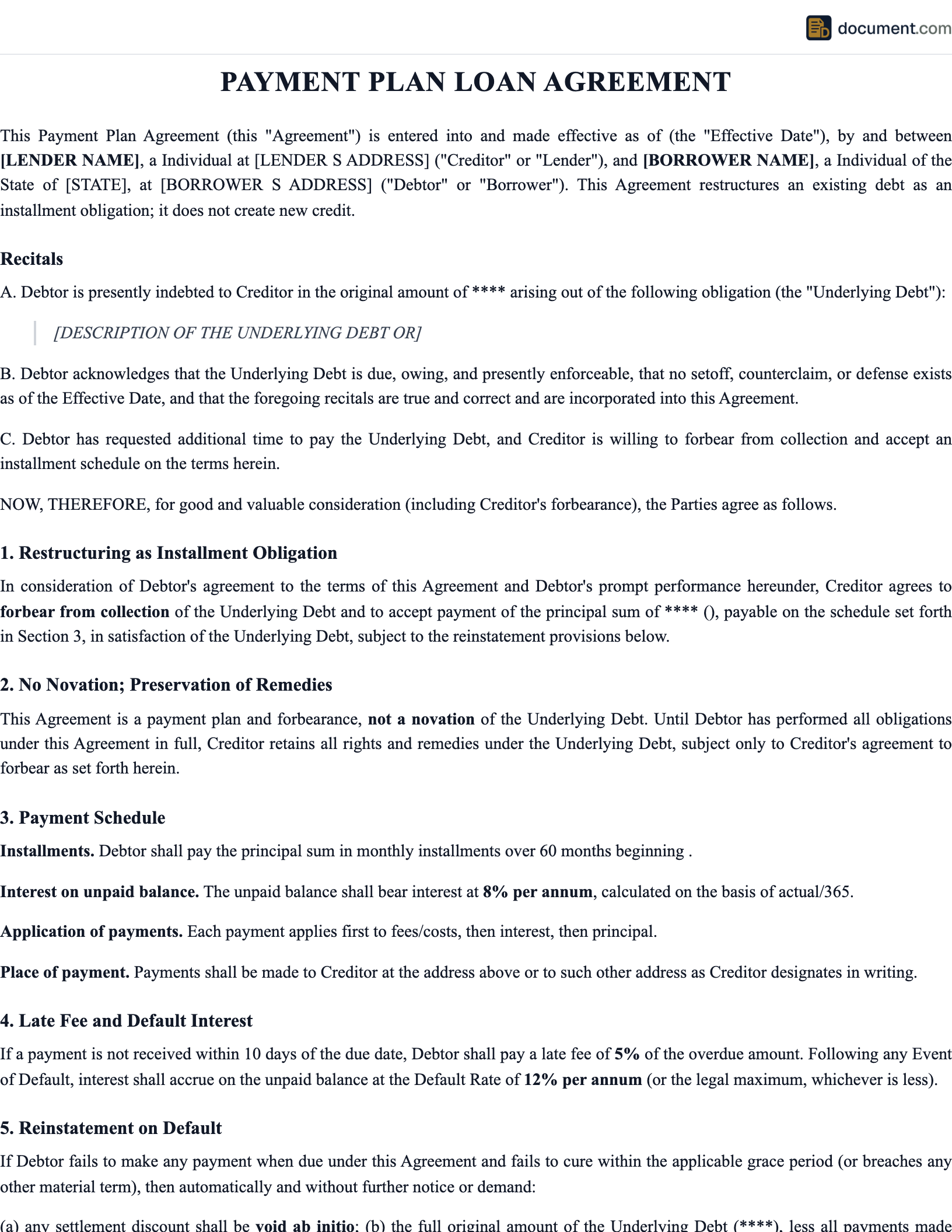



What Is a Payment Plan Agreement?
A payment plan agreement is a written contract between a creditor and a debtor that restructures a financial obligation into a series of scheduled installments over time. The agreement identifies the underlying debt, fixes the total balance owed (including any accrued interest, fees, and costs as of the effective date), sets out the payment schedule with exact amounts and due dates, specifies the interest rate (if any) applied to the unpaid balance, and establishes the consequences of missed payments and the creditor's remedies upon default. It is one of the most widely used collection and credit instruments in American business because it converts a binary pay-or-sue situation into a structured, workable arrangement that benefits both parties.
Payment plans are used in dozens of scenarios. A medical provider lets a patient pay off an uninsured balance over 24 months. A contractor accepts structured payments from a homeowner who cannot pay the final invoice in full. A family member lends money to a relative and documents the loan as a formal installment plan. A plaintiff and defendant settle a lawsuit with a release coupled with a payment plan for the settlement amount. A business restructures an overdue vendor invoice into quarterly payments. In each case, the written agreement transforms an uncertain, potentially contested obligation into a clearly defined, enforceable commitment backed by the legal remedies of contract law.
A well-drafted payment plan agreement accomplishes several legal functions simultaneously. First, it acknowledges the debt in writing — which in most states restarts the statute of limitations on the underlying obligation. Second, it liquidates the balance to a sum certain, eliminating any future dispute about how much is owed. Third, it establishes a clear schedule that either party can use as evidence of performance or default. Fourth, it gives the creditor an acceleration right so that a missed payment converts the entire remaining balance into an immediately due claim. Fifth, it can provide for late fees, default interest, attorneys' fees, and other remedies that are not available under general contract law without an express agreement.
Payment plans can be unsecured (relying only on the debtor's personal promise to pay) or secured (backed by collateral such as real estate, a vehicle, business equipment, or a personal guarantee). They can charge market-rate interest, below-market interest, or no interest at all — subject to state usury laws and the federal imputed interest rules for large zero-interest arrangements. The right structure depends on the nature of the underlying debt, the debtor's creditworthiness, and the parties' expectations about enforcement.
Structured Schedule
Converts a lump-sum debt into predictable monthly installments.
Enforceable Contract
Fully binding contract with acceleration, late fees, and default remedies.
Tolls Limitations
Written acknowledgment typically restarts the statute of limitations on the underlying debt.
Payment Plan Form Preview
Payment Plan Agreement
Fixed Monthly Installments with Interest
Creditor Signature
Debtor Signature
Types of Payment Plan
Fixed Installment Plan
Equal monthly payments covering principal and interest over a set term — the simplest and most common structure.
Amortized Payment Plan
Payments apply interest first, principal second, with a full amortization schedule listing every payment.
Interest-Only Payment Plan
Borrower pays only interest during an initial period, then switches to full principal-plus-interest payments.
Balloon Payment Plan
Low monthly payments followed by a single large final payment covering the remaining balance.
Graduated Payment Plan
Payments start low and step up at scheduled intervals — useful when the debtor's income is expected to grow.
Hardship / Deferred Plan
A temporary payment arrangement that reduces or pauses payments during a period of financial hardship.
When to Use a Payment Plan
Restructuring an unpaid invoice
Contractors, medical providers, and vendors use payment plans to convert an unpaid invoice into scheduled installments — preserving the customer relationship while locking in the balance and the enforcement rights.
Family loans and informal lending
Loans between relatives should always be documented, both to prevent future disputes and to create the written acknowledgment needed for the IRS imputed interest rules on loans over $10,000.
Settlement of a lawsuit or claim
Settling parties often combine a release with a payment plan, so the defendant pays the settlement amount over time. The agreement should include consent-judgment language triggered by default.
Seller financing
A seller can finance part or all of a purchase — of a car, a business, equipment, or real estate — by taking back a promissory note and payment plan rather than cash at closing.
Customer financing programs
Service businesses offer in-house payment plans to customers as an alternative to third-party financing. The plan itself is the contract documenting the arrangement.
Back-tax and government payment arrangements
The IRS, most state tax agencies, and many local government agencies use their own statutory payment plan forms. A private payment plan cannot substitute for the official government form.
Interest Rates and State Usury Limits
The maximum interest rate you can lawfully charge on a private payment plan depends on your state's usury statute. Usury laws draw sharp distinctions between consumer and commercial transactions, between individual and corporate borrowers, and between different types of credit. Charging interest in excess of the state usury cap can result in forfeiture of the interest, forfeiture of the entire principal, civil penalties, or even criminal liability.
| Jurisdiction | General Usury Cap (Private, Non-Regulated) |
|---|---|
| California | 10% per annum for non-exempt loans |
| New York | 16% civil cap; 25% criminal cap |
| Texas | 10% general; up to 18% by written agreement |
| Florida | 18% general; 25% for loans over $500,000 |
| Illinois | 9% consumer; no cap for commercial |
| Delaware | Contract rate; no usury cap on most loans |
| Utah | Contract rate; no general cap |
| South Dakota | No usury cap |
| Massachusetts | 20% criminal usury cap |
| Georgia | 16% on loans under $3,000; contract rate above |
| Arizona | 10% default; contract rate by agreement |
| Arkansas | Federal reserve discount rate + 5% (constitutional cap) |
Rates shown are general principles only. Usury rules are among the most technical areas of state lending law and include numerous exceptions, alternative caps, and transactional categories. Always verify the current statute before setting a rate.
How to Create a Payment Plan: A 10-Step Guide
Identify the Parties and the Underlying Debt
Start by identifying the creditor and debtor by full legal name and address. For business parties, use the exact legal entity name (not a trade name or DBA). Describe the underlying debt precisely: invoice number, original transaction date, services or goods provided, and the original contract or document that created the obligation.
Reconcile the Balance to a Sum Certain
Calculate the exact balance owed as of the effective date of the payment plan, including principal, accrued interest, late fees, and any collection costs already incurred. Both parties should agree on this number in writing — ambiguity about the starting balance is the most common source of future disputes.
Choose the Payment Structure
Decide whether the plan will be fixed installments, amortized with interest, interest-only with a balloon, graduated, or hardship-based. The structure should match the debtor's ability to pay and the creditor's risk tolerance. For most small-dollar restructurings, a simple fixed-installment plan is best.
Set the Interest Rate (and Verify Usury Compliance)
If charging interest, verify that the rate is below your state's usury cap for the relevant transaction type. Document the rate, the method of calculation (simple or compound), and the compounding period if applicable. If not charging interest, confirm whether the federal imputed interest rules apply.
Calculate the Payment Amount and Schedule
Use a spreadsheet PMT function or an amortization calculator to compute the exact payment. Generate a complete amortization schedule showing every payment, the principal and interest breakdown, and the ending balance — attach the schedule as an exhibit.
Draft Default and Acceleration Clauses
Include a clear default definition (typically a missed payment not cured within a specified grace period), a late fee, default interest (often 2-5 percentage points above the regular rate), and an acceleration clause making the entire remaining balance due on default. Without acceleration, enforcement is slow and cumbersome.
Add Security if Appropriate
For large or higher-risk plans, add collateral — real estate mortgage, vehicle lien, UCC-1 filing, or personal guaranty — to convert the unsecured debt into a secured obligation. Secured collateral can be repossessed or foreclosed on default without a court judgment (depending on the collateral type and state law).
Include Attorneys' Fees and Dispute Resolution Clauses
Most state courts will not award attorneys' fees to a prevailing party in contract litigation unless the contract expressly provides for them. Include a mutual attorneys' fees clause, and consider an arbitration or mediation provision for efficient dispute resolution.
Have Both Parties Sign (and Consider Notarization)
Both parties should sign and date the agreement. Notarization is not legally required but is strongly recommended for amounts over a few thousand dollars, particularly for family loans or restructurings of disputed balances, because it forestalls later claims of forgery or duress.
Track Payments and Send Default Notices Promptly
Set up a simple payment tracking system — spreadsheet, accounting software, or a loan servicing platform. Record every payment and issue written notices of default the moment a payment is missed. Prompt enforcement preserves rights and prevents the matter from drifting back into collection limbo.
Key Components of a Payment Plan
| Component | Description |
|---|---|
| Parties | Full legal names and addresses of the creditor and the debtor |
| Effective Date | Date the payment plan becomes binding |
| Recitals | Background facts explaining the underlying debt and the reason for restructuring |
| Acknowledgment of Debt | Express acknowledgment that tolls the statute of limitations and fixes the balance |
| Principal Balance | Exact balance owed as of the effective date |
| Interest Rate | Annual rate, calculation method, and compounding frequency (if any) |
| Payment Amount | Regular installment amount for each scheduled payment |
| Payment Frequency | Weekly, biweekly, monthly, quarterly, or other schedule |
| Number of Payments | Total number of installments in the plan |
| First Payment Date | Date the first payment is due |
| Final Payment Date | Date the last scheduled payment is due |
| Amortization Schedule | Exhibit listing every payment and its principal/interest split |
| Payment Method | Acceptable payment methods (check, ACH, wire, card) |
| Grace Period and Late Fees | Days allowed past due date and the late fee amount |
| Acceleration Clause | Creditor's right to declare the full balance due upon default |
| Default Definition | Specific events constituting default |
| Default Interest Rate | Higher rate applied to the unpaid balance after default |
| Attorneys' Fees Clause | Prevailing party entitled to recover reasonable attorneys' fees |
| Collateral (if any) | Description of any security interest securing the plan |
| Governing Law | State law governing the agreement |
| Dispute Resolution | Jurisdiction, venue, and any arbitration clause |
Default and Enforcement
When a debtor misses a payment, the creditor's first step should be a written notice of default that identifies the missed payment, references the agreement, demands the missed payment (plus any late fee) within a reasonable cure period — typically 10 to 15 days — and warns that the creditor will accelerate the entire remaining balance if the default is not cured. This notice establishes a clear paper trail, preserves the relationship if the default is inadvertent, and satisfies any contractual or state-law notice requirements that must be met before acceleration.
If the cure period expires without payment, the creditor can formally accelerate the debt (making the entire remaining balance immediately due and payable), apply default interest to the accelerated balance, and proceed to enforcement. Enforcement options depend on the agreement and the underlying collateral. For unsecured payment plans, the creditor must obtain a court judgment and then collect through garnishment, bank levy, or lien on the debtor's property. For secured plans, the creditor can also exercise the security interest — foreclose on real estate, repossess a vehicle, or enforce a UCC-1 lien — depending on the collateral and the state's secured transactions rules.
Practical tip: Many payment plan disputes are resolved by a phone call and a revised schedule rather than litigation. Always offer to restructure before accelerating — it preserves the relationship, produces faster payment, and avoids the expense of litigation. Reserve acceleration for situations where the debtor has stopped communicating or clearly cannot pay.
Sample Payment Plan Language
PAYMENT PLAN AGREEMENT
This Payment Plan Agreement (the "Agreement") is entered into as of May 1, 2026, by and between Evergreen Dental Group, PC("Creditor") and Jonathan L. Reeves("Debtor").
Recitals. Debtor owes Creditor the sum of $8,526.00 for dental services rendered between November 2025 and January 2026. Debtor acknowledges the debt and wishes to pay it in installments. Creditor agrees to accept installment payments on the terms below in full satisfaction of the debt.
Payment Schedule. Debtor shall pay Creditor the sum of $377.12 on the first day of each month, beginning May 1, 2026, for twenty-four (24) consecutive months, for a total of $9,050.88 (including interest at 6.00% simple annual). A complete amortization schedule is attached as Exhibit A.
Late Fee and Default.Any payment not received within ten (10) days of its due date shall incur a late fee of $25.00. Two consecutive missed payments shall constitute an event of default, at which time Creditor may, at its option, declare the entire unpaid balance immediately due and payable, apply default interest at 10.00% per annum to the accelerated balance, and pursue any and all remedies available at law or in equity, including reasonable attorneys' fees and costs of collection.
Governing Law. This Agreement shall be governed by the laws of the State of [State], without regard to its conflict of laws principles.
Entire Agreement. This Agreement constitutes the entire agreement of the parties regarding the subject matter and supersedes all prior discussions, understandings, and agreements.
Frequently Asked Questions
Official Resources
Create Your Payment Plan Agreement
Attorney-reviewed templates for every installment structure and every U.S. state.
Start Your Payment Plan