



What Is an IOU?
An IOU — short for the phrase "I owe you" — is a written acknowledgement of a debt from one person or business to another. At its most basic, an IOU identifies the borrower, the lender, the amount owed, and the date the obligation was created. It serves as evidence that money or value was loaned and that the borrower acknowledges the obligation to repay. Although the format is often informal, an IOU is a real legal record that can be used to recover a debt in court if the borrower refuses to pay.
IOUs are most commonly used between friends, family members, roommates, neighbors, and small businesses for short-term loans where a full promissory note or loan agreement would feel excessive. A neighbor who borrows $400 to fix a car, a roommate who covers this month's utility bill, or a contractor advancing materials to a customer all represent classic IOU situations. Because these transactions usually take place between people who know and trust each other, the parties often skip formal documentation — which is exactly when disputes are most likely to arise later.
Compared with a promissory note or loan agreement, an IOU is intentionally simple. It does not have to spell out a payment schedule, an interest rate, late fees, default remedies, or collateral, although it can include any of these items. The trade-off for this simplicity is that an IOU may be harder to enforce when key details are missing — for example, when there is no due date, no interest term, and no clear statement that the money is a loan rather than a gift. Adding even a few additional details, such as a payment date and a signature line, dramatically increases the strength of an IOU as evidence.
IOUs are governed by state contract law and the statute of limitations for written contracts in the state where the debt was created. Most states recognize handwritten or typed IOUs as valid contracts as long as the document includes an identifiable lender, borrower, debt amount, and the borrower's signature acknowledging the obligation. When an IOU lacks a due date, courts generally treat the debt as payable on demand, meaning the lender can request payment at any time and the statute of limitations begins to run from the date of demand or the date of the IOU, depending on the jurisdiction.
Whether you are loaning money to a family member, formalizing a debt between business partners, or simply creating a paper trail for a small personal loan, our attorney-reviewed IOU templates give you a clean, professional document that captures the essentials and avoids the pitfalls of a hastily scribbled note. You can choose a basic IOU for casual situations or a more detailed version with repayment schedule, interest rate, witness, or notary provisions for higher-value loans.
Written Proof
Creates a clear paper trail that protects both lender and borrower
Court-Admissible
Can be used as evidence in small claims and civil court
Quick to Create
Most IOUs can be filled out and signed in under five minutes
Form Preview
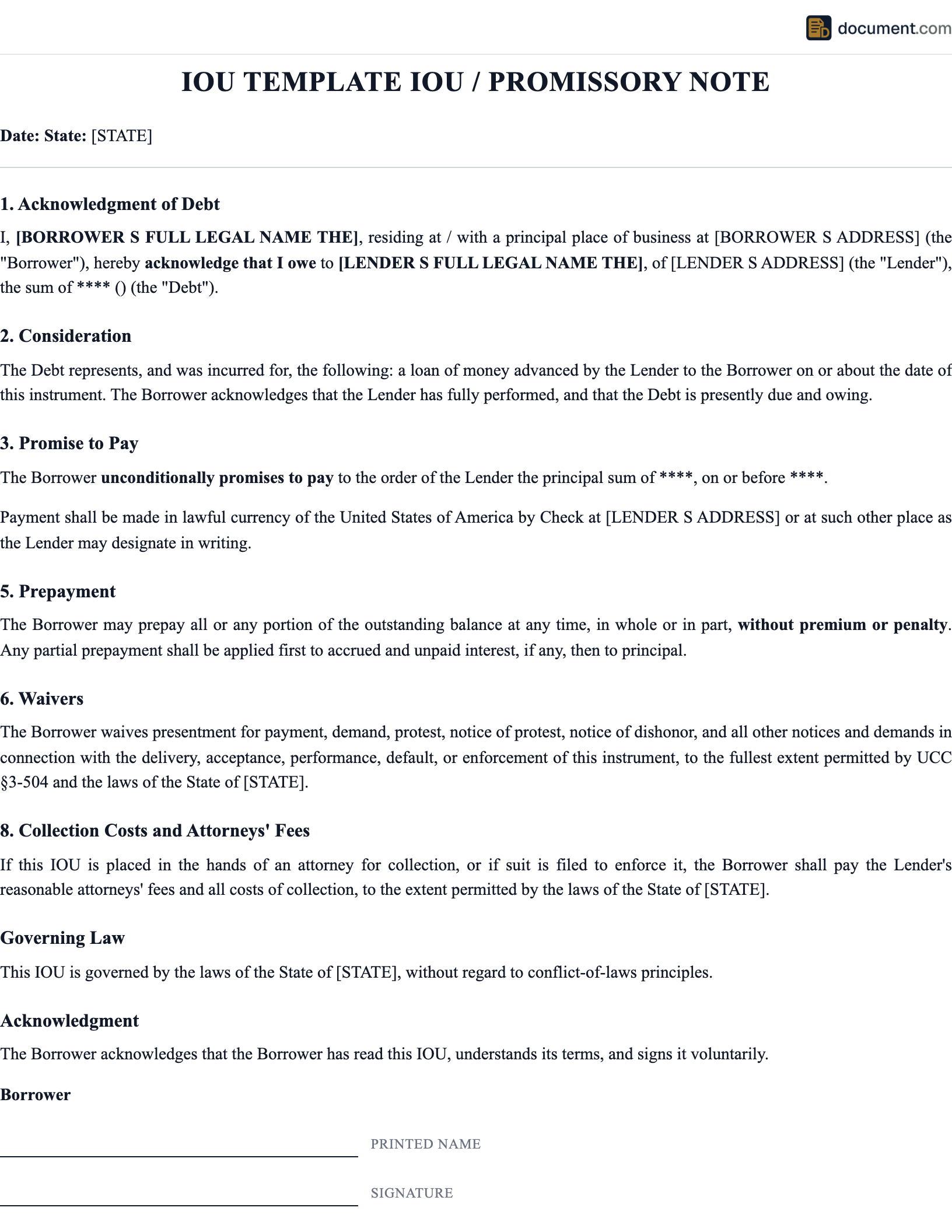
Our IOU template fits on a single page and includes every element courts look for when enforcing an informal debt. Below is a preview of the structure your finished document will follow.
Borrower: ________________________
Lender: __________________________
Principal Amount: $____________
Reason for Debt: _____________________
Repayment Date: _____________________
Interest (if any): ____% per annum
Borrower Signature: __________________
Witness Signature: ___________________
IOU vs Promissory Note vs Loan Agreement
IOUs, promissory notes, and loan agreements are all written instruments that document a debt, but they differ significantly in formality, enforceability, and use case. Choosing the right document depends on the size of the loan, the relationship between the parties, and how much structure the situation requires.
| Feature | IOU | Promissory Note | Loan Agreement |
|---|---|---|---|
| Length | 1 paragraph - 1 page | 1-3 pages | 3-15+ pages |
| Repayment Terms | Optional | Required | Detailed schedule |
| Interest | Optional | Usually included | Always included |
| Default Remedies | Rare | Yes | Detailed |
| Collateral | No | Optional | Common |
| Typical Use | Casual debts under $1,000 | Personal/business loans | Larger structured loans |
How to Write an IOU
Writing an IOU only takes a few minutes, but the document should still include every element a court would expect to see. Follow these steps to create an IOU that holds up if it ever needs to be enforced.
Identify the Parties
Write the full legal name and address of both the borrower and the lender. Avoid nicknames — use the names that appear on government-issued identification.
State the Amount Owed
List the principal amount in both numbers and words (for example: $1,500.00 — One Thousand Five Hundred Dollars). This prevents any later dispute about the figure.
Include the Date
Write the date the debt was created. This is critical for calculating the statute of limitations and any interest that accrues over time.
Add a Repayment Date
Specify the date the loan must be repaid in full, or describe a payment schedule if it will be paid in installments. If no date is given, the debt is treated as payable on demand.
Include Interest (Optional)
If the loan carries interest, state the rate, whether it is simple or compound, and the date interest begins to accrue. Make sure the rate complies with state usury laws.
Sign and Date
The borrower must sign and date the IOU. The lender's signature is optional but recommended. Adding a witness signature or notarization further strengthens the document.
Make Copies
Give one signed original to the borrower and keep one for the lender. Photograph or scan the document and store a backup copy in cloud storage.
Key Components of an IOU
Every well-drafted IOU contains a handful of essential elements. Missing any one of these can weaken the document and make it harder to enforce.
- Date: The day the IOU is created and the debt is acknowledged.
- Parties: The full legal names of the lender and the borrower.
- Principal Amount: The exact sum owed, written in numbers and words.
- Reason for Debt: A short description of why the money was loaned.
- Repayment Terms: When and how the borrower will pay back the lender.
- Interest Rate: Optional, but should be included if the loan is interest-bearing.
- Signatures: Borrower's signature is required; lender, witness, or notary signatures are optional.
Legal Enforceability of an IOU
An IOU is generally enforceable if it meets the basic requirements of a valid contract: offer, acceptance, consideration, mutual assent, and a clear obligation. The borrower must be a competent adult, the loan must be for a lawful purpose, and the document must identify the parties and the amount with reasonable certainty. Courts have enforced IOUs written on napkins and torn pieces of notebook paper — the form does not matter nearly as much as the clarity of the obligation.
Statute of Limitations
Each state sets its own time limit for suing on a written contract, typically between three and ten years from the date the debt becomes due. Once that period expires, the debt becomes time-barred and cannot be collected through the courts. In states such as California (4 years), Texas (4 years), Florida (5 years), and New York (6 years), knowing the deadline is critical to preserving your right to sue.
An IOU may be unenforceable if it lacks essential terms, if the borrower was a minor or mentally incapacitated when signing, if the loan was for an illegal purpose, or if the lender used fraud or duress to obtain the borrower's signature. To maximize enforceability, use a clean typed template, include a due date and interest term, and consider having the borrower sign in front of a witness or notary.
Collecting on an Unpaid IOU
When a borrower fails to pay an IOU, the lender has several options. The right approach depends on the amount owed, the borrower's ability to pay, and the lender's willingness to take legal action.
Send a Friendly Reminder
Most overdue IOUs are paid after a polite written or text message reminder. Keep a record of every communication.
Send a Formal Demand Letter
If the friendly reminder is ignored, send a written demand letter via certified mail. State the amount owed, attach a copy of the IOU, and set a clear deadline (usually 14 to 30 days).
File in Small Claims Court
For amounts under the state limit (typically $5,000 to $10,000), small claims court is fast, inexpensive, and does not require a lawyer.
File in Civil Court
For larger amounts, file a civil suit in your local court. You may want an attorney to assist with pleadings, discovery, and trial.
Enforce the Judgment
Once you obtain a judgment, you can use wage garnishment, bank levies, and property liens to collect, depending on state law.
Sample IOU
Below is a condensed preview of our IOU template. Your finished document will be fully customized for your situation, parties, and amount.
IOU
Acknowledgement of Debt
Date: [Date of IOU]
I, [Borrower Full Name], residing at [Borrower Address], hereby acknowledge that I owe [Lender Full Name], residing at [Lender Address], the sum of $[Amount] ([Amount in Words] Dollars).
1. PURPOSE
This sum was loaned to me for the following purpose: [Reason].
2. REPAYMENT
I agree to repay the full amount on or before [Due Date], in the following manner: [Lump Sum / Installments].
3. INTEREST
Interest on the unpaid balance shall accrue at the rate of [Rate]% per annum beginning on [Start Date].
4. ACKNOWLEDGEMENT
I acknowledge that this IOU is a legally binding obligation and I intend to repay the full amount owed under the terms above.
Borrower Signature:
Witness Signature:
Frequently Asked Questions
Common questions about IOUs, enforceability, interest, statutes of limitation, and collection.
Official Resources
These official and reputable resources offer additional information about debt documentation, small claims court, and consumer protection.
CFPB - Consumer Financial Protection Bureau
Federal consumer finance information and complaint portal
USA.gov - Small Claims Court
Official guide to filing in small claims court in your state
FTC - Credit and Finance
Federal Trade Commission rules on consumer credit and lending
IRS - Applicable Federal Rates (AFR)
Minimum interest rates the IRS expects on personal loans
Nolo - IOU Forms FAQ
Free legal information on IOUs and informal loans
ABA - Free Legal Help
American Bar Association directory of free legal aid resources
Create your Iou Template in under 10 minutes.
Answer a few questions and download a compliant, attorney-drafted document ready for your state.