
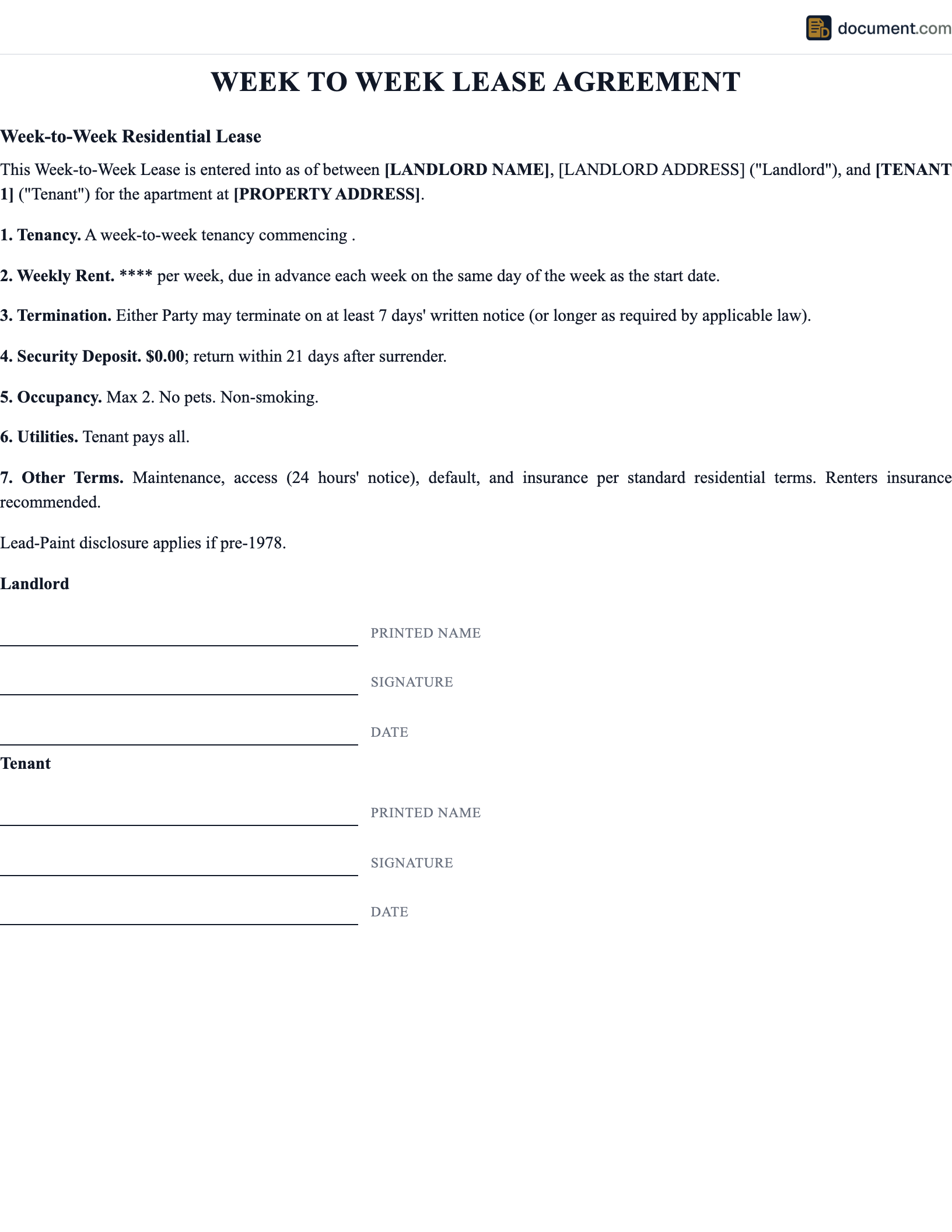



Rhode Island Weekly Lease Overview
Rhode Island's compact geography and diverse rental landscape — from Providence's university corridors around Brown and RISD to Narragansett's beachfront cottages and the military housing clusters near Naval Station Newport — create steady demand for flexible weekly tenancies. The state's Residential Landlord and Tenant Act (R.I. Gen. Laws §34-18-1 et seq.) governs these arrangements with the same force it applies to longer leases, meaning weekly landlords carry the full weight of statutory obligations from day one.
A week-to-week lease in Rhode Island automatically renews every seven days and can be terminated by either party with notice equal to the rental period — seven days under §34-18-37. The state pairs this short notice window with robust tenant protections: a one-month deposit cap, a 20-day return deadline, strict habitability requirements under §34-18-22, and one of the nation's most aggressive lead paint regimes. Landlords who treat weekly rentals as informal handshake deals risk significant statutory penalties.
7 days
Termination Notice
1 month
Max Security Deposit
20 days
Deposit Return Deadline
5 days
Non-Payment Notice
Lead Paint & Disclosure Requirements
Rhode Island's lead paint laws go far beyond the federal baseline. While every state must comply with EPA lead disclosure rules for pre-1978 housing, Rhode Island's Lead Hazard Mitigation Act (R.I. Gen. Laws §42-128.1-1 et seq.) imposes additional duties that directly affect weekly landlords renting older properties — and given that a substantial share of the state's housing stock predates 1978, most landlords will encounter these rules.
Critical: Lead-Safe Certificate Requirement
When a child under six years old will occupy a pre-1978 rental unit, Rhode Island law requires the landlord to hold a valid lead-safe certificate. This means the property must be inspected and any lead hazards must be remediated before the tenancy begins. The requirement applies to weekly leases just as it does to annual ones — there is no short-term exemption.
Beyond lead paint, Rhode Island landlords must also disclose known radon hazards. Weekly landlords in Providence, Cranston, and Warwick should be particularly attentive to these requirements given the age profile of rental housing in those cities. Failure to provide mandated disclosures can expose landlords to penalties and may give tenants grounds to void the lease.
- Federal lead paint disclosure required for all pre-1978 properties
- Lead-safe certificate mandatory when child under six will reside in pre-1978 unit (§42-128.1-1 et seq.)
- Landlord must provide tenant with written information about lead hazards
- Radon disclosure required for known hazards
Rhode Island Security Deposit Rules for Weekly Leases
R.I. Gen. Laws §34-18-19 caps the security deposit at one month's rent for all residential tenancies, regardless of rental period. For a weekly tenant paying $350 per week, the landlord may collect up to the equivalent of one month's rent — not one week's rent. The deposit must be held separately and returned within 20 days of lease termination accompanied by an itemized written statement explaining any deductions.
Rhode Island's 20-day return window is notably tighter than the 30-day standard common in many states. Weekly landlords face a compressed timeline: the tenant may vacate with just seven days' notice, and the landlord then has only 20 days to inspect the premises, document damages, obtain repair estimates if needed, and mail the balance with an itemized statement. Landlords who miss this deadline may forfeit the right to claim deductions.
Deposit Handling Best Practices
Conduct a documented move-in inspection with photos before accepting any deposit. Keep the deposit in a separate bank account. When the tenancy ends, complete your inspection and prepare the itemized statement promptly — the 20-day clock under §34-18-19 starts the day the tenant surrenders possession, not the day you inspect.
Notice & Termination of Rhode Island Weekly Tenancies
Under R.I. Gen. Laws §34-18-37, a periodic tenancy requires written notice equal to the length of the rental period. For week-to-week leases, this means exactly seven days' notice delivered before the end of the current weekly cycle. The notice must be in writing — verbal statements or text messages alone do not satisfy the statutory requirement.
Rhode Island does not impose rent control, so landlords may also use the seven-day notice mechanism to adjust rent between weekly periods. However, rent increases motivated by retaliation against a tenant who reported code violations or exercised a legal right are prohibited under §34-18-46. Tenants who believe a rent increase is retaliatory may raise this defense in court.
- Seven days' written notice required under §34-18-37
- Notice must specify the termination date clearly
- Verbal notice alone is insufficient — statute requires written form
- Retaliatory termination prohibited under §34-18-46
Rhode Island Eviction Process for Weekly Tenants
When a weekly tenant fails to pay rent, R.I. Gen. Laws §34-18-35 requires the landlord to serve a five-day written notice demanding payment before initiating eviction proceedings. If the tenant does not cure the default within those five days, the landlord may file a complaint in Rhode Island District Court. The court process applies even though the tenancy renews weekly — landlords cannot bypass judicial proceedings for any residential tenant.
Self-help eviction is strictly illegal under §34-18-34. A landlord who changes locks, removes a tenant's belongings, or disconnects utilities to force a departure may face liability for damages, attorney fees, and up to three months' rent in penalties. Rhode Island courts take these violations seriously, and weekly landlords should never assume that the informal nature of a short-term lease excuses them from the formal eviction process.
Key Eviction Timeline
- • Non-payment: 5-day written demand (§34-18-35)
- • If unpaid: file complaint in RI District Court
- • Court hearing and judgment
- • Execution of judgment by constable or sheriff
- • Self-help eviction prohibited at every stage (§34-18-34)
Seasonal & Military Weekly Rentals in Rhode Island
Rhode Island's smallest-in-the-nation footprint belies a rental market shaped by two powerful forces: coastal tourism and the U.S. Navy. Narragansett, South Kingstown, and the broader South County coastline attract seasonal renters every summer, and week-to-week leases are a natural fit for vacationers and seasonal workers who need flexible, short-duration housing near the beaches.
Naval Station Newport — home to the Officer Candidate School, the Naval War College, and the Naval Undersea Warfare Center (NUWC) — generates a separate stream of demand. Military personnel and civilian contractors on temporary duty often seek weekly housing in Newport, Middletown, and Portsmouth. Landlords serving this population should be aware that the federal Servicemembers Civil Relief Act (SCRA) allows active-duty tenants to terminate leases early upon receiving deployment or permanent change-of-station orders, potentially overriding the state's seven-day notice period.
Providence's university district adds another dimension. Students affiliated with Brown University, the Rhode Island School of Design, and other institutions sometimes use weekly leases as bridge housing between semesters or while waiting for permanent accommodations. Landlords in the College Hill and Fox Point neighborhoods should ensure their weekly lease forms address the full range of statutory disclosures, especially lead paint compliance in the area's predominantly pre-1978 housing.
Official Rhode Island Resources
Consult these official sources for the latest Rhode Island landlord-tenant statutes, lead paint regulations, and tenant rights guidance.
R.I. Gen. Laws Title 34, Chapter 18
Residential Landlord and Tenant Act
RI Dept. of Health — Lead Program
Lead hazard prevention and certification
Rhode Island District Court
Eviction filings and landlord-tenant disputes
Rhode Island Commission for Human Rights
Fair housing complaints and tenant discrimination
Other Rhode Island Lease Agreement Types
If a weekly arrangement does not suit your situation, explore other Rhode Island lease forms that comply with the same landlord-tenant statutes.
Rhode Island Residential Lease
Standard fixed-term residential lease agreement
Rhode Island Month-to-Month Lease
Periodic tenancy with 30-day notice requirement
Rhode Island Sublease Agreement
Agreement to sublet all or part of a rental unit
Rhode Island Roommate Agreement
Agreement between co-tenants sharing a rental unit
Rhode Island Week-to-Week Lease FAQ
Common questions about Rhode Island weekly tenancies, answered with citations to R.I. Gen. Laws.
Create your Rhode Island Week To Week Lease Agreement in under 5 minutes.
Answer a few questions and download a Rhode Island-compliant document, ready for the state agency.