
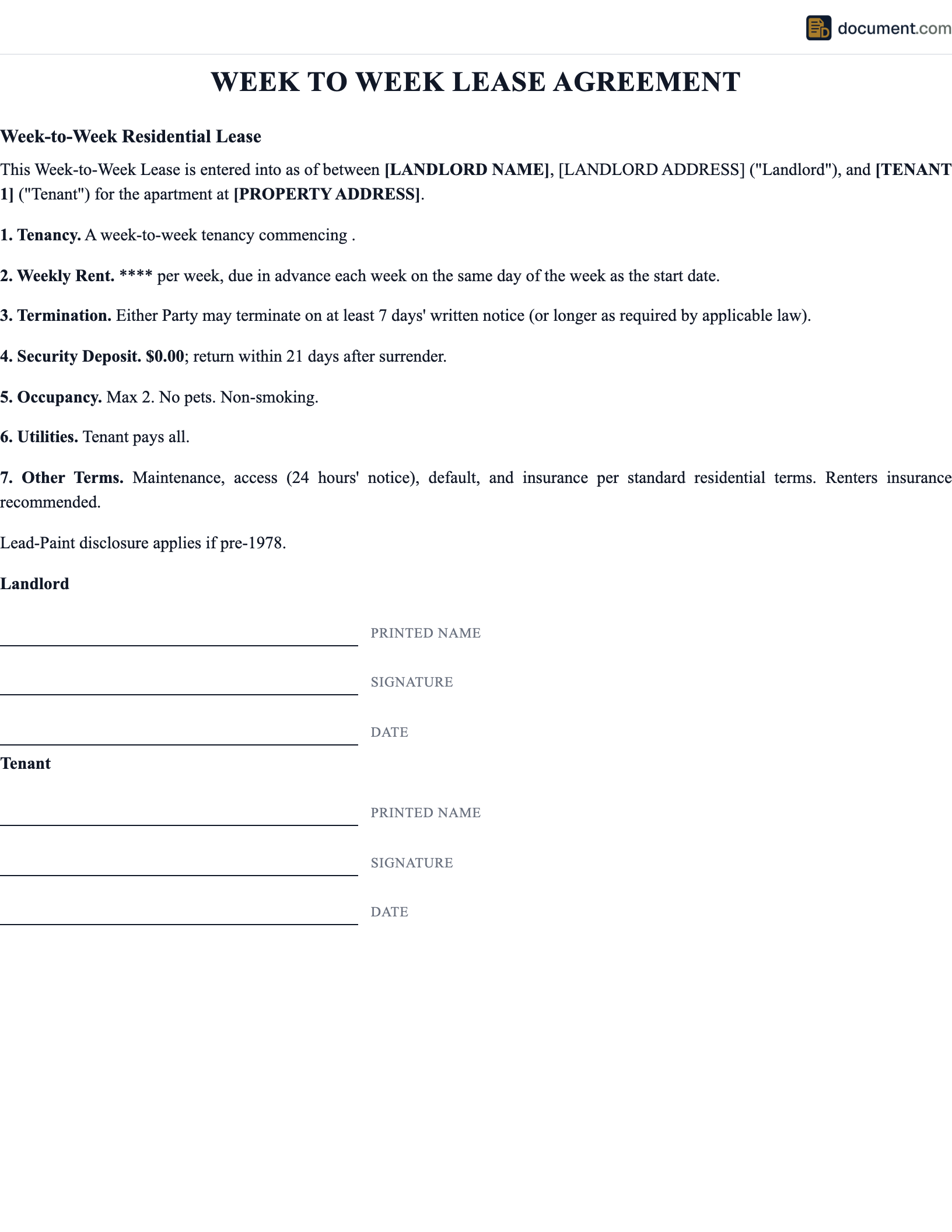



Oregon Week-to-Week Lease Overview
Oregon's rental landscape is shaped by tenant-protective legislation that few other states can match. The Oregon Residential Landlord and Tenant Act, codified in ORS Chapter 90, governs every residential tenancy in the state — including week-to-week arrangements. What makes Oregon truly distinctive is Senate Bill 608, signed into law in 2019, which made it the first state in the nation to impose statewide rent control. For landlords offering weekly rentals, these layers of regulation mean that even the shortest tenancy carries significant compliance obligations.
Week-to-week leases in Oregon serve a variety of housing needs across the state's diverse geography. In the Portland metro area, weekly tenancies offer flexibility for workers in the city's technology and manufacturing sectors. In university towns like Eugene and Corvallis, students and visiting researchers use weekly arrangements during academic transitions. Seasonal workers in the Willamette Valley wine country, central Oregon resort communities around Bend, and timber-dependent rural areas along the coast also rely on weekly housing. Military-connected families commuting from Joint Base Lewis-McChord across the Washington border add further demand in the northern part of the state.
10 days
Termination Notice (ORS §90.427)
No cap
Deposit Amount (ORS §90.300)
7% + CPI
Rent Increase Cap (SB 608)
31 days
Deposit Return Deadline
Oregon's Statewide Rent Control Under SB 608
Oregon made national headlines in 2019 when it became the first state to pass statewide rent control through Senate Bill 608. Under ORS §90.323, annual rent increases on most residential units — including week-to-week tenancies — are capped at 7% plus the regional consumer price index. In practice, this has produced an effective cap near 10% in recent years. The law exempts buildings less than 15 years old and certain subsidized housing, but the vast majority of weekly rental properties fall within its scope.
For weekly landlords, SB 608 introduces a compliance dimension that does not exist in most other states. Even though the tenancy renews every seven days, a landlord cannot simply raise the rent each week without limit. The annual cap applies cumulatively, and landlords must provide at least 90 days' written notice before any rent increase takes effect on a periodic tenancy. Subsequent legislation, including SB 282, has added further tenant protections around no-cause terminations and screening criteria. Landlords who fail to comply with SB 608 may face tenant claims for rent overpayment, and courts can award damages plus attorney fees.
Why SB 608 Matters for Weekly Leases
Many landlords assume that week-to-week leases fall outside rent control because the tenancy is so short. This is incorrect under Oregon law. Unless the property qualifies for a specific exemption (such as the 15-year new-construction window), the 7% + CPI cap applies. Landlords should track cumulative rent changes on an annual basis and retain documentation showing compliance.
ORS Chapter 90 Requirements for Weekly Tenancies
10-Day Termination Notice
Under ORS §90.427, either party must provide at least 10 days' written notice to end a week-to-week tenancy. Oregon is unusual in requiring a notice period that exceeds the length of the rental period itself — most states require only seven days' notice for weekly tenancies. The notice must state the date on which the tenancy will end and must be delivered in writing. Verbal agreements to terminate are not enforceable. Landlords should deliver notice via personal service or first-class mail and retain a copy with proof of delivery.
Habitability Under ORS §90.320
Oregon's implied warranty of habitability under ORS §90.320 applies to every residential tenancy regardless of duration. Landlords must maintain the property in a condition that does not substantially impair the health or safety of the tenant. This includes working plumbing, heating, electrical systems, weather-tight windows and doors, and compliance with applicable building and housing codes. For weekly rentals, landlords must address habitability complaints promptly — tenants may exercise remedies including rent withholding or repair-and-deduct if the landlord fails to act within a reasonable time.
Required Disclosures
Oregon landlords must disclose the name and address of the property owner and any management agent under ORS §90.305. Additional required disclosures include the existence of any outstanding code violations, flood zone status, and information about the tenant's rights under ORS Chapter 90. Federal lead-based paint disclosure applies to pre-1978 properties. Landlords offering furnished weekly rentals should prepare a detailed inventory of all furnishings and have both parties sign it at move-in to avoid disputes at move-out.
Oregon Security Deposit Rules for Weekly Leases
Oregon does not impose a statutory cap on security deposit amounts under ORS §90.300, but the state's deposit return and documentation requirements are among the strictest in the nation. Landlords must return the deposit within 31 days of the tenancy's end. The return must include an itemized written statement describing each deduction, and — critically — the landlord must provide receipts or other documentation proving the actual cost of every repair or cleaning charge. This receipts requirement sets Oregon apart from most states, which allow landlords to deduct based on estimates alone.
If a landlord fails to return the deposit within 31 days, fails to provide the required itemization, or fails to include receipts, the tenant may recover up to twice the amount wrongfully withheld plus reasonable attorney fees. For weekly leases with rapid turnover, this creates a practical challenge: landlords must be prepared to complete inspections, obtain repair invoices, and assemble documentation within a tight window. Conducting thorough move-in and move-out inspections with timestamped photographs is essential to defend any deductions.
Oregon's Receipts Requirement Is Strictly Enforced
Unlike most states, Oregon requires landlords to attach actual receipts or documentation for every deposit deduction — not just an itemized list. A landlord who deducts $300 for carpet cleaning but cannot produce the cleaning company's invoice risks losing the entire deduction in court. Weekly landlords should establish relationships with repair vendors who can provide prompt, detailed invoices.
Oregon Notice to Terminate & Eviction Process
Oregon's eviction framework under ORS §90.394 is highly tenant-protective and distinguishes between first-time and repeat non-payment. For a tenant's first non-payment violation within a 12-month period, the landlord must serve a 72-hour notice to pay or vacate. If the tenant commits a second non-payment within the same 12-month window, the landlord may serve a 144-hour (six-day) notice to vacate with no right to cure. Self-help eviction — changing locks, removing tenant property, or disconnecting utilities — is strictly prohibited under ORS §90.375, and landlords who engage in self-help face statutory damages.
- 10 days' written notice to terminate a weekly tenancy (ORS §90.427)
- 72-hour notice for first non-payment; 144-hour notice for repeat (ORS §90.394)
- Self-help eviction strictly prohibited — landlord must obtain court order (ORS §90.375)
- Retaliation for exercising legal rights is presumed if action occurs within six months (ORS §90.385)
- 90 days' notice required before any rent increase on a periodic tenancy
Portland Renter Protections for Weekly Tenants
Portland imposes some of the strongest municipal renter protections in the United States, and these protections layer on top of Oregon's already tenant-favorable state law. The city's mandatory relocation assistance ordinance requires landlords who issue no-cause termination notices or raise rent by 10% or more to pay the tenant relocation costs equal to three months' fair-market rent. For a weekly tenant in Portland, a no-cause termination can trigger a significant financial obligation that landlords must factor into their decision-making.
Portland's screening criteria ordinance further restricts how landlords evaluate prospective tenants. The ordinance limits the use of credit scores, criminal history lookups, and prior eviction records during the application process. Landlords must apply screening criteria uniformly and cannot deny an applicant based on a criminal conviction more than a certain number of years old. These rules apply to weekly rentals within Portland city limits and create compliance requirements that go well beyond what state law mandates. Landlords operating in the Portland metro area should review the city's current renter protection code before advertising any weekly vacancy.
Portland vs. Rest of Oregon
Landlords outside Portland are subject to ORS Chapter 90 and SB 608 but not to Portland's relocation assistance or screening criteria ordinances. However, other Oregon cities — including Eugene, Bend, and Corvallis — have their own rental registration and inspection programs that may affect weekly tenancies. Always verify local requirements before listing a weekly rental.
Oregon Weekly Lease Fees & Statutory Limits
| Item | Oregon Rule |
|---|---|
| Termination Notice (Weekly) | 10 days (ORS §90.427) |
| Security Deposit Limit | No statutory cap (ORS §90.300) |
| Deposit Return Deadline | 31 days with itemization & receipts |
| Rent Increase Cap | 7% + CPI annually (SB 608) |
| Rent Increase Notice | 90 days' written notice |
| Non-Payment Notice (1st) | 72 hours to pay or vacate (ORS §90.394) |
| Non-Payment Notice (Repeat) | 144 hours, no right to cure |
| Late Fee Limit | Must be reasonable; no statutory cap |
| Lead Paint Disclosure | Required (pre-1978 properties) |
| Portland Relocation Assistance | 3 months' FMR for no-cause or 10%+ increase |
Official Oregon Resources
Verify current requirements using these official state and local government resources for Oregon landlord-tenant law.
Other Oregon Lease Agreement Types
Need a different type of lease agreement for Oregon? Each template below is built for Oregon's specific statutory requirements under ORS Chapter 90 and SB 608.
Oregon Week-to-Week Lease FAQ
Common questions about Oregon week-to-week lease agreements, SB 608 rent control, ORS Chapter 90 requirements, and Portland's additional renter protections.
Create your Oregon Week To Week Lease Agreement in under 5 minutes.
Answer a few questions and download a Oregon-compliant document, ready for the state agency.