



New York Weekly Lease & HSTPA Reforms
New York's rental landscape is defined by a regulatory density unmatched anywhere else in the United States. The Housing Stability and Tenant Protection Act of 2019 (HSTPA) overhauled decades of landlord-tenant law in a single legislative session — eliminating vacancy decontrol for rent-stabilized apartments, capping security deposits statewide at one month's rent, banning pet deposits and move-in fees, and restricting the charges landlords may impose on prospective tenants. These reforms apply to every residential tenancy in New York, whether the lease runs for a year, a month, or a single week.
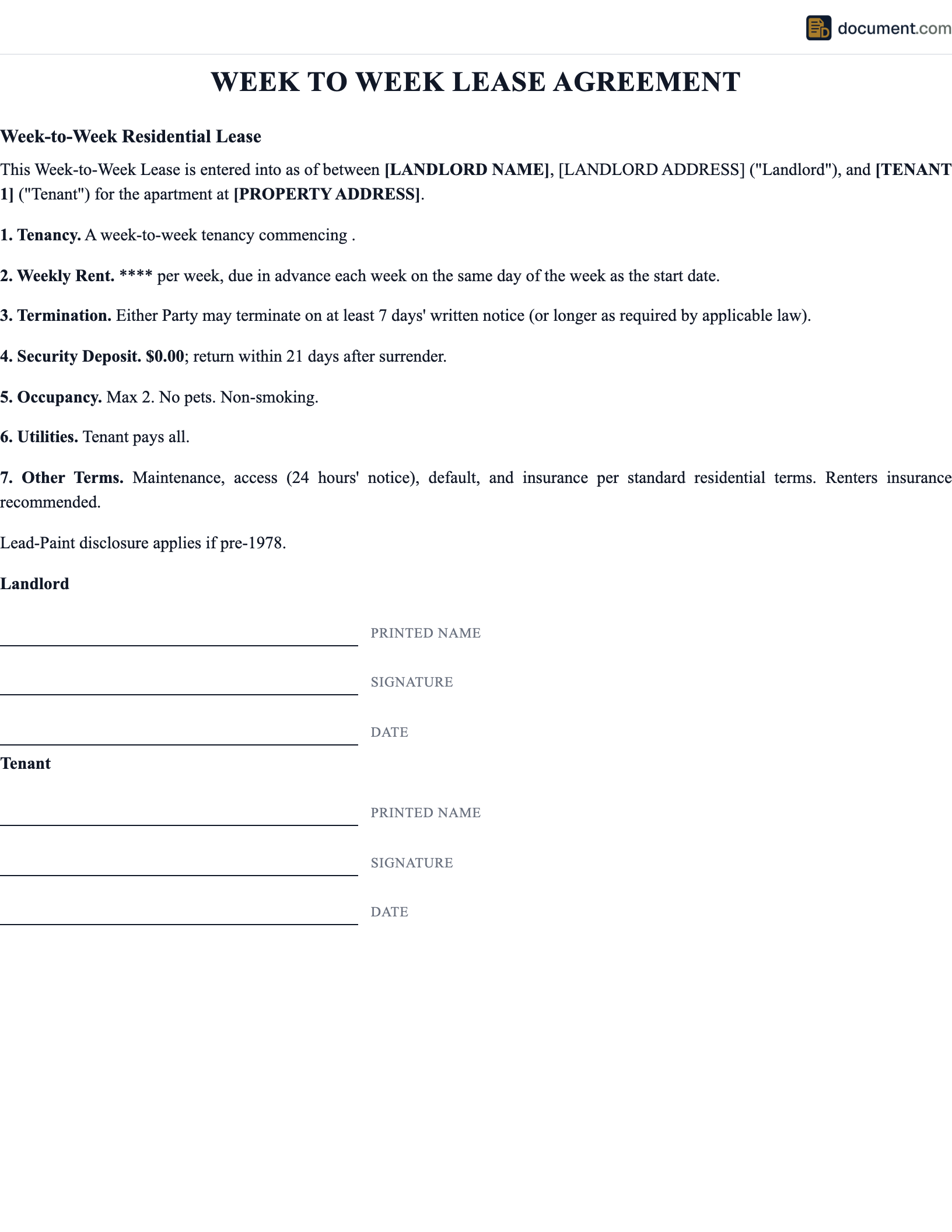
A week-to-week lease in New York renews automatically every seven days and may be terminated by either party with one rental period's notice under common-law principles. Although RPL §232-a specifically addresses month-to-month tenancies (requiring 30 days' notice), New York courts have applied the general common-law rule of one full period's notice to weekly arrangements, making the effective termination window seven days. In New York City, however, the interplay between rent stabilization, the new statewide good cause eviction protections, and Housing Court procedure can make terminating even a weekly tenancy far more complex than the common-law baseline suggests.
Weekly leases are most commonly used across New York for temporary housing near military installations such as Fort Drum, West Point, and Fort Hamilton, furnished rentals in resort communities in the Hudson Valley and the Catskills, transitional arrangements in the Buffalo, Rochester, Syracuse, and Albany metro areas, and short-term accommodations for workers relocating to New York City or Long Island. Regardless of market or duration, the same statewide protections — the warranty of habitability under RPL §235-b, the HSTPA deposit restrictions, and RPAPL Article 7 eviction procedure — apply in full.
7 days
Common-Law Notice
1 month
Max Deposit (HSTPA)
14-day return
Deposit Refund Window
No extra fees
Pet / Move-In / Last Mo.
Legal Requirements & Mandatory Disclosures
Statewide Disclosure Obligations
New York landlords must provide every residential tenant — weekly or otherwise — with the identity and address of the building owner or managing agent under RPL §235-e. For properties built before 1978, the federal lead-based paint disclosure is required. Landlords must also inform tenants of the fire and carbon monoxide safety standards applicable to the unit. If a building has a shared sprinkler system, written notification of its operational status is required statewide.
New York City's Additional Disclosure Layer
NYC imposes some of the most detailed tenant disclosure requirements of any municipality in the country. Under Local Law 1, landlords of pre-1960 buildings (or any building where a child under six resides) must test for and remediate lead paint hazards. The city requires disclosure of bed bug infestation history for the unit and building for the prior 12 months. Apartments where children age 10 or under reside must be equipped with window guards, and landlords must notify tenants of this obligation annually. NYC also requires mold disclosure under Local Law 55, obligating landlords to inform tenants of known mold conditions and to remediate them promptly. These layered disclosure duties make a New York City weekly lease substantially more document-intensive than a comparable arrangement upstate.
Habitability Standards Under RPL §235-b
The implied warranty of habitability, codified in RPL §235-b, cannot be waived by any lease provision. Landlords must maintain working plumbing, electrical systems, adequate heating (NYC mandates minimum 68°F during the day and 62°F at night from October 1 through May 31), hot water, structural soundness, and freedom from vermin and hazardous conditions. Weekly tenants who experience habitability failures may withhold rent proportionally, raise the warranty as a defense in nonpayment proceedings, or — in New York City — file complaints directly with HPD (Department of Housing Preservation and Development), which can issue emergency violations and impose daily fines on noncompliant landlords.
Security Deposit Rules Under RPL §7-108
The HSTPA's amendment of RPL §7-108 created one of the most restrictive deposit regimes in the nation. Landlords may collect no more than one month's rent as a security deposit — a rule that applies uniformly to furnished and unfurnished units, weekly and annual leases, and properties in every county from Manhattan to Chautauqua. The statute explicitly prohibits collecting last month's rent in advance, pet deposits, move-in fees, key deposits, and any other upfront charge beyond the first period's rent and the single-month deposit.
Landlords of buildings with six or more units must place the deposit in an interest-bearing account at a New York banking institution and notify the tenant in writing of the bank name and account number. Upon the tenant's departure, the full deposit or an itemized statement of deductions must be returned within 14 days. Deductions are limited to actual damages beyond normal wear and tear, and landlords who fail to provide the itemized statement within the statutory window may forfeit the right to retain any portion of the deposit.
HSTPA Fee Ban — Strictest in the Nation
Unlike most states, New York does not permit any fees beyond the capped deposit and first period's rent. Landlords who collect prohibited fees face civil liability and may be required to refund the overcharge with interest. Application fees are separately capped at $20 under RPL §238-a, and the landlord must provide a copy of any background or credit report obtained. This framework makes New York the most restrictive state in the country for upfront tenant charges.
Termination Notice & Eviction Protections
Terminating a weekly tenancy in New York requires at least seven days' written notice delivered before the start of the next rental period, consistent with the common-law rule of one full period's notice. RPL §232-a, which governs month-to-month tenancies, provides the closest statutory analogy but does not explicitly address weekly arrangements. Courts have consistently applied the one-period common-law rule to fill this gap.
In practice, however, the notice requirement is only the beginning of the analysis. New York's statewide good cause eviction law, enacted in 2024 for covered residential buildings, restricts landlords from non-renewing tenancies without an enumerated reason — even for week-to-week arrangements. In New York City, rent-stabilized tenants cannot be non-renewed at all absent grounds recognized by the Rent Stabilization Code, and Housing Court judges routinely scrutinize termination notices for procedural defects.
- Seven days' written notice before the next weekly term (common-law standard)
- Good cause eviction law may require landlord to show enumerated grounds in covered buildings
- RPAPL Article 7 summary proceeding required for all court-ordered evictions
- Self-help eviction illegal statewide — treble damages and contempt sanctions apply
- NYC tenants have a statutory right to counsel in eviction proceedings (Local Law 136)
New York Weekly Lease Fees & Statutory Limits
| Item | New York Rule |
|---|---|
| Weekly Notice Period | 7 days (common law) |
| Security Deposit Cap | 1 month's rent (RPL §7-108) |
| Deposit Return Deadline | 14 days with itemized statement |
| Application Fee Cap | $20 max (RPL §238-a) |
| Pet / Move-In / Last Month | Prohibited (HSTPA) |
| Late Fee | Must be reasonable; no statutory cap |
| Lead Paint Disclosure | Required (pre-1978 buildings) |
| Nonpayment Notice Period | 14 days (RPAPL §711) |
Official New York Resources
Consult these official state and city sources for the authoritative text of New York landlord-tenant statutes, HSTPA provisions, and NYC housing regulations.
Other New York Lease Agreement Types
New York's HSTPA reforms and NYC rent stabilization rules apply across lease types. Choose the arrangement that fits your situation — all templates reflect current New York law.
New York Week-to-Week Lease FAQ
Detailed answers to common questions about weekly rentals in New York, with citations to RPL, RPAPL, and HSTPA provisions.
Create your New York Week To Week Lease Agreement in under 5 minutes.
Answer a few questions and download a New York-compliant document, ready for the state agency.