
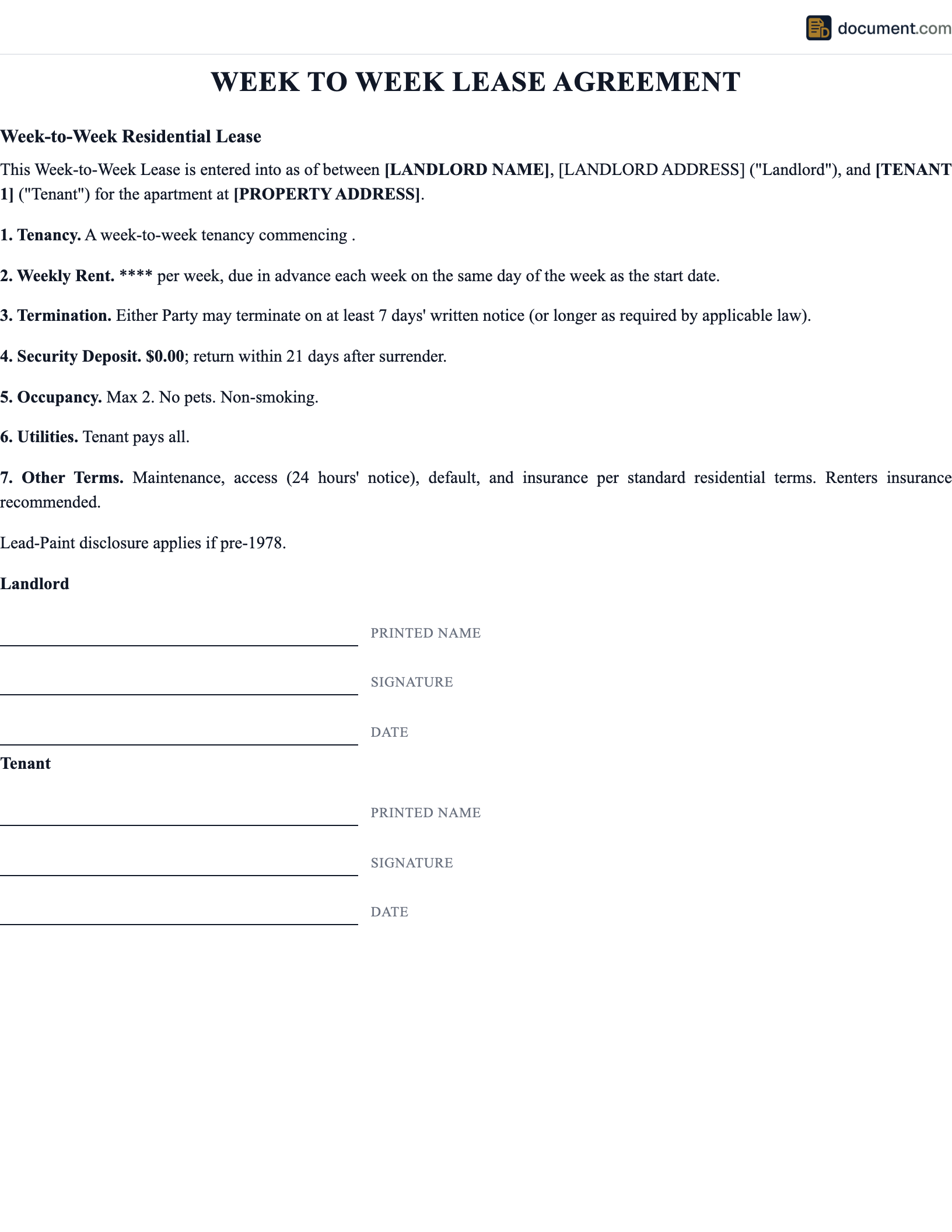



Michigan Week-to-Week Lease Overview
Michigan's Landlord Tenant Relationships Act (MCL §554.131 et seq.) and the Truth in Renting Act (MCL §554.601 et seq.) together create one of the more tenant-protective regulatory environments in the Midwest — and every rule that applies to a twelve-month lease applies with equal force to a seven-day tenancy. That means landlords who offer weekly rentals in Detroit, Grand Rapids, or Traverse City must satisfy the same deposit-banking, checklist, disclosure, and habitability obligations they would face on a year-long lease, compressed into a far shorter timeline.
Weekly leases occupy a growing niche across Michigan. The state's auto-industry corridors — stretching from Detroit through Lansing to Flint — attract contract engineers, skilled-trades workers, and consultants who need housing measured in weeks rather than months. University towns such as Ann Arbor (University of Michigan), East Lansing (Michigan State), and Kalamazoo (Western Michigan) see demand from visiting researchers, adjunct faculty, and students between semesters. Northern Michigan's tourism belt around Traverse City, Petoskey, and Mackinac draws seasonal hospitality workers who rotate through short assignments. And in the Upper Peninsula, remote communities with limited housing stock often rely on weekly arrangements for mining, forestry, and healthcare-rotation workers.
Regardless of the use case, every Michigan weekly lease must address three distinctive requirements that separate the state from most of its neighbors: the mandatory move-in inventory checklist, the regulated deposit-banking obligation, and the Truth in Renting Act's prohibition on unconscionable lease clauses. Getting any one of these wrong can expose a landlord to statutory penalties, forfeiture of the deposit, or both.
7 days
Termination Notice (MCL §554.134)
1.5 months
Deposit Cap (MCL §554.602)
30 days
Deposit Return Deadline
7-day checklist
Mandatory Move-In Inventory
Michigan's Truth in Renting Act and Weekly Leases
The Truth in Renting Act (MCL §554.631 et seq.) is one of Michigan's most distinctive landlord-tenant protections and applies to every residential lease regardless of duration. The act makes void any lease provision that violates Michigan law, shifts a statutory duty from the landlord to the tenant, or is found to be unconscionable. A weekly lease that includes a clause waiving the implied warranty of habitability, authorizing the landlord to confiscate personal property, or permitting entry at any time without notice is void as written — the tenant is not bound by it even if they signed it.
For landlords, this creates a practical drafting constraint that goes beyond boilerplate: every clause in a weekly lease must be individually defensible under MCL §554.633. A tenant who is subjected to an illegal provision may recover actual damages plus $250 in statutory damages under MCL §554.636, and prevailing tenants can also recover reasonable attorney fees. Because weekly tenancies turn over frequently, a single illegal clause can generate repeat exposure across dozens of tenants in a year.
Clauses the Truth in Renting Act Voids
- Waivers of the landlord's duty to maintain habitable premises (MCL §554.139)
- Provisions authorizing landlord seizure of tenant property for unpaid rent
- Clauses requiring the tenant to waive the right to a jury trial in an eviction action
- Blanket exculpatory clauses relieving the landlord of negligence liability
- Automatic-confession-of-judgment provisions
Security Deposit Rules and the Mandatory Move-In Checklist
Michigan's security deposit statute (MCL §554.602 et seq.) imposes a three-part compliance framework that landlords offering weekly rentals must follow precisely. First, the deposit itself cannot exceed one and one-half months' rent. Second, the landlord must place the deposit in a regulated financial institution — a bank, savings association, or credit union — within 14 days of receipt and notify the tenant in writing of the institution's name and address (MCL §554.603). Third, within 30 days after the tenant vacates and provides a forwarding address, the landlord must return the deposit along with an itemized statement of any deductions (MCL §554.609).
Separate from the deposit statute, MCL §554.608 requires landlords to furnish a move-in inventory checklist within seven days of the tenant's occupancy. The checklist must catalog the condition of the rental unit — walls, floors, fixtures, appliances, windows, and any furnishings — and both landlord and tenant should sign it. This document becomes the evidentiary anchor in any deposit-deduction dispute: without it, a landlord may be unable to prove that damage occurred during the tenancy. For weekly leases, where turnover is high and disputes can arise quickly, completing and retaining the checklist is essential.
Deposit Compliance Timeline for Weekly Landlords
Termination Notice for Michigan Weekly Tenancies
MCL §554.134 governs the termination of tenancies at will in Michigan. Because a week-to-week lease renews automatically every seven days without a fixed end date, it is classified as a tenancy at will, and the statute requires that either party give notice of at least one full rental period before the tenancy ends. For weekly arrangements, that means a minimum of seven days' written notice delivered before the start of the next rental period.
Michigan does not prescribe a statutory form for this notice, but it should clearly identify the property address, the date the tenancy will end, and whether the notice is from the landlord or the tenant. Courts have held that ambiguous or oral-only notices are insufficient. Landlords who want to change the rent amount rather than terminate the tenancy entirely must give the same seven-day notice — the increase takes effect only at the start of the next weekly period after the notice period expires. Michigan preempts local rent-control ordinances (MCL §123.411), so there is no municipal cap on the size of the increase.
- Minimum seven days' written notice required under MCL §554.134
- Notice must be delivered before the beginning of the next rental period
- Oral notice alone is not legally sufficient — put it in writing
- Rent increases follow the same notice period; no local rent control permitted
Habitability Standards and Eviction Procedures
Implied Warranty of Habitability
Michigan recognizes an implied warranty of habitability through both statute and case law. MCL §554.139 requires landlords to keep rental premises and all common areas “fit for the use intended by the parties” and “in reasonable repair during the term of the lease.” The Michigan Supreme Court reinforced this duty in Rome v. Walker(1972), holding that tenants may pursue damages when a landlord fails to maintain habitable conditions. For weekly tenants, this means the landlord cannot argue that the short lease term excuses deferred maintenance — heat, plumbing, electrical, structural soundness, and code compliance must be maintained throughout the tenancy.
Eviction Through District Court
When a weekly tenant fails to pay rent, the landlord must serve a seven-day demand for possession under MCL §600.5714(1)(c). If the tenant neither pays nor vacates within seven days, the landlord files a complaint for summary proceedings in the local district court. The court schedules a hearing, and if it rules in the landlord's favor, it issues an order of eviction. Only a sheriff or court officer may execute the order — at no point may the landlord physically remove the tenant, lock them out, or interrupt essential services. Self-help eviction remains illegal in Michigan regardless of the lease term or the amount of unpaid rent.
| Item | Michigan Rule |
|---|---|
| Termination Notice | 7 days written (MCL §554.134) |
| Security Deposit Cap | 1.5 months' rent (MCL §554.602) |
| Deposit Banking Deadline | 14 days (MCL §554.603) |
| Move-In Checklist | Mandatory within 7 days (MCL §554.608) |
| Deposit Return | 30 days with itemized statement (MCL §554.609) |
| Nonpayment Demand | 7-day demand for possession (MCL §600.5714) |
| Late Fee Cap | No statutory cap; must be reasonable |
| Rent Control | Preempted statewide (MCL §123.411) |
Who Uses Weekly Leases in Michigan
Michigan's economic geography makes week-to-week leases practical across several distinct markets. Understanding these use cases helps landlords draft terms that are both legally sound and commercially appropriate.
Automotive Industry Contractors
Detroit, Dearborn, and the I-75 corridor attract engineers, tool-and-die specialists, and supply-chain consultants on project-based assignments. Weekly leases let them stay close to assembly plants without committing to months of rent in a city they may leave on short notice.
University-Town Visitors
Ann Arbor, East Lansing, and Kalamazoo see steady demand from visiting professors, medical residents rotating through university hospitals, and students needing gap housing between academic terms or during summer research programs.
Northern Michigan Seasonal Workers
Traverse City's cherry orchards, Petoskey's ski resorts, and Mackinac Island's tourism operations hire seasonal staff who need flexible housing for weeks at a time. Weekly leases accommodate the variable start and end dates that come with hospitality and agricultural work.
Upper Peninsula & Military
Remote UP communities rely on weekly arrangements for mining crews, forestry contractors, and traveling healthcare providers. Personnel at Selfridge Air National Guard Base and Camp Grayling also use weekly leases during training rotations and temporary duty assignments.
Official Michigan Resources
Consult these state and legislative sources for the full text of the statutes referenced in this guide.
Truth in Renting Act (MCL §554.631 et seq.)
Michigan Legislature — full text of Act 348 of 1972
Security Deposit Act (MCL §554.601 et seq.)
Michigan Legislature — deposit cap, banking, checklist, and return rules
Termination of Tenancy at Will (MCL §554.134)
Michigan Legislature — notice periods for periodic tenancies
Michigan Attorney General — Landlord/Tenant Tips
Consumer-protection guidance on security deposits, habitability, and eviction
Other Michigan Lease Agreement Types
If a weekly arrangement does not fit your situation, Michigan-specific templates are available for every common lease structure.
Michigan Residential Lease
Standard fixed-term residential lease agreement
Michigan Month-to-Month Lease
Periodic tenancy with 30-day notice under MCL §554.134
Michigan Sublease Agreement
Agreement to sublet all or part of a rental unit
Michigan Roommate Agreement
Agreement between co-tenants sharing a rental unit
Michigan Week-to-Week Lease FAQ
Common questions about Michigan weekly lease agreements, answered with specific MCL citations.
Create your Michigan Week To Week Lease Agreement in under 5 minutes.
Answer a few questions and download a Michigan-compliant document, ready for the state agency.