
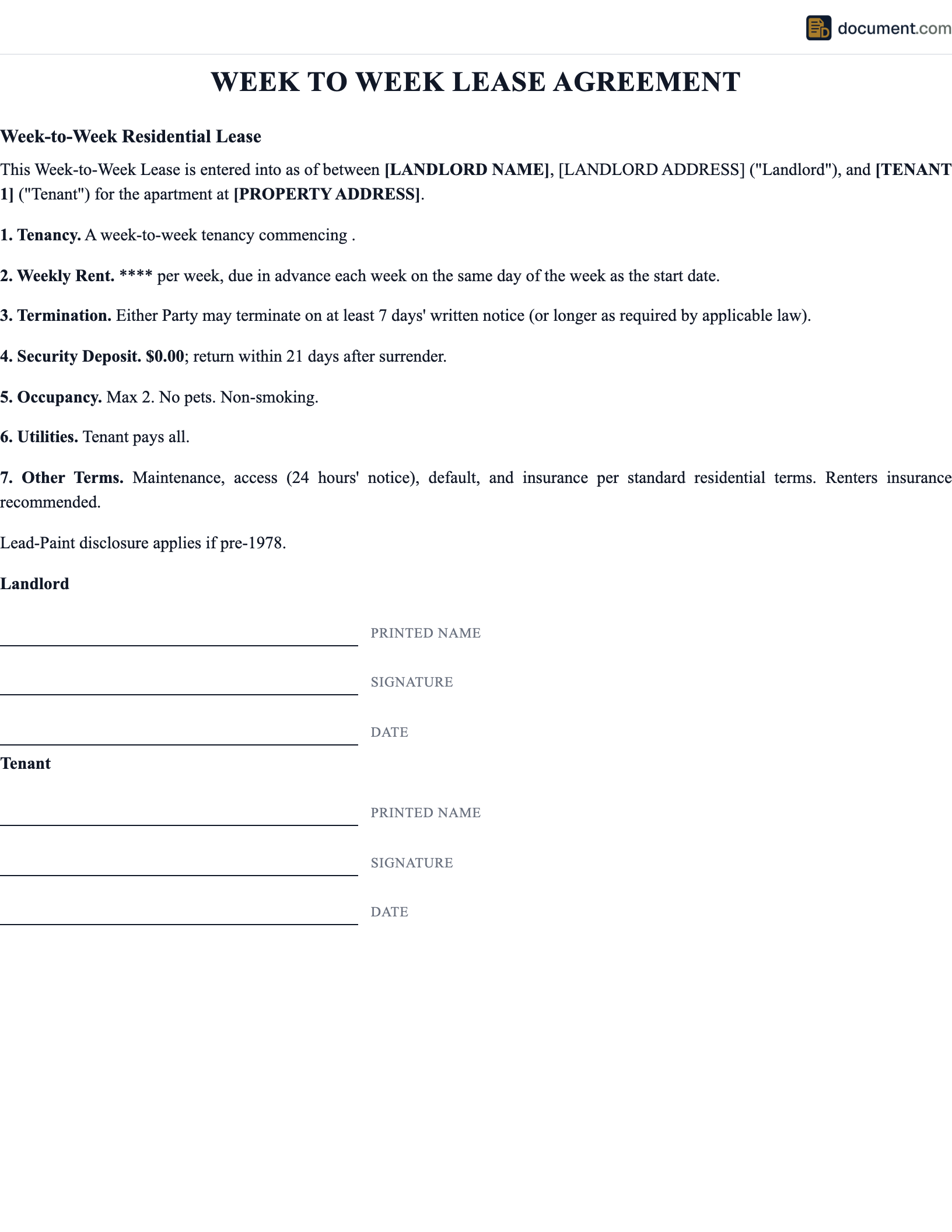



Why Massachusetts Week-to-Week Leases Require Special Attention
Massachusetts is widely regarded as one of the most tenant-protective states in the country, and that reputation is well earned. The Commonwealth's landlord-tenant framework — primarily codified in M.G.L. Chapter 186 (tenancies) and Chapter 239 (summary process for evictions) — places detailed obligations on landlords that go far beyond what most states require. A week-to-week lease in Massachusetts is not simply a shorter version of a standard lease; it is subject to every protection the Commonwealth extends to residential tenants, including the notoriously strict security deposit rules of Section 15B, the State Sanitary Code's heating mandates, and broad anti-retaliation protections.
Weekly tenancies serve important roles in the Massachusetts rental ecosystem. In the Greater Boston metro area — where median rents rank among the highest in the nation — week-to-week leases provide transitional housing for tenants between fixed-term leases, particularly around the September 1 mass move-in date driven by the region's enormous university population. On Cape Cod, the Islands (Nantucket and Martha's Vineyard), and the North Shore, weekly arrangements accommodate seasonal workers who staff the tourism and hospitality industries from May through October. Near military installations like Hanscom Air Force Base, Coast Guard Base Cape Cod, and the Natick Soldier Systems Center, weekly leases give service members and contractors flexibility during temporary duty assignments.
Regardless of why a landlord and tenant choose a weekly arrangement, every provision of Massachusetts landlord-tenant law applies in full. Landlords who assume that a short-term tenancy means lighter obligations are making an expensive mistake — Section 15B alone authorizes treble damages and attorney's fees for deposit violations.
7 days
Notice Period (§12)
1 month
Max Deposit (§15B)
3x damages
Treble Penalty for Violations
No pet deposits
Prohibited Under §15B
M.G.L. c. 186 §15B: Massachusetts's Strictest-in-the-Nation Deposit Rules
Section 15B is the centerpiece of Massachusetts landlord-tenant law, and no other state imposes deposit requirements this detailed or penalties this severe. Every landlord offering a weekly lease in Massachusetts must understand and follow each step precisely, because a single procedural failure — even an honest mistake — can trigger treble damages plus the tenant's attorney's fees.
What a Landlord May Collect at Move-In
Section 15B limits move-in charges to exactly four items: (1) first month's rent, (2) last month's rent, (3) a security deposit not exceeding one month's rent, and (4) the cost of purchasing and installing a new lock and key. That is it. No application fee beyond the actual cost of obtaining a tenant screening report. No cleaning fee. No move-in fee. And critically — no pet deposit. Massachusetts is one of the only states in the country that categorically prohibits collecting any deposit or fee tied to a pet. A landlord may prohibit pets or require pet-related lease clauses, but charging a separate pet deposit violates Section 15B and exposes the landlord to treble damages.
Interest-Bearing Escrow Requirements
The security deposit must be placed in a separate, interest-bearing bank account at a Massachusetts-chartered bank or a federally chartered bank with a branch in Massachusetts. The landlord may not commingle the deposit with personal funds or operating accounts. Within 30 days of receiving the deposit, the landlord must provide the tenant with a written receipt that includes: the amount deposited, the name and address of the bank, the account number, and the landlord's signature. Each year, the landlord must pay the tenant 5% annual interest or the actual interest earned on the account, whichever is less. Last month's rent, if collected, must also be deposited in a separate interest-bearing account and earns interest the same way.
Treble Damages Warning
If a landlord fails to comply with any provision of §15B — fails to provide the required receipt, commingles the deposit, does not return the deposit within 30 days of the tenancy's end, or deducts for items beyond actual damages — the tenant may recover three times the amount of the depositplus reasonable attorney's fees and court costs. Courts have consistently enforced this penalty even for technical violations where the landlord acted in good faith.
On a weekly lease where the monthly rent equivalent is $2,500, a single deposit violation could cost the landlord $7,500 in treble damages plus thousands more in legal fees.
Condition Statement Requirement
Section 15B(1) also requires the landlord to provide the tenant with a written statement of the condition of the premises at the time of move-in. This condition statement must be delivered at or before the start of the tenancy. If the landlord fails to provide it, the landlord forfeits the right to retain any portion of the security deposit for damages to the unit. This requirement is absolute and applies to every residential tenancy in Massachusetts, including week-to-week arrangements. Landlords should photograph the unit thoroughly and have both parties sign the condition statement.
Terminating a Massachusetts Week-to-Week Tenancy
Under M.G.L. c. 186 §12, a tenancy at will where rent is payable weekly may be terminated by either party with written notice equal to the interval between rent payments — seven days. The notice must be given before the beginning of the next rental period, and it must clearly state the date on which the tenancy will end. If the written lease specifies a longer notice period, the lease terms control.
Massachusetts does not permit oral termination of a tenancy. Written notice is mandatory. The notice should be delivered in hand or sent by mail to the tenant's last known address. Landlords who want a clear record should consider both methods simultaneously. Neither the landlord nor the tenant may simply stop showing up or stop paying — the tenancy continues to renew weekly until proper written notice has been given and the notice period has expired.
- 7 days' written notice required under M.G.L. c. 186 §12
- Notice must be delivered before the start of the next weekly period
- Oral notice is insufficient — Massachusetts requires writing
- Security deposit must be returned within 30 days with itemized deduction statement
- Retaliatory termination is prohibited under M.G.L. c. 186 §18
Habitability Standards & Heating Requirements
Massachusetts imposes habitability obligations through both statute (M.G.L. c. 186 §14) and the State Sanitary Code (105 CMR 410.000). These apply to every residential tenancy regardless of duration. The Sanitary Code sets out detailed, room-by-room requirements covering structural integrity, plumbing, electrical systems, pest control, ventilation, and lighting.
The most distinctive habitability requirement in Massachusetts is the heating mandate. Under 105 CMR 410.201, landlords must provide a heating system capable of maintaining at least 68°F in all habitable rooms during the day (7:00 a.m. to 11:00 p.m.) and at least 64°F at night (11:00 p.m. to 7:00 a.m.) from September 15 through June 15 — nine full months of the year. This is not optional and cannot be waived by lease clause. If the landlord fails to provide adequate heat, the tenant has powerful remedies: rent withholding under M.G.L. c. 239 §8A, repair and deduct, or filing a complaint with the local board of health, which can issue orders and fines.
For weekly tenancies during the winter months, the heating obligation is particularly significant because a tenant who moves in during January needs heat from day one. Landlords cannot claim the short-term nature of the tenancy excuses them from maintaining the heating system.
Mandatory Disclosures for Massachusetts Weekly Leases
Massachusetts requires several disclosures that must be provided to tenants before or at the start of any tenancy, including week-to-week arrangements. Failure to make these disclosures can void portions of the lease or expose the landlord to liability.
| Disclosure | Legal Basis & Details |
|---|---|
| Lead Paint Notification | M.G.L. c. 111 §197A — Required for all pre-1978 properties. If a child under 6 resides in the unit, full de-leading is mandatory at the landlord's expense. |
| Move-In Condition Statement | M.G.L. c. 186 §15B(1) — Written statement of unit condition at move-in. Without it, the landlord cannot retain any deposit for damages. |
| Security Deposit Receipt | §15B — Must include deposit amount, bank name and address, account number, and landlord's signature. Due within 30 days of receipt. |
| Utility Payment Responsibility | Landlord must disclose which utilities the tenant is responsible for paying and which are included in rent. |
| Tax Escalation Clause | If the lease includes a tax escalation clause allowing rent increases tied to property tax increases, it must be clearly disclosed. |
| Insurance Information | Landlord must disclose whether the property is insured and the extent of coverage that does or does not protect the tenant's belongings. |
Eviction Through Massachusetts Summary Process
Massachusetts prohibits all forms of self-help eviction under M.G.L. c. 186 §14. A landlord who changes locks, removes a tenant's belongings, shuts off utilities, or otherwise forces a tenant out without a court order faces liability for three months' rent or actual damages (whichever is greater) plus attorney's fees. Every eviction in the Commonwealth must go through the summary process governed by M.G.L. Chapter 239.
For non-payment of rent on a weekly tenancy, the process begins with a 14-day notice to quit under M.G.L. c. 186 §11. The notice gives the tenant 14 days to pay the full amount owed or vacate the premises. If the tenant does neither, the landlord files a summary process complaint in Housing Court or the appropriate Division of the District Court. The court schedules a hearing, and both parties have the opportunity to present their case. Only after obtaining a judgment and a court-issued execution can a landlord have a constable or sheriff physically remove a tenant.
Massachusetts also provides strong protection against retaliatory eviction. Under M.G.L. c. 186 §18, a landlord may not terminate a tenancy, increase rent, or decrease services within six months of a tenant exercising legal rights — such as reporting code violations to the board of health, joining a tenant organization, or withholding rent for habitability defects. If the landlord serves a termination notice within that six-month window, there is a rebuttable presumption of retaliation, and the burden shifts to the landlord to prove a legitimate non-retaliatory reason.
Other Massachusetts Lease Agreement Types
Weekly tenancies are just one option under Massachusetts law. Depending on your situation — whether you are a student renting near campus, a family settling into a longer arrangement, or a landlord managing seasonal properties on the Cape — a different lease structure may be more appropriate.
Massachusetts Residential Lease
Standard fixed-term lease with full §15B deposit protections
Massachusetts Month-to-Month Lease
Periodic tenancy with 30-day notice under §12
Massachusetts Sublease Agreement
Subletting with landlord consent and full tenant protections
Massachusetts Roommate Agreement
Co-tenant terms for shared housing near universities and the city
Official Massachusetts Resources
These government and legal-aid resources provide authoritative guidance on Massachusetts landlord-tenant law, security deposit rules, and tenant rights.
Massachusetts Week-to-Week Lease FAQ
Detailed answers to common questions about weekly tenancies under Massachusetts General Laws, with specific statutory citations.
Create your Massachusetts Week To Week Lease Agreement in under 5 minutes.
Answer a few questions and download a Massachusetts-compliant document, ready for the state agency.