
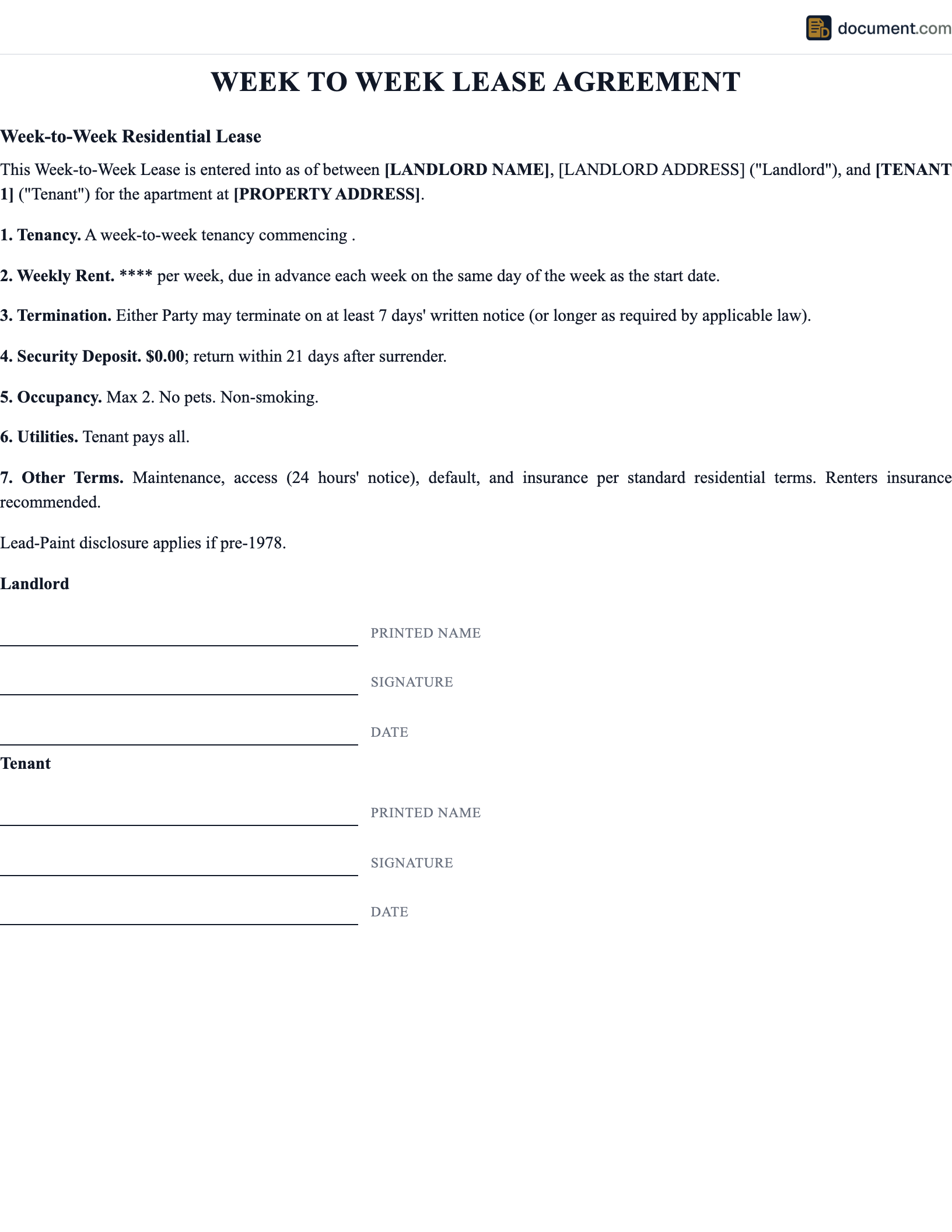



Indiana Week-to-Week Lease Overview
Indiana treats a week-to-week lease as a tenancy at will under IC §32-31-1-1, renewing automatically every seven days until either party delivers written termination notice equal to the payment interval. The state's landlord-tenant code sits in IC §32-31, a relatively compact body of statutes that gives landlords considerable flexibility — no rent-control authority exists at any level of Indiana government, and there is no statutory cap on late fees or security deposits. That permissive posture makes Indiana one of the more landlord-friendly states in the Midwest, yet the legislature balanced it with a mandatory warranty of habitability enacted in 2002 and strict prohibitions on self-help eviction.
Weekly tenancies serve a practical role across Indiana's diverse economy. In Elkhart County — the recreational vehicle manufacturing capital of the world — employers rely on temporary production workers who need housing for weeks or months at a time. University towns like Bloomington (Indiana University), West Lafayette (Purdue), Muncie (Ball State), and South Bend (Notre Dame) see demand for flexible short-term leases around academic calendars and summer research programs. Military-connected housing near Grissom Air Reserve Base, Crane Naval Surface Warfare Center, and Camp Atterbury often operates on weekly terms for personnel awaiting permanent assignments. And each May, the Indianapolis 500 and surrounding racing events generate a surge of short-term rental demand that weekly leases can accommodate without triggering hotel-license requirements.
Because Indiana imposes no statewide short-term rental restrictions at the state level, landlords who choose a week-to-week structure avoid many of the regulatory complications that other states impose on stays shorter than 30 days. However, some Indiana municipalities — including Indianapolis, Bloomington, and Carmel — have adopted local registration or permit ordinances for short-term rentals, so landlords should verify local rules before marketing weekly units.
7 days
Termination Notice
No cap
Deposit Limit
45 days
Deposit Return Window
10 days
Nonpayment Notice
Statutory Requirements Under IC §32-31
Termination Notice for Weekly Tenancies
IC §32-31-1-1 establishes the foundational rule: a tenancy at will — which includes week-to-week arrangements — may be terminated by either party upon written notice at least equal to the interval between rent payments. For a weekly lease, that means a minimum of seven calendar days. Indiana does not prescribe a specific delivery method in the statute, but courts generally accept personal delivery, posting on the premises, or certified mail. Landlords who rely on email or text message alone risk having the notice challenged as insufficient, because Indiana appellate decisions have not yet established digital-only delivery as adequate under IC §32-31.
Indiana's 2002 Warranty of Habitability
Before 2002, Indiana was one of the last states without a codified habitability standard, relying instead on the common-law doctrine of caveat emptor for residential rentals. The enactment of IC §32-31-8-5 changed that by requiring every landlord to deliver and maintain premises that comply with applicable health and housing codes. The warranty covers structural integrity, plumbing, heating, electrical systems, and sanitation. For weekly rentals, the practical implication is significant: a landlord cannot argue that the short duration of the tenancy excuses deferred maintenance. If the premises fail to meet code, the tenant may give written notice under IC §32-31-8-6, and if the landlord does not cure within a reasonable time, the tenant can pursue remedies including rent withholding and lease termination.
Prohibition on Self-Help Eviction
IC §32-31-5-6 flatly prohibits landlords from using self-help measures to remove a tenant — even a weekly tenant who has overstayed a termination notice. Changing locks, removing doors or windows, shutting off utilities, or physically removing a tenant's belongings are all unlawful. A landlord who resorts to self-help faces liability for the tenant's actual damages and attorney's fees. The only lawful path to remove a non-compliant weekly tenant is through the formal eviction process in Indiana's small claims or circuit courts.
Security Deposit Rules & Indiana's 45-Day Return Window
Indiana's security deposit statutes — IC §32-31-3-12 through §32-31-3-18 — stand out nationally for two reasons. First, Indiana places no ceiling on the deposit amount. While most states cap deposits at one to two months' rent, Indiana landlords may collect whatever amount the tenant agrees to pay. For weekly leases, deposits of one to three weeks' rent are customary, but the absence of a statutory maximum means tenants should negotiate and confirm the deposit figure in the written agreement.
Second, Indiana grants landlords 45 days after the tenant vacates and surrenders possession to either return the deposit or deliver a written itemized statement of damages under IC §32-31-3-14. That 45-day window is one of the longest in the United States — neighboring states like Ohio require return within 30 days, Illinois within 30 to 45 days depending on the unit count, and Michigan within 30 days. For weekly tenants who may be relocating quickly for work or school, this extended timeline can create a practical cash-flow gap.
Landlord Penalty for Late Deposit Return
Under IC §32-31-3-16, a landlord who fails to return the deposit or provide an itemized deduction list within the 45-day window forfeits the right to withhold any portion of the deposit. The tenant may then recover the entire deposit plus reasonable attorney's fees. Indiana courts have enforced this penalty strictly — even when the landlord had legitimate damage claims, missing the 45-day deadline can result in full forfeiture. Landlords managing weekly units with high turnover should build a systematic inspection-and-return process to avoid this risk.
Termination, Eviction & Indiana's 10-Day Nonpayment Notice
Indiana's eviction process for nonpayment stands apart from most states. IC §32-31-1-6 requires the landlord to serve a written 10-day notice to quit before filing an eviction action — substantially longer than the three-day notice in states like California or the five-day notice in neighboring Illinois. The 10-day period gives the weekly tenant an opportunity to cure the default by paying all rent owed. If the tenant pays within those 10 days, the tenancy continues and the landlord cannot proceed with eviction.
When the 10-day cure period expires without payment, the landlord must file an eviction action — either in small claims court (for claims up to $10,000) or circuit court. Indiana does not have a dedicated landlord-tenant court, so eviction cases share dockets with other civil matters, which can add processing time in busier counties like Marion (Indianapolis), Lake (Gary/Hammond), or Allen (Fort Wayne).
- Routine termination: 7 days' written notice under IC §32-31-1-1
- Nonpayment of rent: 10-day notice to quit under IC §32-31-1-6
- Self-help eviction: prohibited under IC §32-31-5-6 with damages and fees for violations
- Court filing: small claims (up to $10,000) or circuit court — no dedicated housing court
Indiana Weekly Lease Fees, Disclosures & Limits
| Item | Indiana Rule |
|---|---|
| Termination Notice | 7 days (IC §32-31-1-1) |
| Nonpayment Notice | 10 days (IC §32-31-1-6) |
| Security Deposit Cap | No statutory limit |
| Deposit Return Deadline | 45 days (IC §32-31-3-14) |
| Late Fee Cap | No cap — must be “reasonable” |
| Rent Control | Prohibited statewide |
| Lead Paint Disclosure | Required for pre-1978 properties |
| Flood Zone Disclosure | Required if in designated flood plain |
| Owner/Agent Identity | Must disclose name and address |
Official Indiana Resources
The following state and federal resources provide authoritative guidance on Indiana landlord-tenant law, security deposit obligations, and weekly tenancy requirements.
Indiana Attorney General — Tenant Rights
Consumer protection guidance for Indiana renters
IC §32-31 — Full Statutory Text
Indiana General Assembly landlord-tenant statutes
Indiana Legal Services — Housing
Free legal aid resources for low-income tenants
HUD Indiana Renting Resources
Federal housing assistance and fair housing information
Other Indiana Lease Agreement Types
A week-to-week arrangement isn't the right fit for every Indiana rental situation. Landlords near Purdue Research Park may prefer a fixed-term lease aligned with academic semesters, while property managers in the Indianapolis metro area often use month-to-month agreements that offer flexibility without the high turnover of weekly cycles.
Indiana Week-to-Week Lease FAQ
Common questions about Indiana weekly tenancy law, security deposit procedures under IC §32-31-3, and the state's distinctive notice and eviction rules.
Create your Indiana Week To Week Lease Agreement in under 5 minutes.
Answer a few questions and download a Indiana-compliant document, ready for the state agency.