
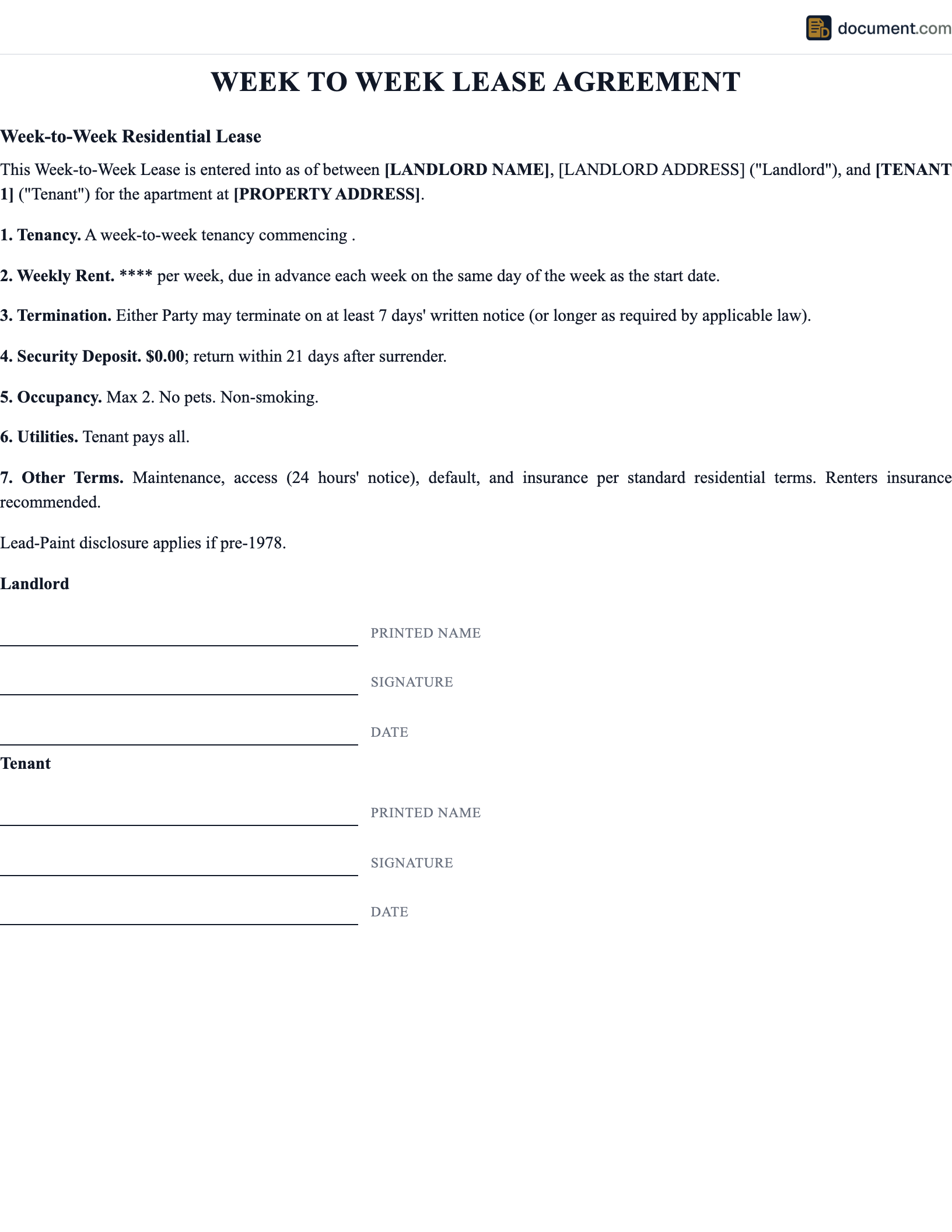



Georgia Week-to-Week Lease Overview
A week-to-week lease in Georgia creates a tenancy at will that automatically renews every seven days until either party gives reasonable notice to end it. Because Georgia never adopted the Uniform Residential Landlord and Tenant Act (URLTA), weekly landlord-tenant relationships are governed entirely by O.C.G.A. Title 44, Chapter 7 — a framework that is generally more favorable to landlords than the URLTA model used in neighboring states like Florida and South Carolina. That distinction matters: Georgia places no cap on security deposits, imposes no statutory limit on late fees, and provides a comparatively limited implied warranty of habitability.
Weekly leases serve a wide range of Georgia renters. The metro Atlanta rental market — the largest in the Southeast — generates demand from corporate relocations, film-industry crews working on productions across the state's "Hollywood of the South" studios, and travel nurses rotating through Grady, Emory, and Piedmont hospitals. In military communities around Fort Moore (formerly Fort Benning), Fort Stewart, Robins Air Force Base, and Kings Bay Naval Submarine Base, soldiers and civilian contractors frequently need housing that can flex with short-notice orders. Savannah's tourism economy, Augusta's seasonal Masters Tournament influx, and Athens's University of Georgia student population add further demand for flexible weekly arrangements.
Despite their short duration, weekly leases in Georgia carry the same core legal obligations as longer agreements. Landlords must perform a move-in inspection before collecting any deposit, comply with flooding-history and lead-paint disclosure rules, and follow the dispossessory process through magistrate court to remove a tenant who will not leave voluntarily. Tenants, in turn, must pay rent on time, maintain the premises, and give proper notice before vacating. A well-drafted weekly lease addresses all of these points up front so both sides know exactly where they stand under Georgia law.
7 days
Reasonable Notice Period
No cap
Security Deposit Amount
30 days
Deposit Return Deadline
Required
Move-In Inspection
Georgia's Non-URLTA Legal Framework for Weekly Tenancies
Why Georgia's Approach Differs
Most states base their landlord-tenant statutes on some version of the URLTA, which establishes robust tenant protections, standardized notice periods, and a strong implied warranty of habitability. Georgia chose a different path. The state's landlord-tenant code under O.C.G.A. §44-7-1 et seq. gives landlords broader discretion on deposit amounts and late-fee structures, while offering tenants comparatively narrower habitability remedies. Under O.C.G.A. §44-7-13, a landlord's duty to repair is limited — the tenant may need to pursue remedies through code enforcement or withhold rent only under narrow judicial supervision, rather than enjoying the straightforward repair-and-deduct rights available in URLTA states.
Weekly Tenancy Classification
O.C.G.A. §44-7-7 addresses tenancies at will and specifically sets a 60-day notice requirement for monthly arrangements. Week-to-week tenancies fall outside that explicit 60-day rule, so Georgia courts apply a "reasonable notice" standard — which, in practice, means at least one full rental period (seven days) before the start of the next cycle. Because the statute does not spell out the exact number for weekly leases, landlords and tenants should define the notice period in their written agreement to eliminate ambiguity. Georgia also does not prohibit rent control at the state level, though no Georgia municipality has enacted a rent-control ordinance, leaving weekly landlords free to adjust rent at each renewal without restriction.
Landlord Lien on Tenant Property
One Georgia-specific mechanism that weekly tenants should understand is the landlord's statutory lien under O.C.G.A. §44-14-340 et seq. When rent goes unpaid, Georgia law grants the landlord an automatic lien on the tenant's personal property located on the premises. Enforcement requires a distress warrant filed in magistrate court — the landlord cannot simply seize belongings — but the lien itself arises by operation of law. For weekly tenants, who may leave belongings behind after a short stay, this can be an unexpected legal exposure.
Georgia Security Deposit & Escrow Rules
Georgia's deposit statute, O.C.G.A. §44-7-30 through §44-7-37, sets no ceiling on the amount a landlord may collect — a stark contrast to the one- or two-month caps common in URLTA states. A landlord renting a furnished weekly unit in Midtown Atlanta or a vacation cottage on Tybee Island could theoretically demand a deposit many times the weekly rent, although market competition usually keeps amounts reasonable.
The escrow requirement is where Georgia gets specific. Landlords who own ten or more rental units in the state, or who employ a property management company for any number of units, must hold the deposit in a surety bond or in an escrow account at a bank or lending institution regulated by Georgia or the federal government (O.C.G.A. §44-7-31). The landlord must provide the tenant with written notice identifying where the deposit is held. Landlords with fewer than ten self-managed units are exempt from the escrow and written-notice requirements, but the one-month return deadline and itemized-deduction rules still apply.
Move-In Inspection Is Mandatory
Under O.C.G.A. §44-7-33, a landlord who collects a security deposit must conduct a comprehensive move-in inspection and provide the tenant with a written list of all pre-existing damage. Skipping this step can prevent the landlord from making any deductions later — Georgia courts have held that without a documented baseline, the landlord cannot prove damages occurred during the tenancy. For weekly leases with rapid turnover, performing and documenting this inspection at every new tenancy is critical.
Termination & Dispossessory Eviction in Georgia
Ending a weekly tenancy in Georgia begins with notice. Because O.C.G.A. §44-7-7 does not assign a fixed number of days for weekly leases the way it prescribes 60 days for monthly tenancies, the lease itself should specify the notice window. Courts generally accept seven days as reasonable for a weekly arrangement. Once that notice period expires and the tenant remains, the landlord must turn to Georgia's dispossessory proceedings — there is no shortcut.
The dispossessory process under O.C.G.A. §44-7-50 et seq. begins when the landlord files an affidavit in the magistrate court of the county where the property is located. The court issues a summons, and the tenant has seven days to file an answer. If the tenant does not respond, the landlord can obtain a default judgment and a writ of possession. If the tenant does answer, the case proceeds to a hearing. Throughout this process, the landlord is strictly prohibited from self-help eviction measures under O.C.G.A. §44-7-14.1 — that means no changing locks, no removing doors or windows, and no shutting off water, gas, or electricity to force the tenant out.
- Written demand for possession must precede any court filing
- Dispossessory affidavit filed in the county magistrate court (O.C.G.A. §44-7-50)
- Tenant receives seven days to answer the summons
- Lockouts and utility shutoffs violate O.C.G.A. §44-7-14.1
- Security deposit returned within one month after vacancy (O.C.G.A. §44-7-34)
Required Georgia Disclosures for Weekly Rentals
Georgia mandates several disclosures that apply to all residential tenancies, including week-to-week arrangements. Unlike URLTA states that often bundle these into a single standardized disclosure packet, Georgia's requirements are scattered across different code sections, making it easy for landlords to overlook one.
| Disclosure | Georgia Authority |
|---|---|
| Lead-Based Paint (pre-1978) | 42 U.S.C. §4852d (federal) |
| Flooding History / Floodplain | O.C.G.A. §44-7-20 |
| Mold Conditions (upon inquiry) | Georgia common law / best practice |
| Deaths on Property (upon inquiry) | Georgia common law / best practice |
| Owner / Agent Identity | O.C.G.A. §44-7-3 |
| Security Deposit Location (10+ units) | O.C.G.A. §44-7-31 |
| Move-In Damage Inspection List | O.C.G.A. §44-7-33 |
Other Georgia Lease Agreement Types
If a weekly arrangement is not the right fit, Georgia's landlord-tenant code supports several other lease structures — each with the same O.C.G.A. Title 44 obligations around deposits, disclosures, and eviction procedures.
Georgia Residential Lease
Fixed-term agreement with O.C.G.A. deposit escrow and inspection rules
Georgia Month-to-Month Lease
Periodic tenancy requiring 60 days' notice under O.C.G.A. §44-7-7
Georgia Sublease Agreement
Transfer partial occupancy rights with landlord consent
Georgia Roommate Agreement
Split rent, utilities, and shared-space responsibilities
Official Georgia Resources
Verify current Georgia landlord-tenant statutes and find local legal assistance through these official sources.
Georgia Week-to-Week Lease FAQ
Answers to common questions about weekly rental agreements under Georgia's O.C.G.A. Title 44 landlord-tenant framework, including deposit escrow, dispossessory eviction, and military-tenant protections.
Create your Georgia Week To Week Lease Agreement in under 5 minutes.
Answer a few questions and download a Georgia-compliant document, ready for the state agency.