



Virginia Sublease Agreement Overview
A Virginia sublease agreement allows an existing tenant to rent all or part of their leased space to another person or business for a period that does not extend beyond the original lease term. In a sublease, the original tenant retains its obligations to the landlord under the prime lease and takes on a new role as landlord to the subtenant. Virginia has no statute that overrides lease restrictions on subletting, which means the prime lease document controls whether subletting is permitted and what conditions must be met.
The Northern Virginia commercial market has an active sublease sector driven largely by federal government contractor activity. When contractors lose government contracts or right-size their operations, they often seek to sublease their office space, creating a steady supply of sublease opportunities in markets like Tysons, Reston, Herndon, and Crystal City. Subtenants in that market can sometimes find favorable rates on well-located, move-in-ready space that would otherwise require a lengthy build-out process.
A well-drafted Virginia sublease agreement protects all three parties by clearly incorporating the prime lease obligations, setting out the sublease rent and term, addressing the risk that the original tenant defaults on the prime lease, and documenting the landlord's consent to the arrangement.
Per lease
Subletting default
Yes
Consent required
Yes
Tenant remains liable
2 months'
Deposit rules
Virginia Subletting Laws
Understanding Virginia's subletting laws is essential before entering into a sublease agreement. Here are the key legal requirements in VA:
Important: Virginia Landlord Consent and Original Tenant Liability
Virginia commercial leases almost universally require written landlord consent before subletting. There is no Virginia statute limiting a commercial landlord's right to withhold that consent. Even after subletting with consent, the original tenant remains fully liable to the landlord under the prime lease if the subtenant defaults. Understanding this continuing liability is essential before entering into any commercial sublease arrangement in Virginia.
Sublessor (Original Tenant) Obligations in Virginia
- Obtain Written Landlord Consent: Review the prime lease for consent requirements and obtain written approval before entering into any sublease agreement
- Remain Fully Liable to Landlord: The original tenant stays on the hook for rent and all prime lease obligations regardless of subtenant performance
- Screen the Subtenant: Verify the subtenant's financial stability and reputation before committing to a sublease, since the original tenant bears the risk of subtenant default
- Provide Prime Lease Copy: Give the subtenant a copy of the prime lease so they understand all building rules, prohibited uses, and operational requirements they must follow
Subtenant Obligations and Risks in Virginia
- Pay Rent to Sublessor: Pay the agreed sublease rent to the original tenant by the due date specified in the sublease agreement
- Comply with Prime Lease: Follow all rules and obligations in the original prime lease that are incorporated by reference into the sublease
- Understand Prime Lease Default Risk: Be aware that if the original tenant defaults on the prime lease, the subtenant's rights can be terminated by the landlord without the subtenant having done anything wrong
- Vacate by Sublease End Date: Leave the premises by the sublease expiration date, which cannot extend beyond the prime lease term
How to Prepare a Virginia Commercial Sublease Agreement
A Virginia commercial sublease requires careful preparation because the original tenant remains liable to the landlord throughout. Follow this sequence to protect yourself as the sublessor and to give the subtenant a clear picture of what they are agreeing to.
Review the Prime Lease and Request Landlord Consent
Read the subletting provisions of the prime lease carefully before approaching the landlord. Identify any conditions on consent, such as financial qualification standards for the subtenant. Submit the subtenant's information to the landlord in writing and wait for written approval before proceeding.
Draft the Sublease to Incorporate the Prime Lease
Incorporate the prime lease by reference and identify which prime lease obligations pass through to the subtenant. Set out the subleased premises precisely, the sublease term (which cannot exceed the prime lease expiration), the sublease rent, payment schedule, and security deposit. Include indemnification provisions protecting the sublessor if the subtenant defaults.
Address the Risk of Prime Lease Termination
Consider including a provision that gives the subtenant notice and a cure opportunity if the sublessor defaults on the prime lease. For significant commercial subleases in Virginia, some subtenants also negotiate a non-disturbance agreement directly with the landlord, which protects the subtenant's right to remain in the space even if the original tenant's lease is terminated.
Execute and Distribute All Documents
Both the sublessor and sublessee sign the fully completed sublease. Provide copies to all parties including the landlord. Attach the landlord's written consent, a copy of the prime lease, and document the condition of the space with a move-in checklist and photos to protect the sublessor from damage claims at sublease end.
Virginia Commercial Sublease Fees & Costs
Below are typical costs and financial considerations for a Virginia commercial sublease transaction. Northern Virginia market subleases tend to involve higher upfront costs due to the complexity of the leases involved.
| Item | Typical Amount or Approach |
|---|---|
| Sublease Rent | Often below prime lease rent in Northern Virginia as sublessor is motivated to exit; negotiated based on market conditions |
| Security Deposit | Typically one to three months of sublease rent for commercial subleases; protects sublessor against subtenant default |
| Landlord Consent Fee | Some Virginia landlords charge an administrative fee for processing sublease consent requests; $500 to $2,500 is common |
| Attorney Review | $1,000 to $4,000+ for Virginia commercial sublease review; higher for complex multi-year NoVA office subleases |
| Tenant Improvement Allowance | Some NoVA sublessor tenants offer a TI allowance or deliver the space with existing improvements to attract subtenants |
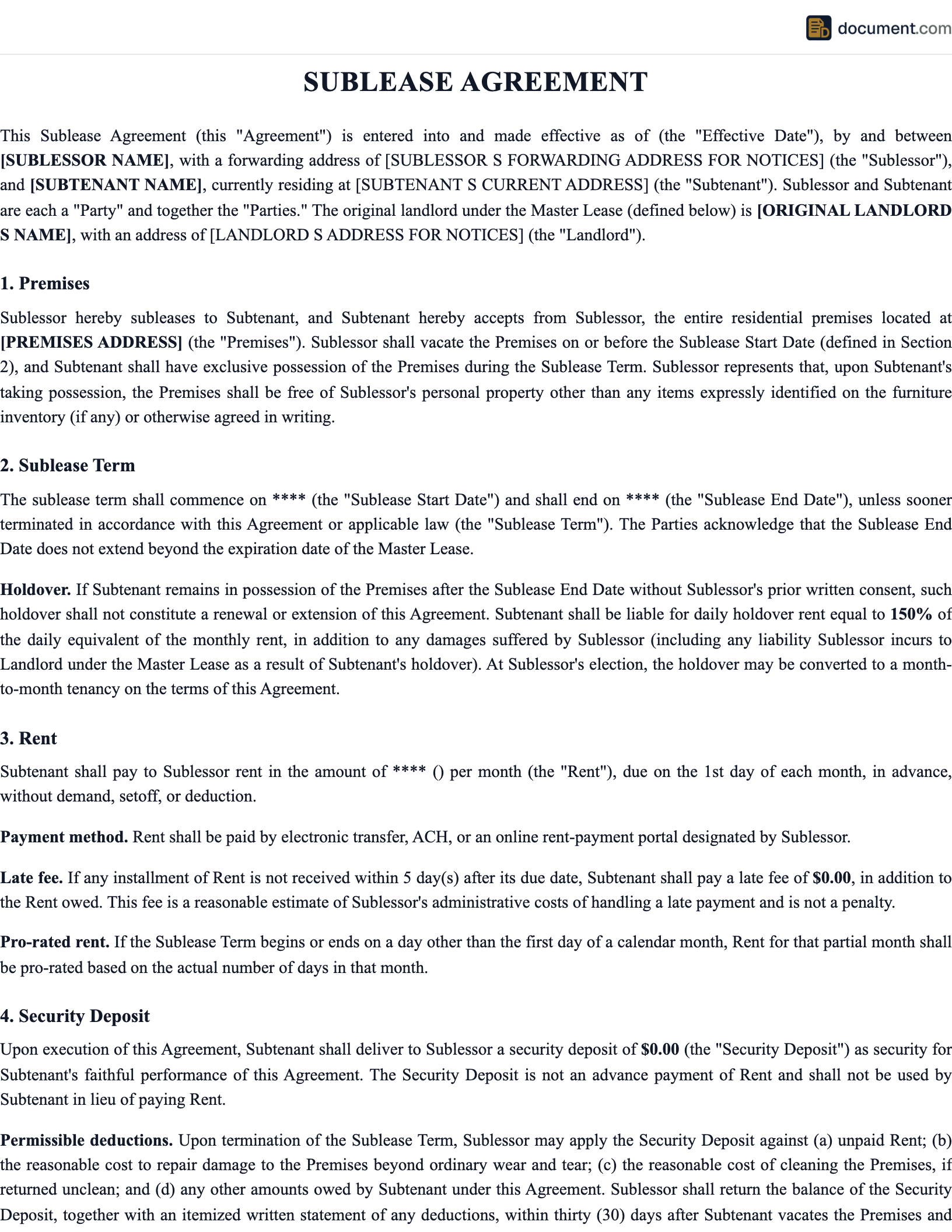
Sample Virginia Sublease Agreement
Below is a preview of our Virginia-specific sublease agreement. Your customized document will include all provisions required under VA law.
STATE OF VIRGINIA
SUBLEASE AGREEMENT
Residential Subletting Contract
SUBLESSOR (Original Tenant):
Name: [Sublessor Name]
Address: [Virginia Address]
SUBLESSEE (New Occupant):
Name: [Sublessee Name]
Current Address: [Address]
SUBLEASE TERMS
Start Date: [Date]
End Date: [Date]
Monthly Rent: $[Amount]
Security Deposit: $[Amount]
Virginia Sublease Agreement FAQ
Answers to common questions about sublease agreements in Virginia.
Other Virginia Lease Agreement Templates
Need a different type of lease agreement for Virginia? We offer state-specific templates for every type of rental arrangement.
Virginia Residential Lease
Standard rental agreements
Virginia Month-to-Month Lease
Flexible short-term rentals
Virginia Vacation Rental
Short-term vacation properties
Virginia Commercial Lease
Business and retail spaces
Virginia Roommate Agreement
Shared living arrangements
Virginia Rent-to-Own
Lease with purchase option
Virginia Equipment Lease
Equipment rental agreements
Virginia Land Lease
Land rental agreements
Virginia Room Rental
Individual room rentals
Create your Virginia Sublease Lease Agreement in under 5 minutes.
Answer a few questions and download a Virginia-compliant document, ready for the state agency.